BOOK LIBRARY · Complete books · Purchases disabled
TrendWindow

← Book Library · Complete book

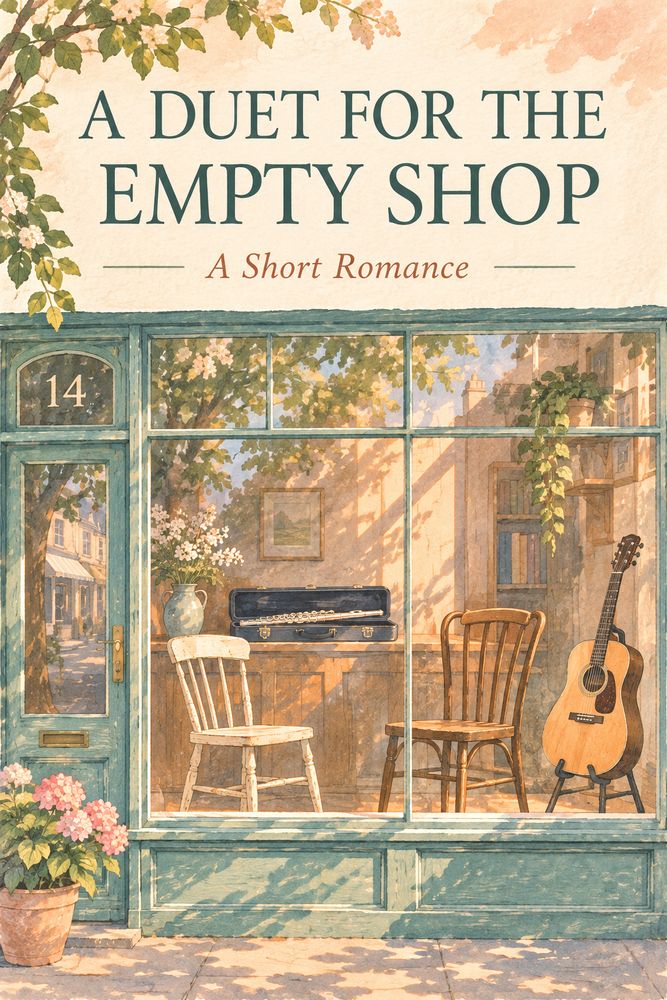
Front cover of A Duet for the Empty Shop

Romance & Relationships

A Duet for the Empty Shop

By TrendWindow Library

A double booking brings Mina and Daniel together in an empty shop with a flute and a guitar. Their weekly rehearsals become a duet, until an unasked-for public invitation tests their trust. A complete eight-chapter romance about listening, second chances and making space for an honest answer.

Read this complete edition, including its ending and notes. No purchase is required.

About this book

A complete short romance. All characters, places and events are fictional.

Original complete short romance prepared with AI assistance. All characters, places, music and events are fictional. Translation meaning reviewed with AI, without independent native-language certification. Not a full-length novel.

1. The hour on the receipt

Mina had bought two hours of silence and received a man with a guitar.

He stood inside the empty shop at number fourteen, looking at the receipt on his phone. Mina stood outside, holding a flute case and a paper cup whose lid did not fit. Between them, the old shop window displayed a ghostly outline where the words KEYS CUT had once been.

“Tuesday, two until four,” she said.

“That is what mine says.”

The landlord, Elsie, lived above the shop. She came downstairs in slippers, compared their receipts and made a face at her own handwriting.

“I used the paper diary and the calendar on the phone,” she said. “Apparently neither speaks to the other.”

She could refund one booking. Mina had arranged a shift swap at the bakery; the guitarist, Daniel, had taken an afternoon off from the bus depot. Neither wanted the other to go home.

The room had a counter, three unmatched chairs and a pale rectangle where a cabinet had stood. Mina tried one note. It sounded larger than she expected. Daniel played a chord so softly that she almost missed it.

“We could try an hour together,” he said. “If it's awful, I'll leave at three.”

“If it's awful, we both get to say so.”

They put their receipts on the counter and opened their cases. Mina had not played with anyone since a disastrous school concert thirty years earlier. Daniel did not ask whether she was good. He asked where she wanted his chair.
2. A place for the missed note

They had no music in common. Mina brought exercises on loose sheets, while Daniel knew fragments of songs he never quite finished. Rather than force a familiar tune into the wrong shape, they began with a phrase Mina had made up while waiting for bread dough to rise.

It was only six notes. On the fifth, she hesitated.

Daniel waited instead of filling the silence. When she tried again, he followed her into the last note and let his chord fade.

“I thought you'd keep going,” she said.

“I didn't know where you were going.”

There was no joke in his voice. She liked that more than she expected.

At three, neither offered to leave. They tried the phrase slowly, then with a longer pause in the middle. Once, Daniel reached for the wrong chord and laughed at himself. Mina discovered that the room could hold a mistake without turning it into a verdict.

Elsie knocked at half past three. Her neighbour worked nights, she explained, and the sound carried into his bedroom. The rental arrangement had been a trial; they would need a better time if they returned.

Mina apologised. Daniel stopped playing at once. They agreed to finish the session with quiet planning rather than another run through the tune.

On the back of a flour delivery slip, Mina wrote their available hours. Daniel added his. There was one overlap: Thursday, five until six. Elsie would ask the neighbour and confirm. A possible second meeting was less romantic than a promise. Mina folded the paper carefully anyway.

3. The Thursday arrangement

Thursday became theirs, booked one week at a time. Elsie confirmed that the time suited the neighbour and put it in a single calendar. Each paid half of the room charge. They agreed that a missed week did not create a debt of company, and that either could cancel with a message before noon.

Mina liked the arrangement because it sounded almost too plain to disappoint her.

On the second Thursday, Daniel brought two clean mugs. On the third, Mina brought a loaf that had cracked along one side and could not go on the bakery's front shelf. They ate it sitting on the counter, with their instruments safely in their cases.

Daniel had learned guitar at twenty and kept stopping whenever work became busy. Mina had kept her flute through two moves and a marriage that had ended without a dramatic final quarrel. She did not give him the whole story. He did not ask for it as the price of being trusted.

“I can talk about ordinary things,” she said, when she realised how long she had been describing the new dough mixer.

“That was an ordinary thing.”

“I meant more interesting ordinary things.”

He pointed to the cracked loaf. “I didn't know a loaf could be perfectly good and still lose its place in a window.”

She looked at him, unsure whether he meant anything beyond bread. He looked back without trying to make the sentence larger.

That evening their six-note phrase became a little tune, with an answering section Daniel wrote down in his uneven musical handwriting. They called it Number Fourteen. For the first time, Mina wished the hour were longer for reasons that had nothing to do with practice.

4. The poster in the window

The trouble began with a compliment from a stranger.

“Looking forward to Saturday,” a woman said as Mina unlocked the shop. “My granddaughter loves the flute.”

Mina turned towards the window. A poster showed two drawn chairs and the words SATURDAY AT THREE: MINA AND DANIEL. Below, in smaller letters, it promised “a neighbourhood afternoon of music.”

Daniel arrived carrying a folding stand. He saw her face before she said anything.

“Elsie suggested it,” he explained. “She wants people to know the room can be used. I thought we'd play our tune, then some of my pieces. Nothing formal.”

“You put my name on it.”

“I thought you'd like—”

“You thought. You didn't ask.”

Mina set her unopened case on the counter. She had enjoyed the small audience of one because Daniel had seemed willing to listen without asking her to become someone else. Now a window was announcing a version of her she had not agreed to be.

“It's only a few neighbours,” he said, then heard what he had done to the size of her objection.

She took her case back. “A few neighbours can still be too many.”

Daniel did not block the door. He asked whether he could send a message later. She said yes, but not an argument disguised as an apology.

Outside, Mina walked past the bakery without going in. She was angry with him. She was also disappointed by how much she had wanted to see him that evening. The feelings did not cancel each other out.

5. An invitation with room for no

Daniel's message arrived at eight. He had removed the poster and told Elsie he had announced Mina without asking. If an event went ahead, it would be advertised only after every performer had agreed. Her name would not appear. He was sorry he had treated a shared rehearsal as permission for a public performance.

There was no sentence explaining that he had only meant well.

Mina read the message twice. She replied that she needed a week away from the room. Daniel answered that he understood. He would not take her absence as permission to keep their Thursday slot indefinitely; Elsie would hold the next booking until Mina decided.

The following week, he practised alone at home. He found that the tune sounded strangely unfinished without the pause she always took before the fifth note. He had wanted to show the neighbourhood what they had made. Somewhere in that wish, he had begun treating her as part of his achievement.

On Tuesday, Mina asked to meet him for coffee, away from the shop. She wanted to know why he had not simply asked.

“I was afraid you'd say no,” he said.

“That doesn't make asking less necessary.”

“I know.”

She stirred a drink that did not need stirring. “I might have said yes to something smaller. I don't know. You took away the part where I found out.”

He listened. When she finished, he asked whether she wanted another rehearsal or only the coffee. She looked at the empty space beside his cup, where his guitar case would usually have been.

“One rehearsal,” she said. “Then we'll see.”

6. What the room could hold

They returned on Thursday without trying to make the hour feel like the earlier ones. Daniel had brought no new tune. Mina had brought no bread. They sat down and began with the six notes.

At the pause, he waited. This time she knew waiting could be a choice rather than an absence of ideas.

Afterwards, Elsie showed them a letter. A repair business wanted the shop from the following month. The temporary rehearsal arrangement would end after two more Thursdays. She had never promised a permanent room, but she was sorry to see them pack it away.

Mina surprised herself by asking whether they could invite two people the following Thursday: her sister Ruth and Daniel's friend Tomas. No poster, no open door, no charge. They would hear the tune once, and there would be tea afterwards.

Daniel asked a question before answering. “Would you still want that if I said we could keep it just for ourselves?”

“Yes. I want to try. I don't want to be volunteered.”

Elsie confirmed the proposed time with the neighbour and agreed to the small gathering. They would keep the entrance clear and use only the chairs already in the room. She would remain upstairs, with an invitation to come down if she wished.

On the way out, Daniel asked Mina whether he could take her hand. She gave him the hand without the flute case. It was an unremarkable stretch of pavement, beside a drain and a stack of delivery crates. Later, she would remember it better than the coffee shop.

7. Four listeners, counting themselves

Ruth arrived with biscuits. Tomas brought nothing, then apologised until Mina told him that arriving was sufficient. Elsie stayed upstairs for the tune and came down for the tea.

There was no introduction about hidden talent. Daniel said they had made a short piece together in this room and wanted to play it for two friends. Mina lifted her flute.

She missed the second note.

For a moment, the old school hall returned: the long silence, the teacher's eyebrows, a row of faces she had imagined would remember forever. Then Daniel lowered his hands and looked at her, not at the listeners.

“Again?” he asked.

She nodded.

The second attempt was not flawless. Near the end, his fingers landed clumsily and one chord buzzed. They reached the last note together. Ruth clapped without announcing that Mina should play professionally. Tomas asked whether the middle section was meant to sound like a question.

“Perhaps,” Mina said. “We haven't finished deciding what it is.”

Over tea, Ruth talked about her garden fence. Tomas described a bus route he had taken in the wrong direction. The music did not have to turn the afternoon into a ceremony. That was part of why Mina could enjoy it.

When the others left, she and Daniel washed the mugs and wiped the counter. He asked whether she wanted a recording next time. She said she might, but wanted to discuss where it would be kept before anyone pressed a button. He nodded and left his phone in his pocket.

8. A key they did not keep

On their last Thursday, they played Number Fourteen once and packed their cases. The shop was already changing. Elsie had stacked the spare chairs at the back, and the new tenant had left a sample of blue paint by the door.

Mina returned the key. For a second, she felt that giving up the room meant giving up the version of herself who had learned to enter it.

Then Daniel unfolded a small piece of paper. The community centre had a room available on alternate Sunday afternoons. He had written down the cost and contact number. He had not booked it.

“Would you like to look at it with me?”

Mina read the details. Every other Sunday was possible. It would leave room for her sister, his friends, missed practice and the ordinary interruptions that made a life their own.

“Yes,” she said. “And this Sunday, would you like dinner? No instruments required.”

“Required, or allowed?”

“Allowed to stay at home.”

Outside, he kissed her after she moved closer. It was brief and slightly awkward because the guitar case stood between their knees. She laughed, and he shifted it without letting go of her hand.

They walked towards the bus stop carrying what belonged to them. Behind the window, the empty shop waited for another use. They had no claim on its future, and no need to pretend they did. Their tune could travel. So could the pauses in it, and the two people who were learning how to listen before they began again.

The end.

Explore more books →