BOOK LIBRARY · Complete books · Purchases disabled
TrendWindow

← Book Library · Complete book

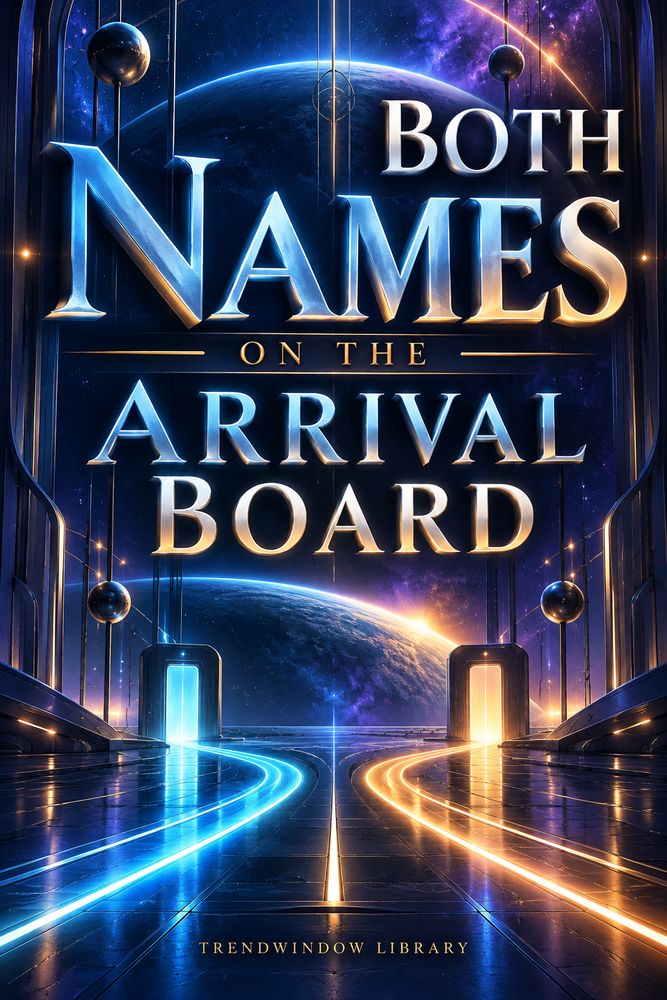
Front cover of Both Names on the Arrival Board

Fantasy & Science Fiction

Both Names on the Arrival Board

By TrendWindow Library

A transit incident brings two Mera Vales to Rill Station. A complete science-fiction story about shared memory, chosen names and making room for both lives.

Read this complete edition, including its ending and notes. No purchase is required.

1. One Recorded Arrival

Mera Vale stepped through the transit door and found her name on the board.

RILL STATION. ARRIVAL CONFIRMED.

She had expected nausea, or brightness, or the brief impression of being somewhere she could not describe. Instead, there was a grey floor and a woman at a desk asking whether she had any luggage to collect.

'One bag,' Mera said.

Then the door opened behind her.

The woman who came through wore her coat, carried the same small crease between her eyebrows and stopped with the same impatience before a question.

'One bag,' the second woman said.

The clerk looked at the board. It still showed one arrival.

For a few seconds, the room offered no useful sound. Mera looked at the other woman and saw the scar at the base of her thumb. She had made it at nineteen, repairing something she should have left alone. The woman was looking at Mera's hand.

'Who are you?' Mera asked.

The answer arrived in her own voice.

'Mera Vale.'

The clerk put down her pen.

'My name is Noma,' she said. 'Please sit down. Both of you.'

There were two benches. Mera chose the left. The other woman chose the right, then frowned as if someone else had made her usual choice first.

The door closed. Noma did not let anyone open it again.

2. The Same Story Twice

They were forty-eight. Both remembered leaving home three weeks earlier to work on the outer array. Both remembered their sister Eda asking them not to come back with another broken appliance to mend. Both remembered agreeing to take Eda to the lake when the work was finished.

The trial transit passage was meant to shorten the return journey to Rill, where they would take an ordinary shuttle down to Tern. Mera remembered agreeing to that trial. So did the woman opposite her.

Doctor Senn asked questions separately. She did not ask them to compete for the most convincing memory. She spoke to each as a person who had arrived frightened and wanted to understand where she was.

The technician, Ivo, said the equipment had recorded one completed transit event and two exits a moment apart. He could not tell them that the earlier exit made one woman the original. He could not tell them what would happen if either went through again.

'Then neither of us is going through again,' the woman on the right said.

Mera felt relief, then an unreasonable annoyance that someone had spoken her answer first.

Noma found two rooms and arranged food. The station director, Arel, would speak to them in the morning.

'There is only one passenger record,' Noma said.

'There are two people eating dinner,' Doctor Senn replied. 'We can begin there.'

Mera took the room nearest the end of the corridor. The other woman paused outside the next door. For the first time, they had made choices the other did not remember making.

3. A Name Chosen in the Morning

Neither slept much. Mera knew this before they met at breakfast, then reminded herself that knowing was no longer the same thing as remembering.

The other woman had borrowed a dark jacket from station stores. Mera still wore her coat. The small difference was comforting until she noticed how closely the woman was looking at it.

'I don't want them calling us First and Second,' the woman said.

'Neither do I.'

'Or keeping a coloured badge between us forever.'

Mera sat opposite her. The table was small enough that their hands nearly met when they reached for water.

'I thought about a name,' the woman said. 'Venn.'

It had been the name of a teacher they both remembered. A patient woman who had once let a whole class sit in silence until someone asked the question they were all avoiding.

'You don't have to give up Mera so I can keep it,' Mera said.

'I know. I'm not doing it to make their form work. I want to hear a word and know it means me, now.'

Mera tried the name aloud.

'Venn.'

The woman looked up.

They both laughed, briefly and without relief large enough to settle anything. It was still a beginning. Venn kept Vale. She wanted the old life acknowledged as hers too.

4. Eda on the Screen

They called Eda together after agreeing that either could end the call and speak privately later.

Eda was forty-six and answered with a spoon in her hand.

'You're late,' she said, then saw the second face. 'What is that?'

Mera began to explain. Venn waited. Then Mera stopped and let her finish, an act that felt stranger than the second face itself.

Eda put down the spoon.

'There are two of you.'

'Yes,' Mera said.

'And you're both there.'

'Yes,' Venn said.

The questions became smaller. Were they hurt? Had they eaten? Could anyone explain what would happen next? They answered what they could and said when they did not know.

Eda asked whether one of them was coming home.

'We both want to,' Mera said.

Eda looked toward the door of the room behind her. Her flat had one spare bed. Mera could see the calculation and almost offered to solve it before Eda spoke.

'I'll borrow another bed,' Eda said. 'That part can wait until I know when.'

She did not promise that none of this would be difficult. Before ending the call, she said she wanted to talk to each of them again. Separately, if they wished.

Venn stayed in front of the dark screen for a while. Mera left her there without assuming she knew what she was thinking.

5. The Single Line

Director Arel did not call either woman a mistake. She did keep returning to the single line on the passenger register.

The transit company had paid for one journey. The shuttle booking was for one traveller. The incident report had room for one passenger and a box for equipment failure.

'Add a second passenger,' Venn said.

'To which journey?' Arel asked.

'This one. The one we're in.'

Arel rubbed her forehead. She could arrange temporary accommodation from the incident fund. Long-term registration needed an authorised decision, and she could not make every other record recognise a person by saying she wished it would.

Mera understood the difficulty. She had maintained systems built by people who assumed that everything important would fit a field they had already made. Understanding the problem did not make it acceptable to sleep in it indefinitely.

'What happens while you decide?' she asked.

Arel said both would have rooms, meals and access to independent advice about the station's process. Neither would be sent back through the passage. Ivo's team had stopped the trial.

'Write those parts down too,' Mera said.

Noma did. She read the statement to both women, corrected one date and gave each a copy.

When they left, Venn folded hers into a small square. Mera kept hers flat. Neither difference proved anything about which life deserved to continue.

6. What They Did Not Share

That afternoon, Mera found Venn looking at a view of Tern through the station window.

'You want to stay,' Mera said.

Venn turned.

'I was looking out of a window.'

'We always wanted more time up here.'

'We did. You don't know what I want this afternoon.'

The answer hurt because it was accurate. Mera had spent her life inside those memories. She could not stop treating them as a map to the other woman's next thought.

She apologised. Venn accepted, then asked for an hour alone.

Mera went to the visitors' room and called Eda privately. They spoke about the lake, about the flat and about how strange it was to feel crowded by someone who had not chosen to arrive.

'I don't want her gone,' Mera said. 'I want to stop being afraid that being kind means disappearing.'

Eda listened. She did not ask Mera to be generous on command or declare one sister more familiar than the other.

Later, Venn returned with a small drawing of the view. Mera had never thought she could draw well enough to keep a picture. She did not say that Venn must therefore be a different kind of person. She asked whether she could look.

Venn handed it to her. The lower edge of the planet was crooked. Mera liked it anyway.

7. No Test for the Better Mera

The company sent questions for the registration hearing. Several asked about memories before the transit.

Mera and Venn answered what they chose to answer. They also asked what those questions could establish if the answers were the same.

Noma brought the concern to Arel. Ivo confirmed that the station had no reliable method for ranking the two lives by their order of arrival. The equipment records described the incident; they did not appoint a rightful person.

At the hearing, Venn asked to be called by her chosen name, with her shared earlier identity recorded rather than concealed.

Mera asked that nobody take Venn's new name as permission to regard her as someone with no past.

Arel asked what they wanted immediately.

'Two records of the people who are here,' Mera said.

'Two valid ways to leave,' Venn said. 'And no requirement that one of us work for the company to earn the right to exist outside this room.'

Arel looked at them for a long moment. Then she asked Noma to record that request exactly.

The hearing did not become a public performance. There were no spectators voting for the more persuasive woman. The two spoke, received questions, took breaks and read the proposed decision before answering it.

By the end, Mera was tired of proving that she was tired. Venn pushed a glass of water toward her without saying she knew exactly how she felt.

8. The Extra Journey

The decision took another day.

Both women would receive separate registration under a shared origin entry. The original incident record would remain intact. It would be linked to two current passenger records, not corrected to pretend one had never arrived.

Noma read the names carefully: Mera Vale. Venn Vale. Both women checked their own details.

The station would fund both return journeys as part of its specific response to this incident. Other claims would have their own process. Nobody promised a second copy of the same wages or a whole new life with no practical questions attached.

The next suitable shuttle with two available seats left in six days. The station would cover the rooms and meals until then. Neither passenger would be pushed into someone else's place.

'Six days,' Mera said.

It sounded bearable now that the number had an end.

Venn asked whether the registration would remain valid if she later chose to return to the station. Arel said yes. It was not a ticket for one approved future.

Afterwards, Mera found herself checking the arrival board. It still showed the completed event from the day of the accident. Noma was arranging its update through the ordinary record process.

Mera did not demand that the earlier line be destroyed. She wanted the next person reading it to know what had actually happened.

9. An Offer with No Condition

On the third of the six days, Venn asked Ivo about maintenance work at Rill.

He described a six-month position currently open to applicants with the relevant experience. He did not offer it as compensation or ask her to study the transit passage that had brought her there.

Venn had the same years of maintenance experience Mera remembered, but only she wanted to apply that week. She went through the station's ordinary selection process and received an offer, with pay and accommodation written down. She read it before accepting.

She could go home first. She chose a start date after a two-week visit to Eda.

Mera read the offer when Venn asked her to. She felt envy before she felt relief, then disliked the order.

'I could have applied,' she said.

'You still could, for something you want.'

'I don't think I want this.'

'All right.'

Venn did not have to make Mera refuse the same future in order to keep her own. Mera did not need to prove that going home was a smaller ambition.

They sent Eda the shuttle details together. Then Venn called her alone to talk about the visit and the later departure.

Mera walked outside the visitors' room without waiting to overhear a choice she had not made.

10. Two Bags

Before departure, Noma came to their rooms with the final travel documents. Each woman checked her own. Both names were on the same shuttle's passenger list.

Mera had the original blue travel bag. Venn had bought a dark one from the station shop using a small personal allowance provided during the incident. There had been no duplicated luggage. They had divided the shared contents by agreement and obtained what each still needed.

They wrote down the remaining practical matters rather than pretending a new name settled them all: earlier earnings, belongings at home, questions about records beyond the station. Each had a contact and a clear route for those decisions. Neither had to surrender her identity while the details were worked through.

Eda sent a message that the second bed was ready and that she had bought too much food.

'As usual,' Mera said.

Venn smiled, then asked whether Mera wanted to sit beside her on the shuttle.

It was the first time the choice had been asked so simply.

'Yes,' Mera said.

They left the rooms clean, returned the borrowed jackets and thanked Noma. At the gate, Ivo wished them a quiet journey. Nobody made a joke about arriving in greater numbers.

They boarded through an ordinary doorway and sat in two ordinary seats.

11. Both Names

Tern's arrivals hall smelled of rain on coats. Mera saw Eda before Eda saw them.

For a moment, she wanted to walk faster and reach her first. The impulse passed without becoming an instruction. Venn had stopped beside her, holding the dark bag with both hands.

'Come on,' Mera said.

They went together.

Eda looked from one face to the other. She said Mera's name, then Venn's. Her voice caught on the second, and she said it again more steadily.

She hugged each of them. The second embrace was different because the first had already happened. It did not need to be less.

Behind them, the board changed. Two names appeared beneath the shuttle's arrival notice.

MERA VALE. ARRIVED.

VENN VALE. ARRIVED.

Mera looked long enough to read both. Venn did too.

There would be a visit to the lake. There would be work to arrange and papers to finish, conversations in which Eda made a mistake and corrected herself. In two weeks, Venn would return to a job she had chosen. Mera would remain on Tern for the work and the life she wanted there. The same beginning no longer required the same next day.

Eda took the blue bag. Mera reached for it, then let her carry it. Venn shifted the dark bag to her other hand.

They walked out of the hall together. At the door, Eda asked which way they wanted to go home.

Mera started to answer, then looked at Venn.

'The long way by the water?' Venn said.

'The long way,' Mera agreed.

12. About This Edition

This is a complete original short science-fiction story. Mera Vale, Venn Vale, Eda, Noma, Doctor Senn, Ivo, Arel, Rill Station, Tern and the transit passage are invented characters, places and technology. The adults share a fictional duplicated personal history; Mera and Venn are forty-eight, and Eda is forty-six. The story does not claim that current transport, cloning, memory-copying or medical technology can create the event it describes. It is not an account of a real experiment, a clinical case, legal advice or instructions for identity documents or technical access.

The central resolution is complete. Both women are recognised with separate legitimate records linked to their shared origin, both receive a funded journey home and neither is erased, ranked as less real, forced into exile or required to work for permission to leave. Venn freely accepts later work through the station's ordinary process after her registration is secure. Their visit home and distinct chosen futures finish the narrative. Remaining ordinary administrative details have stated contacts and processes; they are not a withheld final decision about either person's existence.

English is the canonical original. Writing, full reader translations and editorial review are AI-assisted. No human-authorship claim or independent native-language proofreading certificate is made. Original built-in generated English front and back covers use conceptual orbital architecture, twin light paths and dimensional lettering, not photographs of a real station or real people. No existing science-fiction story, identifiable dialogue, copyrighted image or private personal record is reproduced. No ISBN or printed proof is claimed.

Eleven narrative chapters and this edition note form twelve fixed digital content units, not printed pagination. The complete approved book and its ending are intended for public reading in all six aligned editions. Purchases and all four payment providers remain disabled. Translation review preserves both adult people's equal standing, Venn's freely chosen name without loss of her past, the separate room and travel arrangements, six-day wait, optional six-month job after a two-week home visit, consent and both names on the completed arrival board. Original cover artwork remains English.

Explore more books →