BOOK LIBRARY · Complete books · Purchases disabled
TrendWindow

← Book Library · Complete book

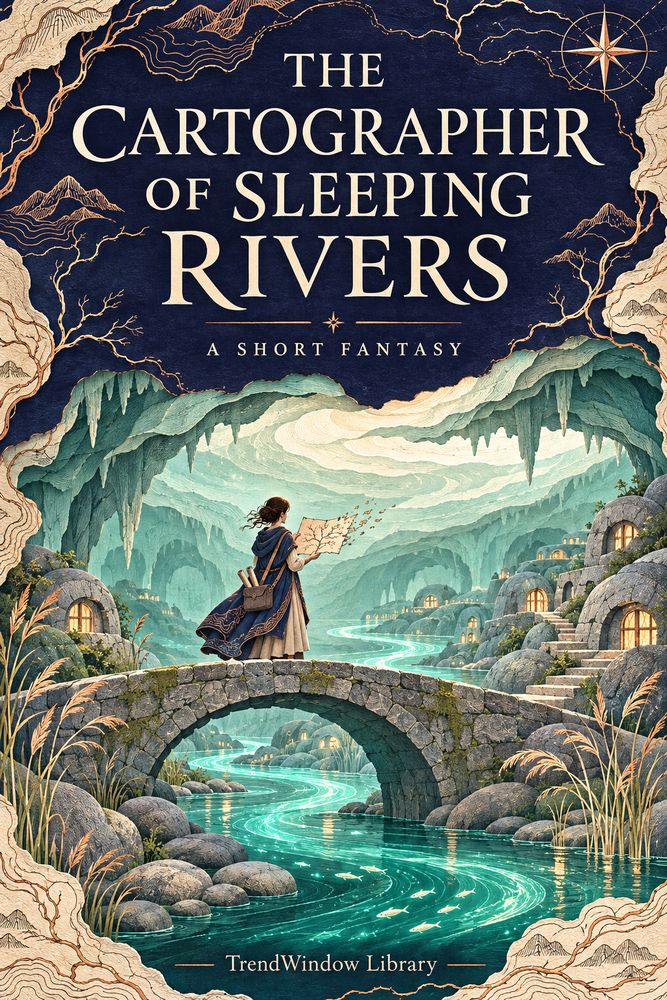
Front cover of The Cartographer of Sleeping Rivers

Fantasy & Science Fiction

The Cartographer of Sleeping Rivers

By TrendWindow Library

A moving river on an inherited map leads Leda beneath her drought-stricken town. To wake the water, she must confront her grandfather's unfinished promise, move the homes in its path and let a treasured map dissolve.

Read this complete edition, including its ending and notes. No purchase is required.

About this story

A complete short fantasy in eight chapters. The people, places and rules of magic in this story are invented. This is fiction, not a guide to rivers, drought or engineering.

Original AI-assisted fiction and translations, reviewed by an AI assistant. No independent human-editor or native-speaker certification is claimed.

1. The dry mark

The river on Leda's map moved while she was eating breakfast. A blue thread crossed the margin where her grandfather had drawn a mill, then curled around the stain left by her teacup. She held the paper flat. Under her thumb, the thread beat once.

It had been a dry summer in Orven. At the public well, people lowered their buckets quietly, as if a smaller noise might reach deeper water. Leda had spent the morning copying property boundaries for a man whose orchard no longer bore fruit. He still wanted every corner marked. Ownership, he said, did not evaporate.

The great map covered most of her worktable. Grandfather had left it to her with his house, three excellent pens and a letter praising her steady hand. She had read the letter so often that its folds had become holes. The map, however, remained supple. Even its oldest ink looked wet.

Someone knocked with the flat of a hand. Tovan, the village baker, stood outside carrying a cup wrapped in cloth. There was a finger of grey water at the bottom.

“From the last bucket,” he said. “The council wants you at noon.”

She showed him the moving line. He touched neither paper nor table.

“Does that mean there is water?”

“It means the map is changing.”

“I would prefer water.”

After he left, Leda noticed a word beneath the mill: Sere. She knew every field and lane on that sheet. She had never seen this name. When she spoke it aloud, the floorboards answered with the sound of a spoon turning in a glass.

2. A door below the mill

At the council table, Leda unrolled an ordinary village plan she had drawn from her own surveys. The moving original lay inside her satchel. She was ashamed of the precaution before anyone asked a question.

Old Mayor Venn wanted a route to the northern springs. Tovan wanted to know whether those springs existed outside the stories of people who had never been north. The shepherd sisters offered their cart for carrying water. Nobody offered an easy answer.

Leda explained what she had seen. Venn reached for her satchel, then stopped when she pulled it closer.

“If the river lies under the mill,” he said, “go there.”

“That is not what I said.”

“Then find out what you did say.”

She disliked him for making her uncertainty sound like a task. Nevertheless, by afternoon she and Tovan had reached the abandoned mill. He brought bread, a lantern and two lengths of rope. She brought the map and a ruler, which seemed absurd until she needed it to lift a swollen latch.

The cellar floor was dry. A circular door stood upright against a wall without any opening behind it. Across the wood, shallow scratches spelled names. Some had been crossed out.

Leda laid the map against the door. Its blue thread found a scratch, and both shone.

“Sere,” she said.

The door opened onto a flight of stairs descending through daylight. There was no sun at the bottom, only a pale sky beneath the ground.

Tovan tied one end of a rope to the mill wheel. “In case maps are less reliable than string.”

“String can break.”

“Yes,” he said. “I understand string.”

They went down together, leaving the lantern behind. In that light, its flame had become almost invisible.

3. The country underneath

Below Orven stood another town. Its houses were made of piled river stones, their doorways filled with reeds. There were no people. Across the square lay a river like a long sleeping animal: translucent, folded into itself, its surface rising and falling. Fish hung inside it, motionless but bright.

The rope ended at the bottom stair. Tovan had paid out its full length. He tied it there, marking their way home, and followed Leda along a bank of white sand.

An old woman sat on a stone bridge, mending a coat with a needle as long as Leda's pen. Her bare feet did not touch the river. Beside her stood a bowl full of pebbles, each bearing a name.

“You have brought the fastening,” she said.

Leda held her satchel shut. “Who are you?”

“The keeper until somebody else agrees to keep.”

“Did you put this river to sleep?”

“No. Your grandfather did.”

Tovan glanced at Leda, then at the bridge. She was grateful that he said nothing.

The keeper explained the map's rule. Each blue line held a river in its proper channel. During a flood, a mapmaker could fold that line away and let the river sleep beneath the earth. But the fold had to be opened again. Otherwise the sleeping river would slowly draw the remaining water underground, gathering it into its dream.

“He saved Orven,” Leda said.

“Once.”

“He would have woken it.”

The keeper put down her needle. “Would he?”

It was an unbearable question because Leda could hear how much she wanted the answer to be yes. She opened the satchel. Across the map, Sere tightened into a knot.
4. The unwritten bank

The keeper spread the map on the bridge. Beneath the mill, tiny writing rose through the paper: a date, followed by Temporary closure. The date was forty-three summers old.

Leda had been told about that flood. Her grandfather had carried children through the rain and brought the town out of danger. His portrait hung in the council room. Nobody had mentioned the river's disappearance afterwards. People spoke of the new grazing ground as if the grass had always been there.

“Why didn't you come and tell us?” Tovan asked.

The keeper turned her palms upward. They were patterned with the same reeds that filled the doorways. “I can keep what is here. I cannot walk where it is not.”

To wake Sere, Leda had to wash away the ink that held it. The current would return along its former channel. The map would dissolve: all its roads, all the annotations in her grandfather's hand, all the borders she had spent seven years learning to copy.

“Just one line,” she said. “Can I cut out one line?”

The keeper pointed to the blue tributaries. They shared ink with wells, marshes and other sleeping rivers. Cutting the sheet would not separate the promise that bound them.

Tovan bent over the old channel. “My ovens are here.”

The council grain store stood there too. So did six houses.

The keeper offered no comforting correction. A river woke hungry for its bed. They could clear the route and carry people away; they could not command it to wake somewhere convenient.

Leda rolled the map carefully. “We need to go back.”

For the first time, the keeper smiled. “That is a better answer than hurry.”

5. What the town would move

Venn wanted proof. Leda took him down the stairs, and he returned so pale that Tovan made him sit on the mill steps. Afterwards, the council meeting was held outside, where everyone could hear.

They laid out a plain sheet and drew the old channel from memory. Leda marked what she knew, then circled the places where her grandfather's drawing became uncertain. She refused Venn's suggestion that she join those circles with a confident line.

“We need room for what we don't know.”

The six households argued about moving. One woman had just repaired her roof. A man wanted the council to buy his house before he left it. Tovan spoke last. His bakery would be lost, but he would take his portable stove uphill and bake beside the shepherds' barn. He asked for help carrying flour, not praise.

That gave the meeting something practical to do. By evening, the grain store had been emptied. Beds, hens, family pictures and a sleeping child travelled uphill in the sisters' cart. The woman with the new roof took its best tiles. Nobody called her unreasonable.

Leda worked by candlelight, making a new map without magic. She drew the proposed clear ground broadly, refusing to make a narrow promise. Venn assigned two people to walk the houses and count everyone before morning.

At midnight, she unfolded her grandfather's letter. It praised her patience, her accuracy, her willingness to finish difficult work. There was nothing about the river. She had used his praise as evidence that he could not have hidden anything from her.

She placed the letter in a tin box. It was ordinary paper. It could survive what the map could not.

Outside, wheels rattled over stones. The town was still moving.

6. The price of a copy

Before dawn, Leda returned alone to the keeper. Tovan was helping dismantle the bakery's shelves. He had asked her to wait for him before waking Sere, and she had promised.

She wanted one last thing: to copy her grandfather's map in full. Surely its magic could remain below while its words survived above. She spread a fresh sheet beside the original and began tracing a meadow.

The line on the new paper turned blue. Far below the bridge, the river stopped breathing.

The keeper took the pen from her hand.

“You are copying the fastening.”

Leda tore the fresh sheet. The blue faded, and the river stirred again.

“You could have warned me.”

“I thought you came to release it.”

“I did.” Her voice sounded small. “I also came to keep something.”

The keeper returned the pen. “Then remember what you can. Do not make the river hold your memory.”

Leda sat for a long time. She read a note about a bridge that had fallen before she was born. She followed her grandfather's careful symbol for an apple tree. In one corner he had corrected a spelling twice. The second correction was wrong too. She laughed, unexpectedly, and then cried without covering the map.

When Tovan arrived, flour still whitened his sleeves. He had brought the final count: every household out, everyone accounted for, animals uphill, paths watched. The map remained dry.

“You waited,” he said.

“I said I would.”

He sat beside her. She told him about the failed copy. He did not tell her she should be ashamed. After a while he asked which apple tree the little mark meant, and she told him that too.

7. Sere wakes

The keeper led them to a shallow pool beside the sleeping current. “Put the map here. Keep your hands on the bank. When the ink loosens, let it go.”

Above them, the underside of the town trembled. Leda could see the foundations of her own house as pale shapes in the sky. They lay beyond the old channel, though that no longer felt like a guarantee bestowed by paper.

She lowered the map. The first road vanished immediately. A field boundary followed. The mill became a brown cloud, and her grandfather's little apple tree drifted away with its roots upward.

Then the river's name lifted from the sheet. Sere opened an eye.

It was not a human eye. It was a deep place in water, dark at the centre, with all the stones of its bed visible around it. Leda felt herself being looked at without being understood or forgiven. The river had no reason to judge her.

The current rose. She caught the last corner of the map by instinct. Tovan said her name once. She opened her hand.

Water struck the bridge. The keeper held up her coat, and its patched lining widened into a path of reeds. Leda and Tovan ran along it to the stairs. The rope was still there. He pulled himself up, then helped her through the circular door.

Behind them, daylight folded shut.

They climbed to the hill before the old channel filled. Water swept through the empty bakery and curled around the stripped grain store. Leda stood among the displaced families, shivering. Nobody cheered yet. A woman counted the roof tiles in her cart, then counted her children, then took Leda's wet hand.

8. A map with room

Sere settled into its bed over three days. The town did not become easy on the fourth. People still needed houses, and the new water had brought mud, broken wood and arguments about who should build where. Venn wanted a clean boundary map as soon as possible.

Leda agreed to make one slowly.

She walked with the shepherd sisters and the people who had lost homes. They marked the flood's reach with stones. Where accounts differed, she wrote both down. The new map had dates, corrections and blank spaces. A note along the river said: Observed after waking; banks may change.

Tovan's first uphill loaves were scorched underneath. He sold them cheaply and accepted that the next batch would require less fire. The woman with the roof tiles helped him build a covered workbench. In return, he taught her son to measure flour without turning the whole barn white.

The mill door no longer opened. Its scratches had vanished. Leda visited once with a needle and a length of strong thread, then left them on the cellar step. She did not know whether the keeper received them. She allowed that uncertainty to remain.

At home, she hung her grandfather's letter above the table. Beside it she wrote what he had done: saved the town, bound the river, failed to return. She did not remove his kindness from her memory to make room for his failure.

One evening a child asked why her new map was smaller than the old one.

“Because I know less than I thought,” Leda said.

The child considered this, then pointed out a footpath she had missed. Leda handed over the pencil. Outside the open window, Sere went on making a sound that belonged to water, not to paper.

Explore more books →