BOOK PREVIEWS · First five content pages · Purchases not yet available
TrendWindow

← Book Library · Five-page preview

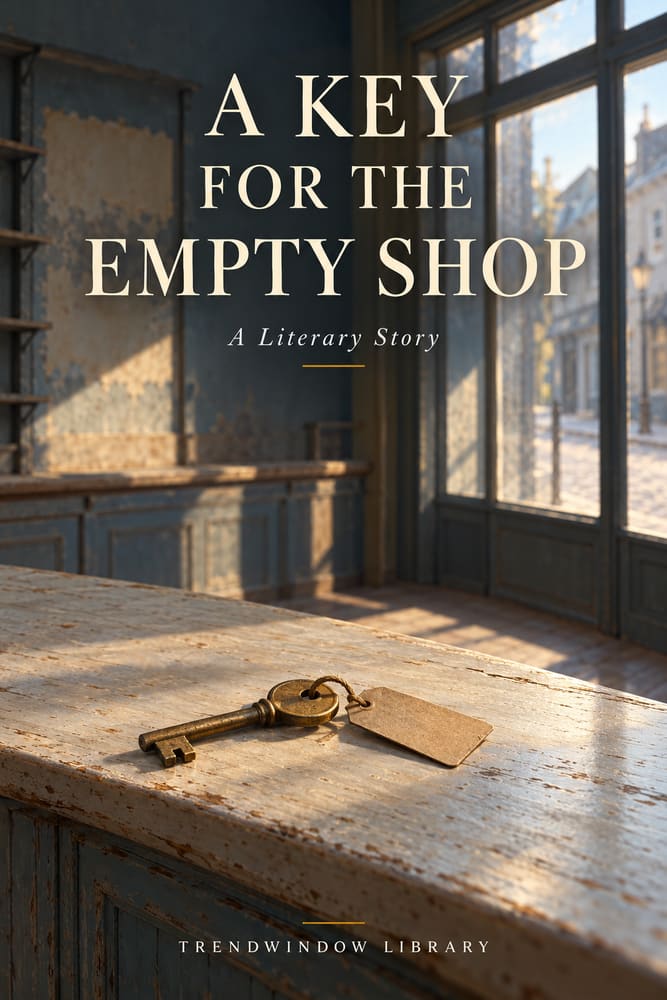
Front cover of A Key for the Empty Shop

Contemporary & Literary Fiction

A Key for the Empty Shop

By TrendWindow Library

A complete original literary story about Ivo, a paid worker with one week to prepare a closed toy shop for a new tenant, and the difference between erasing a room and making his own work visible.

First five fixed content pages only. Full-book access and purchases are not available.

1 Fourteen Hours

The key had a cardboard label that said EMPTY, though the shop was not. Ivo could see that before he turned the lock. A railway station occupied most of the window, its platform full of people smaller than his thumbnail. Behind it stood a chair with one arm wrapped in brown tape.

Sonia, the letting agent, waited while he tested the key.

“Seven days,” she said. “Back next Monday at noon. Fourteen hours of your time, as agreed. Tell me if the list doesn't fit.”

He liked that last sentence enough to distrust it.

The list covered an inventory, ordinary cleaning and preparing loose items for collection. A separate team would move the fixed shelving. He was not there to repair wiring, open unknown containers or lift furniture alone. Sonia had written those limits down. He read them before signing.

“What shall I call the job on the invoice?”

“What it is.”

He almost laughed. On forms, he had been calling himself a temporary property assistant. It sounded as though he might eventually become a person who did not carry bin bags.

At forty-one, Ivo cleaned offices at night and took small daytime contracts when the buses and his sleep allowed. The office contract had lost a floor the previous month. This job filled part of the missing money, not the missing certainty.

Sonia gave him a phone number for Vera, the former tenant. Nothing was to be discarded until the agreed inventory had been checked. The room had been closed six months. Closed, he understood, was not the same word as finished.

When she left, he stood behind the counter. The miniature station had a sign: NORTHBOUND. A tiny man with a suitcase waited beside a clock that would never change.

Ivo wrote: Window display. Railway. Await instruction.

It was his first sentence in the room.

2 Rectangles on the Wall

He photographed the room for the private condition record, as the contract allowed. Not for his own page. Not the names on old paperwork. Three broad views, then details of damage, with the address kept in the job folder.

Where shelves had already been removed, the wall showed pale rectangles. He had always liked these accidental maps of use. They were more honest than a freshly painted room pretending nobody had needed anything there.

Vera answered on his second call.

“I thought Sonia was coming.”

“I'm doing the inventory. Ivo.”

“Yes. She said.”

He could hear traffic behind her. She worked at a large shop across town now, Sonia had explained, though it was not Ivo's business to put that in his list.

They agreed a time for Wednesday. He would label the loose objects and leave the back-room boxes unopened. Vera would identify what was hers to collect and what needed another person's agreement.

“People keep asking for pieces,” she said. “As if a shop closing turns everything into souvenirs.”

“I'll refer them to you.”

“Please do.”

He found six mugs, three broken display stands, a drawer of price labels and a photograph facing the wall. He did not turn the photograph over. He listed it as a framed photograph in the counter drawer.

Outside, a man tapped the glass and pointed at the station. Ivo shook his head, then opened the door enough to explain that the owner had to decide. The man said he remembered it from childhood.

After he left, Ivo looked at the station again. Somewhere under its platform lay the dust of six months. Remembering something did not tell him how to remove it without breaking it.

He added: Two-person collection required. Do not lift by scenery.

3 The Person Who Made the Rain

Sol came on Tuesday with a sandwich and no appointment. They were twenty-six, wearing a coat whose cuffs had been repaired with green thread.

“I used to work here. Is Vera in?”

Ivo gave them Wednesday's time. Sol looked past him at the station.

“She said I could have the rain.”

He waited.

The rain was a sheet of fine clear threads suspended over the miniature platform. In the window light, the threads caught silver. Ivo had taken them for scratches in the glass.

“I made it. The station was a kit, but the weather was mine.”

“I can't give anything out without confirmation.”

“I'm not asking you to steal it.”

“I know. I'm trying not to decide something that isn't mine.”

Sol ate half the sandwich, standing beside the door. They told him they had worked Saturdays and holidays, arranged windows, answered questions about toys too expensive for most children to buy. Everyone remembered the display. Few remembered who spent Sunday evening making it rain.

Ivo thought about the private photographs on his phone. When he finished a room, people usually saw the absence of dirt, not the hours that had removed it.

“Will you ask her?” Sol said.

“I'll put the question on the list. You should speak to her too.”

Before leaving, they pointed out the station's hidden fixing screws and told him not to test them himself. He marked the display for the collection team.

On the inventory, he changed Railway display to Railway display with handmade rain. Maker: Sol; ownership and collection to confirm with Vera.

It was a longer line. He did not shorten it to make the column neat.

4 A Picture Without a Name

On Wednesday morning, the neighbourhood page posted an old photograph of the shop. Sonia sent Ivo the link because someone had asked whether it was open again.

The caption said: A little magic returns. New hands bringing our favourite shop back to life.

The photograph was not Ivo's. It showed Vera much younger, leaning out of the doorway. The post did not say when it had been taken. People congratulated whoever was making the place useful again. One asked whether the old owner had finally cleared her mess.

Ivo read that sentence three times. He was standing among the things it described.

He sent Sonia a short message: The post makes it sound like the old shop is reopening. I'm preparing for a different tenant. Please correct that.

She replied that she had not written it, but would ask the page administrator to make the distinction. She could not promise to remove every comment.

He wanted to write his own explanation. He imagined a photograph of the cleaned floor and a paragraph that would make everyone understand the work. Then he looked at the drawer with the face-down photograph.

The room had not become his story because he had been paid to enter it.

When Vera arrived, he showed her the post before the inventory. She read it without sitting down.

“I closed a business,” she said. “I didn't leave a body in the street.”

He put the phone away. She took off her coat and hung it on the taped chair. For the next hour, they talked about objects with names rather than strangers with opinions.

5 The Blue Box

Vera opened the back-room boxes herself. Stock to collect. Papers to take home. Damaged packaging approved for disposal. Ivo marked each decision and asked her to check the list before he moved on.

In the last box was a blue wooden engine, much larger than the trains in the window. One wheel had been replaced with a plain disc.

“A customer repair?” he asked.

“My first attempt at making something to sell. Terrible wheels. I kept it as a warning.”

She turned it over and smiled without looking happy.

“Everyone thinks I must miss the shop every minute. I miss parts. I don't miss waking at four to work out which bill could wait. Both are true.”

Ivo had been preparing an encouraging sentence about a fresh start. He let it remain unsaid.

They called Sol together. Vera confirmed that the handmade rain could go to them. The station base would go to a local hobby group that had agreed to collect it with two people on Friday. Neither arrangement depended on Ivo deciding who deserved the past.

Vera put the blue engine in her own bag.

“Are you reopening somewhere else?” he asked.

“Not now.”

He heard the invitation to leave the answer alone.

At the end of the visit, she turned over the framed photograph and took it. He did not see the face. On his sheet he crossed out Photograph: pending and wrote Collected by Vera.

It was possible, he realised, to make a complete record without knowing everything.

Explore more book previews →