BOOK LIBRARY · Complete books · Purchases disabled
TrendWindow

← Book Library · Complete book

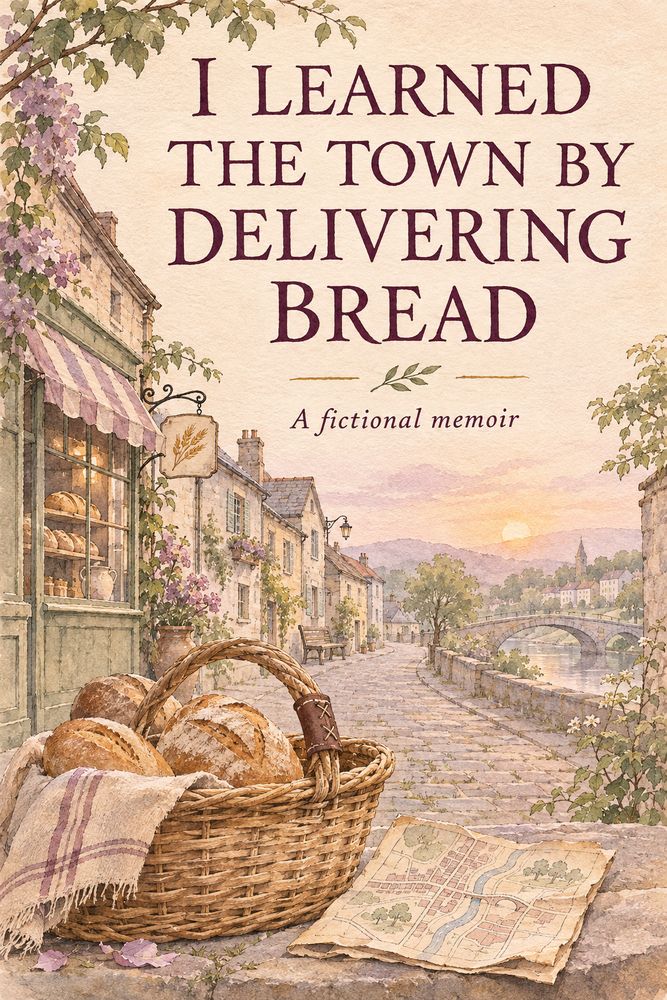
Front cover of I Learned the Town by Delivering Bread

Biography & Memoir

I Learned the Town by Delivering Bread

By TrendWindow Library

At nineteen, Neri learns Calderbridge through a bread delivery round: two houses with the same name, a closed bridge, a cousin he has misunderstood and a baker who teaches him to ask again. Years later, a drawing on a paper bag brings him back. A complete fictional memoir in eight chapters.

Read this complete edition, including its ending and notes. No purchase is required.

About this book

A complete short fictional memoir in eight chapters.

Neri, the narrator, and all people, places and remembered events in this book are invented. The first-person voice is a literary device, not a claim to a real person's life or testimony. This is a story, not baking or food-handling guidance.

Original complete short fictional memoir prepared with AI assistance. Narrator, people, town and remembered events are invented; not real testimony or baking and food-handling guidance. Translation meaning reviewed with AI, without independent native-language certification. Not a full-length autobiography.

1. The map in my pocket

At nineteen I arrived in Calderbridge with a map too large for any useful pocket. Every morning I folded it differently, hoping the town would become smaller. By the end of my first week, the river had split along a crease and the railway station was nearly detached.

I slept in my cousin Lila's box room above a shop selling curtains. She had cleared a shelf for me but left one porcelain bird at its far end. I arranged my three shirts beneath it as though it were watching an inspection.

The bakery job began because I could not bear to spend another afternoon pretending to look for work. Berto asked whether I could carry a basket and read addresses. I said yes too quickly to both. He gave me a pencil, a canvas shoulder bag and a basket whose left handle had been repaired with a strip of leather.

“The town is flat,” he said, “except where you have to go.”

I thought this was a test of my sense of humour. It was an accurate description of the delivery round.

On my first morning, I wrote the street names in order on a clean sheet. Berto added a little circle beside number eighteen, Mill Lane. I asked what it meant.

“She may be in the back garden. Knock and wait.”

That was the first thing my printed map did not tell me. It would not be the last. I put the sheet inside the map and went out with warm bread pressing gently against my ribs through the basket.

2. The woman behind the gate

Number eighteen belonged to Mrs Vale, who wore a man's old raincoat over whichever dress she had chosen that day. I knocked, waited as long as my nervousness allowed, and knocked again. From behind the house came a voice asking whether I intended to remove the door.

I took the loaf round through a green side gate. She was tying a climbing plant to a support with strips cut from a faded pillowcase. On the ground beside her stood a cup with no handle. It held the strips, not tea.

“You're new.”

I told her I had arrived that month. She asked whether I liked Calderbridge. I gave the answer I used with everyone: very much.

She looked at the loaf. “You've only seen the street from here.”

I thought she meant the view from her gate. Later I wondered whether she had meant my life. I have made her wiser in memory than she probably wished to be. What I know is that she paid, asked for the same order on Thursday, and told me to stop calling her madam.

Back at the bakery, Berto asked whether number eighteen had answered. I said she had been gardening. He put another small circle on the next delivery sheet.

I began making my own marks: a steep step, a gate that caught on the ground, a door painted almost the same colour as its wall. I did not yet know which details would help me find a house and which were merely things I enjoyed noticing.

3. Bread for the wrong kitchen

The two houses called Willow Cottage were on opposite sides of the river. One belonged to a man who ordered two small brown loaves. The other was a guest house whose kitchen took a larger delivery on Fridays. Their names were painted in similarly ambitious lettering.

I read the name and congratulated myself on recognising it. I did not read the street underneath.

At the guest house, a woman in an apron said she had expected us earlier. That was enough encouragement. I handed over the two loaves, accepted her thanks and walked away with the satisfied speed of a person who has made a mistake but has not discovered it.

Berto discovered it when the first house telephoned. He did not ask whether I had been careful. The loaves were plainly in the wrong place.

“Tell me which door,” he said.

I described the blue porch. He nodded and called the guest house. Its larger order had been delayed separately; the woman had assumed my two loaves were the beginning of it. They had already been cut. Berto arranged the deliveries again and put the extra bread in his waste-and-errors book.

I offered to pay. He said we would discuss my work, not conduct an auction for my shame. I was to read the whole address and repeat the order before handing it over.

That afternoon I walked to both houses without a basket. I learned the bridge between them by the ache in my feet. On the map, the mistake measured less than the width of my thumb.

4. My father's afternoon

My father visited in October. I wanted to show him the town that had begun to recognise me, though I still introduced myself as temporary when anyone asked how long I would stay.

He arrived wearing the jacket he kept for journeys. The station clock was wrong, so I thought he was early and he thought I was late. We argued mildly until a porter told us the clock had stopped the day before.

I had planned a tour of the square, the river and the hill with the old observatory. Instead, my father asked to see where I worked.

At the bakery, Berto shook his hand with flour on his wrist. He said I was learning the round. Nothing about talent or a brilliant future. I wanted a grander sentence, something my father could repeat at home.

My father asked which streets I covered. I began listing them, then pointed out the window to explain a shortcut. He listened as though I were describing a country he might never visit again.

After lunch, I took him to the river. We sat on a bench while a boy tried to persuade a paper boat to leave a patch of reeds. My father asked whether I was eating enough. I said the bakery made that difficult to avoid.

When his train left, I found a folded note in my coat pocket. It held money for a warmer blanket and a sentence: You know your way around now.

I kept the sentence long after I spent the money. I had wanted him to admire where I might go. He had noticed where I already stood.

5. The extra loaf

At the end of some days, Berto sent bread to a small evening kitchen in the church hall. These were arranged deliveries, written on a separate sheet. I had to stop treating anything outside the ordinary round as an act of personal generosity.

One wet evening, I carried the basket through the hall's side entrance and saw Lila helping lay tables. She had not told me she went there. I assumed she was volunteering until she put her own coat over the back of a chair and sat down.

I pretended not to see her. I set the basket in the kitchen, spoke too loudly to the woman receiving it, and left.

At home, Lila asked why I had ignored her. I said I had thought she wanted privacy.

“You could have said hello,” she replied. “You do at the grocer's.”

She was working fewer hours at the curtain shop. I had noticed her eating toast for supper and called it a habit. The room I rented from her was not evidence that her own life was comfortable.

I apologised. She accepted without helping me feel noble. The following week I greeted her in the hall as I would anywhere else. We talked about the broken umbrella she had left by our door. Nobody required a speech.

I began to understand how easily I had turned a delivery route into a view of other people. From a doorstep I could see an overdue-bill notice, an expensive rug or an empty room. I could not see enough to know a life. Bread gave me an entrance, not an explanation.
6. The morning without a shortcut

In winter, work closed the little footbridge I used between the station road and Mill Lane. The sign offered no interest in my basket or my timetable. It simply said the crossing was closed.

I returned to the bakery and told Berto the round would take longer. He asked how much longer. I did not know, and for once I admitted it before guessing. We divided that morning's deliveries so I could walk the alternative route and record the time it actually took.

The longer road passed a repair shop with a window full of clocks. I had lived in Calderbridge for months without knowing it existed. Near it was a narrow passage into the market, which I had always approached from the other side.

I wanted the passage to be my discovery. Then a woman carrying empty crates walked through ahead of me, and I saw the polished groove left by years of wheels on the threshold. Nothing had been waiting for me to find it.

That afternoon I corrected the route sheet. The new walk was longer, and pretending otherwise would only make the next morning worse. Berto changed the order of two stops. One customer agreed to a different delivery time; another did not, and we had to arrange that stop separately.

I no longer hated the folded map. I still used it. But it had become one account of the town, useful alongside a closed sign, a conversation and the time on a clock that worked.

7. Teaching the round

In spring, Berto hired a second delivery worker, a young woman called Tess. She asked questions I considered obvious and noticed things I had stopped seeing.

On our first shared morning, I told her that Mrs Vale was usually in the garden. Tess asked whether she should always use the side gate. I started to say yes, then remembered that I had been invited through it on particular mornings. I told her to knock first.

At the two Willow Cottages, I gave her the full story of my mistake. I had practised a version in which both houses were absurdly difficult to distinguish. Standing beside Tess, I abandoned it. I had read the name and skipped the street. That was the useful part.

She wrote both addresses clearly on her sheet. Her handwriting was wider than mine. She needed two lines where I used one, which irritated me until I realised that I could read her version without holding it close to my face.

We stopped outside the evening kitchen. I explained the delivery arrangement and where to leave the basket. I did not tell her who I knew at the tables.

By noon, Tess had drawn a little square beside a doorway I had never marked. The step was lower on one side and easier with the loaded basket. I copied her square onto my own sheet.

Teaching the town did not prove that it belonged to me. It showed how much of my knowledge had been borrowed from people who had let me arrive badly, ask again and eventually get something right.

8. The route home

I stayed three years. After that I took other work, moved twice and carried different kinds of worry in bags with better handles. Lila left the curtain shop. Berto eventually retired. The bakery changed hands and then became a café that kept bread in a glass cabinet.

Many years later, I returned to Calderbridge for an afternoon. The station clock worked. The little footbridge had a different railing. I could not find the clock repair shop; a window advertising haircuts stood where I thought it had been.

I bought a loaf at the café and asked for directions to Berto's house, though I had delivered to the street once. I was tempted to pretend I remembered. Instead I let the young person behind the counter draw the last turn on a paper bag.

Berto opened his door slowly. He had grown smaller, or my memory had kept him at the scale of his ovens. He recognised me before I finished saying my name.

“You're late,” he said.

“The town isn't flat.”

He laughed and took the loaf. We ate it at his kitchen table. He asked about Lila, and I asked whether he missed the bakery. He said he missed some mornings and was grateful not to have others.

When I left, he returned the paper bag with two slices for my journey. On its side was the small drawing of the last turn. I folded it carefully and put it in my pocket.

I had once believed that knowing a town meant never needing directions. Now I carried the bread home and let someone else's pencil show me the way.

The end.

Explore more books →