BOOK LIBRARY · Complete books · Purchases disabled
TrendWindow

← Book Library · Complete book

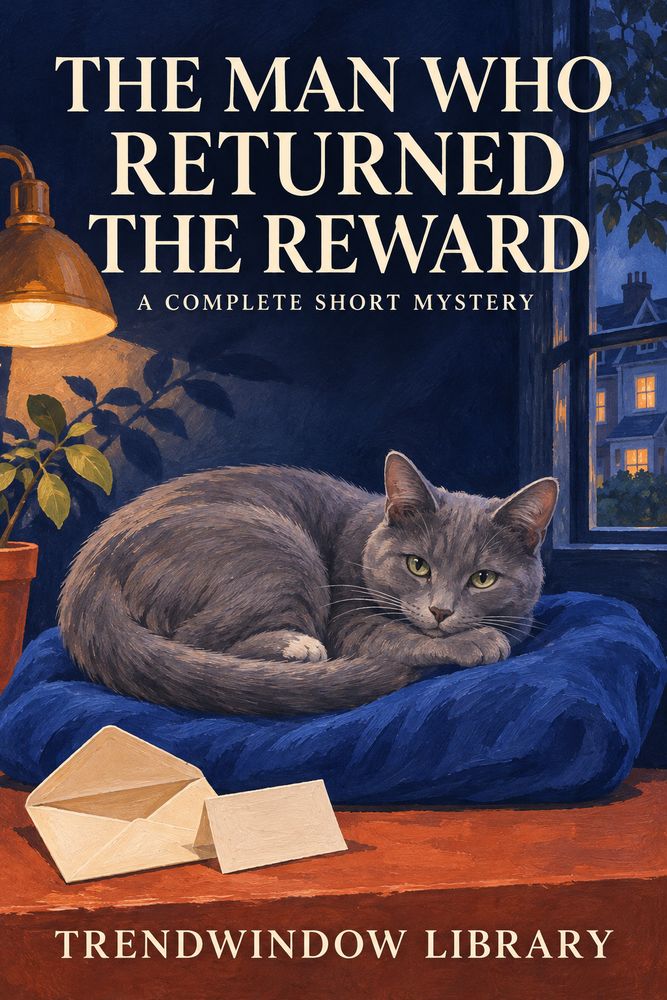
Front cover of The Man Who Returned the Reward

Mystery, Crime & Thriller

The Man Who Returned the Reward

By TrendWindow Library

A finder returns his reward after a second missing-cat notice unsettles the first happy ending. Delivery driver Mika follows two names and a question gratitude cannot settle. A complete original short mystery.

Read this complete edition, including its ending and notes. No purchase is required.

1. One Hundred in an Envelope

Ewan put the envelope beside Mika's delivery book and asked her to watch him give it back. The flap was open. Inside lay the same hundred he had shown her on Sunday, pleased and embarrassed, after returning a grey cat to a woman in Alder Lane.

"Did she ask for it back?" Mika said.

"No. That's why I need someone there."

Mika drove parcels for the print shop and knew Ewan from his years as porter at the flats opposite. Retirement had changed his hours, not his habit of bringing everyone else's uncertainty to the nearest counter. He could usually be persuaded to tell the whole problem if nobody offered an answer too soon.

"The cat may belong to somebody else," he said.

He unfolded a notice. MISSING: PEBBLE. A grey cat sat on a blue cushion. One back paw had a pale patch. The notice said Pebble had slipped out on Saturday and gave Sana's first name and telephone number. Mika recognised the paper: her employer had printed those notices that morning.

"This looks like the one I found," Ewan said. "The one I took to Lydia."

He had found the cat in an empty delivery crate behind the print shop on Sunday morning. Lydia's older lost-cat notice was still in the window of the corner store. It showed a grey cat called Soot and offered a hundred for his safe return. Ewan had called; Lydia came with a carrier. She had said the cat was hers and handed over the envelope.

"Did you compare the pictures?"

"With the cat moving and her crying, I thought I had. That isn't the same as doing it properly."

He did not say a pale paw was a unique identity card. Two grey cats could resemble each other. He said he had carried an animal from one person's certainty into another person's locked house, and now he wanted the question opened again.

Mika looked at her delivery route. Alder Lane was her next stop. She called the shop to say she would need a little longer there. Then she asked Ewan whether he had spoken to Sana.

"Not yet. I don't want to give her a promise I can't keep."

"We can give her a question," Mika said.

2. The Two Names

Sana answered on the second ring. Mika explained who they were, where Ewan had found the cat and why they were calling. She did not announce that Pebble had been found. She asked whether Sana could look at the other notice and speak with them.

Sana came to the shop carrying a folder and an empty carrier. Her hands tightened around its handle whenever someone passed the door.

"He stayed with my mother while I moved," she said. "On Saturday we brought him to my new flat. He got out while we were carrying the last box. We've both been looking."

She showed recent pictures of Pebble: stretched on her mother's rug, under a kitchen chair, asleep across the same blue cushion. In one, the pale patch showed at the heel of the left hind paw. She also had older pictures from the years she had cared for him. These were her account and its supporting record, not Mika's authority to make a legal judgement about an animal.

Ewan fetched Lydia's notice from the corner store with the shopkeeper's permission. The print was faded. Soot's feet were hidden behind the edge of a wicker basket. The face looked similar, but neither photograph could do all the work they wanted from it.

"What did she call him when she arrived?" Sana asked.

"Soot."

"Did he answer?"

"He looked up when the carrier opened. I don't know what he was answering."

Sana nodded slowly. She did not turn that movement into a test he had failed or passed.

Mika asked Ewan what had made him bring the envelope back before anyone had demanded it.

He took out a second paper: Lydia's thank-you note, delivered through his letterbox that morning. Thank you for bringing him home, it said. Underneath, the last word had been crossed out and replaced: to me.

"That could be nothing," he said. "People change words. But then I saw Sana's notice. I couldn't keep the money while pretending the question was settled."

The correction in the note was not a confession. It was a reason to ask. Together with Sana's recent account, it made a visit worth requesting. Mika called Lydia and said there might have been a mistake about the cat. Lydia said there was no mistake.

"Then let us compare what we know," Mika said. "With you there."

After a long silence, Lydia agreed.

3. The Door in Alder Lane

They waited outside Lydia's blue door until she opened it. Ewan held the envelope. Sana held the carrier. Mika carried neither; she wanted to remember that her task was not to collect a parcel.

Lydia's hallway smelled of floor polish. A grey cat was visible through the glass door into the sitting room, perched on the arm of a chair. Sana drew in a breath, then stopped herself from calling through the glass.

"That's him," she said softly.

Lydia kept one hand on the sitting-room handle. "You can't know that from here."

"Then let me show you the pictures."

They sat at the small hall table by Lydia's invitation. Sana laid out her photographs in date order and explained the move. She offered her mother's number so Lydia could hear the account directly if she wished. She did not claim that a cat's glance through a door was enough to decide everything.

Ewan set down the envelope.

"All of it," he said. "I haven't spent any."

Lydia did not reach for it. "A reward doesn't mean you can change your mind about what happened."

"It doesn't stop me asking whether I made a mistake."

On a shelf above the hall table stood a small tin, painted with a grey cat. A card propped beside it read SOOT, OUR OLD FRIEND. Beneath the name were two years: 2011 and 2025.

Sana saw the card when Lydia saw her see it. For a moment, nobody said anything.

"Was that another Soot?" Mika asked.

Lydia looked toward the sitting room. The cat had climbed down from the chair and was out of sight.

"That was Soot," she said.

"The one on your notice?"

Her hand left the door handle. "Yes."

The card had not proved a death by itself. Lydia's answer connected it to the notice she had used. Mika asked her to explain the connection in her own words. There was no need to search the house, read private papers or turn a shelf into a verdict.

4. What the Notice Had Kept

Soot had died the previous autumn, Lydia said. The notice belonged to an earlier time when he had disappeared for two days. She had kept a copy in a kitchen drawer. On Saturday she put it in the store window again.

"Why?" Sana asked.

"I thought someone might bring a cat who needed a home."

"It says your cat is missing. It doesn't say you can offer a home."

Lydia nodded, staring at the table. She had told herself that the wording did not matter much. When Ewan called about a grey cat, she had gone with the old carrier. She had recognised that this was not Soot. The white patch on the paw was one difference, but not the whole of her recognition. She had lived with her own cat for fourteen years.

"I knew," she said. "Before I gave you the envelope."

Ewan closed his eyes. Mika let the silence stand. It was not her place to hurry Sana into forgiving the admission because it had been difficult to make.

Sana asked whether Lydia had seen the newer notices. Lydia had seen one that morning, on the lamp post at the corner. It included the blue cushion and the same description Sana had brought. She had taken the notice down and put it in her bag.

She fetched it now. It was creased across Pebble's face.

"I was going to call," she said.

"You told us on the phone there was no mistake," Mika replied.

Lydia nodded again. She had not called. She had hoped Sana would stop looking, and she had sent Ewan the note as though gratitude could finish the transaction. The changed words, home to to me, were her own brief hesitation. They had not been intended as a message asking him to investigate.

The mystery did not require an extraordinary talent for reading crossed-out words. Ewan's unease had led to Sana's account. Their visit had brought the two notices together. Lydia's explanation established the deliberate mistake that the pictures alone could only raise as a question.

"I miss him," Lydia said, looking at the tin.

"I'm sorry," Sana answered. "But this one is alive, and I've been afraid for him since Saturday."

Lydia began to cry. Sana kept both hands around the carrier's handle. Her sympathy did not become agreement to leave Pebble behind.

5. A Carrier, Not a Bargain

Mika asked the next question plainly: would Lydia open the sitting-room door and allow Sana to take Pebble home? Lydia said yes. Nobody had to force the door, offer more money or exchange the cat for a promise of silence.

Sana asked the others to give her room. She entered with her carrier and sat near the chair. Mika and Ewan stayed in the hall. What followed was an ordinary reunion, not a demonstration that a particular call or movement would identify every cat. When Sana came back with the carrier closed, she looked exhausted rather than triumphant.

"Thank you for letting me take him," she said to Lydia. "You need to tell the shopkeeper what happened to the notice. And put mine back."

Lydia agreed. She also agreed not to call Ewan's return a theft of her reward. He had brought the whole sum back and placed it on the table. She counted it there, wrote that she had received it in full and gave him the signed paper. Mika witnessed the exchange as a participant in the story, not as an official determining legal ownership.

Ewan folded the paper carefully. "I should have asked more questions yesterday."

"You can say that without saying you knew what she knew," Mika said.

Sana asked Lydia not to visit her new flat. If there was anything further to say, she could contact Mika at the shop, with Mika's agreement. Mika agreed to receive a message, not to promise a conversation or carry out an open-ended duty. Sana remained free not to answer it.

Lydia offered to pay for the notices. Sana declined to decide anything else that afternoon. Getting Pebble home came first. The offer was left as an offer; it did not purchase forgiveness or settle every possible consequence of what had happened.

At the door, Lydia asked whether they thought she should get another cat. No one there knew enough to decide that for her, and a new animal could not be assigned the job of erasing this morning.

"Call someone you trust," Mika said. "Tell them what actually happened today. Start there."

Lydia picked up her phone. The others did not stay to supervise the call.

6. The Notice Taken Down

Sana rang the shop that evening. Pebble was back with her and her mother. She had told the friends who were searching, and asked them to stop circulating the missing notice. Mika could tell the corner store the cat had been found; she could not publish Sana's address or Lydia's private history.

Lydia had already visited the store. In front of the shopkeeper and Ewan, she said the old Soot notice was not a current search. Her cat had died; she had knowingly claimed a different cat. She returned Sana's folded notice and explained why she had removed it. The shopkeeper took the obsolete notice out of the window. He did not replace it with a public accusation or a photograph of Lydia's front door.

The specific correction travelled to the people who had been given the wrong account. It was neither a secret kept in exchange for money nor a spectacle built from someone's grief. Sana could decide separately what further help or advice she wanted. Mika did not turn the afternoon into a claim that she had settled everyone's rights forever.

On Tuesday Ewan came into the print shop without an envelope. There was no money to count this time, no photograph he wanted Mika to judge. He waited while she finished with a customer, then stood by the delivery counter where he had first asked her to go with him.

"Everyone says I'm honest for giving the money back," Ewan said. "I wish I'd been more careful before taking it."

"Those can both matter."

He looked at the blank space where Sana's notice had hung by the till. "I thought the story was finished when somebody thanked me."

Mika closed her delivery book. A thank-you could be sincere, mistaken or meant to stop the next question. In this case they knew which it had been because they had asked, listened and brought the accounts together. That did not turn every expression of gratitude into a trap.

Ewan went to the corner store. Mika began her route. On her seat lay a note from Sana: no reward promised, no account demanded, just news that Pebble had fallen asleep on the blue cushion.

This time the end of the story belonged to the person who had been looking for him.

Edition Note

This is complete original short fiction. Its people, places, animals, notices, money and events are invented. It does not describe a real dispute, give veterinary advice, certify animal identity from behaviour or a visible mark, or establish legal ownership and legal procedures. The fictional resolution depends on the caregivers' accounts, Lydia's admission and a consented return, not on a universal test readers should apply to animals.

Grief is part of one character's explanation, not a diagnosis, excuse or promise that another animal will treat it. The complete English manuscript, full translations and original English front and back artwork use AI assistance with editorial review. No independent human-authorship or native-human translation certification, ISBN or print proof is claimed. The central mystery and return are resolved within this edition.

Explore more books →