BOOK LIBRARY · Complete books · Purchases disabled
TrendWindow

← Book Library · Complete book

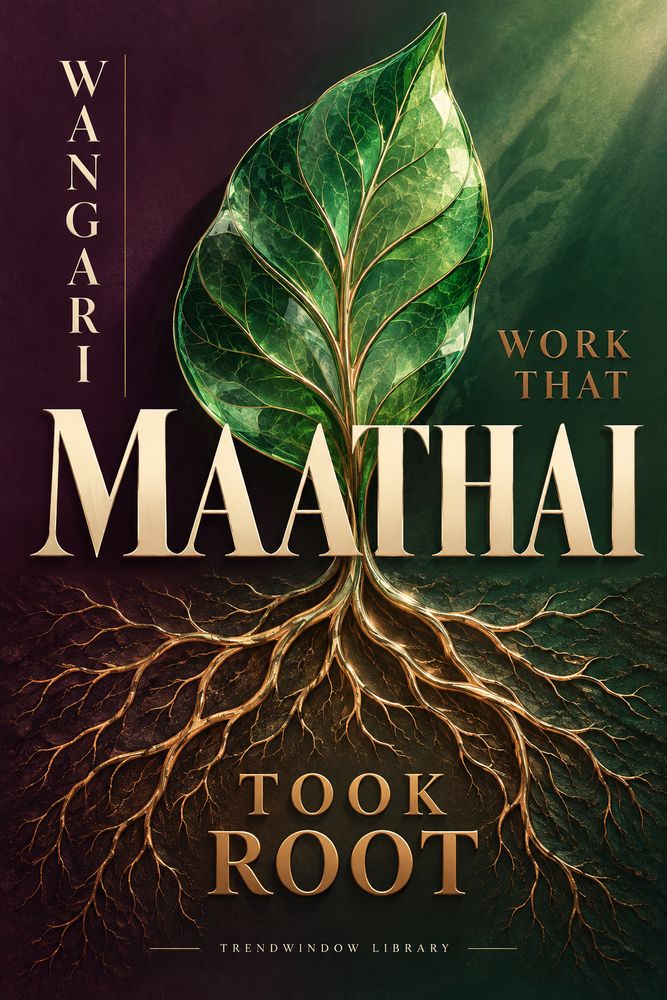
Front cover of Wangari Maathai: Work That Took Root

Biography & Memoir

Wangari Maathai: Work That Took Root

By TrendWindow Library

A sourced short biography of Wangari Maathai, connecting scientific education, the Green Belt Movement, women’s participation, public land and the 2004 Nobel Peace Prize.

Read this complete edition, including its ending and notes. No purchase is required.

1. The Needs That Named the Problem

A stream drying up is an environmental change. It is also a change in someone's day. Water has to be found elsewhere; another journey enters the work of a household. When firewood becomes harder to obtain, the distance is carried in people's time and effort. The history of the Green Belt Movement begins with such connections between a landscape and ordinary needs.

The movement's own account places its founding in 1977, under the auspices of the National Council of Women of Kenya. Rural women had reported less reliable streams, insecure food supplies and longer journeys for firewood. [1] These observations gave the environmental question a human scale before an international audience knew the founder's name.

Wangari Maathai, born in Kenya in 1940, brought scientific training and organisational work into that setting. Her later Nobel Peace Prize can make the beginning look like the first step toward a known destination. In 1977, however, there was work to organise, not a prize waiting at the end of a prescribed route.

This complete short biography follows her education, the growth of collective action, the connection between environmental protection and public rights, and the recognition and work of her later years. The interpretation is that an idea takes root through relationships and continuing responsibilities as well as through the person who first advances it.

That interpretation leaves room for the women whose reported needs helped define the problem. They were participants in the history, not scenery around a founder's portrait. A biography that begins with the famous individual alone can miss the knowledge already present among the people she worked with.

The first question in this account is therefore practical: how does an experience that might be dismissed as a private difficulty become a matter people can name and address together?

2. A Scientist's Education

Maathai was born in the Nyeri region of Kenya. She studied biological sciences at Mount St. Scholastica College in Kansas, graduating in 1964, then pursued graduate study at the University of Pittsburgh. Doctoral work took her to Germany and the University of Nairobi, where she received her doctorate in 1971 and taught veterinary anatomy. The Green Belt Movement's biographical record provides this sequence. [2]

The institutions and places matter because scientific education requires opportunities as well as ability. A degree names an achievement, but it also implies teaching, facilities and a route into a field. Moving between countries did not make those conditions disappear; it changed where the work could be pursued.

Her university career included becoming departmental chair in 1976 and associate professor in 1977. [2] These appointments belong beside the later movement, rather than being discarded as a preface to the supposedly more important life. The academic and environmental strands were parts of one person's career.

It would be misleading to treat scientific training as a complete explanation of community organising. Knowing a subject does not automatically supply a functioning organisation. Equally, practical organising does not require a biography to erase the founder's scientific work. The interesting relationship lies in the movement between specialised education and problems experienced beyond the university.

The record can establish that relationship without an invented scene in which a young Maathai predicts the Green Belt Movement. Later achievements do not need to be announced in childhood to make a life coherent.

The education chapter ends with a scientist in Kenya, with academic responsibilities and developing public commitments. The next part of the story concerns what happened when environmental concerns became a shared activity rather than only a subject to describe.

3. From an Action to an Organisation

Planting a tree is a recognisable action. Building an organisation around it introduces different questions: who participates, how knowledge moves, what work continues after the planting and how local groups connect with one another.

Right Livelihood's account of Maathai describes the development of community tree planting into a grassroots organisation involving women's groups and nurseries. It records her 1984 award and a Pan-African network established in 1986. [3] Those stages show that the movement was more than a single event repeated for photographs.

The distinction between an activity and an organisation helps explain the title of this book. A visible action can draw people together for a day. Sustained work needs responsibilities that survive the day: people able to meet again, exchange experience and deal with what has not gone as expected.

A nursery also changes the time of the story. The public image may show a seedling entering the ground, while the work has a before and an after. Preparing plants and caring for them are not merely decorative details around the ceremonial moment.

This book does not assign every current procedure to the movement's earliest years. Organisations develop methods over time. A present-day description can show continuing work without proving that every group in 1977 followed an identical checklist.

The collective dimension deserves particular care in a biography of a founder. Maathai's leadership is central, but an account in which she personally performs all the work would make the organisation less intelligible. The existence of groups and nurseries is not an interruption of the individual story. It is part of how that story acquired reach.

An idea had become something other people could participate in. That was an organisational achievement as well as an environmental one, and it created questions about whose knowledge and choices counted in public life.

4. When Land Becomes a Public Question

The Green Belt Movement's history links its environmental campaigns with opposition to land grabbing, protection of public spaces such as Uhuru Park and advocacy for political prisoners. [1] A tree-planting movement had entered arguments about the use of land and the exercise of power.

The connection is easier to understand when public space is treated as more than an empty area waiting for a proposal. Decisions about it affect who can use it and whose account of its value is heard. The environmental question and the civic question meet in that decision.

For Maathai, public advocacy carried risks. Right Livelihood records persecution, detention and physical attacks connected with her work for a democratic, multi-ethnic Kenya. [3] These belong in the account without being turned into a spectacle of suffering or an instruction that everyone should accept the same risks.

A biography can recognise courage and still ask what was being contested. Otherwise the conflict becomes a test of personal toughness and the land, institutions and other participants fade away.

Her later public service also needs a clear chronology. The University of Nairobi's institute records her election to parliament in December 2002 and appointment as assistant minister for environment and natural resources in January 2003. [4] Election and appointment were different events, not two names for one office obtained at one moment.

The movement from university work to organising, advocacy and public office did not remove the difficulty of the underlying issues. It changed some of the positions from which she could act. Holding an office and achieving an environmental outcome are not interchangeable measures of success.

By this stage, the story cannot be described adequately as one person asking others to plant trees. It includes the relationships among land, livelihood, representation and decisions that affect people beyond any single planting site.

5. Women's Work and the Meaning of Participation

The needs described at the movement's beginning were not abstract categories on a chart. They involved food, water and fuel, and the work needed to obtain them. Maathai's Nobel lecture, preserved in a University of Nairobi repository record, connects the early response with needs identified by rural women. [5]

That connection changes what participation means. People may bring knowledge of a problem before an outside description gives it a technical name. Listening is then part of the work of defining the task, not simply a polite opening before the real decisions begin.

Participation also involves more than being present in a group photograph. A person can attend an event without having much influence over what follows. To understand an organisation, a reader can ask who identifies needs, who makes decisions and who carries the continuing responsibilities.

These are interpretive questions proposed here, not claims that every group answered them in the same way. A short biography cannot turn the movement's reported aims into proof of identical outcomes for every participant.

The environmental and social strands are nevertheless clearly connected in its own history. Community education and questions of power appear alongside the practical response to degraded surroundings. [1] A narrow account that recognises only the planted tree would leave out the organisation's understanding of why the work mattered.

Maathai's life is useful to read at this level of relationship. Scientific training, local knowledge and public organisation need not replace one another. The question is how they become connected without treating one set of people as the only holders of knowledge.

The scale can remain ordinary: a reported difficulty, a shared activity and a responsibility that continues. Much of the significance of the movement lies in those links becoming visible together.

6. Recognition in 2004

In 2004 Maathai received the Nobel Peace Prize, becoming the first African woman to receive that prize. The official Nobel record connects the recognition with sustainable development, democracy and peace. [6] The three terms make the award broader than a prize for an isolated act of planting.

A date of recognition can reorganise the public story of a life. Earlier work becomes easier to locate because the reader already knows where the timeline is heading. Yet the honour came after years of academic work, organising and advocacy. It did not create those years retrospectively.

The published abstract of her Nobel lecture acknowledges people and groups whose work is often quiet and unrecognised. [5] That emphasis is important in a biography carrying one person's name. An individual award can direct attention toward collective work rather than requiring all credit to stop at the recipient.

Recognition also changes an audience. A person known through local or national work may now be asked to speak internationally. The widening audience does not make every local question solved or turn every organisational claim into an independently measured result.

This account therefore does not combine tree totals from different years into a fresh present-day figure. A historical number in an award record and a later organisational report describe different reporting moments. They should remain attached to their own dates and scope.

The award is a major turning point in public visibility. It is not the end of the life followed here. Maathai continued to write and participate in international environmental work, and the movement continued to involve people whose tasks could not be completed by a ceremony in Oslo.

7. Writing, Representation and Continuing Care

The Green Belt Movement lists four books by Maathai: The Green Belt Movement, Unbowed: A Memoir, The Challenge for Africa and Replenishing the Earth. [2] The range is a reminder that speaking about experience and preserving an account of it were also part of her work.

This biography is not a rewrite of those books. In particular, it does not borrow the authority of a memoir by placing newly composed scenes in Maathai's voice. Her own writing and a later short account of her life are different kinds of text.

The United Nations records that she became a Messenger of Peace in December 2009, with attention to the environment and climate change. [7] That later role connects the biography with an international setting, while the movement's local work remains part of the same history.

The continuing practical work can be seen in the movement's current description of restoration. It lists group formation, nursery work, planting and follow-up, including checking survival and replanting. [8] This is a description consulted in 2026, not a claim that the exact procedure existed unchanged throughout her lifetime.

The distinction between planting and follow-up has a simple significance. The first action does not contain every later result. Returning to see what happened is part of the responsibility. A living tree cannot be replaced, in the account, by the memory of a successful event.

The same distinction can guide how we read a legacy. The name of a founder may remain prominent while the practical work continues through other people. Attending to that work is a more substantial form of remembrance than assuming a familiar name explains everything being done.

The story is nearing its ending, but it has not become a promise that every effort will thrive. Care is an activity that meets real conditions. Its meaning is not reduced by acknowledging that results need to be observed rather than presumed.

8. A Life Ends; Responsibilities Continue

Maathai died on 25 September 2011. The United Nations' remembrance and the Right Livelihood record both mark the end of her life. [3][7] The movement's history continues beyond it, which makes two different endings necessary: one for the person and another, still open, for the work.

This short account has followed a complete arc from education to organising, public advocacy, office, recognition and later commitments. It has not attempted a full political history of Kenya or an exhaustive environmental evaluation of the organisation.

What holds the arc together is a series of relationships. The problem of a stream belongs with the work of a household. Scientific education belongs with the life of a public organiser. A founder's leadership belongs with the groups that make an activity durable. Environmental protection belongs with questions about land and participation.

These connections are not a substitute for facts. They are a way to read facts that otherwise risk becoming an impressive list of appointments and awards. A reader can respect the achievements while still asking what each date and claim actually establishes.

The title returns us to work taking root. The image is conceptual, not a claim that an organisation grows naturally without decisions. People organised it, met difficulties and continued responsibilities. Keeping those people visible gives the founder's achievement a clearer shape.

There is no invented final conversation here, and no assurance that the world completed the task she advanced. The life ended; the needs and questions did not all end with it.

The concluding measure is therefore neither a ceremony nor an undated total. It is the relationship between an initial response and the continuing care required to make it meaningful. A seedling can draw the eye. The work around it explains why a biography must look further than the moment it enters the ground.

Sources and Edition Information

Research checked on 1 November 2026. Original AI-assisted short interpretive biography from TrendWindow Library. Eight chapters and these notes form nine fixed content units, not printed pagination. No private thoughts, dialogue, field visit or personal acquaintance is invented. Original explanatory connections are distinguished from factual milestones. This is not Maathai's memoir, an adaptation of the documentary Taking Root or an exhaustive political or ecological assessment. No current tree total, universal survival result, human-authorship or independent native-human proofreading certification is claimed. Original English covers are conceptual artwork, not portraits or technical botanical diagrams.

[1] Green Belt Movement, Our History: https://www.greenbeltmovement.org/history/ . Main account read for the 1977 foundation under the National Council of Women of Kenya, reported rural needs, community education, land and public-space advocacy. The organisation's account of its work is not an independent outcome audit.

[2] Green Belt Movement, Wangari Maathai: https://www.greenbeltmovement.org/wangari-maathai/ . Main biographical account read for Nyeri, undergraduate study in 1964, graduate and doctoral sequence, 1971 doctorate, 1976 and 1977 appointments and book titles. Conflicting abbreviated institutional references to the master's year are avoided here.

[3] Right Livelihood, Wangari Maathai: https://rightlivelihood.org/the-change-makers/find-a-laureate/wangari-maathai/ . Award organisation's main account read for groups and nurseries, 1984 recognition, 1986 network, risks in public advocacy and the death date. Historical numerical claims are not presented as current verified totals.

[4] University of Nairobi, Wangari Maathai Institute, About Prof. Wangari Maathai: https://wmi.uonbi.ac.ke/node/242 . Official indexed public biography text used for election in December 2002 and appointment in January 2003. Direct retrieval timed out. Its different master's-year reference is not used; no complete university archive is claimed read.

[5] University of Nairobi repository, Nobel lecture, Wangari Maathai, 2004: https://erepository.uonbi.ac.ke/items/06c80329-a564-4c2f-83f4-c29c477af523 . Public indexed abstract read for the 10 December lecture, acknowledgement of collective work and early rural needs. Direct retrieval timed out; no full lecture transcript, recording or linked PDF is claimed read. No speech passage is reproduced.

[6] Nobel Prize, Wangari Maathai, Facts: https://www.nobelprize.org/prizes/peace/2004/maathai/facts/ . Official indexed award record for the 2004 Peace Prize, recognition's scope and first African woman recipient. Direct page was unavailable. Green Belt Movement and Right Livelihood independently corroborate the award; no full Nobel lecture read is implied.

[7] United Nations, Wangari Maathai: https://www.un.org/en/node/55032 . Official indexed remembrance used for the December 2009 Messenger of Peace appointment and death on 25 September 2011. Direct retrieval was unavailable. Its historical tree count is not used as a current audit.

[8] Green Belt Movement, Restoration of Ecosystems and Forest Conservation: https://www.greenbeltmovement.org/restoration-of-ecosystems-and-forest-conservation-reviving-ecosystems-building-climate-resilience/ . Current main procedure read for groups, nurseries, planting and follow-up. Its method is not projected unchanged back to 1977; its numerical impact claims are not independently certified here.

Brief factual paraphrases support an original interpretation, without copied memoir passages, documentary material or third-party images. A limited exact-title search and catalogue comparison found no duplicate among returned results and existing records, not an exhaustive clearance or plagiarism score. Complete translations preserve the full account, source boundaries and ending. All covers remain in English.
Explore more books →