BOOK LIBRARY · Complete books · Purchases disabled
TrendWindow

← Book Library · Complete book

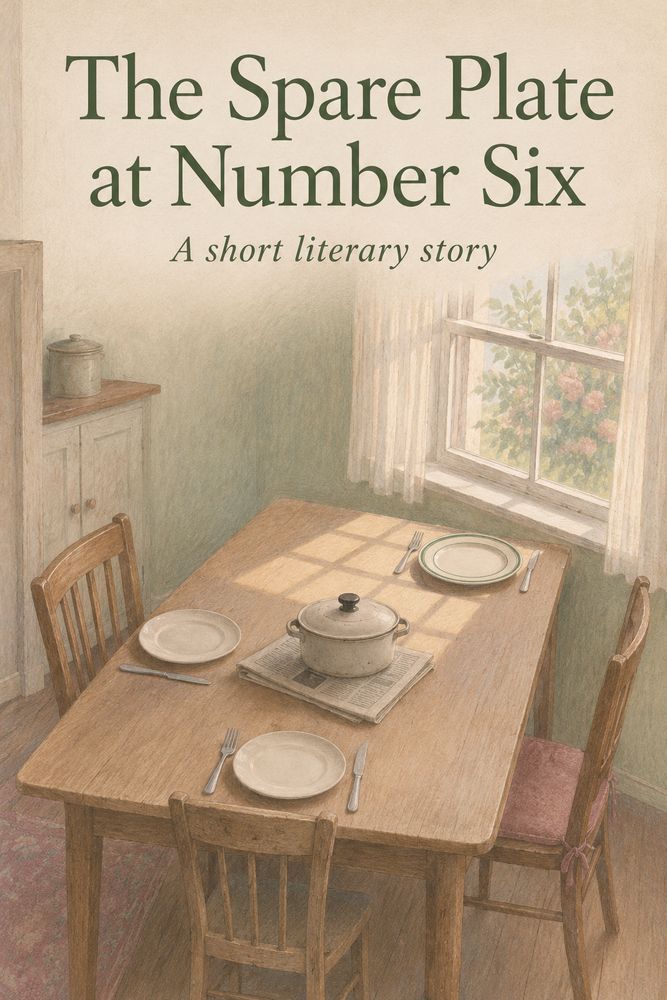
Front cover of The Spare Plate at Number Six

Contemporary & Literary Fiction

The Spare Plate at Number Six

By TrendWindow Library

After Teo moves out, Hugo keeps setting an extra plate. His daughter Lena must learn to ask before helping. A complete literary story in eight chapters about shared meals, affection, boundaries and a place that can remain open without a promise.

Read this complete edition, including its ending and notes. No purchase is required.

About this book

A complete short work of literary fiction. All characters and events are invented.

Original complete short literary fiction prepared with AI assistance. All characters and events are invented. This is not psychological or clinical advice. Original covers are conceptual illustrations. Translation meaning reviewed with AI, without independent native-language certification.

1. Three places

When Lena arrived at number six, her father had put three plates on the table. One faced the window, one faced the door, and the third occupied the narrow end where nobody could stretch their legs.

“Is Teo coming?” she asked.

“He has his own place now.”

Hugo said it as though she had forgotten, although she had helped carry Teo's books down the stairs three weeks earlier. She had the mark from a cardboard handle on her palm for two days. Teo's new flat was across town, above a shop that repaired lamps. He had shown her a photograph of its small balcony before carrying the last box out.

Her father set a pan on the folded newspaper he used instead of a trivet. Lena took the chair by the door. Hugo sat at the narrow end.

“Why don't you sit there?” she asked, pointing at the window.

“I can reach the pan from here.”

He could reach it from either chair. She almost said so, then noticed that the spare plate had a small green line around its edge. Teo had eaten from that plate on Tuesdays. Hugo's plain white one was chipped underneath, where the damage could not be seen while it lay on the table.

They talked about her bus journey and the new gutters next door. Her father served her more potatoes before she had finished the first ones. The empty place remained between their sentences.

When she stood to wash up, Hugo took the green-edged plate away first. It was clean. He rinsed it anyway and left it standing in the rack.

2. A useful daughter

Lena returned on Sunday with freezer boxes. She had bought them in a set because the separate ones cost almost as much. On the bus she imagined neat portions, fewer pans, her father eating something he had not already eaten twice that week.

He looked at the boxes and asked whether she was moving in.

“I'm helping you cook for one.”

“You haven't asked what I cooked.”

She opened the refrigerator too quickly. Inside were a covered bowl, half a lemon, milk and a dish of beans. It was neither the disaster she had feared nor an arrangement that required her to take charge.

Hugo let her stack three boxes in the cupboard. The others stayed in their cardboard sleeve. She did not know where to put her good intention once it had stopped being useful.

At lunch there were three plates again. This time she moved the green-edged one to the sideboard before sitting down. Her father watched her hand but said nothing. His silence made her talk about the boxes for longer than either wanted.

Afterwards they put leftovers in one. The lid would not close because she had filled it too high. They took out two spoonfuls, tried again and laughed when the corner sprang open.

It was a small, ordinary laugh. Lena wished she could accept it without turning it into proof that her visit had worked.

As she left, she saw the spare plate back in the drying rack. He had washed it again, though no food had touched it.

3. The room without a witness

The upstairs room still smelled faintly of Teo's orange soap. The bed had no cover. Sunlight fell across the pale rectangle where his bookshelf had stood. Hugo had left the curtain hooks in a small bowl on the sill.

“Will you take another tenant?” Lena asked.

“I haven't decided.”

She had expected him to say no, then expected to persuade him. The undecided answer gave her nothing to push against.

Teo had rented the room for five years. At first he worked evenings and left notes about parcels. Later he and Hugo began sharing Tuesday supper. Sometimes Teo cooked; sometimes he arrived late and ate while Hugo listened to a radio programme. Rent still changed hands. So did complaints about the washing machine and whose turn it was to buy washing-up liquid.

Lena remembered the arrangement as company for her father. Standing in the empty room, she realised she had rarely asked what it had been for Teo.

There was a dent in the wall behind the door. Hugo said a suitcase had made it. Lena offered to fill it.

“Not today.”

She put the curtain hook back into the bowl after lifting it. Her father was not asking her to preserve a shrine. He simply had not decided what to do with a room that was his again.

Downstairs, the green-edged plate lay on the counter with a pear on it. Lena felt briefly triumphant: a different use. Then she was ashamed of monitoring a piece of crockery as though it could report her father's progress.

4. What Teo had left

Teo came back for a bicycle pump the following Wednesday. Lena happened to be there, waiting for a delivery Hugo could not carry alone. Her father had gone to buy bread and asked her to tell Teo where the pump was.

It stood behind the umbrella basket. Teo found it without looking. That small familiarity made the hallway seem occupied again.

“How is the balcony?” Lena asked.

“Windy. I bought a plant before I bought a table. The plant has a better view than we do.”

He and his partner, Asha, were still unpacking. They had disagreed about where to keep the cups and then discovered that half the cups belonged to neither of them. He told the story cheerfully, holding the pump across his knees.

Lena wanted to say that Hugo missed him. Instead she asked whether Tuesday suppers had been good.

“Mostly,” Teo said. “Sometimes I stayed because I wanted to. Sometimes I didn't know how to say I was going out.”

“He wouldn't have minded.”

Teo looked at her. “He was also my landlord.”

She let the sentence sit. She remembered her father calling Teo reliable, and how often reliable had meant available.

“I liked living here,” Teo added. “I also wanted a place that was ours. Both can be true.”

When Hugo returned, Teo thanked him for keeping the pump. He did not stay for lunch. At the door he said they should have coffee sometime. Hugo said yes, then asked whether the brakes on his bicycle were still rubbing.

“I've had them fixed,” Teo said gently. “Coffee would be nice.”
5. Not only for the absent

That evening Lena asked about the place by the window. She asked after the pans were put away, when she could not disguise the question as help with the table.

“I know he's moved,” Hugo said.

“I know you know.”

He rubbed a thumb along the green line. “The first Tuesday after he left, I put two out. I saw what I'd done. Then I left them.”

She waited.

“With two places, I sat down. With one, I kept thinking I could eat by the sink. Finish a few things first. Put the radio on later. The other plate made it look like a meal I ought to turn up for.”

Lena looked at his chipped white plate. She had assumed the spare belonged only to the absent person. It had also been doing something for the person still there.

“And when I come?”

“I add yours. I don't think it through every time.”

He was not offering a theory. Sometimes he forgot to clear the spare; sometimes he moved it before he ate. He liked the table with more on it than his own dinner. He also disliked being asked if someone was expected.

“You could use the good plate yourself,” Lena said.

He turned it over, inspecting a mark on the base. “I could.”

She nearly reached for the chipped plate to throw it away. Then she left both where they were. It was enough to have asked one question and heard an answer she had not prepared.

6. Coffee, not a repair visit

Hugo asked Lena to help him write a message to Teo. He had already typed three lines about the bicycle. She asked what he actually wanted to do.

“See him.”

“Then ask that.”

He deleted the lines himself. The new message asked whether Teo and Asha would like him to come for coffee. Teo answered the next day: Saturday at four, if that suited him; they were going out at six.

Hugo read the time limit twice. Lena watched him resist turning it into a slight.

“Four,” he said. “I can do four.”

He went alone. When Lena called that evening, he described a crooked shelf, a yellow lamp and the balcony plant, which had lost two leaves. She waited for the account of the shelf repair.

“Did you fix it?”

“They didn't ask me to.”

He had brought biscuits in their packet. Asha put them on a blue plate. They talked about a film, the lamp shop downstairs and a neighbour who practised scales with the window open. At half past five Hugo asked for his coat. Teo walked him to the bus stop.

“He said next time they could come here,” Hugo told her.

“Have you picked a day?”

“No. He said next time.”

There was a pause, then her father laughed. “I'm learning not to turn every sentence into an appointment.”

On Tuesday he cooked for himself. Lena did not ask how many plates he had used. For the first time in weeks, her call ended before she had checked the refrigerator by asking questions about its contents.

7. One Thursday a month

Lena had been coming more often than she could comfortably manage. She had postponed a walk with a friend, left washing in the machine overnight and twice bought supper at the bus station. She had begun resenting duties her father had not actually assigned.

At number six, she told him she could not keep visiting every few days.

“I didn't know we had agreed that,” he said.

“We hadn't.”

It was a difficult relief. She could not accuse him of breaking an agreement. Nor could a grateful thank-you settle how often she ought to come; they needed to discuss it.

They settled on the first Thursday of each month for supper, unless one of them needed to change it. Calls would still be calls, not inspections. Lena would sometimes stay longer and sometimes leave early. Hugo asked whether he could come to her flat instead on a Thursday when she was busy.

She said yes, provided he did not arrive carrying a pan she would have to return the following day.

“A box, then,” he said.

They looked at the unused freezer boxes and laughed.

Later, Hugo mentioned inviting his friend Gus to play cards. They had once met at a repair workshop and kept promising another game. He had almost invited him for supper, then remembered that Gus preferred to eat early.

“Cards and tea,” Hugo said. “He doesn't need to become a tenant to sit here.”

Lena smiled without telling him that this sounded healthy. Her father was making an invitation, not submitting a result. She could be pleased without grading it.

8. The narrow end

On the first Thursday of the following month, Lena arrived late because her bus had stopped behind a broken-down van. She had warned Hugo by phone. He opened the door wearing a tea towel over one shoulder and asked whether she wanted water before anything else.

There were two places at the table. The green-edged plate faced the window. Lena took the chair by the door and found the plain white plate in front of her.

“That one's chipped underneath,” Hugo said. “If it bothers you, take the other.”

It did not bother her. She ran a finger around the rim, which was smooth, and put down her fork.

At the narrow end stood a small bowl of plums on a folded newspaper. The bowl was new to the table, borrowed from the upstairs room where Hugo had used it to collect curtain hooks. The hooks were now in a jar. The room was still empty. He had not decided about another tenant.

Gus had come for cards and beaten him twice. Teo and Asha had not yet chosen a day to visit. Lena's friend had enjoyed their rescheduled walk. None of these facts needed to fit into one story of improvement.

After supper, Hugo carried his green-edged plate to the sink. Lena brought hers. He asked whether she wanted a plum for the journey, and she chose one with a small pale patch.

When she left, the two chairs remained pulled back from the table. The narrow end was empty except for the bowl. At number six there was still room for someone else, and nobody had been asked to promise when they would fill it.

Explore more books →