BOOK LIBRARY · Complete books · Purchases disabled
TrendWindow

← Book Library · Complete book

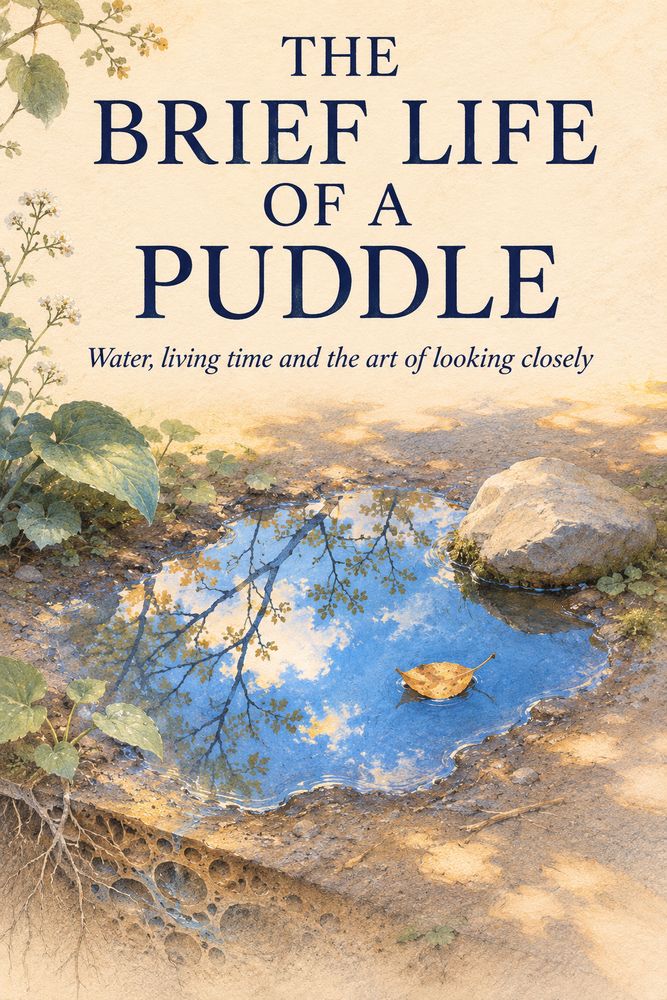
Front cover of The Brief Life of a Puddle

Science, Technology & Nature

The Brief Life of a Puddle

By TrendWindow Library

An eight-chapter short science book following a temporary puddle through rainfall, infiltration, evaporation and living time. Hypothetical examples distinguish what an observer sees from what a water balance can establish.

Read this complete edition, including its ending and notes. No purchase is required.

About this book

*Water, living time and the art of looking closely*

A puddle can disappear between breakfast and the walk home. That is enough time to tempt a very short explanation: the sun dried it. Sometimes that explanation is partly right. It leaves out the ground, the route by which water arrived, the air above it and the lives for which a wet interval matters.

This short science book follows temporary water from arrival to disappearance. Its recurring garden-path puddle is a thought experiment, not a reported field study. Numerical examples are invented to explain a balance; named species and regional wetlands come from the sources listed at the end. A roadside puddle, a seasonal woodland pool and a specialist vernal-pool habitat are not interchangeable. Their differences are part of the story.

© 2026 TrendWindow Library. Original short explanatory science book prepared with AI assistance. Sources and limitations are listed. The path scene and numerical examples are hypothetical; no field study, species identification or water-quality test is claimed. Translations received an AI meaning review, not independent native-language certification.

1. Before there is a surface to reflect the sky

Picture a shallow hollow beside a garden path after rain. The first useful question is not how deep it is, but where its water came from. Rain can land directly in the hollow. Water can also arrive across adjacent ground. The small slope that is almost invisible to a walking person can matter greatly to a thin moving sheet.

Runoff is water travelling over the land surface. Gravity and the shape of the ground influence its route; rainfall intensity, earlier wetness, vegetation and land cover influence how much joins that route.[1] The patch feeding our imagined hollow is its contributing area. Its boundary need not coincide with the puddle's visible edge. A narrow wet patch may receive water from a much wider piece of ground.

Consider an idealised calculation. Ten millimetres of rain falling on one square metre represents ten litres of water. The calculation is depth multiplied by area: 0.01 metre times 1 square metre gives 0.01 cubic metre, or ten litres. That does not mean ten litres must remain in a puddle there. Some water may enter soil, move onward or remain on surfaces. We have calculated an input, not a measured storage volume.

Suppose the hollow already contains two litres and receives three more during a brief interval. If one litre leaves during that same interval, four litres remain. The accounting is ordinary: starting amount plus arrivals minus departures. The challenging part outdoors is identifying and measuring the routes. Rainfall alone is not a full water budget.

A puddle may also overflow. Once water reaches a low place on the rim, further arrival can feed a route away. Its level can then change little while water continues passing through. A still-looking surface does not prove that nothing is entering or leaving. Likewise, a growing surface does not prove that evaporation has stopped; inputs may simply exceed losses.

By the time a reflection becomes visible, the surrounding landscape has already helped make it. The hollow supplies a place for storage, but not necessarily all the water stored. To follow the puddle's life, keep the boundary of the basin and the boundary of its contributing area as two different drawings.

2. The ground is not a sealed floor

Infiltration is the entry of water from the surface into the ground. USGS describes how some infiltrated water remains in shallow soil while some moves deeper and may recharge groundwater.[2] A shrinking puddle therefore need not have sent all its water into the air. An exit can be underneath the reflection.

Soil is not simply solid material with a wet top. Its particles and structure leave spaces through which water can enter, move and be retained. Those spaces differ in size and connection. Roots and burrows can create pathways. Compaction can alter the structure. The condition of a patch today also includes water left by earlier rain. The same location can respond differently to two storms without the laws of physics changing between them.

It is tempting to assign a single speed to a soil name: sand fast, clay slow. Such comparisons can be useful beginnings, but a real surface has structure, layers and an existing moisture condition. USGS identifies soil characteristics and saturation among the controls.[2] A photograph of brown ground is not enough to measure its infiltration rate. Nor does the absence of standing water prove that every arriving drop became deep groundwater.

Some water stays in the zone where spaces contain both air and water. Plants can use part of this moisture, and water can later return to the atmosphere through evaporation or plant transpiration.[2,4] Groundwater recharge is a more specific destination than merely crossing the soil surface. The distinction keeps a useful observation from becoming an exaggerated conclusion.

Return to the invented four-litre puddle. During another interval, imagine one litre entering the soil and half a litre evaporating, with no other flows. Two and a half litres remain. From the change in storage alone we could infer a combined loss of one and a half litres. We could not infer its division between soil and air without further evidence. The numbers illustrate a measurement problem; they are not typical rates for a garden.

On intact paving, entry into the underlying soil may be restricted; joints or cracks can still provide routes. On soil, a relatively resistant layer may help water persist. Neither surface promises a universal drying time. What looks like a simple floor is part of an uneven, changing system beneath our feet.

3. Leaving without boiling

Evaporation changes liquid water into water vapour. It does not require a puddle to reach the boiling point. Water molecules can leave a liquid surface at ordinary outdoor temperatures; energy is needed for the change of phase.[3,4] The molecule remains water. Evaporation is not the splitting of water into hydrogen and oxygen.

The energy need helps explain why sunlight matters, but sunlight is not the only possible source. Heat can arrive from the surrounding air and the ground as well.[4] A shaded puddle can evaporate. A sunny puddle can persist if it receives water or if conditions limit the rate of loss. Saying that the sun is visible tells us something about the setting, not the entire energy and water balance.

Humidity and air movement matter too. Other conditions held equal, a drier atmosphere and moving air generally favour loss of water to the atmosphere. Temperature and available radiation also matter.[5] The qualification is essential. Wind, temperature, shade and humidity often change together. Two puddles in different places are not a controlled experiment merely because one lies in sunlight.

The National Weather Service uses weather variables to estimate evaporation and transpiration from a defined reference crop.[5] That is useful evidence about the interacting controls, but it is not a ready-made clock for our hollow. A shallow pool on a path has its own dimensions, ground contact, shading and water supply. Borrowing a forecast number without its assumptions can create a precise-looking answer to the wrong question.

There is also a difference between water vapour and a visible cloud of tiny droplets. Water in its gaseous phase is not the white plume we often point to. The absence of a visible plume above a puddle is no evidence against evaporation. Conversely, mist close to the ground does not tell us how much water came from one particular wet patch.

Evaporation uses energy and can cool the surface from which it occurs.[3,4] That cooling belongs in the explanation rather than being treated as a contradiction to warm-weather drying. Energy is being transferred as water changes state. The event is quiet enough to escape sight, but not so mysterious that it needs an invented disappearance.

4. A receding shore is not a measuring cylinder

The shape of the basin determines what a falling level looks like. In an imagined shallow bowl, a small decline can expose a broad margin. In an imagined steep-sided container, the same decline can leave nearly the same surface area. Real puddles may include shelves, ruts and several connected low spots. A single depth reading cannot describe all that geometry.

Suppose a deliberately simplified flat-bottomed pool covers two square metres at an average depth of five millimetres. Its volume is ten litres. The word average is doing important work. If five millimetres is only the deepest point, multiplying it by the entire area overestimates the volume. A ruler at one edge does not automatically provide a basin-wide average.

Now imagine that the wet area later halves. Has half the water gone? Not necessarily. The remaining area may occupy the deeper part of the hollow. To turn changing area into changing volume, we need some knowledge of the basin's shape and water level. A sequence of photographs can document a shoreline very well while remaining a poor direct measurement of litres.

This distinction also protects comparisons. A thin film can vanish sooner than a deeper pool, yet the rate of loss per unit area may not have been greater. One began with less water for each patch of exposed surface. Where all other conditions really are comparable, that difference matters. Outdoors, other conditions are rarely guaranteed equal.

The practical answer is not to abandon observation. It is to name what was observed. “The wet edge retreated towards the centre, leaving the small stone outside the wet area” is a clear record. “Half the water evaporated” is a much larger claim, requiring both volume and route-of-loss evidence. A useful notebook can contain the first statement and keep the second as a question.

Our recurring puddle therefore becomes several things at once: a visible outline, an amount of stored water, a level relative to the ground and a set of exchanges. Treating them separately lets a simple photograph remain valuable without making it answer questions it cannot settle.

5. The clock that living things must meet

For an organism that develops in temporary water, the question is not only whether water is present. It is whether suitable water remains long enough. The duration and pattern of inundation are often described through the term hydroperiod. One wet afternoon and several wet months can offer very different possibilities, even if two basins look similar in a photograph.

Seasonal pools provide a particularly clear example. In Massachusetts, the wet-dry cycle of vernal pools limits the establishment of permanent fish populations and supports amphibians and invertebrates using fish-free breeding habitat.[9] This is a regional ecological example, not a claim that every roadside puddle is a vernal pool or that the same species occur worldwide.

Drying can therefore be both a boundary and part of a habitat's character. A permanent body of water is not automatically a better version of a temporary one. But a wet period that ends before a particular animal completes its aquatic development can also be unsuccessful for that breeding attempt. “Temporary” does not mean that timing is unimportant. Timing is central.

The San Diego fairy shrimp offers a species-specific case. The U.S. Fish and Wildlife Service identifies it as Branchinecta sandiegonensis, found in parts of southern California and northwestern Baja California. Its account describes hatching and maturation within seven to fourteen days after a pool fills, depending on water temperature. It also describes resistant cysts produced through reproduction that can withstand prolonged drying.[8] These details belong to this species and its circumstances; they are not a timetable for all small aquatic animals.

The adult animal and the resistant stage must not be confused. A cyst surviving in dry sediment does not mean an active shrimp continues swimming without water. The continuity lies across different life stages. This is one reason that apparently empty ground may carry more biological history than a casual glance reveals. EPA describes seeds, eggs and cysts as ways that organisms in vernal-pool communities persist through the dry season.[7]

Nothing in our invented garden-path scene establishes that such organisms are present there. Discovering movement in water is the beginning of an identification question, not permission to assign a rare species name. The larger lesson is that an interval we measure in days can be a complete opportunity, a failed opportunity or a waiting period in another organism's life. The puddle's physical clock and the organism's developmental clock meet without necessarily agreeing.

6. Water is also a changing mixture

A puddle contains more than the water visible as a surface. Runoff can carry material from the ground it crosses. EPA identifies sediment, oil, excess nutrients and wastes among the possible contributors to nonpoint-source pollution.[10] That list describes possible routes, not a diagnosis of every puddle. A clear appearance alone cannot establish what is dissolved or whether water is suitable to drink.

As water is lost, the behaviour of a substance depends on the substance and on its other routes. Here is another deliberately simplified example. If one gram of a nonvolatile dissolved substance remains in ten litres of water, its concentration is 0.1 gram per litre. If water volume falls to five litres while the full gram remains dissolved, the concentration becomes 0.2 gram per litre. This doubling follows from the assumptions, not from a test of outdoor water.

In a real pool, material may settle, attach to particles, enter organisms, react, arrive with new runoff or leave with outflow. Some substances can pass into the air. It would be wrong to promise that every pollutant's concentration simply doubles whenever the water halves. The small calculation is useful because it exposes what must be held constant before the answer follows.

Oxygen adds another important distinction. Aquatic animals that use dissolved oxygen do not obtain it by extracting the oxygen atom from each water molecule. Dissolved oxygen is oxygen present in the water as a separate gas in solution.[6] Water can remain visibly present while oxygen conditions change.

At otherwise comparable conditions, colder water can hold more dissolved oxygen than warmer water. Actual concentrations also reflect exchanges and biological processes; bacteria can consume oxygen while organic matter decays.[6] The temperature relationship is a capacity comparison, not a substitute for measuring a particular pool. A warm puddle is not automatically oxygen-free, and a cold one is not automatically suitable for every species.

This chapter changes how we interpret the receding shore. Less water may mean altered concentrations, temperatures and living conditions, not just a smaller drawing on the ground. None of those changes is fully described by a photograph. To notice the limits of sight is not to diminish observation. It is to understand what additional questions a visible change has opened.

7. A notebook without a disturbance

A useful observation can begin from a dry, safe place beside a small water patch. There is no need to enter traffic, approach floodwater or step into a sensitive wetland. Observe only where access is permitted. Leave wildlife, sediment and water in place. Moving organisms or adding water to keep an interesting pool alive would change the very system being described.

Choose a repeatable viewpoint and describe the patch without making its boundary permanent. Record the date and time, recent rain if known, surface type, shade and a fixed nearby landmark. Note whether water visibly enters or leaves. If no flow is visible, write exactly that; do not replace it with “no flow exists”. A quiet route through soil can remain unseen.

Photographs taken from the same position help compare outlines. Keep scale and viewing angle consistent where possible, without placing equipment in the water. A landmark on dry ground can orient the sequence. The result is a record of visible change, not a claim to have measured the entire volume or identified the organisms beneath the surface.

Consider this invented notebook entry: “09:00: wet edge reaches the pale stone; shade covers the patch; no visible inlet. 13:00: the stone is outside the wet edge; part of the patch is sunlit.” The observations support a changed outline between those times. They do not establish that sunlight caused all the loss. Soil entry, an unseen route or changes before the second visit remain possibilities. The notebook becomes stronger by keeping those alternatives open.

A comparison with a second patch can generate a hypothesis. If the shaded patch persists longer, shade may be one contributor. But the two may differ in depth, soil, contributing area or hidden supply. Repeating observations can reveal patterns; it does not automatically remove every difference. The honest aim is a better question, not a dramatic conclusion after a single afternoon.

A simple final entry might separate three lines: what I saw, what I think may explain it, and what I would need to distinguish explanations. “Wet area smaller” belongs on the first. “Evaporation and infiltration may both contribute” belongs on the second. “A water balance with independent measurements” belongs on the third. This is a complete observation even when the third line remains unanswered.

8. After the reflection is gone

At the end of our thought experiment, the garden-path hollow no longer reflects the sky. That ends its visible episode of standing water, not the movement of all the water that passed through it. Some may have entered soil, some may have moved across the surface, and some may have become vapour. Without measurements, we cannot assign percentages to those routes.

We can nevertheless explain why disappearance is not destruction. Evaporation changes phase. Infiltration changes location. Outflow changes the boundary across which we count the water. A puddle is a temporary store within a larger circulation, not a separate substance that comes into existence with the rain and ceases to exist when the path looks dry.[1–4]

Nor does dry ground tell the whole biological story. In particular seasonal-pool communities, resistant stages or seeds may remain for a later wet interval.[7,8] Elsewhere, a short-lived patch may have supported none of the specialist life discussed here. The responsible conclusion depends on the place and its evidence. Wonder does not require pretending that every hollow contains the same hidden world.

Our route has joined four kinds of time. There is the storm's arrival, the changing balance of water in storage, the exchange of energy with the surroundings and the interval available for living things. These clocks can run together at different speeds. A fresh shower may restart the visible pool without resetting every chemical or biological condition to its earlier state.

The next time the hollow fills, the previous episode can guide attention. Look for the contributing slope, remember the distinction between level and volume, and notice which claims would need more than a photograph. If you keep a record, include the dry visit too. An absence observed on a real date is part of a sequence, not a reason to discard the page.

The brief life of the puddle closes where it began, beside an ordinary path. The reflection has gone; the explanation has become larger. Rain, ground, air and living time met in a small place and then separated again. We do not need to make the puddle permanent to take it seriously. We need to follow its changes carefully enough that its disappearance leaves us with understanding rather than a missing picture.

### Sources and scope

Sources consulted 9 November 2026. The text is an original explanatory synthesis, not a report of new experiments. All numerical budgets and the recurring path scene are hypothetical. No species identification, water-quality test or wetland legal determination is claimed. General observation suggestions do not instruct collection or habitat alteration.

[1] USGS, Runoff: Surface and Overland Water Runoff: https://www.usgs.gov/water-science-school/science/runoff-surface-and-overland-water-runoff
[2] USGS, Infiltration and the Water Cycle: https://www.usgs.gov/water-science-school/science/infiltration-and-water-cycle
[3] USGS, Evaporation and the Water Cycle: https://www.usgs.gov/water-science-school/science/evaporation-and-water-cycle?page=1
[4] NOAA, The Hydrologic Cycle: https://www.noaa.gov/jetstream/atmosphere/hydro
[5] National Weather Service, Forecast Reference Evapotranspiration information: https://www.weather.gov/cae/fretinfo.html . Used for qualitative controls; reference-crop values are not puddle forecasts.
[6] USGS, Dissolved Oxygen and Water: https://www.usgs.gov/water-science-school/science/dissolved-oxygen-and-water
[7] US EPA, Vernal Pools: https://www.epa.gov/wetlands/vernal-pools
[8] U.S. Fish and Wildlife Service, San Diego Fairy Shrimp: https://www.fws.gov/species/san-diego-fairy-shrimp-branchinecta-sandiegonensis
[9] Massachusetts, Vernal Pools: https://www.mass.gov/info-details/vernal-pools . Regional example; relevant institutional text read through search results.
[10] US EPA, Basic Information about Nonpoint Source Pollution: https://www.epa.gov/nps/basic-information-about-nonpoint-source-nps-pollution . Relevant institutional text read through search results.
Explore more books →