BOOK LIBRARY · Complete books · Purchases disabled
TrendWindow

← Book Library · Complete book

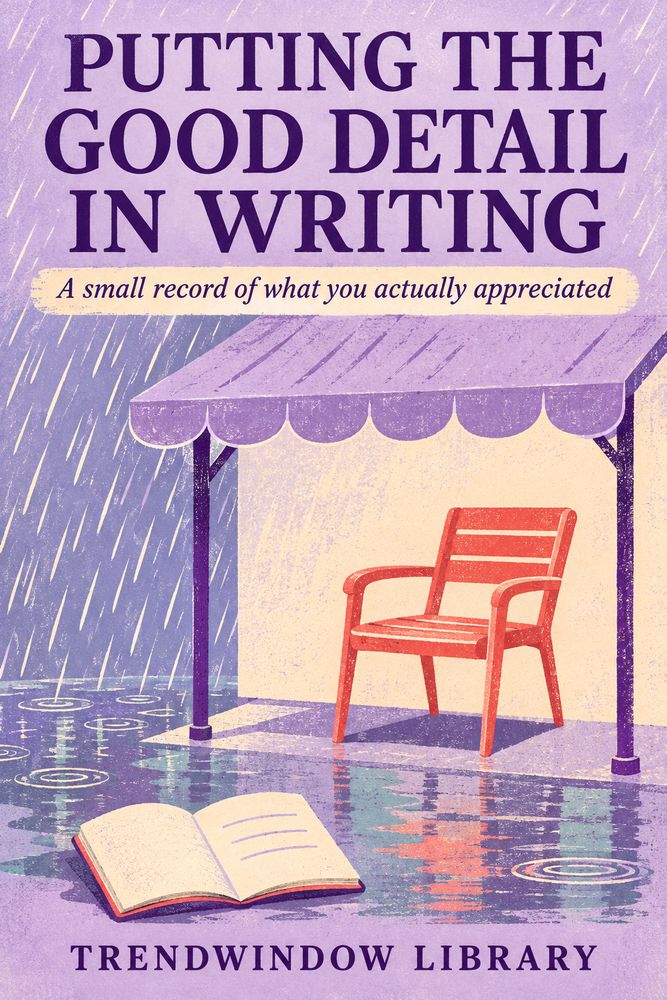
Front cover of Putting the Good Detail in Writing

Personal Growth & Psychology

Putting the Good Detail in Writing

By TrendWindow Library

An original short educational handbook on writing one specific appreciated detail without erasing a difficult day. A complete fictional example and an original three-heading note keep contributions, privacy and research limits clear.

Read this complete edition, including its ending and notes. No purchase is required.

1. One Moment, Not a Verdict on the Day

Dena had planned a Saturday photograph walk with her friend Jo. By the time they met outside the community clubroom, the rain had made them decide to cancel it. Dena had arranged her morning around the walk. She was disappointed, and a sentence about looking on the bright side would not put that morning back.

Jo asked Marta, the clubroom host, whether they could borrow one chair. With Marta's permission she moved it under the awning, where the seat stayed dry. Dena sat for two minutes while they decided how to get home. It was a small kindness inside an unsuccessful plan. Neither woman needed to call the whole outing wonderful to acknowledge the chair.

This is an invented scene, not an account of a real visit or weather event. Its purpose is to give a writing exercise a definite object. The good detail is not that the walk happened, because it did not. It is that a friend obtained a dry place to sit while they dealt with the cancellation.

Start at that scale if you want to try the exercise. Instead of searching for proof that the day was good, choose one event you can describe honestly. It may be a completed task, a useful offer or a moment you enjoyed. The event does not have to outweigh every difficulty beside it.

Write what happened before writing what it means. I sat on a dry chair while we changed our plans gives a reader something to understand. Everything happens for the best asks a whole day to obey a conclusion. The first can be true while the second feels false or irrelevant.

Dena can keep both entries: the walk was cancelled, and the chair was welcome. Writing one does not require crossing out the other. The task is a record of something valued, not a vote on whether she was entitled to feel disappointed.

2. Give the Detail Enough Edges

A useful record needs enough detail to distinguish one occasion from a general slogan. Dena could write I am grateful for friends. That may express a real feeling, but it does not preserve what Jo did on this particular morning. A week later, it would be easy to forget the chair entirely.

She adds an action and a setting: Jo asked permission to bring a chair under the clubroom awning. She adds what she valued: having a dry seat while the cancelled plan was discussed. She does not need a dramatic ending, a perfect photograph or a claim that the rain was secretly a gift.

An original way to check your own entry is to ask whether it could describe almost any day without alteration. If it could, add one relevant detail. Dinner was good could become We ate the soup my brother had kept warm while I finished work. The detail makes the event recognisable without requiring the meal to become a life lesson.

Precision is not the same as collecting everything. You need not record another person's private conversation, exact address or unshared difficulty. A detail should serve the event, not turn your note into a file on someone else. Nor should you manufacture a time or a quotation to make the account seem more vivid.

If you remember an action but not the exact words, report the action. She offered a chair is enough. You do not have to invent a speech in which Jo understood every disappointment Dena had ever had. A modest entry can preserve real care more faithfully than a polished scene that never occurred.

For Dena, the entry begins to have edges: a cancelled walk, an offered chair, permission from a host and two dry minutes. It is specific without becoming a claim about all friendship.

3. Name Contributions Without Inventing Motives

Jo moved the chair, but she did not make every condition that allowed Dena to sit there. Marta gave permission. The awning provided shelter. Dena does not know who installed it or who cleaned the chair before that morning. An honest note can identify what she knows and leave the rest unassigned.

This matters when appreciation turns a person into the sole cause of everything good. Jo saved my entire day may sound generous, yet it makes her responsible for a result Dena has not actually established. Jo made it easier to wait through one part of a cancelled plan says less and means something she can describe.

You can distinguish an observed action from a guessed intention. Jo carried a chair is observed. Jo did it because she always knows exactly what I need claims access to her thoughts and an unlimited ability. Dena can appreciate the action without awarding Jo a permanent job as the person who must know.

Try the same distinction with a completed task. If a colleague sent a useful page reference, name the reference and how you used it. Do not assume they stayed late, sacrificed another plan or expect a favour in return unless you actually know. Credit does not improve when it is decorated with invented costs.

Appreciation also need not create a debt without limits. Dena can value the offered seat and still say no to an unrelated request next week. Jo has not purchased her future agreement by moving a chair. If they have an actual arrangement to repay a cost or return an item, they can keep it explicit rather than hide it inside an emotion.

In the scene, they return the chair to the clubroom before leaving. Marta's permission was for borrowing it, not taking it away. The small practical ending belongs in the account too. An appreciated object remains somebody's object, and a helpful moment does not erase the terms on which it happened.

4. Use a Three-Heading Note

The original note in this book has three headings: What happened, What I appreciated and What made it possible. It is an educational writing exercise, not a scale, a treatment or a replication of a study. There is no required number of entries or score to earn.

Emmons and McCullough's 2003 experiments reported benefits on some, not all, measures; they did not establish how long effects lasted. That bounded finding does not validate this particular note or promise a change in health or happiness.

Dena's What happened is: Our photograph walk was cancelled. Jo borrowed a chair with Marta's permission and put it under the awning. I sat for two minutes while we planned the journey home. The entry includes the cancellation so that the chair is not asked to disguise it.

Her What I appreciated is: A dry seat and Jo's company during an awkward change of plans. She is allowed to value something small. She does not add that she was suddenly delighted by everything else that had happened.

Her What made it possible is: Jo asked and carried the chair; Marta allowed the loan; the awning kept that seat covered. I do not know who provided every earlier contribution. This last part is a boundary on the account, not an instruction to investigate the building or demand a list of everyone's work.

You can complete the note in ordinary words. If one heading does not fit, adapt it honestly or leave it unanswered. For example, you may appreciate seeing evening light without owing it to a particular person's favour. Do not invent a benefactor just because an exercise has a space for contributions.

When all three lines contain what you can reasonably say, stop. More pages are not automatically a more truthful expression of appreciation. A finished short entry can remain short, and a difficult feeling can remain alongside it.

5. Decide What, If Anything, to Share

Writing an appreciated detail does not oblige you to publish it or send a message. A private note may be enough. If you do want to thank someone, choose a form and an amount of information appropriate to the actual relationship. This book does not send anything on your behalf.

Dena thanks Jo directly for getting the chair. Jo says she was glad there was one available. They do not turn the exchange into a promise that Jo will arrange every future outing or that Dena will never complain about a cancelled plan again. The words concern a completed act.

Suppose you want to share a picture of a helpful moment. The picture may include another person's face, workspace or private possessions. Your appreciation does not itself supply permission to display those things. Ask where appropriate, choose a less revealing form, or keep the note private. A public post is not a higher grade of gratitude.

Likewise, receiving help does not require endorsing everything a person does. You can name one useful act without withdrawing a separate complaint or giving up a boundary. If a gift carries an unwanted demand, the demand does not become acceptable because you are keeping an appreciation record. Deal with the practical situation; do not use the exercise to silence the problem.

Some entries have no recipient. Dena might also value a quiet patch of colour she noticed on the way home. She can write about it without forcing it into a thank-you addressed to someone. The point is to preserve what she actually valued, not to complete a performance for an imagined audience.

After thanking Jo, Dena puts the note in her own notebook. Marta is not named in a public account, and no photograph of the clubroom is posted. The fictional scene contains an ordinary expression of thanks, not a claim that this edition has contacted a real person.

6. Close the Record Without Changing the Whole Story

At home, Dena reads the three headings once. She notices that her first version said Jo always rescues me. She changes it to the action from this morning. The revision gives Jo credit without making her the keeper of every difficult day.

She also keeps the line about the cancelled walk. There is still a plan to rearrange if both friends want another outing. The note has not made the rain useful, refunded the morning or solved an unrelated worry waiting at home. None of those tasks had to be completed for the chair to be appreciated.

Here is a contrasting invented entry. Arun planned a quiet lunch but spent it finding a misplaced form. A colleague showed him the correct drawer. He writes the specific help he valued, then separately notes that he still needs a better place to keep the form. The appreciation does not require calling the whole lunch restful or abandoning the practical change.

If you cannot identify a good detail honestly, do not invent one to finish the exercise. You can leave the page blank or write Not doing this today. That is not a diagnosis, a moral failure or proof that you have overlooked a secret blessing. If something needs immediate attention or outside help, attending to it has priority over completing a record.

For an entry you do choose to finish, check three things. Does it describe an event rather than a slogan? Does it distinguish what you appreciated from what you merely wish had happened? Does it recognise contributions without making claims you cannot know? These are editing questions for this original exercise, not a psychological score.

Dena's final note says what happened, what she valued and what she knows made it possible. The chair has been returned. Her friend has been thanked in a form she chose. The disappointment remains part of the same Saturday, and the next outing is left as a future choice rather than a promised cure.

She closes the notebook. A small good detail has been put into words without being asked to repair the entire day. That is the completed task this book offers.

Sources and Edition Note

Research checked on 5 November 2026. This is an original nonclinical educational handbook with invented examples and an original three-heading writing exercise. It does not reproduce a research questionnaire or promise better health, sleep, mood, character or relationships. It is not an instruction to tolerate harm, repay unlimited favours or conceal a needed complaint. Seeking practical or professional help does not depend on finishing these pages.

Robert A. Emmons and Michael E. McCullough, 2003, original paper: https://greatergood.berkeley.edu/pdfs/GratitudePDFs/6Emmons-BlessingsBurdens.pdf . Selected abstract, general discussion and limitations read in the original article. This book states a narrow finding, not a complete review or a replication of its interventions.

NLM PubMed, original paper record: https://pubmed.ncbi.nlm.nih.gov/12585811/ . Bibliographic and abstract cross-check for the same paper, not another independent study.

Robert Emmons, UC Davis publications index: https://emmons.faculty.ucdavis.edu/publications/ . Selected 2003 entry checked for authorship and provenance. Linked chapters and every other listed paper have not been reviewed for this edition.

Writing, complete translations and original English front and back illustrations use AI assistance with editorial review. The artwork is conceptual, not a photograph of real participants, a clubroom or a current trip. No independent human-authorship, native-human translation certification, ISBN or print-proof claim is made.

Explore more books →