BOOK LIBRARY · Complete books · Purchases disabled
TrendWindow

← Book Library · Complete book

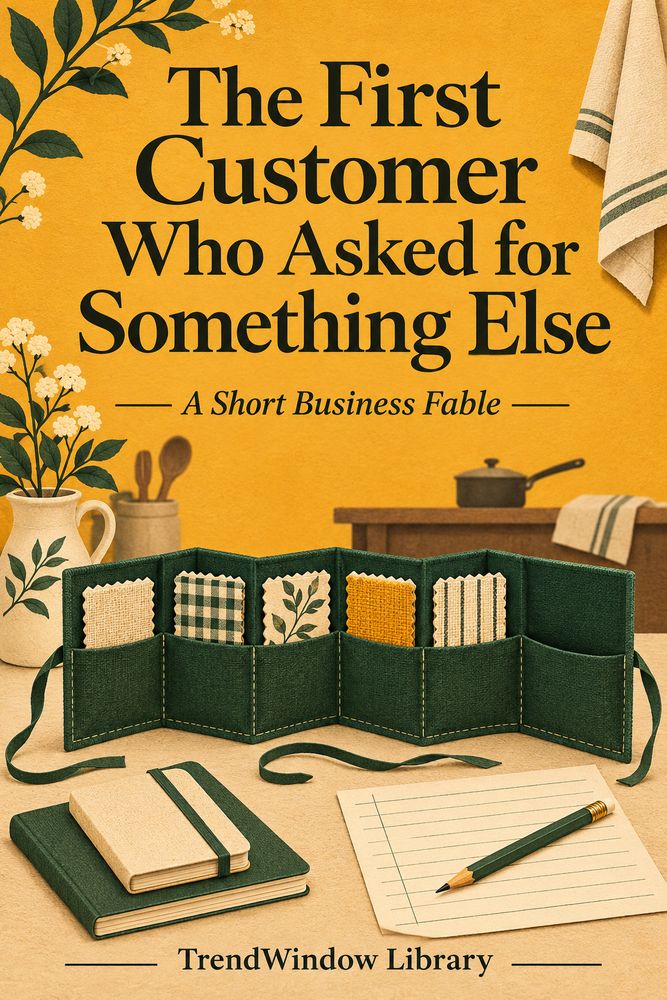
Front cover of The First Customer Who Asked for Something Else

Business, Career & Money

The First Customer Who Asked for Something Else

By TrendWindow Library

A notebook maker accepts an unexpected request for a fabric-sample holder. Across two orders, a missing card and an underestimated work sheet, she must choose what belongs in her business without treating one customer as a whole market.

Read this complete edition, including its ending and notes. No purchase is required.

About this story

A complete short business fable in eight chapters. Sera, Elin, Ivo, their town and all transactions are invented. Prices use an imaginary unit called a mark. The figures describe this particular story, not a pricing formula, market study, financial forecast or legal advice. No actual business experience or measured commercial outcome is claimed.

© 2026 TrendWindow Library. Original AI-assisted fiction and translations, reviewed by an AI assistant. No independent human-editor or native-speaker certification is claimed.

1. The space between the books

Sera arranged her pocket notebooks in three rows at the covered market: blue beside rust, plain covers beside stitched ones. She was finishing forty more for Ivo's bookshop, due on Friday; that work was at home under a clean board. The books on her stall were hers to sell. Keeping the two piles separate was a small discipline she had learned by disappointing someone once.

At eleven a woman put six fabric samples in the empty space between the rows. Each was attached to a stiff card. They spread like a badly dealt hand.

“Could you make something for these?” she asked.

Sera reached for a large notebook. The woman shook her head. Her name was Elin; she took samples to customers in neighbouring towns. They had to come out individually, and the holder had to stand on a table. She did not want a book with cloth pasted inside. She wanted six separate pockets joined like an accordion, with a tie to hold the folded object closed.

Sera could imagine it immediately. That was the dangerous part. She saw the finished thing, a neat fan in deep green, without seeing the hours between its first cut and its last knot.

“Certainly,” she almost said. Instead she asked Elin to demonstrate her present arrangement. The cards lived in an envelope reinforced with tape. One corner caught every time Elin removed the largest sample. At a customer's table she balanced the cards against a water jug. Once a jug had been taken away while she was speaking.

Sera asked to measure the largest card. Nine by twelve centimetres. Then she measured the thickest fabric, which made that card quite another proposition. Elin needed the holder in three weeks, not that afternoon.

They agreed only that Sera would send a sketch and a price by Tuesday. Elin left one spare sample with her. No sale had occurred. Yet when the market closed, Sera wrote “new product” in her notebook, and drew a box around the words large enough to contain a different life.

2. The order already on the table

Her workroom was one end of a shared kitchen. Forty books lay under the board; a saucepan occupied the spot where she wanted to cut a prototype. She moved the saucepan and then, after a moment, moved it back. Supper was also a real commitment.

On Monday she bound the remaining notebook spines before trying the sample holder. An hour later six paper pockets stood in a row. Folded flat, they were thicker than her sketch. The tie met the wrong edge. She turned the model around, and the whole row fell sideways.

Ivo arrived to collect a spare display copy, separate from the forty-book order. He watched her prop the model with a tin.

“Are you changing what you make?” he asked.

“Someone asked for this.”

“That wasn't what I asked.”

Sera disliked him for a minute. Then she showed him the forty books and confirmed Friday. He did not ask her to abandon the experiment. He asked whether the experiment would occupy the hours she had already promised him.

She drew two columns on a loose sheet: the notebook order and the sample holder. Beside the first she wrote the tasks still unfinished. Beside the second she wrote what she did not yet know: folding allowance, upright support, fastening, time. The second column was exciting partly because it was empty of deadlines she had accepted.

That evening she stopped the experiment when her allotted hour ended. It felt less like discipline than leaving a sentence unfinished. She put the paper model on a high shelf and made supper beneath it.

Before bed she crossed out “new product” and wrote “Elin's request.” The smaller phrase did not make the idea less interesting. It made the source of her interest visible. One person had described one difficulty. Whether anyone else shared it, and whether Sera wanted to solve it repeatedly, remained two separate questions.
3. Forty-eight

On Tuesday Sera sent a drawing of six pockets, a folding support behind them and a fabric tie. Elin replied with a correction: when open, the pockets must face her customer, not her. Sera had drawn the fastening across the front. Moving it changed the way the support folded.

She estimated twelve marks for board, cloth, thread and the tie. Ninety minutes of work at an internal allowance of twenty marks an hour would add thirty. She wrote forty-eight as the price, leaving six beyond those two estimates. It was not a complete account of running her business. She had not assigned kitchen space, equipment wear or other overheads to the object. The figures were a rough decision about one experiment.

She told Elin it was a first version, made for the six measured cards, with no promise to hold different samples. Delivery would be Thursday of the following week, leaving time before Elin's next journey. They would meet to try it before Elin decided whether to accept the finished object. These were the arrangements of these two fictional people, not a model contract for anyone else.

Elin agreed to the forty-eight marks. Sera felt relief so strong that it resembled evidence. She wanted to photograph the paper model and announce a range of travelling sample cases.

Instead she sent the drawing back with Elin's correction included and asked her to confirm the direction of the pockets. A short answer came: yes, that way. The correction had been obvious to the person who would use it and invisible to the person imagining a photograph.

Sera wrote the price on her work sheet. Below it she wrote three times she would record: making the first model, making the finished holder, and discussing changes. Until then, she had been calling only the second one “work.” The paper pockets on the shelf seemed to lean towards her, waiting to find out whether she meant it.

4. The hour that did not fit

The first cloth pocket swallowed the smallest card and gripped the largest. Sera unpicked it. The second held both but collapsed when she connected it to its neighbour. She needed a little more room at each fold, and more room changed the closed width. By Wednesday evening she had made a second paper model and spoiled a strip of green cloth.

She recorded the strip rather than hiding it beneath the useful remnants. She recorded the discussion with Elin too. It was easy to count an hour while cutting; harder to count ten minutes spent reading a message and thinking about its answer.

On Thursday she completed Ivo's notebooks, checked their covers and packed them. The experimental holder remained unfinished. She could have stayed up late and worked on both. Instead she left the sample holder alone. Its agreed delivery was a week away. Nothing in the excitement had moved that date closer.

Ivo collected the books on Friday. After he left, the empty board looked like permission. Sera made a separate support that tucked behind the pockets. The holder stood without a tin. She folded it closed and discovered that the knot pressed into the fabric sample nearest the edge.

She shifted the tie, tried again, and watched the object stand through supper. The achievement was pleasing enough to make her want to erase the preceding failures. Her sheet prevented that. The first experiment had taken three hours in all, including the models, messages and making, rather than the ninety minutes she had estimated. Materials used, including the spoiled strip, still came from the twelve marks she had allowed.

Forty-eight minus twelve left thirty-six before paying herself for any of those hours or covering other expenses. At her chosen internal allowance, three hours represented sixty. The first two estimates now totalled seventy-two, not forty-two. She had not paid sixty marks to another worker; this was a way of seeing her own time. Calling the remaining thirty-six “profit” would have hidden the main discovery.

5. A demonstration with a missing card

At their Thursday meeting Elin opened the holder, stood it on the table and inserted five cards. The sixth was absent.

“I left that one at a customer's,” she said.

Sera had imagined a test with all six in place. Now the empty end pocket changed the balance. Elin reached across the fan and caught the tie with her sleeve. The holder tipped, though the cards stayed inside. Neither woman spoke for a moment.

“I can hold it with my hand,” Elin offered.

Sera remembered the water jug. A holder requiring a hand was not the object they had discussed. They folded the support one position farther out and tried again. This time it stood. Elin removed the thick card, returned it and folded the holder. The cloth did not catch its corner.

Sera marked the successful support position with a small stitched line before their second meeting that afternoon. She recorded the extra time separately. The three-hour total on her sheet became three hours and twenty minutes. She did not quietly leave the old number there because it looked better.

Elin tried the marked position, accepted the holder and paid the agreed forty-eight marks. Sera did not present an unexpected bill for her own misjudgment. She also did not promise that a second holder would cost the same. She said she would have to work out a repeat price after seeing how this one behaved on a journey.

“I'll tell you what happens,” Elin said.

That evening Sera had a payment, a tested adjustment and a photograph taken with Elin's permission. She did not have a promise of repeat orders. The photograph showed five cards. She considered adding the missing sixth with a spare scrap to make it look complete, then left the empty pocket visible. It belonged to the test that had taught her most.

6. The question behind the compliment

A week later Elin reported that the holder had worked at two appointments. At the third, the table was too narrow to spread it fully. She had held the folded pockets in her hand. The stitched guide had been useful; the long loose ends of the tie had not. Could they be shorter on another version?

Sera asked whether Elin wanted another for herself. Elin said a colleague had admired it. The colleague might want one with ten pockets for larger cards.

Sera reached for a fresh sheet. Then she put it down. Ten larger pockets were not a repeat of the object she had just learned to make. She asked whether the colleague could send measurements and describe how it would be used. Admiration passed through another person was not yet an order, and the larger version had not been tested.

Meanwhile, she priced a repeat of the six-pocket holder. She allowed fourteen marks for materials and three hours at her internal twenty-mark allowance: seventy-four before the overheads she still had not allocated. She proposed eighty-two. The eight-mark difference was not a guaranteed profit. A slower job or another change could absorb it. She could offer one making slot the following month, not a queue of unspecified delivery promises.

Elin answered that her colleague had been expecting about forty-eight. Sera felt the old urge to apologise with a discount. Instead she explained that the first price belonged to an experiment she had underestimated. She could not promise the ten-pocket version at either price without examining the request.

The colleague did not send measurements. No order followed. Sera wrote “enquiry through Elin; no measurements; no order” in her book. She did not write “customer lost to high price.” Price might have mattered; so might need, timing or the effort of replying. The empty space after her note was uncertainty, not permission to invent a reason.

7. Keeping the narrow offer narrow

At the next market Sera displayed Elin's permitted photograph beside her notebooks. The caption said “Six-pocket sample holder: one completed custom example.” It did not say bestseller, popular new range or guaranteed solution. She could hear how much duller the accurate words sounded, and decided to let the picture do the interesting part.

One visitor asked for a purse. Another wanted thirty holders by the next Saturday for an event. A third studied the picture and bought a notebook. None of those encounters was a purchase of the object in the photograph.

Sera told the event organiser she could not deliver thirty in that time. He asked if a simpler version would help. She considered offering one before admitting she had no tested simpler version. Inventing a promise would be quicker than making thirty objects, but only at the stall.

When she got home, she wrote a narrow description for herself: six removable cards of the measured size, folding support, shortened tie, one available slot next month, other sizes require a fresh conversation. She left the price beside that description so it could not drift onto something larger without her noticing.

Ivo called about another notebook order. This time she checked her calendar before answering. She could take it and still leave one slot for the holder, provided she did not also accept the extra decorative stitching he suggested. She offered plain covers on the usual schedule or stitching on a later date. He chose the plain covers.

This was not a discovery that every refusal increased demand. The event order had gone elsewhere; the ten-pocket enquiry had disappeared. There was work she would not receive, and money attached to it. She could mourn that without treating every possible order as work she ought to be able to do. She cleared the table for Ivo's books and left the small square marked “holder” empty for one more week.

8. The second object

Elin wrote on the last day of that week. She wanted a second six-pocket holder at eighty-two marks for a separate set of the same-sized cards. She had asked about ten pockets for her colleague, not for herself. Sera confirmed the dimensions, shorter tie and the date already reserved. This time she did not have to move anyone else's order to make space.

The second holder took two hours and forty minutes. Sera recorded the time rather than replacing her three-hour allowance with a triumphant new standard. This object had benefited from the first one's models. A future object might not. The materials cost fourteen marks as estimated. She kept the record of the first sale beside it, including the late adjustment and the forty-eight-mark price.

At collection Elin slid in her cards and tried the support. One sample was thicker than the others but within the thickness they had checked. The shortened tie cleared her sleeve. She paid and left carrying two different sets in two similar green holders.

Sera had made two sales to the same person. She had learnt more about one person's work and her own making time. She had not learnt how many strangers would buy at eighty-two, whether orders would arrive each month or whether she wanted to stop binding notebooks. The story did not require those questions to become answered merely because the second object stood straight.

She erased the box around “new product,” which was still faintly visible through the crossed-out words on the first page. On a clean page she wrote what she would do next: finish Ivo's books, keep the six-pocket description, consider one custom request at a time. She put both versions of the time sheet in the same folder. The first was not an embarrassing draft of success; it was part of what the second had cost.

Then she washed the board, returned the saucepan to the stove and opened a notebook with no price written in it. On its first page she drew six pockets, one deliberately empty. The drawing was not an announcement. It was a reminder of the moment a customer used what Sera had made, and the object finally became more than the picture in her head.

Explore more books →