BOOK LIBRARY · Complete books · Purchases disabled
TrendWindow

← Book Library · Complete book

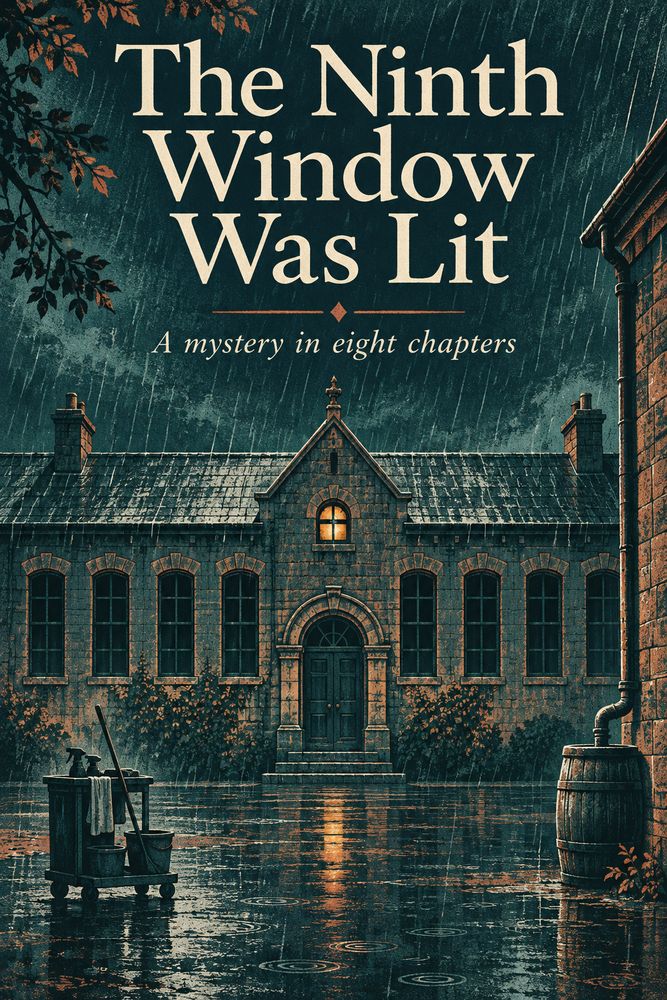
Front cover of The Ninth Window Was Lit

Mystery, Crime & Thriller

The Ninth Window Was Lit

By TrendWindow Library

A light in an overlooked window draws night cleaner Nora Vale into a mystery at an invented records building. Before a clearance crew arrives, she must distinguish what she saw from what others assume. A complete eight-chapter fictional story.

Read this complete edition, including its ending and notes. No purchase is required.

About this book

*A mystery in eight chapters*

This is an original work of fiction. Mere House, its records, people and events are invented. The story makes no claim about a real council, institution or historical collection. This complete short book resolves its central mystery; it is not presented as a full-length novel.

Original complete short mystery prepared with AI assistance. All characters, records, events and institutional arrangements are fictional; no real collection or historical letters are represented. Not a full-length novel or an institutional procedure. Translation meaning reviewed with AI, without independent native-language certification.

1. The light between four and five

At eleven seventeen on Wednesday, Nora Vale wheeled the last bin into the yard and saw a light where her instructions said there was nothing to clean.

Mere House had been a residential home before the council filled it with records. Its west wing faced the yard: eight tall windows under eight stone lintels, all dark. Between the fourth and fifth was a smaller opening set higher in the wall. Nora usually mistook its black glass for a missing patch of brick. Tonight it held a thin yellow rectangle.

She counted again, beginning at the rain barrel. Eight tall windows. One short window. The ninth was lit.

A sheet passed in front of the light. Then a hand. Neither seemed ghostly enough to justify the cold sensation under her coat.

On the cleaning board, the west wing was labelled VACANT—NO ENTRY. On Friday morning, a clearance crew would remove its remaining furniture before refurbishment. Marin Shaw, the building manager, had said there were no records there, no staff and no reason for anyone to go through the dividing doors.

Nora finished putting out the bin. She did not cross the yard to try a window or go looking for another entrance. At the service desk she wrote the time, the position of the light and what had moved across it. She wrote “hand,” then added “appeared to be.” Her daughter, who repaired watches, had once told her that a good description left room for a faulty first impression.

Ivo, the caretaker, read the note with his glasses balanced on his forehead.

“Fourth room?” he asked.

“Between four and five.”

“There isn't a room between four and five.”

“I didn't say there was.”

He lowered his glasses. The distinction interested him more than an argument would have. Together they looked from the service doorway. The narrow window was dark now.

Ivo suggested a reflection from the road. Nora pointed to the yard wall, which hid the road from that part of the building. She did not insist that this ruled out every possible reflection. She asked him to put her note in the morning handover.

As he reached for the folder, a trolley rattled somewhere beyond the records workroom. The sound stopped. A door closed with unusual care.

2. A door that was not a room

Nora returned the following afternoon to collect the scarf she had left in her locker. The west wing's dividing doors were still closed. On the cleaning board, someone had underlined NO ENTRY twice.

Ivo was sorting old maintenance drawings at the desk. He had not forgotten her note. One drawing showed the house before the conversion, when the eight tall windows belonged to eight bedrooms. The short window lit a cross-landing. A later drawing divided that landing with a partition and labelled the small enclosed space LINEN.

“So there was a place,” Nora said.

“A cupboard large enough to stand in. The bedrooms were on the main corridor. This was reached from what became the records workroom.”

He laid the two drawings beside each other. No new window had appeared in the wall. The discrepancy was between the building and the shorthand people used for it: eight rooms, therefore eight windows worth noticing.

Marin Shaw arrived carrying a paper cup and the clearance schedule. He glanced at the drawings.

“That store is empty too.”

“Then someone may be using it,” Ivo said.

“A work lamp, perhaps. A contractor.”

“Do we have a contractor here at eleven?”

Shaw put his cup down without drinking. “I'll check. Meanwhile, please don't encourage people to wander through restricted areas.”

Nora said she had seen the light from the yard. Shaw looked at her uniform, although she was wearing it only because she had another cleaning shift elsewhere later.

“I know. Thank you for reporting it.” He spoke as if thanks could also end a conversation.

Before leaving, he took the clearance schedule from the desk and folded it. Ivo kept the drawings. Nora noticed that the word LINEN remained clearly readable on the later plan.

She went to her locker. On her way back she passed Ada Renn, the records assistant, pushing a low trolley out of the workroom. A folded cloth covered its load. One corner had slipped, showing the edge of a grey cardboard box tied with faded blue tape.

Ada stopped when she saw Nora looking.

“Don't leave that in the corridor,” Nora said. “The wheel catches on the loose strip.”

Ada nodded too quickly and pulled the cloth down.
3. What the trolley carried

The trolley was not unusual. Ada used it for everything from stationery to bound registers. The cloth was unusual: normally she liked labels visible. Nora knew this because she cleaned around Ada's desk, where pencils stood in separate jars marked SHARP and NOT YET.

That evening, Nora found a piece of faded blue tape beneath the workroom table. She left it on the table rather than treating it like evidence from a television programme. The room was full of boxes. A strip of tape could belong to any of them.

Ada came in while Nora was folding the cleaning cloths.

“Did you tell Mr Shaw you saw me?”

“I told Ivo about a window.”

“Not about the trolley?”

“No. What was on it?”

Ada looked through the open door. “Something that shouldn't be thrown away.”

“That could describe half this place.”

For a moment Ada smiled. Then she asked Nora to forget the conversation.

Nora said she could avoid gossip, but she would not withdraw an accurate report. The clearance crew was due in the morning. If somebody needed an object kept, someone responsible had to know which object and where it was.

Ada pressed her thumb against the rim of a pencil jar. “I told someone responsible.”

She would not say more. Nora did not search the trolley, open a box or follow her into the restricted space. Instead she cleaned the patch of floor she had come to clean. When she left, Ada was still standing beside the pencils.

In the yard, the short window lit again. This time Nora could distinguish a lamp's hard edge behind the glass. A person bent over it. The yellow light made a stack of papers look almost white.

Nora wrote a second note: same window, light visible again, person-shaped movement, no identification. Then she added Ada's exact words about something being thrown away, marking them as a separate conversation rather than proof of what was behind the window.

It felt pedantic. It also felt kinder than deciding Ada was a thief, a rescuer or a liar before anyone had opened the right door.

4. The empty-room certificate

Ivo had been given a copy of the clearance paperwork. He read it at the service desk with Nora standing on the public side of the counter. The instruction was not merely to remove chairs. It described the west wing and its associated stores as free of retained records, with loose material cleared for disposal.

At the bottom was Shaw's signature. The date was that afternoon.

“Associated stores,” Nora repeated.

Ivo turned back to the drawing. The linen store was connected to the workroom, but it sat inside the west-wing outline on the clearance plan. Its ambiguous identity had become dangerous in a very ordinary way: one person could call it part of the office, another part of the vacant wing, and a crew could be sent to empty it.

Ivo telephoned Shaw. Nora heard only Ivo's side: the window, the reports, the wording on the form. Then a pause.

“No, we haven't entered. Yes, I understand you're not asking us to.”

He put down the receiver.

“He says the form is correct. If Ada has left supplies in there, she'll move them before the crew arrives.”

“Supplies?” Nora said.

“That was his word.”

Nora asked who could change the instruction. Ivo named Ellen Wren, the council's head of records. She had authorised the refurbishment but had not signed this clearance sheet. Ivo could send her an internal incident report through the normal office channel. He had been hoping Shaw would settle the matter without one.

“What do we know enough to put in it?” he asked.

“The light. The form. The old plan. And that we don't know what's in the store.”

They attached Nora's two notes and a copy of the relevant drawing. Ivo did not accuse Shaw of stealing records or Ada of hiding them. He requested a check before the disposal instruction was acted on.

Nora went back to her work. Ten minutes later, Ivo found her beside the stairwell. Wren had replied: hold the clearance crew at reception; no disposal until she had inspected the store with the responsible staff.

Nothing had been solved. Something irreversible had at least been postponed.

5. A witness without a theory

Wren arrived at seven forty the next morning, wearing a coat buttoned incorrectly at the throat. She corrected it while Ivo explained the drawings. Nora had stayed after her shift, with the extra time entered on her sheet. She did not intend to become an unpaid feature of the building's emergency arrangements.

Shaw arrived next. Ada was already in the workroom. The trolley stood beside her desk, uncovered and empty.

Wren asked Nora what she had seen. Nora described the first light, the hand-shaped movement and the second night's lamp. Asked whether she had recognised Ada, she said no.

“But you saw her with boxes,” Shaw said.

“A covered trolley. I saw the corner of one box.”

“Grey boxes are used for waste sorting.”

“They're also used for records,” Ada said.

Wren held up one hand. “We can find out what these contain. We needn't make the colour do all the work.”

She asked Ada whether she had been in the store after hours. Ada said yes. The answer left no room for a reflection, a ghost or a contractor with an unexplained night shift. Nora felt relief, followed by a sharper curiosity.

“Why?” Wren asked.

Ada brought a folder from her desk. Inside was a transfer list for twelve cartons from the former residents' correspondence collection. The list was three weeks old. Shaw had signed receipt at Mere House. Beneath his signature, in Ada's smaller writing, was a note: temporary location required; allocation pending.

“I asked where they should go,” Ada said. “Twice. Then the workroom had to be cleared for the survey. I put them in the linen store.”

“Did you update the location register?”

“No.”

“Did you tell anyone after moving them?”

“I left Mr Shaw a note. I should have entered it properly too.”

Shaw said he had thought the cartons were duplicates awaiting disposal. Wren asked him to show the authority for that decision. He opened his clearance folder, stopped at a blank divider and closed it again.

6. Behind the unpainted panel

Ivo opened the linen store by its ordinary door from the workroom, with Wren present and the inspection authorised. It was not a hidden entrance, only a panel that looked unfinished beside the painted office wall. Someone had stored a folded display board in front of it. Ivo moved the board aside.

The short window was above shoulder height. Beneath it stood twelve grey cartons, a low table and a battery work lamp. A chair from the old bedrooms had been turned to face the table. There was no electrical mystery. Ada had brought the lamp because the store's ceiling light did not work.

Wren counted the cartons against the transfer list. She did not begin reading private letters for the assembled audience. Instead, she and Ada checked external identifiers and the collection description, setting aside any detailed examination for the proper inventory.

On the table lay a few empty protective folders, a pencil and a handwritten list of names. Ada explained that she had been matching the carton labels to the old transfer descriptions. She had not finished. Some labels were loose; she did not want the last link between a box and its entry to disappear in the move.

“Why at night?” Nora asked.

“During the day I was told to clear the workroom. After that, I could do this without someone asking when I'd be out of the way.”

She sounded less heroic than exhausted.

Wren said the records would be held securely and inventoried. Ada's concern had been real, but the unrecorded move had made the boxes harder for anyone else to protect. That failure would also go into the account.

Shaw stood near the door. He said the refurbishment timetable had left little room for complications. The surveyor wanted an empty area. The contractor wanted a firm date. He had expected the records team to sort out twelve old cartons without delaying everybody else.

“You signed for them,” Wren said. “Then you signed that this area held no retained records.”

“I expected them to be gone.”

“Gone where?”

He looked at the lamp. It was switched off now. In daylight, its small plastic body seemed an inadequate thing to have interrupted so many confident arrangements.

7. The account that changed

The clearance crew spent the morning on authorised work in another part of the building. Wren withdrew the west-wing disposal instruction and arranged a new inventory before any replacement instruction could be issued. These were actions Nora could see. She could not know what every later meeting would decide.

Shaw asked to speak to Wren privately. When they returned, he made a short statement for the incident record. He had received Ada's note about the move. He had believed the cartons could be dealt with later and signed the clearance form to keep the schedule moving. He had no written disposal authority for them.

It was not the elaborate theft Nora might have imagined during a sleepless journey home. It was a decision to let a document say what a timetable required, and to hope that other people would quietly make it true.

Wren did not call that an innocent misunderstanding. Nor did she announce a criminal verdict in the corridor. She referred the conflicting records and Shaw's statement for the council's review and assigned another officer to approve any new clearance instruction.

Ada recorded the cartons' actual location and helped prepare the inventory. She also wrote down the move she had failed to record at the time. Her late-night work was neither erased nor allowed to excuse that omission. Nora appreciated this more than a simple declaration that one person had been good and another bad.

Before leaving, Wren asked Nora to check the wording of her observations in the incident summary. The draft said she had seen Ada working in the store on the first night.

“I didn't,” Nora said.

“We now know she was there.”

“That doesn't change what I saw.”

Wren crossed out the sentence and wrote a narrower one. Nora read it, nodded and signed only the part that represented her own account.

Outside, the rain had stopped. Nora went home carrying the scarf she had forgotten two days earlier. She slept through a delivery van, a neighbour's radio and the noon bells. The house had finally stopped asking her to count it.

8. Nine places on the plan

A week later, Nora found a revised plan beside the cleaning board. The west wing still contained eight former bedrooms. The linen store was separately marked, with a named person responsible for access and a clear note that its contents were awaiting inventory. VACANT no longer covered the whole area like a convenient coat.

The twelve cartons had been moved to an assigned secure records space. Ada showed Nora the completed location entry, not the private letters. One box still needed its description checked. She left that line marked unresolved instead of filling it with a guess.

“Will anyone ever read them?” Nora asked.

“When the collection has been assessed, under the right access arrangements. I don't know which parts will be available.”

It was a smaller answer than “We saved history.” Nora trusted it more.

Ivo had repaired the ceiling light. The battery lamp stood on Ada's desk awaiting its return to her cupboard at home. Shaw was no longer directing the clearance while the review continued. No one told Nora that the matter had ended in a punishment, and she did not invent one. The immediate danger to the cartons had ended; the account of how it happened had been preserved.

That night she crossed the yard after the last bin. Eight tall windows were dark. The short ninth window was dark too. Darkness no longer meant that the space behind it did not exist.

Ivo came to the service door with the keys.

“Nothing tonight?” he asked.

“Nothing I've seen.”

He smiled and waited while she washed her hands. When she returned, he had left the handover book open rather than putting it away. Her name appeared beside the original report, spelled correctly. It was a modest kind of recognition, but it belonged to the work she had actually done.

Nora signed out. On the board, the small store had its own line, its own responsibility and enough space for someone to write what remained unknown. The mystery had begun with a light nobody's description allowed. It ended with a place on the plan.

### Author's note

All incidents, documents, dialogue and institutional arrangements in this story are fictional. Nora's observations, the authorised inspection and the preservation of the cartons resolve this invented case; they are not evidence about any real archive or a substitute for an institution's records, privacy or safety procedures. No historical letters are reproduced, and no real collection is represented.

Explore more books →