BOOK LIBRARY · Complete books · Purchases disabled
TrendWindow

← Book Library · Complete book

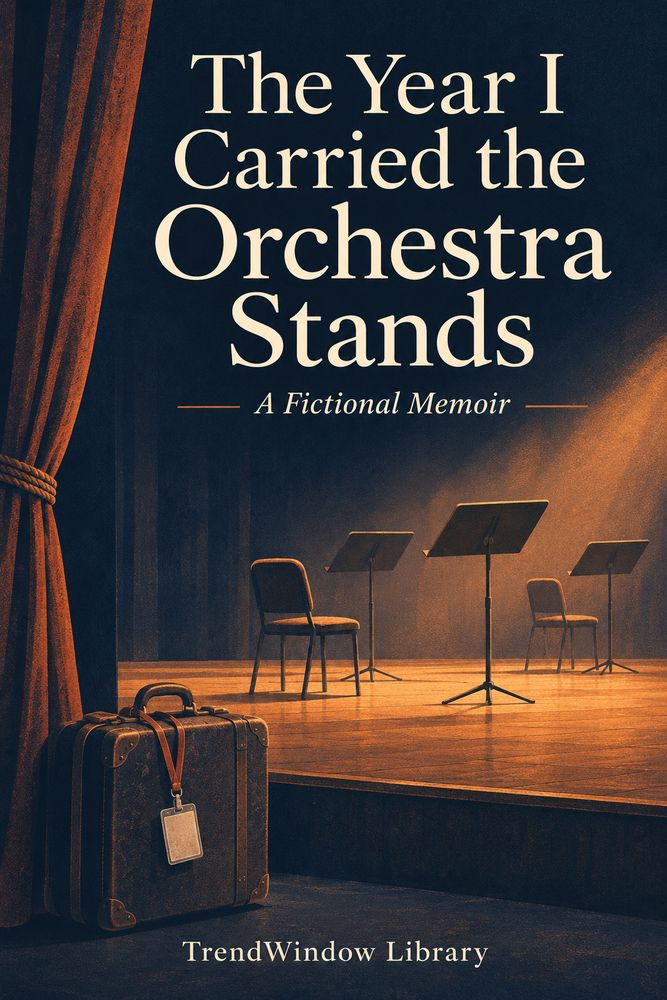
Front cover of The Year I Carried the Orchestra Stands

Biography & Memoir

The Year I Carried the Orchestra Stands

By TrendWindow Library

A complete fictional memoir in eight chapters. Nico spends a year carrying an orchestra’s music stands and mistaking proximity for belonging. A sister’s move, a stage manager’s chosen work and a bookbinder’s ordinary table help him decide what kind of life he actually wants.

Read this complete edition, including its ending and notes. No purchase is required.

About this story

A fictional memoir in eight chapters. Nico, the narrator, the orchestra and everyone he describes are invented. This is a work of fiction written in the first person, not the author's testimony or a documented account of an ensemble. Its working arrangements belong to the story and are not employment or equipment-handling advice.

© 2026 TrendWindow Library. Original AI-assisted fiction and translations, reviewed by an AI assistant. No independent human-editor or native-speaker certification is claimed.

1. The pass with my name

The photograph on my first orchestra pass made me look as though I had already travelled a great distance. I had actually come six stops on the bus. Rain had flattened one side of my hair, and the woman at reception had asked me to stop correcting it because there were other people waiting.

NICO, it said. STAGE ASSISTANT. The second line was smaller. In photographs that I sent home, it was usually too small to read.

I was twenty-six. At nineteen I had stopped preparing for a clarinet examination and told everyone I was taking a break. During the seven years of that break I had worked in a stationery shop, answered phones and become skilled at discussing music without anyone asking me to play. When the assistant's job appeared, I said that I was finally getting back to it.

Jo, the stage manager, did not ask what I meant by that. She showed me the work schedule. The contract ran from January to December. Eleven weeks were spread across several tours; the other scheduled days would be at our home hall. There were early starts, late finishes and ordinary afternoons checking what had returned. I nodded most enthusiastically at the tours.

On the first morning she asked me to count the music stands in a store cupboard. I counted thirty-one. She counted thirty-two. One stood behind the door, where my new coat had hidden it.

"You can admire the building later," she said.

I liked her immediately, which was convenient because she had not offered me another choice. She knew which floorboards protested and which people needed a minute before answering a question. This knowledge did not make her mystical. She wrote things down and occasionally forgot where she had put the pen.

That afternoon, from the wing of the stage, I heard the orchestra stop together. The silence seemed made rather than accidental. I had never been so close to that sound ending. My chest tightened with the old desire to be necessary to it.

Then someone asked for a stand to be moved. I did the task Jo assigned me and returned to my place. Nobody mistook me for a player. I would spend much of the year being offended by a mistake nobody had made.
2. Eleven weeks in a suitcase

The first tour was in February. I packed a shirt for an invitation that never arrived and forgot a second pair of work socks. The shirt travelled through four towns without leaving its hanger. My socks acquired a history I did not put in photographs.

Before that trip I thought travel meant entering places. Our schedule taught me how many ways there were to pass through them. I knew the backs of halls, a bakery near one loading entrance, the shape of a hotel radiator. I could identify a town by the carpet outside its breakfast room and could not have found its river.

Mina, my sister, asked whether I had seen anything beautiful. I sent her a picture of the auditorium. She asked whether I had gone outside. I answered the next morning, when the bus was already leaving.

I do not mean that the work was a disappointment disguised as an adventure. Some evenings were wonderful. At a small hall in a place I called Bellwater in my notebook, the audience kept clapping after the players had gone. We stood with our coats over our arms and listened to applause intended for people who were already looking for dinner. Jo laughed at a joke on her phone. Ada, a violist, borrowed my pen to write a number on a paper napkin. I kept the pen as though it had been invited somewhere.

There were also long waits in rooms with no view. I filled them by telling new acquaintances that I was "with the orchestra." This was true. It was a true sentence with a small untrue room inside it, where I hoped they would put me.

Ada once asked what I played. I said clarinet. She asked when I practised. I made a joke about being too busy carrying everyone else's career.

She did not laugh. "That sounds tiring," she said, and went back to marking her part.

Later I decided she had been cruel. Later still, I could not find a cruel word in what she had said. She had asked an ordinary question. I had given her an accusation instead of an answer.

3. What the photograph left out

In April a photograph appeared in the little newsletter sent to supporters. The orchestra was taking its bow. At the far edge, behind a curtain, half my face showed. I enlarged the image until the players blurred and sent it to Mina.

"Found you," she wrote.

I had wanted something more than that. Congratulations, perhaps, though I could not have said what she should congratulate me for. I was doing paid work reasonably well. I was not onstage at the moment the photograph recorded. Both things could be true without cancelling each other.

At home, Mina was moving out of the flat we had shared. She had warned me in January, reminded me in March and sent a date in April. I kept calling it her possible move. On the appointed Saturday I was away, and she moved without waiting for the word possible to disappear from my vocabulary.

She sent a photograph of our old kitchen. The table was gone. The clean rectangle on the floor looked almost rude. I asked why she had taken it; she reminded me that it was hers.

I had wanted home to remain assembled while I was away becoming interesting. I did not explain this to her. I complained that she could have given me more notice. We did not speak for four days.

During those days I polished my account of the argument for imaginary listeners. Then Jo asked why I had entered the wrong return date on a sheet. There was no graceful way to make my sister responsible for that. I corrected the date and called Mina after work.

"You did tell me," I said.

She waited. I discovered that an apology can sound unfinished when it does not contain an excuse.

"I didn't want to hear it."

We discussed where I would live when the lease ended. It was a practical, slightly embarrassing conversation, and it helped more than my photograph. I rented a small room within reach of the hall. Mina invited me to dinner at her new place when our schedules matched. She did not promise to leave the table exactly as it had been.

4. A day nobody applauded

In June a leaking roof made one hall unusable before the audience arrived. I remember the afternoon's grey light better than the cancelled programme. No disaster followed. People made decisions, visitors were told, and the equipment that had already been brought in had to leave again.

I was angry at the wasted work. Jo said it was still work. I thought she was defending the management. She was mostly asking me to stop blocking a doorway while I complained.

Back at our home hall, we had a day of checking and putting away. There were no musicians to watch, no audience, no borrowed glow. Jo found a damaged stand, marked it out of use and arranged for someone qualified to deal with it. I wanted to improvise a quick fix. She refused. I knew very little about the thing I had carried so often.

We ate lunch on opposite sides of a table. I asked whether she ever wished she were doing something else. I meant performing. She understood exactly what I meant and chose not to rescue me from the question.

"Sometimes I wish I ran a swimming pool," she said. "Usually when you're asking me that."

Then she told me which parts of her job she liked. She liked a room becoming ready. She liked solving a problem before someone else had to think about it. She disliked uncertain hours and people who believed caring about music replaced paying attention to a schedule. None of this was a consolation prize to her.

I had assumed that anybody near the stage must be trying to get closer to its centre. Jo's answer made my imaginary map of the building look very small.

In the afternoon we finished the count. This time I included the stand behind the door. Jo checked my figure and went home. No one clapped. I felt a modest satisfaction that did not require me to imagine an audience. It lasted until the bus came, which was longer than I expected.

5. The table by the window

In August, during a stretch at home, I took a split folder from my own bag to a bookbinder's shop. It held old letters and the clarinet exercises I had carried through three addresses. I had expected to leave it at a counter. Oren, who ran the shop, asked what I wanted to keep and what I only wanted to store.

I thought he meant the papers. He did mean the papers. I am putting no secret wisdom in his mouth; he was trying to understand the job before quoting for it.

While he looked, I watched his colleague work at a table by a window. There was a quiet concentration in the room, interrupted by the telephone, a delivery and someone looking for a ruler. The quiet was not a performance. It allowed interruptions without being destroyed by them.

Oren said they might need a paid assistant later in the year. I asked whether he meant someone already trained. He said they needed someone willing to learn and willing to do ordinary preparation and stock work. I had heard the word learn more clearly than ordinary before. This time I asked what a normal day included.

He described repetitive work, customer messages, checking materials and time spent waiting for a job to be ready for its next stage. There was no suggestion that books made any of this sacred. The pay would be lower than my orchestra job, but the proposed hours were more predictable. Nothing was available yet. He asked me to send a short application if I remained interested.

I walked home annoyed. A door had opened a little, and it had not led to a version of myself I could easily explain at a party.

That evening I opened the folder. Inside was an exercise with a date from seven years earlier. I remembered the room where I had played it, and the relief of not having to return for the examination. I had edited that relief out of every story I told about stopping.

I sent the application the next day. Then I took my clarinet case from under the bed. I did not play a triumphant passage. I checked what was there, made arrangements to have the instrument looked at, and admitted how long it had been.

6. The offer for another year

In September Jo told me that a place would be available the following year. She wanted me to consider it, not answer while standing in a corridor. I thanked her with the expression I used when I expected good news to decide something for me.

It did not. I had become better at the work. I knew people. Another year offered money I could estimate and a role I could describe. The bookbinder had offered only a short paid trial day in October, after which he would decide whether there was a place for me. I could not arrange these facts into a heroic choice between courage and fear. Both possibilities contained practical risks and ordinary advantages.

On the trial day I put materials in the wrong place and had to move them again. I answered a customer too confidently and asked Oren to correct what I had said. The window did not make the afternoon beautiful. I went home tired in a way that allowed me to eat dinner at my own table.

A week later Oren offered a three-month paid trial beginning in January. He wrote down the hours and pay. There was no promise of a permanent role. I made a budget, found the gap I had hoped not to find, and reduced some expenses. It was possible, though less comfortable. Mina asked what would happen if it ended after three months. We talked about looking for other work. She did not call this a lack of faith.

I told Ada I was thinking of leaving. She asked what appealed to me about the new work. I started explaining why I had failed at music. She stopped me.

"That wasn't the question."

This time I answered it. I wanted to learn a craft without using it as proof that I belonged to someone else's achievement. I wanted more evenings I could arrange myself. I liked the work I had seen, including enough of its dullness to distrust my first impression.

In November I declined the next year at the orchestra. Jo was disappointed about finding a replacement. She was also kind. Neither reaction required her to declare that I had found my true destiny.

7. The last load

Our final trip ended in December. On the way back I noticed that the good shirt was still in my suitcase. It no longer meant an invitation. It meant I had packed an unnecessary shirt again.

The replacement assistant joined us for my last days at the home hall. His name was Ben. He had worked in another venue and asked useful questions without telling me which instrument he played. I almost asked. Then I let him decide whether it mattered.

I showed him where the stands were kept and mentioned the one that could disappear behind the door. He found it without difficulty. This was mildly insulting to the story of my personal development, but useful for the count.

After the final concert, we put away what had to be put away. I listened to the last few audience members talking in the corridor. They discussed the music, their coats, where they had parked. A performance could be important without transforming everybody who heard it. I had spent the year demanding more transformation from it than it had offered.

Ada returned a pencil she had borrowed from me. It was not the pen from February. That pen had disappeared months earlier. We laughed about this for a reason that does not survive being explained.

Jo checked my final hours with me and told me when to expect the remaining pay. I returned the pass. The plastic was scratched over my face, but the small words STAGE ASSISTANT were perfectly clear.

"You were good at it," she said.

I did not tell her that I was moving on to something better. I said that I knew, though I was still learning how to accept that sentence without adding a future to it.

Outside, I phoned Mina. She asked whether I wanted to come for dinner on Sunday. I checked my calendar instead of saying I would let her know after the schedule arrived. Yes, I said. I could come. She asked me to bring bread, and the year ended without a speech.

8. A seat in the hall

The following January I bought a ticket for an orchestra concert. I used the public entrance. The person checking tickets did not know me, which briefly wounded me before I remembered that we had never met.

From my seat I could see only a little of the wing. Ben crossed it once. I knew roughly what he was doing, but I did not leave my seat to check. The stands were there. They had not acquired any memory of me.

At the bookbinder's I was three weeks into the trial. I had learnt some tasks and was slow at others. Oren had corrected my estimate of how long one job would take. My budget remained narrow. I was not writing these facts to disguise a great success as modesty; they were the facts available. I liked going back the next morning.

I had also begun playing my clarinet again, badly enough that my neighbour's politeness deserved recognition. There was no examination date. Some evenings I practised for a short while. On others I did not. The instrument had stopped being evidence in a case I was bringing against my younger self.

The orchestra began. From the audience, I heard things I had missed while waiting for instructions at the side. I missed other things I used to hear from there. No place in the building contained the whole music.

At the interval I saw Jo in the corridor. She was busy. We exchanged a few words and she went back to work. I did not interpret this as rejection. Her evening had a shape that did not depend on my visit.

When the concert ended, I clapped with everyone else. Then I collected my coat and walked out before the stage was cleared. For a moment I felt the old tug to remain near the work, to be seen beside it, to turn a borrowed closeness into a life.

I could love what I was leaving in the hall. I could go home anyway.

On the bus I remembered that Mina had asked me to return a dish. I put a reminder in my phone. The next morning there was work to learn, and that evening, if I chose, there would be music. Neither had to stand in for the other.

Explore more books →