Evening brings a final task: leave the shared place usable for tomorrow. Mira and Samir do not attempt to preserve one perfect arrangement. They preserve the ability to make an appropriate arrangement again.
Their closing note contains four lines. “Comparison work: paper position improved.” “Laptop: separate keyboard used; reflection needs another look.” “Transitions: one missed because calls overlapped.” “Shared chair: return items, then each person checks their own setup.” These fictional entries describe actions and unfinished questions, not measured health benefits.
The next morning, Mira can begin with a known task instead of a vague instruction to sit better. She knows which change to retain, which to revisit, and which cannot be settled alone. The notebook has not made the room ideal. It has made the next decision clearer.
A reader can borrow that small structure without borrowing the characters' settings. First name the task. Then examine support and reach together. Make a safe, understandable change and notice what else it affects. Plan a feasible opportunity to vary the activity. Record an unresolved issue and the next person or step needed to address it.
Keep the result proportionate. A clearer desk is not a medical outcome. A comfortable moment does not prove that a whole day will work. One arrangement that helps today may need revision when the task, person, equipment, or room changes. None of this makes the effort pointless. It tells us what the effort is for.
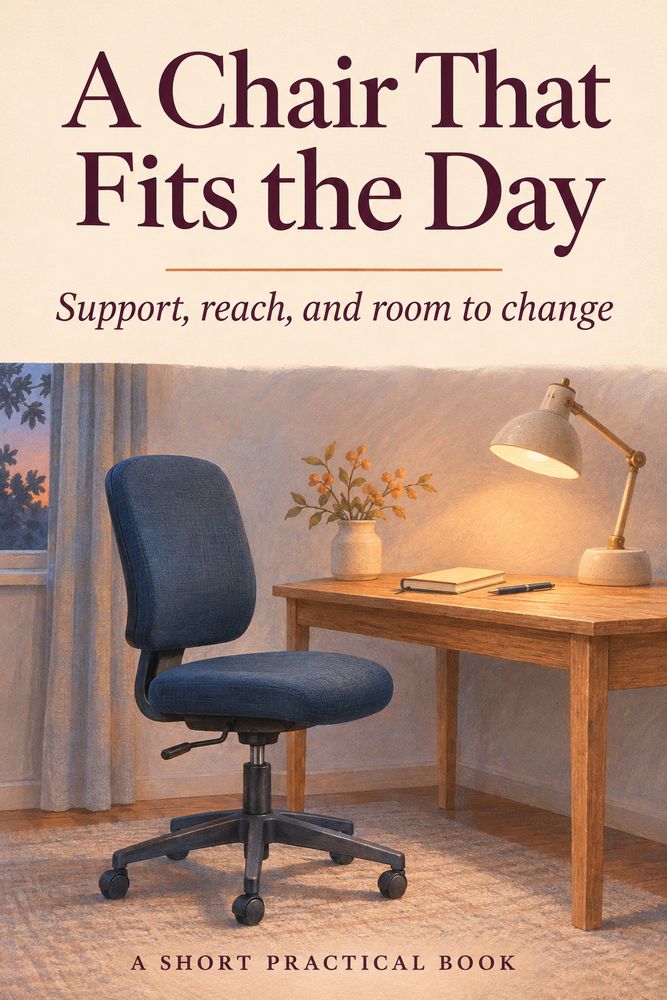
The chair in the title is therefore not a product waiting to be discovered. It stands for a relationship that can be adjusted with care. Sometimes furniture must change. Sometimes the task must move. Sometimes the schedule or available support is the limiting part. The person is not required to become smaller than the problem.
Mira switches off the lamp. The chair remains by the table, ready for another person and another task. The day's achievement is not that she learned never to move. It is that support, reach, and room to change have become ordinary questions she is allowed to ask.
### Sources and scope
Sources checked 9 November 2026. The examples and household notes are original fiction used for explanation. No clinical trial, professional workstation assessment, product testing, or diagnosis was performed. The institutional sources provide general guidance within their own contexts. Existing individual advice and applicable local procedures take priority.
[S1] OSHA, [Computer Workstations](https://www.osha.gov/etools/computer-workstations), individual fit.
[S2] OSHA, [Good Working Positions](https://www.osha.gov/etools/computer-workstations/positions), support and variation.
[S3] OSHA, [Chairs](https://www.osha.gov/etools/computer-workstations/components/chairs), seat, back, and armrest relationships.
[S4] OSHA, [Monitors](https://www.osha.gov/etools/computer-workstations/components/monitors), viewing and placement.
[S5] HSE, [Working with display screen equipment, INDG36(rev4)](https://www.hse.gov.uk/pubns/indg36.pdf), 2013 leaflet, portable-computer guidance.
[S6] HSE, [Work routine and breaks](https://www.hse.gov.uk/msd/dse/work-routine.htm), activity changes.
[S7] OSHA, [Document Holders](https://www.osha.gov/etools/computer-workstations/components/document-holders).
[S8] OSHA, [Telephones](https://www.osha.gov/etools/computer-workstations/components/telephones).
[S9] CCOHS, [Working in a Sitting Position: Basic Requirements](https://www.ccohs.ca/oshanswers/ergonomics/sitting/sitting_basic.html), fact sheet revised 31 July 2024.
[S10] NHS, [Repetitive strain injury](https://www.nhs.uk/conditions/repetitive-strain-injury-rsi/), reviewed 28 May 2026; seeking help for persistent or worsening symptoms.