BOOK LIBRARY · Complete books · Purchases disabled
TrendWindow

← Book Library · Complete book

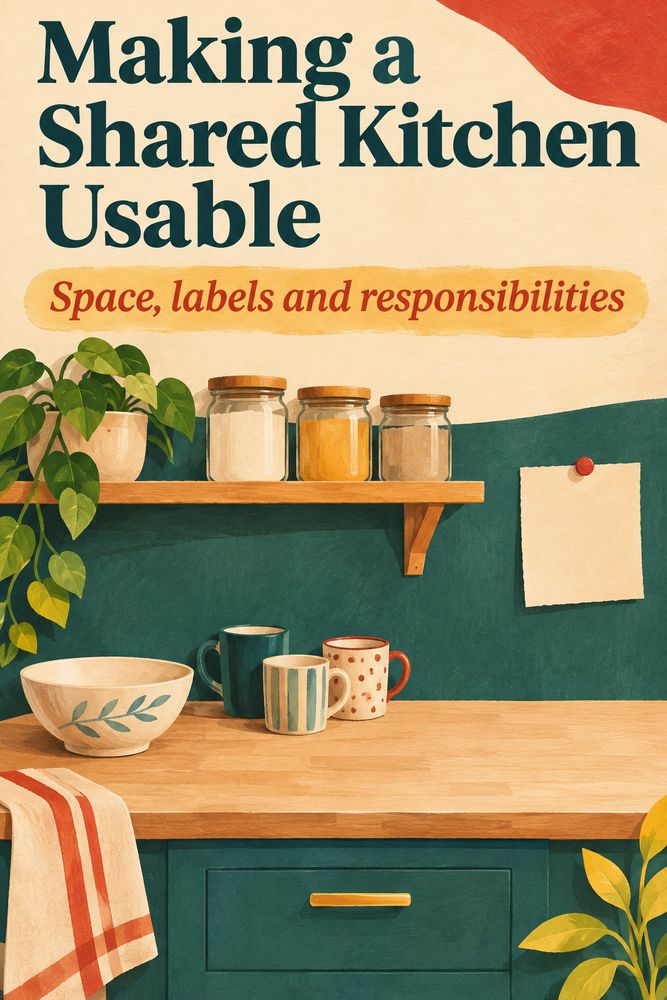
Front cover of Making a Shared Kitchen Usable

Health, Wellness & Lifestyle

Making a Shared Kitchen Usable

By TrendWindow Library

An eight-chapter guide to a usable shared kitchen through an invented week with Nila, Owen and Sam. Covers accessible storage, ownership, meaningful date labels, cleaning responsibilities and agreed changes, with UK food-safety background. No measured savings or health outcomes are claimed.

Read this complete edition, including its ending and notes. No purchase is required.

About this book

A short household guide to space, labels and responsibilities

This book concerns an ordinary shared home, not a commercial kitchen. Nila, Owen and Sam are invented adults, and their week is a teaching example, not a measured trial. The household arrangements are suggestions to adapt together. Food-safety background comes from the primary UK sources listed at the end; follow the instructions for your food and appliances and the relevant local guidance. This is not a complete cooking or allergy-management manual, and no savings or health outcomes are promised.

Original complete short household guide prepared with AI assistance. Nila, Owen, Sam and their week are invented teaching examples, not a measured trial. Four primary UK sources rechecked on 22 November 2026; original consultation date retained. Follow relevant local, product and appliance instructions. Not a complete cooking, sanitation or individual allergy-management manual. Original conceptual covers. Translation meaning reviewed with AI, without independent native-language certification.

1. Start with the next meal

The kitchen looks tidy in a photograph. Three matching jars stand beside the cooker. A wooden board leans against the wall. Yet Nila cannot find a clear place to put down her breakfast bowl because the only usable section of worktop holds yesterday's washing-up. Owen says the kitchen was clean when he left it. Sam asks whether anybody knows whose saucepan is in the sink.

Their problem is not a shortage of attractive containers. They have not agreed what another person should be able to do on entering the room. Before buying anything, they choose a small test: can each person prepare their usual next meal, find what they need and leave the working area ready for someone else?

They talk through this while the cooker is off. Nila needs a quick breakfast before an early bus. Owen returns later in the evening. Sam often cooks a longer meal at weekends. None of these patterns makes someone the rightful owner of the worktop. They do explain why a plan based on one person's timetable will miss the others.

Each names one obstacle without diagnosing another person's character. Nila names the occupied worktop. Owen names the disappearing clean spoon. Sam names food moved to an unfamiliar shelf. The descriptions lead to decisions; “you are always careless” would lead somewhere else.

Their first aim is deliberately limited: make the next meal possible without a search, an argument or an improvised rearrangement. That does not settle all household disagreements. It gives this particular conversation something concrete to improve.

2. A shelf should work for its user

They begin with the dry cupboard, leaving food that needs refrigeration where it belongs. Nobody tips the entire kitchen onto the floor. They examine one section at a time, with the owner present for uncertain belongings. An unfamiliar packet is not automatically unwanted, and an expensive pan is not communal because it occupies communal space.

Nila's everyday bowl is on a high shelf, behind a heavy serving dish. She can reach it only by moving something she finds awkward to lift. Sam rarely uses the serving dish. By agreement, they move the everyday bowls to an accessible lower shelf and the serving dish to a place Sam can comfortably use. They make no claim that the new height suits every person or every kitchen; they check whether this arrangement works for the people who live here.

They distinguish three kinds of storage: personal items, shared items and an agreed small space for temporary arrivals. A visiting friend's container can go in the last space without annexing a whole shelf. It still needs an owner and a plan to leave. “Temporary” is not a permanent name for unidentified possessions.

The shared spoons stay in one drawer. Owen prefers another drawer, but agrees that a known location matters more than his preference in this case. In return, Sam agrees not to reorganise the drawer alone during a weekend cleaning session.

Their cupboard is not symmetrical. Equal-looking shelves would be a poor result if one person still could not use their belongings. They have arranged access, not a display. They also leave enough room to remove a bowl without dismantling the stack around it.

3. Ownership does not decide food-safety order

The fridge tempts them into a simple division: one person per shelf. That looks fair on paper, but it cannot override food-safety needs. The Food Standards Agency advises keeping raw meat, fish and shellfish below ready-to-eat food, with appropriate containment to prevent leaks. A name label does not prevent contamination.

Their revised plan uses names within suitable storage areas rather than giving someone permission to put any food anywhere. They identify a place for contained raw foods and separate space above for ready-to-eat items. When a larger purchase will not fit safely, the answer is to reconsider the purchase or available storage, not to balance an open packet wherever there is a gap.

FSA guidance gives a fridge range of 0–5°C. Checking temperature and following the appliance instructions are separate from arranging shelves; a handsome layout cannot establish that food has been kept cold enough. They do not treat an owner's handwritten date as proof of proper storage either.

Sam suggests a shared “use first” area. They keep the idea only for foods that can appropriately be stored together and are still suitable to use. The phrase cannot extend a use-by date or cancel instructions after opening. Nor does it turn personal food into a gift. Ownership and storage remain separate questions.

The three agree that nobody must defend an unsafe arrangement simply because a shelf was allocated to them. They also agree that rearranging another person's food requires communication. A workable plan protects the food while making it possible to find who is responsible for it.

4. A label must answer a real question

Owen writes “Tuesday” on a container. Nila asks which Tuesday, and whether it means cooked, opened or intended for lunch. He sees that his reminder to himself does not necessarily inform anyone else. They decide that a useful household note should name the contents, the owner and the event attached to a clear date, adding a time when relevant.

This does not replace the original packaging. They keep the product's instructions and ingredient information available when moving food to a suitable container. A handwritten “opened” date records an event; it does not invent a new shelf life. If essential information is missing, they do not fill the gap with a confident guess.

In the UK guidance, use-by dates concern safety and best-before dates concern quality. Proper storage and after-opening instructions still matter. Food beyond its use-by date cannot be judged safe by a pleasant smell. Their household shorthand preserves these differences instead of calling every printed date “expiry”.

For practice, Owen labels an empty demonstration box “Owen — opened 10 November 2026”. Nila points out that it still lacks the contents. He adds “example only — no food inside” rather than pretending the empty box contains a real meal. For actual food, the label must describe what is actually there and retain the relevant product information.

They do not invent one universal number of days for all leftovers. Different foods and circumstances need the relevant guidance. The purpose of their system is to keep necessary information visible so that the right rule can be followed, not to replace that rule with a household slogan.

5. Cleaning has more than one timescale

“Sam cleans on Sunday” is not an answer to a spill on Wednesday. They separate immediate cleaning after use from agreed periodic work. A rota can allocate a cupboard wipe or a bin check; it cannot make yesterday's dirty preparation surface ready for today's meal.

FSA guidance stresses clean hands, equipment and preparation surfaces, and following cleaning-product instructions. The housemates keep the required materials available and distinguish a surface that merely looks clear from one properly cleaned for its next use. They do not improvise chemical recipes or assume every product serves every purpose.

They write a short handover description in ordinary language: personal dishes dealt with, preparation area appropriately cleaned, shared utensils returned clean, waste put in the right place, and any unresolved problem communicated. This is their household agreement, not a certified sanitation protocol. It sits alongside the food-safety guidance rather than claiming to replace it.

Owen asks what happens if he is called away. “Tell us” is only the beginning of the answer. A request for help needs an actual response; silence does not mean somebody else accepted the work. They choose a simpler meal on evenings when the available time will not cover preparation and cleanup, instead of assuming Nila will finish the job because she gets up first.

The periodic tasks also include checking that cleaning supplies remain available. A beautifully completed rota cannot wash a dish if the necessary product has run out. They assign both the check and a person to arrange replacement, with a shared spending limit agreed separately.

6. Shared does not mean interchangeable

Sam's labelled food is for Sam unless he offers it. Nila's ingredients are not a reserve pantry for everyone else. Owen's contribution to a shared purchase does not give him permission to change another person's recipe. The kitchen contains several kinds of consent, and none can be inferred from an open cupboard door.

They create one clearly named shared-food area for things genuinely offered to everyone. An offer can be limited: “Use some for tonight's meal” is different from “Finish the packet whenever you like.” They agree to ask rather than debate afterwards whether the other person ought to have been more generous.

Food requirements need equally clear language. UK allergen guidance warns that a vegan label does not guarantee absence of a particular allergen. The housemates therefore avoid using “vegan”, “healthy” or “homemade” as promises that a food suits someone else's needs. They keep ingredient information and do not guess when it is uncertain.

If someone has an allergy, the household must follow the arrangements required for that person, including appropriate professional guidance; this short guide cannot specify an individual allergy plan. A personal spoon or a shelf label alone is not a universal safety guarantee. Necessary restrictions should be agreed before preparing or sharing food, not announced when the plate is already on the table.

In our example, Sam offers a packet of tea to the shared cupboard. He does not offer the special blend beside it. The distinction is small, but respecting it shows how a shared space can remain welcoming without making every possession interchangeable.

7. A plan needs a way to change

Their first timetable gives Sam a long stretch of worktop time on Saturday afternoon. On Friday, Nila learns that she will be at home on Saturday afternoon and wants to prepare a meal then. She asks about changing the arrangement before beginning. Sam can shorten his preparation, but not to the ten minutes Owen casually suggests on his behalf.

They discuss the actual overlap: the clear surface, the sink and the time needed to leave them ready for the next person. The plan is not just a start time. Sam offers an earlier slot that he can genuinely use; Nila accepts the later one. Owen's suggestion remains a suggestion until the people doing the work agree.

They keep this note in one familiar place. It contains the change, not a running account of who has been most considerate. Nobody is appointed permanent household manager merely because they wrote the first list. At the next review, somebody else will check the arrangements with the group.

If a plan proves impossible, they name the unfinished work rather than ticking it off. A pan still in use is not washed. A replacement cleaning product still on a shopping list is not in the cupboard. They can choose a practical next action only if the current state is described accurately.

The same principle applies to equipment problems. A faulty appliance is not repaired by a new label. They follow the appropriate reporting and repair route rather than attempting a household modification outside their competence. Their agreement organises use; it does not grant technical expertise.

8. The kitchen they leave for one another

At the end of the invented week, they review specific changes. Nila can take out her bowl without moving the heavy dish. Owen can find the shared spoons. Sam knows where his personal ingredients belong. They have not measured money saved, minutes recovered or illness prevented, so they do not claim those results.

There is also an unresolved mistake: the note about a temporary visitor's container has no collection date. They ask its owner and agree when it will leave. They do not declare the system perfect because most of the shelves now look orderly. The correction becomes part of the arrangement rather than an excuse to abandon it.

Their final one-page agreement records the storage locations, how to distinguish personal and shared food, what a useful date note means, what each person leaves ready after cooking and who checks periodic tasks. It also says how to request a change. The document is short because it refers to the food and appliance instructions instead of trying to reproduce an entire safety manual.

Owen comes in later that evening. He finds a clear preparation area and his own food where the agreed plan puts it. He makes his meal and completes his part of the handover. The scene is ordinary, and that is the point. The room does not require a new negotiation each time somebody wants to eat.

Nila turns off the kitchen light after checking her breakfast things are in their usual places. The jars still match, but they no longer provide the only evidence of order. The kitchen works through the small promises its users can understand, carry out and revise together.

Primary sources consulted 10 November 2026: [Food Standards Agency, Student guide to food safety and hygiene](https://www.gov.uk/government/publications/student-guide-to-food-safety-and-hygiene/student-guide-to-food-safety-and-hygiene), updated 8 July 2026; [FSA, Why avoiding cross-contamination is important](https://www.gov.uk/government/publications/why-avoiding-cross-contamination-is-important/why-avoiding-cross-contamination-is-important), published 18 December 2017; [GOV.UK, Best before and use-by dates](https://www.gov.uk/understanding-food-labelling/best-before-and-use-by-dates); [GOV.UK, Allergen labelling](https://www.gov.uk/understanding-food-labelling/allergen-labelling). UK terminology is explained rather than presented as universal law. The housemates, cupboard choices, demonstration box and week-long narrative are original inventions, not reported results from these sources.
Explore more books →