BOOK LIBRARY · Complete books · Purchases disabled
TrendWindow

← Book Library · Complete book

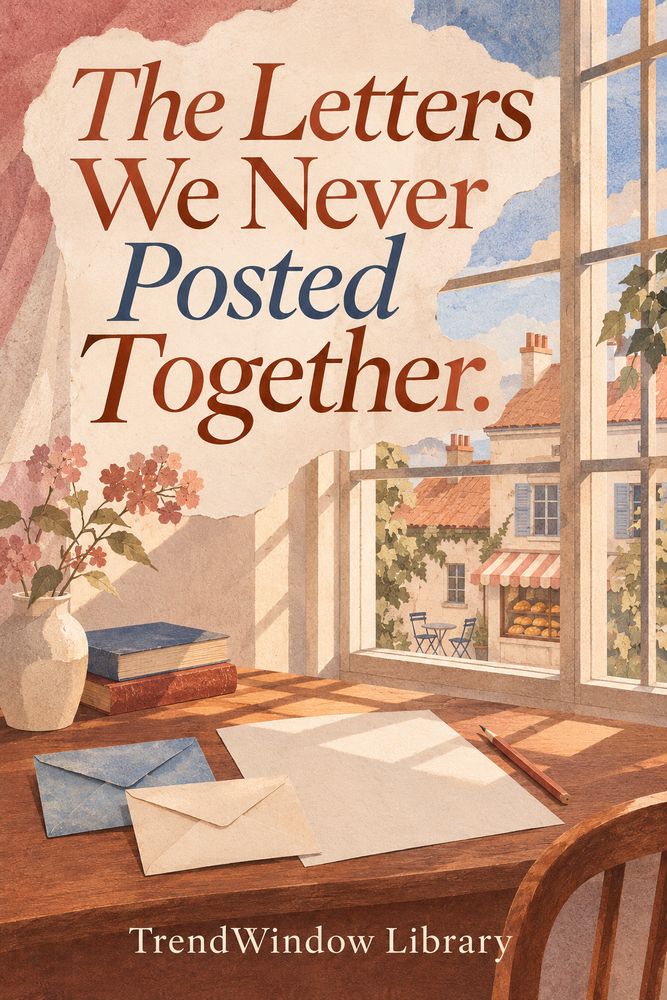
Front cover of The Letters We Never Posted Together

Romance & Relationships

The Letters We Never Posted Together

By TrendWindow Library

A complete short romance in eight chapters. A moving day brings Eva and Jonas together with the letters they never sent. They face their old choices and build a new relationship without giving up their separate lives. Original fiction with a resolved ending.

Read this complete edition, including its ending and notes. No purchase is required.

About this story

A complete short romance in eight chapters. All characters, places and events are invented. This is a story about two adults choosing a new relationship; their old letters do not erase the choices that separated them.

© 2026 TrendWindow Library. Original AI-assisted fiction and translations, reviewed by an AI assistant. No independent human-editor or native-speaker certification is claimed.

1. The label on the wrong box

Eva had written KITCHEN on the box that contained every letter she had failed to send. This was less a disguise than evidence of the hour at which she had packed it. At midnight, after labeling seventeen boxes, she had begun to believe that everything she owned belonged in the kitchen. Now the box sat beside the kettle on the small packing table in her aunt's empty print shop, and Jonas had arrived to carry the large table downstairs.

They were both thirty-two. Eight years earlier they had been friends who could spend an afternoon saying almost nothing and still feel they had held a conversation. During the two years since Eva had returned to town, they had managed three polite meetings in shops. She knew that he repaired lamps, that he lived alone, and that his hair curled at the back when it needed cutting. She did not know whether he was pleased to see her. His message had said only: Mina asked about the table. Is ten convenient for you?

Her aunt was retiring, selling the presses and moving to a smaller house. Eva was leaving the flat above the shop for a place across town with a window over a bakery yard. The new flat was not a prize or a defeat. It was what she could afford from her illustration work, and its lease was in her name. Mina had offered the big worktable to Eva. Jonas had agreed to help carry it. Those were the facts. Eva repeated them privately while he stood in the doorway holding a packet of biscuits.

"Ten was convenient," she said, looking at the clock. It was three minutes past. "It still is." He put the biscuits down. Neither of them laughed quite naturally. When she lifted the kitchen box to clear a path, its untaped bottom opened. Envelopes slid between their shoes. Jonas bent, then stopped when he saw his name. "Would you rather I didn't?" he asked. "Pick them up, please. Don't read them." He gathered them face down and handed them back without a joke.

One envelope was blue, with a square pale patch where she had once removed a stamp. He looked at that patch rather than at her. "I've got some too," he said. "Letters?" "To you." Outside, Mina called that the van would not arrive until two. Eva put the envelopes on a high shelf. There were four hours to move a table and eight years they had never learned how to put down. She switched on the kettle. "We can start with tea."

2. Permission to unfold

They measured the stairs before they spoke about the letters. Jonas held the tape at the corner while Eva wrote the width on the back of an old delivery card. The table had come upstairs in pieces. Mina remembered this only when they asked, then went away to find its fittings bag. The answer relieved Eva. She had imagined a morning in which Jonas solved a problem she had created, and she disliked how quickly that old arrangement could return.

Over tea, he said the letters were at home, ten minutes away. He did not offer to fetch them as though producing evidence. "I kept writing the first part of conversations," he said. "I never got very good at the second." Eva turned her mug so its chipped handle faced her. She had written five letters. Two were angry, one was an apology, one concerned a film he would have liked, and the last was only a page about a rainy Tuesday. Keeping them had sometimes felt more deliberate than not sending them.

"We don't have to exchange everything," she said. Jonas nodded. "Or anything today." She took the blue envelope from the shelf and laid it beside her mug. "You may read this one. Not the others." He asked whether she wanted to leave the room. She chose to stay, but moved to the far end of the table and began sorting blunt pencils. He opened the flap with his thumb. The letter was eight years old. Its first line, visible upside down, made her feel briefly sick: I cannot be the sensible half of a future you have already chosen.

He read to the end. He did not immediately explain himself. Eva sorted a yellow pencil into the wrong tin and moved it back. "I thought you left because our plan frightened you," he said at last. "It did," she answered. "But not because I was frightened of work." Their plan had been a tiny illustration and print studio in two rooms behind Mina's shop. There had been sketches, a name and a row of imaginary clients. There had not been enough money or a clear agreement about who wanted what.

Jonas folded the letter along its old creases. "May I take it home?" "Yes. That one is yours now." He went to fetch a letter of his own, leaving the opened blue envelope on the table until he returned for it. Eva noticed that he had asked twice before taking what she had offered once. She was not yet sure whether that was caution or a new kind of attention. She did not have to decide before the kettle boiled again.

3. An offer with a condition hidden inside

Jonas returned with one cream envelope and a small bag of screws Mina had located in a drawer at the front of the shop. He gave Eva the envelope separately, as if the two tasks deserved different hands. "This was written before you left," he said. "The angry one is staying at home." She almost asked how angry. Instead she read the letter he had chosen to give her. His younger handwriting leaned forward, impatient with the margins. He had written that he would stay in town and make the studio work, that she could count on him, that some chances mattered more than leaving.

Halfway down the page he mentioned the job he had refused in another city. Eva looked up. She had heard about that job much later, from Mina, and had imagined that the refusal preceded their plans. "You'd already said no when you wrote this?" "Yes." "And you wanted me to know you'd done it for us." Jonas moved the empty biscuit packet away from a damp ring on the table. "I wanted you to say I had chosen well." There was no clever answer hidden behind the admission. He looked embarrassed in an ordinary, adult way.

At twenty-four, Eva had won a place on an illustration course away from town. She had accepted before telling Jonas. For ten days she had carried the news as though silence might make it easier to deliver. Meanwhile he had called paint suppliers, drawn shelves and declined his own job offer. Neither had asked the other to make those choices. Each had later arranged the facts into a story in which the other person had gone first.

"You never asked me to refuse the course," Eva said. "Not in those words." "No." "You made staying sound like the decent thing." Jonas nodded once, then looked at the tabletop. "I did." She waited for him to mention her ten days. He did not. That restraint made it possible for her to mention them herself. "I let you plan while I knew I was going. I didn't want to be the person who spoiled it." "It was spoiled anyway," he said. His voice was quiet, not forgiving. "I know."

They were still sitting opposite each other when Mina came in with sandwiches. She set down three plates and asked which cupboard was going to the charity shop. Eva answered. Jonas moved his letter away from the mustard. They ate while Mina discussed a stubborn drawer. Nothing had been settled by lunch, but neither old letter had turned out to be a secret key that made the other person innocent. Eva found that disappointing for a moment, then easier to bear than the stories she had kept improving in her head.

4. What the other letter did not say

After Mina left, Eva brought down the apology. It had been written three years after her departure, in a room with a radiator that clicked all night. She remembered the room more clearly than the reasons she had not posted the letter. Pride was one of them. Fear that Jonas had forgotten her was another. A third reason was less flattering: an unsent apology could remain elegant because nobody could answer it.

She read this one aloud. The letter said she was sorry for letting him hear about her course after she had accepted. It also contained a sentence blaming him for making honesty impossible. Eva stopped there. "That isn't fair," she said. Jonas did not hurry to rescue her from it. "You made it uncomfortable," she continued. "I still could have told you." He watched her draw a line through the sentence. "You can leave the old version," he said. "It is what you thought." "I can keep what I thought without asking you to accept it now."

When she finished, he said he was sorry he had treated his own sacrifice as a bill she ought to pay. He had liked being the person who stayed, the dependable one. It had allowed him to be angry without examining whether he truly wanted the studio. Eva asked him whether he had. "Parts of it. The repair bench. Working beside you. Not the invoices, and not the business you actually wanted." She had wanted illustration commissions and time to learn. They had drawn one doorway around two different lives and called it a shared dream.

They spoke about the years in between without trying to account for every month. Eva had worked in a stationery shop before finding regular illustration clients. Jonas had taken a repair job he liked, lost it when the owner retired, and started taking work on his own. They had each had a relationship that ended. Both were single now. Neither offered an old partner as a villain who had kept them apart. At some point the conversation became easier, which made Eva wary of confusing ease with repair.

"I liked you," Jonas said. "Back then. More than I knew how to say." Eva folded the apology, but did not put it in an envelope. "I liked you too." For a moment the empty shop seemed to wait for the obvious next line. Eva refused to give it one. "That doesn't tell us what to do today." "No," he said. "Today we have a table." She laughed properly for the first time that morning. Before they stood up, she handed him the folded apology. "You may keep this one too." He thanked her and put it with the blue letter. They washed the plates and went upstairs, taking the tape measure with them.

5. The table that would not turn

The table still would not turn at the landing. They had cleared the shelves and removed its legs, but a low light fitting blocked the angle they had expected to use. Jonas began, "If I just—" and stopped. Eva knew that beginning. It had once meant he would continue until a task became proof of his devotion or her lack of gratitude. "Let's put it down," she said. They rested the tabletop safely on the floor and stood breathing beside it. There was no audience to impress except each other, which had often been enough.

Mina came up, studied the obstruction and suggested asking the van driver for help when he arrived. Jonas phoned him, described the table and accepted a later collection slot. Eva felt the day shift beneath her: an extra hour, a delayed key handover, a bakery yard she had not yet learned to enter in the dark. She called the new landlord herself and arranged the change. Jonas did not take the phone or tell her what to say. When she returned, he was wrapping the table edge in an old blanket.

They went downstairs to wait, carrying the remaining blankets. Rain began. The shop's front door had to remain open for the last boxes, and a sheet of water gathered just inside. Eva moved the letters off the table before either of them thought about the valuable prints. They caught each other doing it and smiled. "Paper first," Jonas said. "Particular paper," she answered. He asked whether she wanted help unpacking that evening. The offer was simple, but she felt the old expectation gathering around it. She wanted him to leave while she still wanted him there.

"Not tonight," she said. "I want the first evening to myself." A brief disappointment crossed his face. He did not disguise it as a joke. "All right. Would tomorrow be useful, or would you rather ask me?" "I'll ask." He tied the remaining blankets into a bundle. The conversation took less than a minute. Eva had spent years remembering a version of them in which a refusal would have needed a whole afternoon of explanation. She knew one easy refusal did not prove they had changed. It was nevertheless a refusal she had been allowed to make.

With the driver helping, the table finally came down. A missing bolt turned up in the fittings bag, hidden inside a fold, and Mina counted the pieces before the van left. Eva handed back the upstairs keys. Jonas stood beside his bicycle with the blue letter in his coat pocket. She could have thanked him and gone. Instead she said, "I'd like to see you when there isn't anything heavy to carry." He looked up at once. "I'd like that too." She asked for his phone and entered her new number herself.
6. An invitation with a time on it

Eva's first evening in the new flat was not romantic. She ate bread over the sink, found that the bedroom curtain was still in Mina's van, and discovered that the kettle lead had been packed with her shoes. The table stood under the bakery-yard window, too large for the room in a way she had already decided to forgive. She put the letters in its shallow drawer. Then she sent Jonas a message: Saturday, four, the riverside café? A date, if you want one. No furniture involved.

His reply arrived while she was making tea. Yes to a date. Four works. Eva read it twice, then put the phone down. There was no need to interpret the punctuation or ask a friend whether an ordinary yes concealed an extraordinary fear. She had asked something clear enough to be refused. He had answered it. In the morning she had a difficult client call, a missing sketchbook and a delivery to rearrange. The date stayed where it belonged, one good thing in a week that still required work.

On Saturday Jonas wore a clean blue shirt and arrived carrying nothing. "I almost brought flowers," he said. "Why didn't you?" "I couldn't work out whether you'd have to carry them all afternoon." "You could have asked." He smiled. "I could." They walked along the river after coffee. Eva told him about a picture-book project she had not yet won. He described a lamp with a shade its owner had kept after the base broke. Neither offered to solve the other's work. They were interested without immediately becoming useful.

At a narrow part of the path, Jonas moved behind her to let a family pass. When they came level again, their hands touched. Eva took his. It felt both familiar and wholly new, which was an inconvenient combination for walking straight. "I don't want to move back into our old plan," she said. "Neither do I." "I mean it. I like my flat. I might work away sometimes." "I like my workshop. I don't want us to prove anything by giving things up." The words were easy. They would have to find out how they behaved around them.

At her bus stop he asked whether he could kiss her. She said yes, then laughed because he looked more nervous than he had while holding half a table on a staircase. The kiss was brief. They arranged to meet on Wednesday before either could turn the moment into a promise about their entire lives. On the bus, Eva found a crumb in her coat pocket and the receipt for two coffees. She kept the receipt until she reached home, then put it in the recycling. The afternoon had happened. It did not need every scrap of paper to survive it.

7. Six weeks without a grand gesture

During the next six weeks, Jonas was late once and canceled once. Eva canceled twice. The numbers mattered less than what followed them. He sent a message before the evening he could not manage and suggested another day. She admitted when a deadline meant she wanted silence rather than company. They learned that saying they missed each other did not automatically require one of them to abandon the task in front of them. It was a modest lesson, repeatedly forgotten and learned again.

Their first argument arrived over a shelf. Eva mentioned that she needed one above the table. Jonas appeared the following afternoon with timber he had already bought. She heard an accusation in his cheerful voice before he had made one. "I didn't ask you to do it," she said. He set the timber against the wall too sharply. "I thought you'd be pleased." For a few seconds they were twenty-four again, except that the room was hers and they both knew how the scene might continue. Eva asked him to sit down before either said something polished and unfair.

He admitted he had liked the idea of leaving something useful in her flat. She admitted that she had answered as though he had already demanded thanks forever. They did not split the difference neatly. Buying materials had been his decision; she did not owe him a shelf project. Her sharpness had still hurt. He took the timber back to his workshop. A week later, after measuring the wall herself, she asked whether he would help her choose brackets. They went together. She paid for what she chose. The shelf was slightly shorter than his first idea and exactly long enough for her books.

They also had evenings when nothing needed resolving. Jonas learned that Eva disliked talking during the first ten minutes of a film. Eva learned that he enjoyed markets but hated being hurried through them. Mina invited them to dinner and did not ask for an announcement. One wet Sunday they made soup badly, added too much water, and ate it with enough bread to make the mistake unimportant. Affection became less dependent on the unusual courage of the moving day. It appeared in repeated, unremarkable acts of returning.

At the end of the sixth week, Eva received an offer to illustrate a small book, with two meetings in another town. She told Jonas before accepting, not to seek permission but because she wanted him to know. "Do you want it?" he asked. "Very much." "Then I hope the train is comfortable." She accepted the work. Later he said he would miss their usual Friday evening. They chose Sunday instead. Neither pretended not to mind the change. Neither treated it as a test the other had failed.

8. Two envelopes, one ordinary morning

The new letter began with a request, not an explanation. Eva wrote it at the big table while trays rattled in the bakery yard below. Would you come to dinner next Thursday, if you're free? I want to hear about the market, and I want to make something that isn't soup. She added that she liked being with him and was still learning how to say what she wanted before turning it into a complaint. Then she stopped. The page did not need to contain everything they might become.

Jonas had written to her too. He mentioned it when they met outside the station on the morning of her first work trip. "I thought we could post them," he said. "Separately, obviously. Together at the box." The awkward distinction pleased her more than a graceful speech would have. Each envelope had the other's current address. There was no dramatic forwarding address, no final chance before a ship sailed. She would be back the next afternoon. He had a repair to finish and washing on his kitchen rack.

They stood beside the postbox with the letters in their hands. Eva thought of the five envelopes she had dropped from the kitchen box. Two had been given to Jonas. The others remained hers. She had not burned them to demonstrate a new life, and she had not appointed them permanent witnesses against him. Some pages belonged to the person who had needed to write them. They could stay in a drawer without directing what happened outside it.

"What if yours says no to Thursday?" she asked. "Mine asks you about Thursday." They laughed, then resisted the temptation to open both envelopes on the pavement. There would be pleasure in receiving them. Jonas put his through the slot first. Eva followed. The small metal flap returned to its place. Nothing in the sound resembled a door closing on eight lost years. Those years had contained work, other people, mistakes and pleasures neither wanted erased. They were choosing from where they stood, not recovering a life that had waited intact.

At the station entrance Jonas kissed her goodbye and let go of her hand. Eva went to her train. Two days later, his letter arrived beneath a circular for window cleaning. It said yes to dinners they had not yet learned to cook, and asked whether next Thursday at seven would suit her. She put it on the table, checked her calendar and called him. "Seven suits me," she said. "Bring yourself. I'll tell you if I need anything else." Outside, someone in the bakery yard laughed as an empty tray fell. Eva closed the window halfway, took out a clean sheet of drawing paper, and began her work.

Explore more books →