BOOK LIBRARY · Complete books · Purchases disabled
TrendWindow

← Book Library · Complete book

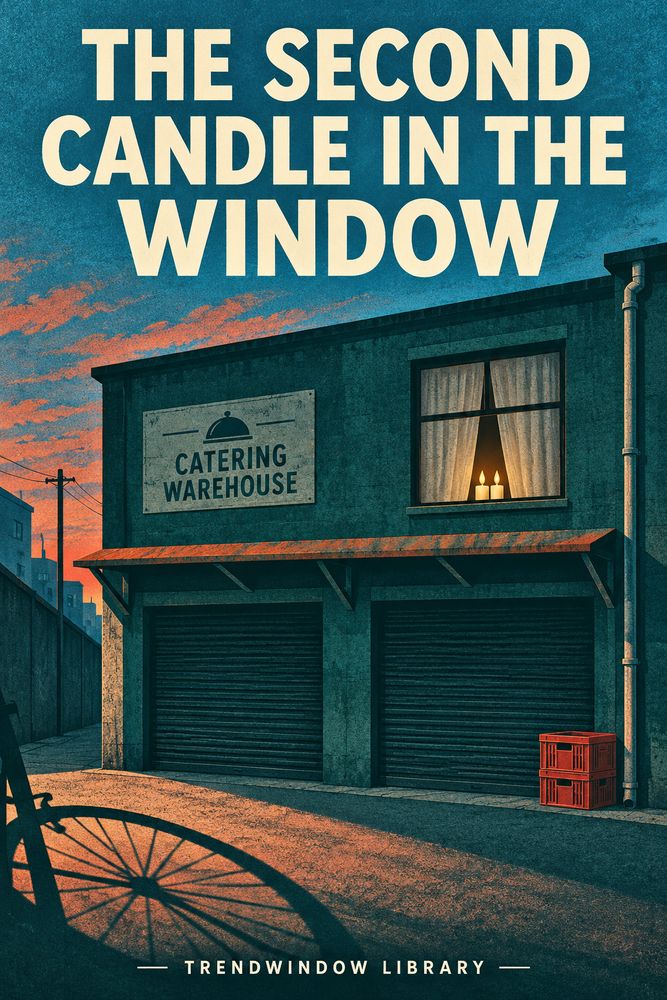
Front cover of The Second Candle in the Window

Mystery, Crime & Thriller

The Second Candle in the Window

By TrendWindow Library

A complete original short suspense story. Dina Holt has left, her employer says. Beth Ives sees a second battery candle in the upstairs window—and finds that a disputed delivery count cannot explain a locked door.

Read this complete edition, including its ending and notes. No purchase is required.

1. The Shift That Had Finished

Beth Ives returned to the catering warehouse because her scarf was still hanging behind the packing-room door. She had cycled halfway home before feeling the cold at her neck. Through the front window she could see the red crates stacked for Monday. The working day was supposed to be over.

Owen Rook stood beside his van with a bundle of papers. He owned the business, including the habit of speaking as if every question delayed something important.

“Dina’s gone,” he said before Beth asked. “Back door. About ten past five.”

Beth looked at the clock on her bicycle display. It was twenty to six. She and Dina Holt had arranged to walk to the six o’clock bus together. Beth would leave her bicycle at the covered stand and collect it after visiting her sister. Dina had said she wanted company after an unpleasant discussion about a delivery.

“She didn’t message me.”

“Perhaps she changed her mind.” Owen pulled the van door closed. “Scarf’s on the hook. Be quick.”

Beth entered the packing room alone. It smelled of onions and clean trays. Her scarf was where she had left it. Dina’s green jacket was hanging beside it.

That did not prove anything. Dina might have taken a different coat or forgotten her jacket as Beth had forgotten the scarf. Beth called her name once. No answer came from the empty room.

Upstairs, something scraped across the floor. Owen appeared in the doorway.

“A crate,” he said.

Beth had not asked what made the sound. She wound the scarf around her neck and went out. The upstairs office window glowed above the shuttered front entrance. Behind its pale curtain stood one battery candle, the winter decoration that Owen usually left on its timer.

Beth wheeled her bicycle across the narrow lane. Then she looked back.

A second small light had appeared beside the first.

2. Two Lights, Not an Answer

The second candle was not a flame. It was a cheap electric ornament with a plastic tip. In the previous winter the packing-room supervisor, Asha, had bought it when the first candle looked lonely.

When Asha worked late upstairs, she placed the second light in the window. “Still here,” she would say to the last person leaving below. It was a small private habit of that workplace, not a system that could explain every light or every absence.

After Asha retired, Dina sometimes did the same thing. That morning Beth had seen the second candle lying on the office desk beside a pile of delivery slips.

Someone could have moved it earlier. Beth might have missed it when she first looked. A timer could have switched it on. She did not know. What she knew was that Owen’s certainty about an empty building did not fit comfortably with the sound upstairs, the jacket and the new light.

She called Dina’s phone. From inside the warehouse came the faint repeated notes of Dina’s ringtone. Nobody answered.

Owen was looking through the papers in his van. Beth could have gone back through the packing room. Instead she crossed to the small key-cutting shop opposite. Imran Vale was pulling down its blind.

“Will you stand outside with me?” she asked. “I’m worried Dina may still be upstairs. Owen says she left.”

Imran put his keys back in his pocket. “Have you spoken to her?”

“Not yet.”

They stood together in the lane, clear of the van. Beth called Dina’s name towards the upper window. The curtain moved. A hand appeared in the narrow opening of a small casement.

“Beth?”

“Are you all right?”

The answer came plainly enough for both of them to hear.

“He locked the office. He won’t let me out.”

3. The Page Waiting for a Name

Beth stayed beside Imran. She took out her phone and contacted the police. She gave the address and described what she had heard, including Dina’s exact words. She did not describe a crime she had not seen or promise Dina an arrival time she could not know.

Owen shut his van door and came across. “What is all this?”

“Dina says she is locked in the office,” Beth said. “She wants to leave.”

“We’re sorting out a discrepancy. She agreed to finish it.”

From the window Dina called, “I agreed to check the papers. I didn’t agree to be locked in.”

Owen looked up sharply. “You have the statement. Sign it and we’re done.”

Beth heard Imran draw breath beside her. The second candle had not told them what was happening. Dina’s words and Owen’s reply were doing that now.

“I have called for help,” Beth said. “Open the door.”

Owen took a bunch of keys from his coat. “Come inside. I’ll explain.”

“We can speak here.”

For several seconds he did not move. Then he walked through the packing-room entrance and disappeared up the stairs. Beth and Imran remained in the lane. They heard a key turn and a door strike a wall.

Dina came down carrying her handbag. Her face was pale, but she walked steadily. Owen followed with a sheet of paper held out in front of him.

“You haven’t finished.”

“I’m leaving,” she said.

Beth moved towards her without taking her arm. Dina crossed the lane and stood beneath the key shop’s awning. Imran opened his shop again and offered her a chair.

“My phone,” Dina said. “It was charging downstairs.”

Owen had it in his other hand. He put it on a crate by the entrance. Beth asked Dina whether she wanted her to fetch it. Dina nodded, and Beth brought it across. She did not go upstairs or touch the papers Owen still carried.

4. Forty and Fifty-Two

Dina sat near the shop door, where she could see the lane. She asked Beth to call her sister Miri, then changed her mind and called herself. “I’m out now,” she said. “Can you come?”

Beth did not ask her to repeat everything at once. She put a glass of water within reach and sat on a stool a little way from the chair.

After a while Dina said, “There were forty lunch boxes. I packed them.”

Beth remembered the morning delivery. She had loaded the red crates, but she had not counted the individual boxes. She could confirm what she had done, not turn Dina’s count into her own memory.

“Owen’s invoice says fifty-two,” Dina continued. “He wanted a statement that I packed and checked fifty-two. I told him I couldn’t sign that. He said the customer was making trouble and I needed to support the business.”

There were twelve boxes between the two figures. Beth could work out that difference; she could not work out the whole delivery dispute from it. The packing list, the customer’s account and Owen’s papers would have to be examined rather than replaced by a quick agreement in the lane.

“I went upstairs because he said we’d compare the slips,” Dina said. “He left and locked the door from outside. When I asked him to open it, he said I could come down after I signed.”

Her phone had been charging in the packing room. She had tried calling through the office door. Then she saw the second candle on the desk and put it in the window. She hoped Beth might return for their walk to the bus.

“I didn’t know whether you’d see it.”

“I nearly didn’t.”

Dina looked at the shop’s little clock. The bus they had planned to catch was already gone. She began to apologise, then stopped before finishing the word.

“You haven’t made me late,” Beth said.

5. The Accounts Kept Apart

Two officers arrived while Owen was still beside his van. One spoke to him in the lane. The other, Officer Senn, came into the shop and asked Dina whether she wanted to speak away from him.

Dina said yes. Beth asked whether she should leave too. Dina wanted her nearby, but the officer first spoke with Dina, then separately with Beth and Imran.

Beth described the jacket, the sound and the lights. She made clear that she had seen only one light on her first glance, and could not be certain the second had not been there unlit. She repeated what she had heard through the window and what Owen had said afterwards. She did not claim to have seen him lock the door.

Imran gave his own account. He had heard Dina call out and Owen say she should sign. He had seen Owen go inside with keys and Dina come down. He had not been there when Beth first entered the packing room.

Owen called through the open shop doorway. “The door sticks. We’ve had trouble with it for months.”

Officer Senn went to the threshold. “We will speak with you separately. Let her finish.”

The statement Owen wanted signed remained unsigned. Dina told the officer where the original packing list and delivery slips were kept. Beth did not collect them herself. Later she saw Owen put his bundle on the van seat while the other officer spoke to him. Nobody asked Beth to decide the invoice dispute before Dina could go home.

Miri arrived in a small grey car. She entered the shop quietly, without first confronting Owen. Dina stood and went to her. This time she did take the offered arm.

Before leaving, Dina asked for her jacket. With Owen standing outside and the officers present, Beth collected it from its hook. The scarf had been an ordinary forgotten thing. The jacket had been ordinary too. What mattered was that the people who noticed them had kept asking until the person upstairs could answer for herself.

6. A Morning Not Owed

Three days later Dina met Beth at a café near the bus stand. The delivery records were still being checked. Dina had given her account and had kept a copy of her own notes. Beth could not tell her how the investigation would end, and did not try.

“He sent a message saying I’ve misunderstood him,” Dina said.

“What do you think?”

“I think I asked him to open a door.”

She stirred her tea. For the first time that morning Beth saw her stop checking the entrance.

Dina had not returned to work at the warehouse. Her next job was not magically waiting. There were bills, a conversation about wages still to have, and a week she would rather not have spent remembering every sound from the upstairs room. Miri was helping her look at what could be managed first.

“I keep thinking I should have carried my phone,” Dina said.

Beth did not give her a list of things she ought to have done. “You were asked to check some papers. Someone else chose to lock the door.”

Dina nodded slowly. “I know. I’m trying to let that be the whole sentence.”

They talked about the bus route, then about a soup Dina wanted to make. She could talk about something else without withdrawing what had happened. The two subjects could sit on the same small table.

Outside, Beth unlocked her bicycle. Dina was taking the next bus to Miri’s house. Neither needed to hurry back to the warehouse.

“Thank you for coming back for a scarf,” Dina said.

“Thank you for answering.”

Beth watched her board. Dina found a seat by the window and raised her hand. It was not a signal that needed decoding. Beth raised hers in return.

The bus pulled away. Beth waited for the lane to clear, then turned her bicycle towards home. For once she did not measure the morning by the time she should already have been at work.

Edition Note

This is a complete original work of fiction. All people, businesses, records, places and events are invented. The two battery candles are a custom of this fictional workplace, not a universal safety signal; the cover artwork is conceptual. The story is not legal, emergency-response or workplace-safety advice and makes no promise about real police or court outcomes. This AI-assisted digital short book includes original English front/back artwork and complete aligned translations. It does not claim independent human authorship, native-human certification, an ISBN or a print proof.

Explore more books →