BOOK LIBRARY · Complete books · Purchases disabled
TrendWindow

← Book Library · Complete book

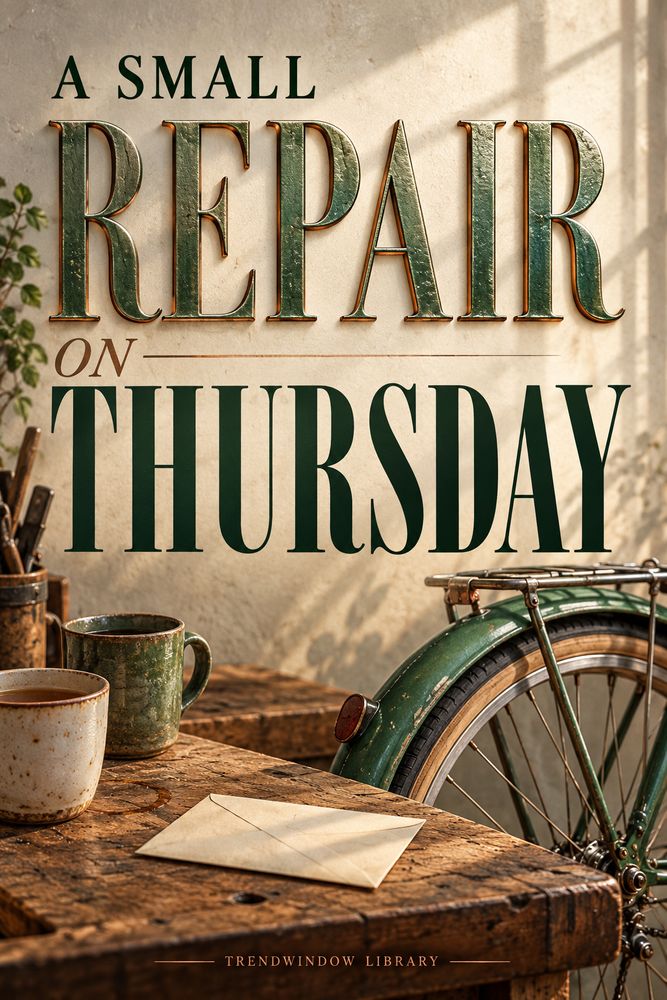
Front cover of A Small Repair on Thursday

Contemporary & Literary Fiction

A Small Repair on Thursday

By TrendWindow Library

A bicycle brings Martin back to his brother’s repair shop after eight months. A complete original literary story about a debt and an unfinished conversation.

Read this complete edition, including its ending and notes. No purchase is required.

1. The Bicycle at Nine Ten

Wes recognised the bicycle before he recognised his brother. It was pale green, with a dent in the rear mudguard and a bell that looked too new for the rest of it. His niece had sent him a photograph when she bought it.

Martin wheeled it through the shop door at nine ten on Thursday. He was forty-eight, five years older than Wes. Wes had not seen him in eight months.

'It's making a noise at the back,' he said.

Wes was holding a mug with cold tea in it. He put it beneath the counter, where another cold mug already stood.

'Lena's?'

'Yes. She's working till four. Said I'd bring it down.'

His brother had managed the difficult first sentence by leaving it out.

Nadia looked up from the other work stand. She was forty-one and had worked with Wes for six years. She knew Martin, but she did not know enough to decide whether to make them tea. She returned to her work.

Wes took the bicycle and attached a job label. Lena was nineteen. She could arrange her own repairs. He asked whether she had given Martin a spending limit.

'Thirty-five. Ring her if it's more.'

Wes wrote that down. The label gave him somewhere to look while Martin waited for a different kind of answer.

2. Eight Hundred

Ten months earlier, Wes had lent Martin eight hundred pounds towards a van repair. Martin repaid two hundred after two months. The remaining six hundred had acquired a place in every conversation they did not have.

At first Wes asked casually. Then he asked by message. Then, one evening on the telephone, he asked why his brother could answer a photograph of a football result but not a question containing a number.

Martin said he was doing his best. Wes said he could not tell the difference between that and doing nothing. They ended the call without agreeing on another payment.

For eight months Martin had stayed away from the shop. Wes had stopped sending photographs.

The bicycle stood between them now. Wes was annoyed that a grown man could enter with a bent mudguard and make him feel thirteen, waiting to find out whether his older brother would let him come along.

'Can you do it today?' Martin asked.

'I'll look at it. I'll tell Lena what I find.'

'Right.'

Martin rubbed his thumb along the counter's edge. There was a small white mark on the wood where a customer had once dropped a heavy lock. Wes knew exactly when it happened. He could not remember the customer's face.

Martin left his number, although Wes had never deleted it. Then he said he would come back later and went out without asking for tea.

3. The Work on the Label

After Martin left, Wes checked the bicycle in the ordinary way. He found the source of the noise and assessed the work it needed. It was a modest job, not a reason to treat the machine as safe without checking the rest.

He called Lena with a price of thirty-five pounds and a collection time of four. She approved it. Her father had dropped it off because his route to the school where he worked passed the shop, not because she needed him to speak for her.

'Is Dad still there?' she asked.

'He's gone.'

'Could you tell him I'll collect it? He said he might, but I finish nearby.'

Wes said he would. She thanked him and returned to her job at the library.

Nadia put a finished wheel on its rack.

'Shall I take this one?' she asked, indicating Lena's bicycle.

'No. It's all right.'

'It can also be all right over here.'

He looked at her. She was not offering to mend his family. She was looking at the jobs that had arrived and the jobs they had promised to finish.

He gave her Lena's label and took the repair already waiting on his own stand. Nothing in the shop timetable needed rearranging for his brother's visit.

For an hour he worked on something that would not become better because he had a persuasive argument. He found that useful, and then became annoyed with himself for finding it useful.

4. The Missing Tea

At lunch, Wes discovered a message from Martin: Back about three, if that suits.

He typed Fine, deleted it and wrote Three is fine.

Nadia ate a sandwich at the counter. She had brought one too many oranges and offered him the spare. He accepted it, then spent a long time taking off the peel in little pieces.

'You don't have to tell me,' she said.

'I wasn't going to.'

'I know.'

He nearly laughed. Instead he explained the loan, more briskly than he intended. Eight hundred, two hundred back, six hundred left. He gave her the numbers as if they would make the account complete.

'Was that why you stopped seeing him?' she asked.

'He stopped coming.'

'And you?'

'I stopped asking him.'

Nadia folded her sandwich paper. She did not tell him which of them was right.

Wes had rehearsed several speeches for Martin over the months. In some, his brother apologised immediately. In others, Wes told him to keep the money and stay away. Every version ended before they had to spend an ordinary afternoon together.

He put the orange peel in the bin and made fresh tea. He drank it while it was still hot. The two cold mugs remained beneath the counter until Nadia pointed them out.

5. The Envelope

Martin returned at three with an envelope. He set it on the counter, then moved it away from Lena's job label.

'One hundred and fifty,' he said. 'For what I owe you. Not for the bike.'

Wes counted it. He disliked how necessary that felt, and counted it anyway.

'Four hundred and fifty left.'

'Yes.'

The money had come from extra shifts, Martin said. He had brought it that morning but had not found a way to hand it over without making the bicycle look like a request for something in return.

'You could have said that.'

'I could have.'

Wes waited for an explanation beginning with but. Martin did not give one.

He worked as a school caretaker. Wes knew the name of the school and the times his brother usually started. He had not known about the extra shifts. He did not know whether Martin wanted praise for them.

'I've talked to Grace,' Martin said. Grace was his partner, forty-seven, and had not borrowed the money. 'About what I can actually manage. Not what I wish I could say to you.'

He proposed fifty pounds a month, beginning the following month, for the remaining nine payments. Wes did the sum. It was not quick, but it was a sum that ended.

6. What Was Still Owed

Wes put the envelope in a drawer separate from the shop's cash.

'I needed you to answer,' he said.

'I know.'

'You keep saying that now. I didn't know you knew it then.'

Martin looked towards the door. A customer stood outside examining the opening hours. Nadia went to let her in and dealt with the collection at the other end of the counter. The brothers lowered their voices.

'I thought if I rang without money, you'd ask about it,' Martin said.

'I probably would.'

'Then I kept waiting till I had more.'

'And I kept wondering whether I had to pretend I'd forgotten in order to have a brother.'

Martin's face changed. Wes wished he had said it less sharply, but did not withdraw it.

'I didn't mean to make you do that.'

'You did, though.'

'Yes.'

There was no speech Wes could give that would return the money sooner. There was also no reason he had to say it no longer mattered.

He agreed to the monthly amount. He asked Martin to tell him before a payment was missed, if there was a problem, instead of disappearing again. Martin agreed. They wrote down the balance and the plan in plain words so neither would have to guess later.

Wes kept a copy. Martin took the other. Nobody called it a fresh start.

7. A Customer Called Lena

At four, Lena arrived in her library work clothes and asked for her bicycle. She greeted Martin with surprise, then looked towards the rack rather than asking why her father was still there.

Nadia brought the bicycle round. She explained the completed work and the checks they had made, without turning the conversation into a lesson for the whole shop. Lena asked a question, listened and paid the thirty-five pounds herself.

Martin reached towards his pocket and stopped. He had not been asked to pay.

'I've got it,' Lena said, not unkindly.

'I know.'

Wes heard his brother's answer differently that time. Martin moved out of the doorway so she could take the bicycle outside.

Lena had another errand before going home. She did not stay to make the reunion easier. At the door she asked Wes whether the photograph of her new flat had arrived.

'It did. I meant to answer.'

'You can still answer.'

'I will.'

She waved and left. Nadia returned the job label to the completed pile. The repair was finished, the customer had paid, and the money in the drawer still belonged to a separate conversation.

Wes looked at his phone. Lena's photograph showed a kitchen window with no curtains yet and a box labelled plates. He sent her a message saying he liked the window and asking whether the plates had survived.

8. The Hour Before Closing

Martin had time before his evening shift. Wes had work before closing. They both knew this and nevertheless stood as if someone had to announce the end of the visit.

'I'd better let you get on,' Martin said.

'What time do you start?'

'Six.'

'I'm finished at five.'

That left an hour. Wes could hear the offer forming and wanted to avoid making it sound like a reward for the envelope.

'We could get something to eat.'

Martin agreed. Not eagerly enough to make Wes retreat, and not reluctantly enough to make him wish he had said nothing.

He went to the café across the street to wait, rather than hover over the remaining repairs. Wes finished the day's work with Nadia. She would open the shop the next morning; they checked what was ready and what still needed doing.

'All right?' she asked as she collected her bag.

'For today.'

She nodded, took her keys and left him to close.

Wes checked the door, the lights and the drawer. He put Martin's repayment and his own copy of the plan into his personal bag. It did not go into the day's repair takings. When he crossed the road, his brother had found a table beside a radiator that was not switched on.

9. Chips Before Six

They ordered food from a menu neither needed to study. Martin asked whether Wes still took vinegar on his chips. Wes said he had not changed every part of himself.

For a while they talked about the school boiler, without pretending either wanted advice about it. Martin told a story about a child returning a lost glove to the wrong classroom and refusing to accept that there might be more than one red glove in the school.

Wes told him about the customer who had dropped the lock on his counter. In the telling, he remembered the customer's face. That surprised him.

Martin asked after Nadia. Wes said she was well and better than him at noticing when a conversation had become an obstacle in a working shop.

They did not spend the meal examining their relationship. Once, when Martin began to apologise again, Wes said he had heard him. He meant it as permission to eat, not as a cancellation of what they had agreed.

At twenty to six, Martin checked the time.

'I'll ring on Sunday,' he said.

'About what?'

'I don't know yet.'

Wes looked at him, then nodded.

'All right.'

They paid for their own meals. Outside, Martin went towards the school and Wes towards the bus stop. They did not embrace in the street. Wes watched him go far enough to see that his brother had remembered the envelope was no longer in his coat.

10. The Reply

At home, Wes found a reply from Lena. The plates had survived, apart from one she had already broken before the move. She sent another photograph, this time of the box emptied onto a shelf.

He put his bag on the kitchen table and took out the repayment. One hundred and fifty pounds. Four hundred and fifty still outstanding. He recorded the amount without adding a sentence about how he felt.

The plan would need to work in months that had not happened yet. A Thursday meal could not prove that it would. For once, Wes did not try to finish the future in his head before letting the day end.

He washed the mug he had used at breakfast. At the shop he had left no cold tea waiting under the counter.

His phone lit with Martin's message. Home from work later. Sunday afternoon?

Wes wrote Yes, after three. He did not delete it to make it sound less welcoming.

There would be things to say about money again. There would also, he hoped, be something else to say. He left Lena’s two photographs on his screen for a moment, then put the phone down and made himself supper from what was in the fridge.

The bicycle was back with its owner. The repayment was where it belonged. His brother had a time to call.

Wes left Sunday afternoon unfilled.

11. About This Edition

This is a complete original short work of contemporary fiction, created with AI assistance for TrendWindow Library. Wes, Martin, Lena, Nadia, Grace, the repair shop and all events are invented. The sums and arrangement are part of one fictional family, not financial advice, a debt agreement template or a description of legal rights. The narrative is not a bicycle repair guide, inspection checklist or guarantee about the condition of a real vehicle. No repair procedure is taught.

Ten narrative chapters and this edition note form eleven fixed reading units, not printed pagination. The original English front and back covers and complete translations were created for this digital edition. The assistant compares translations with the English text; independent native-human certification, human authorship, an ISBN and print-proof approval are not claimed. The complete approved editions are publicly readable. Purchases and all four payment providers remain disabled.

Explore more books →