BOOK LIBRARY · Complete books · Purchases disabled
TrendWindow

← Book Library · Complete book

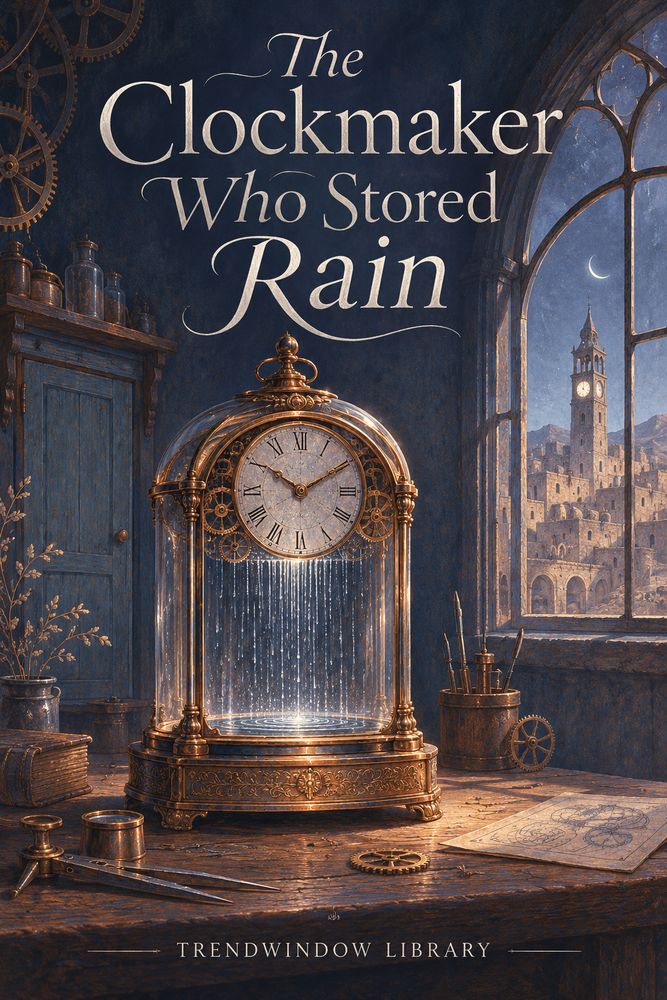
Front cover of The Clockmaker Who Stored Rain

Fantasy & Science Fiction

The Clockmaker Who Stored Rain

By TrendWindow Library

A complete original short fantasy in eight chapters. Clockmaker Ivenna must release twelve stored minutes of rain, including the last recording of her mother, so her drought-stricken city can face an uncertain ordinary future.

Read this complete edition, including its ending and notes. No purchase is required.

About this story

A complete original short fantasy in eight chapters.

The city, people, history and workings of rain and clocks in this story are invented. This is not an explanation of real weather or a guide to clock repair.

© 2026 TrendWindow Library. Original AI-assisted fiction and translations, reviewed by an AI assistant. No independent human-editor or native-speaker certification is claimed.

1. The minute behind the blue door

Every morning Ivenna heard her mother complain about the pears.

“Hard as door handles,” Sera said. Then a spoon struck a bowl, rain rattled the workshop awning, and the minute ended before Ivenna could hear her own reply.

The glass clock stood behind a blue cupboard door. Its hands never moved. When Ivenna held her thumb against the brass rim, the rain became visible inside it: a narrow grey curtain, a kitchen window, her mother's sleeve. She could not enter the scene or speak into it. She could only watch that minute arrive at its last instant and begin again.

Outside, the gutters of Ordel were full of dust.

It was the third dry summer. Customers brought clocks with cracked wooden cases and asked whether time was running faster in the heat. Ivenna said no, adjusted what needed adjusting and let them sit in the shade. Under her bench she kept a jug for visitors. By noon it was empty.

That afternoon the cistern keeper arrived carrying the tower clock's minute hand under one arm. Tovin had wrapped its sharp end in an old stocking.

“It fell off,” he said.

“That usually happens before someone brings one here.”

He did not smile. In the empty fountain square, he told her, the tower had struck thirteen. The public clock had no thirteenth bell. People were arguing over whether they had heard a warning or a promise.

Ivenna took the hand. Near its socket, where no one below could see it, a thread of water shone in a groove.

She fetched her mother's old tower drawings. There were twelve circles around the centre wheel. Nine were marked with the address of her workshop.

Tovin looked towards the cupboard. Behind the blue door, something tapped once against glass.

“Do you have water in there?”

“Rain,” she said.

“At the cistern, we've stopped making that distinction.”

She left the drawings on the bench between them. She had inherited the tower's care along with the shop, but for years she had repaired its hands without asking what they were waiting for.

2. Twelve clocks in a dry city

The oldest drawing showed Ordel beneath a flood. Not a precise map: a child had added a boat beside the official seal, and someone had drawn a furious cat in it.

During that flood, twelve clockmakers had stopped twelve minutes of rain. The clocks were joined, by a craft the drawings described but did not explain, to the twelve channels beneath the tower. Each held a different minute, with the voices and weather that had passed through it. Together they held the city's rain in a pause.

The instruction at the bottom was plain: after the flood, return the clocks and let the minutes finish together.

The flood had gone. The clocks had not returned.

The pause had not swallowed every shower at once. Renewing it borrowed rain from days still to come, without changing the old minute inside each clock. One clear afternoon had become a week; later keepers had renewed the pause whenever rain was inconvenient. Weddings, roof repairs, the procession of the glassmakers. Over generations, a temporary arrangement became the way things were done. Now the borrowed days had become three dry summers, and nobody knew how much weather was waiting on the other side.

“My mother kept the rain away too,” Ivenna said.

“And your mother didn't empty the cistern alone.”

Tovin spread a second sheet over the first. It listed cracked supply pipes, blocked roof channels and households the water carts could not reach. Rain would help. It would not mend those things.

They counted the clocks. Eight stood on the workshop's high shelves; the ninth was behind the blue door. Two were listed in the civic archive and one in the conservatory, where gardeners had once kept a minute of weather for an annual seed ceremony.

Tovin wanted to fetch them immediately.

Ivenna found a later note in Sera's writing: a rain clock could only be opened willingly by its present keeper. Breaking the glass would not release the minute. It would merely leave the rain suspended in the broken pieces.

“And when we open them?” he asked.

“They become ordinary clocks. No more listening.”

He looked at the cupboard again but did not ask whose voice it held.

Outside, a cart creaked past with six covered water jars. They heard the driver stop to argue about a seventh. Ivenna turned the drawing over so that the cat in its boat was hidden.
3. The little glass test

There was a practice clock in a drawer beneath the files. It had never been joined to the tower. Apprentices used such clocks to learn the holding craft before they were trusted with anything larger than a drop.

Ivenna had made this one when she was fourteen. Inside its minute, a single drop hung from the end of a green thread. Her younger voice said, “Now?” and Sera answered, “When you're ready.” The rest was the scrape of a chair.

“This isn't one of the twelve,” she told Tovin. “It won't change the weather.”

She turned the little key. Nothing happened.

She checked the spring, feeling relieved in a way she disliked. The spring was sound. So was the wheel. She had turned the key while wishing that the minute would refuse her.

Tovin went outside to move his cart out of the sun. He left without giving her a speech about courage.

Alone, she held the glass clock against her ear. Fourteen-year-old Ivenna asked again. Her mother gave the same answer, exactly as before. That was the cruelty of it: even Sera's patience had become a mechanism.

This time Ivenna let herself want the minute to end. She wound the key once. The drop struck her wrist, cold enough to make her flinch. The clock began to tick.

She pressed its rim. She heard only ticking.

When Tovin returned, she was wiping the bench with a cloth that did not need to be there.

“Does it take the memory?” he asked.

“No. I remember the thread. I remember being annoyed that she wouldn't tell me the exact moment.”

She tried to recall the sound of the chair. Already she was uncertain whether it had scraped once or twice. She had known that uncertainty before the clock existed; she had forgotten how exposed it felt.

Tovin set the practice clock upright. Its small second hand moved past a scratch in the glass.

“I'll ask the gardeners,” he said. “You ask the archive.”

She almost asked him to stay. Instead she put the clock on the front counter, where its ticking could be heard by anyone who came through the door.

4. A name in the public ledger

The archive clerk, Rell, brought out a ledger before he brought out the clocks.

“If these leave the building, there must be a record.”

“If they stay, there may not be a building worth keeping records in.”

He gave her a tired look. “You can dislike the book and still write your name in it.”

She wrote it.

The first clock held the opening of a bridge: trumpets, wet flags, a speech nobody had transcribed. The second contained rain over the archive roof while clerks carried books away from a leaking ceiling. Rell's predecessor had kept that minute as proof that the roof needed replacing. The roof had been replaced seventy years ago.

Yet Rell did not lift either clock from its felt pad.

“My father was one of the bridge musicians,” he said. “I was told I could hear him here when I took the post.”

In the little scene a row of brass instruments shone. Ivenna could not tell which musician was his father. Rell could. He pointed before the minute had reached the man.

She explained the practice clock, including the detail she could no longer hear accurately. She made no promise that ordinary memory would keep every note.

He asked for the afternoon. She left him the drawings and returned to her shop.

Tovin was waiting there with the conservatory gardener's written agreement. The gardener would bring the seed clock herself. In return, she wanted the city to clear the old channels before any rain was released. He had already begun arranging the work.

At dusk Rell arrived carrying two padded boxes. The keeper's ledger was under his elbow.

“I listened,” he said. “Then I wrote down which man he was.”

He placed the boxes carefully on the bench. He had also copied the bridge speech. It was shorter and less impressive than he had expected.

“Will you put your ninth clock with them?”

Ivenna looked up at the eight clocks already packed from the high shelves.

“Tomorrow.”

Rell did not argue. He left the ledger open at her name, which was already dry on the page.

5. What the clock would keep

That night Ivenna took the ninth clock into the kitchen. The pears were thirteen years gone. So was the bowl, broken during a winter when she had dropped it and then cried for reasons too large for the pieces.

Sera's sleeve still brushed the table in the glass.

It was not the last minute of her mother's life. It was the last ordinary conversation Ivenna had chosen to preserve before the illness that followed. She had forgotten that distinction. She had begun treating the clock as though it contained her mother rather than one complaint about fruit.

She watched it four times. On the fifth, she noticed that Sera was trying to reach something beyond the window's reflection. Ivenna could not remember what. She wanted the minute to give her one new answer before she surrendered it.

It would not.

On paper she wrote: Mother disliked hard pears. Then she crossed out disliked. Sera had liked them cooked. Ivenna added the smell of them softening in a pan and the way her mother scraped the spoon against the rim. None of that was in the clock.

She could keep writing. That did not make losing the exact voice easy.

In the morning she carried the clock to the tower wrapped in her own apron, because Sera's old apron was too threadbare. Nine clocks from her shop stood beside the two archive boxes. The gardener arrived with the twelfth, held against her chest like a sleeping creature.

Tovin showed them the cleared channel mouths. Volunteers were still carrying away dust and leaves. He had put someone beside each opening to keep people from crowding it when the rain came. Water would be shared under the existing ration until they knew what the cistern held.

“Do you think it will be enough?” Ivenna asked.

“I think we'll still have work tomorrow.”

She unwrapped the ninth clock. Rell made room for it without touching the glass.

For the first time since they had begun, all twelve stood together. Their hands pointed to twelve different old minutes. Above them the tower's empty face showed the pale circle where its minute hand belonged.

6. The missing beat

They tried the mechanism without attaching the rain clocks.

Ivenna fitted the repaired hand and turned the tower's testing wheel. Twelve small levers should have lifted together. Eleven moved. The last rose a beat late.

“Would a beat matter?” asked the gardener.

Ivenna looked at the line on the drawing that joined all twelve circles. She did not know how much a beat mattered. That was enough reason not to find out with the clocks attached.

They stopped.

Below, someone shouted that the clockmaker had changed her mind. Tovin went down to explain. Ivenna heard his voice without hearing every word. It helped that he did not call the delay a success.

The tower room grew hot. She took the mechanism apart far enough to find a worn tooth in the small coupling wheel. Under strain, it slipped. Her mother had marked that wheel for replacement, but later repairs had dealt with easier faults around it. Ivenna recognised her own handwriting beside two of those repairs.

She could not make a replacement properly by sunset.

Rell closed the room and stayed with the clocks while she returned to the shop. The gardener brought him supper. Tovin cancelled the gathering below rather than let people wait all night on a rumour.

At her bench Ivenna worked under two lamps. Twice she put down a tool because her hands were shaking. She ate bread over the sink, then returned to the wheel. The little practice clock ticked on the counter. She had not realised how often she listened for it now.

Near dawn she returned to the tower. They ran the test once, twice, a third time. Twelve levers rose together. Only then did she fit the twelve rain clocks into their cradles.

Each keeper would wind their own clocks. The tower would carry their willingness to the same final beat. It could coordinate the opening; it could not choose for them.

Ivenna rested her palm beside the ninth key. From beyond the glass her mother was about to complain again. For a moment Ivenna wanted to apologise to her, but she could not decide what the apology would be for.

7. A rain that belonged to no one

Rell wound the archive clocks. The gardener wound hers. Ivenna moved along the first eight, pausing at one where she heard a child laugh at a thunderclap. She did not know the child's name. Someone once had.

At the ninth clock she stopped.

Nobody counted down. Nobody told her that the city mattered more. They had already trusted her far enough to leave the choice in her hands.

“Hard as door handles,” Sera said.

Ivenna laughed. It came out badly, almost a cough. She remembered the reply that the clock had never let her hear: Then stop buying them, Mother. They had both laughed that morning. She thought they had. The possibility of being wrong hurt, and she let it remain a possibility.

She turned the key.

The tower made a small sound, nothing like a bell. All twelve clocks ticked. For an instant the room smelled of twelve wet places: a bridge, a kitchen, a roof, leaves in a glasshouse. Then the scents thinned into the ordinary dusty air.

Outside, nothing happened.

They waited. Rell sat on a box. The gardener opened a window. Tovin went down to check the channels, then came back with dust on his knees.

Ivenna thought she had given away the voice for nothing.

The first drop struck the sill while she was looking at the clock, not the sky. Another followed. Across the square, a woman looked up and shut her eyes. Then she remembered the washing on her balcony and ran indoors.

The rain was light. It darkened the paving one patch at a time. A blocked corner drain overflowed until Tovin and two neighbours cleared the last packed leaves. Someone complained that the promised downpour had failed to arrive. No one in the tower had promised one.

Ivenna stood in the doorway with the ninth clock under her arm. Its glass held no kitchen now. A moving hand crossed the place where her mother's sleeve had been.

Tovin offered to carry it for her.

“No,” she said. “But walk with me.”

They crossed the square slowly. By the shop door, the shoulders of her apron were wet through.

8. The clock on the open shelf

For three days people came to the workshop with jars and asked whether Ivenna could keep a little rain for them.

She explained the difference between collecting water and stopping weather. A few listened. Others said she was becoming difficult now that everyone knew her name.

The city removed the holding cradles from the tower. Rell entered the decision in his ledger. The gardener kept her clock in the conservatory to mark the time for opening the doors. The two archive clocks returned to their shelves, where they were finally useful for telling clerks when to go home.

The rain came and went. Some days were still dry. The cistern filled slowly; the ration continued while the cracked pipes were repaired. Tovin came for the workshop jug one afternoon and brought it back full. He did not describe this as the end of his difficulties.

Ivenna put eight ordinary clocks up for sale. Beside each, she placed a note explaining what it had once held. She could name some of the people in those minutes, not all. She left blank spaces where she did not know.

The ninth stood on an open shelf in her kitchen.

Weeks after the first rain, she caught herself trying to remember exactly how Sera had said door handles. The voice she found in her mind was close, then not close. She sat down until the disappointment had passed far enough for her to stand again.

Then she cooked pears. She let them soften too much and ate them anyway.

Her new apprentice arrived the following morning with a clock that ran backwards. Ivenna began by asking him to describe what he saw, rather than what he thought she wanted to hear. He said the hands moved the wrong way, but the ticking sounded perfectly pleased with itself.

She laughed and moved a lamp so he could see the wheel.

At noon rain began against the awning. The apprentice glanced towards the jars on the shelf.

“Shall I bring one?”

“For the leak by the door,” Ivenna said. “Then come back. You haven't shown me the bent pin.”

He set a jar beneath the drip. She cleared a place beside her at the bench. In the kitchen, beyond the open door, her mother's clock went on with its ordinary minute, and no one asked it to begin again.

Explore more books →