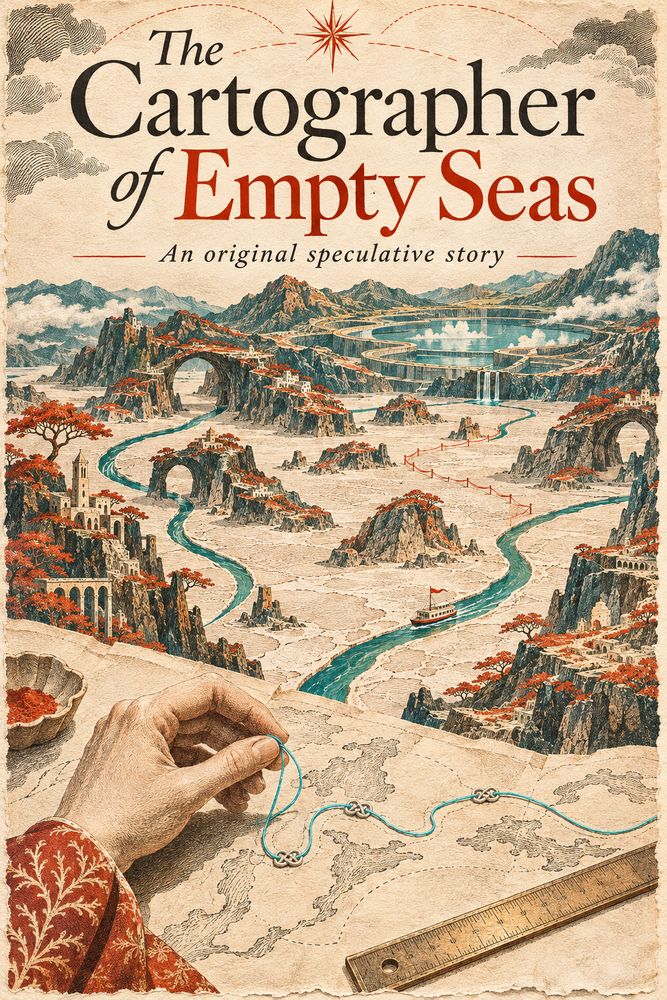
The old pilot house belonged to Dain's aunt, who had retired to the northern islands. Her charts remained in a cupboard above the stove, wrapped against damp in the cloth of a festival banner. She had left Dain permission to use them, though not to cut them into shelf lining.
Sera unrolled a sheet dated twenty years earlier. Three narrow branches connected Merrow's harbour to the inland Salt Basin. Each bore depth marks and the names of small landing places. The modern chart showed a flat strip labelled Managed Reserve.
“Names disappear before places do,” Dain said.
“Sometimes a survey is replaced.”
“Was this one?”
She did not know. She made a tracing, copied the date and marked it HISTORICAL—NOT A CURRENT PASSAGE.
Following the bank next morning, they reached a fence beside the reserve. Behind it, water shone among terraces of white stone. Merrow's empty harbour had an uphill neighbour full enough to reflect the sky.
Kes, the tide engineer, found them at the public inspection board. She wore a coat with salt-stiff cuffs and carried a ledger bound in green leather. Sera showed her the fresh soundings and the old chart.
“The reserve supplies the capital's canal,” Kes said. “Its level has been held high since the spring. Pumps draw water toward the upper terraces; the closed branches keep it from returning to the harbour.”
“By shutting these branches?”
“By controlling them.”
“There is a difference at the far end?”
Kes looked toward Merrow. “Not a useful one.”
She would not let them through the fence. Instead, she opened the inspection ledger at a table outside. Release totals and gate settings were public records under the reserve's own charter, though the office had never sent copies to the harbour.
The entries matched the falling water in Sera's notebook. One margin recorded a broken retaining bank on the third branch. Kes placed her finger there before Sera could turn the page.
“You cannot simply open everything. That bank would fail.”
Sera copied the warning as carefully as the figures that might expose the office. A useful map had to contain inconvenient facts from both sides.