BOOK LIBRARY · Complete books · Purchases disabled
TrendWindow

← Book Library · Complete book

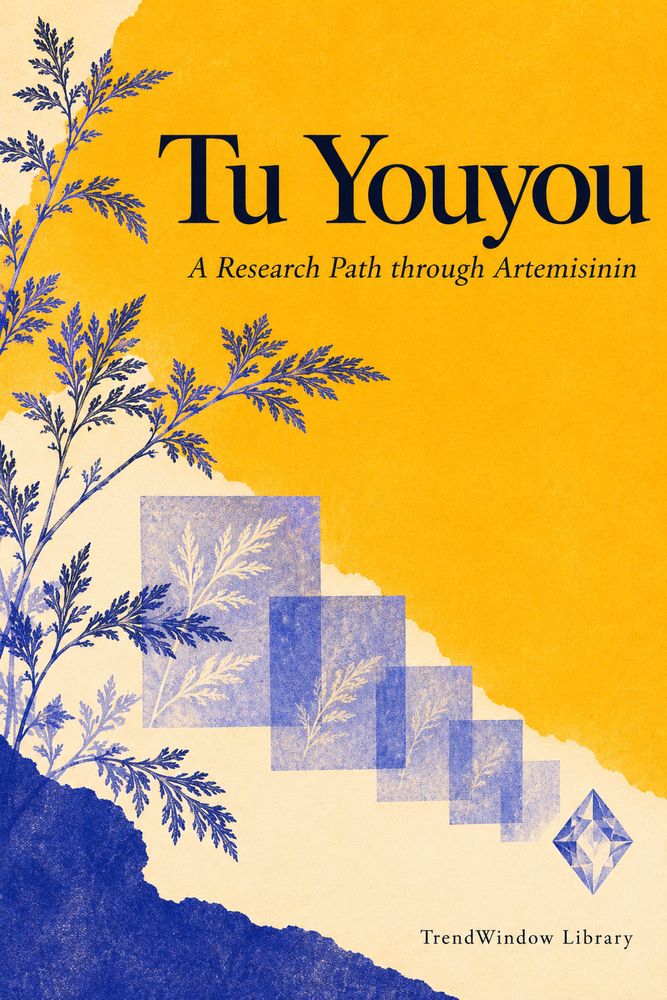
Front cover of Tu Youyou: A Research Path through Artemisinin

Biography & Memoir

Tu Youyou: A Research Path through Artemisinin

By TrendWindow Library

A complete original short interpretive biography of Tu Youyou. Selected records follow pharmaceutical training, artemisinin research and recognition in 2015. Primary sources and clearly stated limits distinguish the stages of investigation, collective work and a documented endpoint from invented private scenes or medical advice.

Read this complete edition, including its ending and notes. No purchase is required.

1. An Education before an Honour

Tu Youyou's story is often introduced with a prize. This short biography begins with the preparation that a prize announcement can compress. China's National Office for Science and Technology Awards records her birth in Ningbo in December 1930, her graduation from the School of Pharmacy at Beijing Medical College in 1955, and her entry into a research institute that year. These are selected institutional facts, not a reconstruction of her childhood.

Education and employment make a useful opening because they give the later achievement a setting. A discovery does not have to be treated as a sudden gift arriving outside a working life. There is a difference between knowing that someone completed pharmaceutical training and pretending to know what she thought while studying. This account follows the first kind of statement. It leaves the second unwritten where the selected evidence does not support it.

Consider how a reader might arrange these early dates. One column can record an event; another can record what the event actually establishes. Graduation establishes a completed course of study. An institutional appointment establishes a working affiliation. Neither entry, by itself, proves that a particular breakthrough was inevitable. The space between preparation and achievement deserves to remain a space in which work occurred, rather than a prediction supplied afterwards.

That distinction also leaves room for the people around a scientist. An institute is a setting for more than one person's activity. Beginning there makes it easier to recognise collaboration later without taking Tu out of her own biography. Her place in the account is central; centrality does not require every surrounding contribution to disappear.

Our route will follow selected records of a research problem, a change in investigation, the difference between an extract and an isolated substance, and later recognition. It closes at a documented milestone in 2015. It does not claim to describe every part of Tu's life or to update her personal circumstances to the present.

2. A Question That an Old Text Could Open

Tu's award-time Nobel autobiography places her appointment to lead a Project 523 research group at her institute in 1969. That wording matters: leadership of an institute's group is not leadership of the entire national programme. A large project and a particular team can belong to the same history without becoming interchangeable names for one person's work.

Her autobiographical account describes looking through older medical literature and investigating possible candidates. For the reader, the important movement is from a recorded suggestion to a question that can be examined. A text can help someone notice a possibility. Its age does not settle whether that possibility will survive investigation.

Imagine three labels for a reading notebook: clue, question and finding. They are our reading aids, not a method attributed to Tu. A clue might direct attention towards something previously overlooked. A question asks what should be investigated about it. A finding reports what an investigation actually supports. Moving a sentence from the first label to the third without the intervening work would erase the very research this biography is trying to understand.

There is another temptation: to make an old passage sound as though it already contained a finished modern medicine. That would flatten the distinction between consulting a record and developing a tested pharmaceutical substance. The older material belongs in this story as part of the search. It does not remove the need for later work, and it does not authorise a reader to turn a historical account into a household remedy.

The chapter therefore ends with an open research question rather than a miracle. An inherited record can be productive because it changes what someone asks next. The value of that change can be acknowledged without granting the record an answer to every subsequent question. This leaves Tu's work visible as investigation, instead of reducing it to either obedience to a tradition or a moment detached from all prior knowledge.

3. More than One Meaning of a Breakthrough

Ushma S. Neill's 2011 JCI interview with Tu provides a participant's recollection of difficulty repeating early results. In that interview, Tu explains that reproducibility mattered to whether a promising candidate could be taken seriously. The report distinguishes encouraging extract results in 1971 from subsequent clinical investigation and the work of isolating an active substance. These are stages of research, not synonyms for one completed event.

The distinction gives this biography its middle. A promising observation can be important while still leaving something unresolved. Identifying what remains unresolved does not belittle the observation. It shows why another step has a purpose. Without that distinction, a reader encounters a flat sequence of successes and cannot understand what the next experiment or investigation was meant to clarify.

Our own reading exercise is to put a different question beside each kind of statement. Beside an extract result, ask what material and setting the account describes. Beside an isolated substance, ask what has now become a more specific object of investigation. Beside a clinical report, ask what was actually studied in people. These questions are offered to organise historical reading; they are not instructions for conducting experiments or treating illness.

An especially careful reader resists borrowing certainty from a later honour and placing it back into every earlier stage. A Nobel award can tell us that an achievement was recognised. It cannot make every preliminary result, at the time it appeared, a completed answer. Retaining the uncertainty in the middle makes the eventual recognition more intelligible.

This account deliberately supplies no extraction recipe, solvent, temperature, dosage or self-experimentation instructions. Those details are unnecessary to follow the distinction between a clue, a promising extract and a researched medicine. The chapter's conclusion is a change in the reader's view of progress: a breakthrough can be a sequence of questions becoming more precise, rather than a single instant in which every difficulty ends.

4. Following a Person without Erasing a Team

Tu's award-time autobiography describes the isolation of artemisinin in 1972 and collaboration on structural investigation. Keeping those statements together prevents an uneven account in which one name receives a biography and everyone else's work becomes scenery. Leadership and collaboration can both remain explicit.

A small publication record offers another useful boundary. PubMed indexes “Antimalaria studies on Qinghaosu” in the December 1979 Chinese Medical Journal, volume 92, issue 12, pages 811–816, PMID 117984. Its indexed record supplies no listed individual authors and no abstract. That is a description of the bibliographic entry reviewed here. The underlying paper has not been read for this edition.

What should a reader do with that limitation? First, avoid filling an empty author field with a confident guess. Second, avoid treating the field as proof that any particular researcher did no work. Third, keep the publication's date separate from the earlier investigations it may concern. A catalogue entry is evidence of a publication; it is not a substitute for reading all the research behind it.

These distinctions change the texture of a biography. Instead of asking only who deserves a single triumphant sentence, the reader can ask which record supports which contribution. A personal recollection, an institutional profile and a bibliographic record have different purposes. Setting them beside one another can reveal their limits as well as their usefulness.

This is also a practical way to respect a named subject. Tu does not need an exaggerated solitary role in order for her leadership to matter. Nor does the existence of a collective programme make her individual contribution meaningless. The account can hold those ideas together without pretending to have reconstructed every laboratory, clinical investigation or exchange between institutions.

The chapter closes with a fuller object than a lone name: a research path with a central person, a group, collaborating institutions and records that preserve different parts of the path. Some details remain outside the selected evidence. Leaving them outside is a deliberate boundary, not an invitation to invent them.

5. A Historical Discovery Is Not a Household Prescription

A reader who has followed the earlier chapters may want the history to offer a simple present-day action. Here the date on a source becomes especially important. A recollection from 2011 and an autobiography prepared for a 2015 award describe earlier work. Neither should quietly become personalised medical guidance in a book researched in 2026.

For a limited present-day boundary, this edition consulted the World Health Organization's malaria questions and answers dated 4 December 2025. WHO does not support using Artemisia plant material in forms such as teas, tablets or capsules for malaria prevention or treatment. This book therefore makes no recommendation to prepare or use such material. It is a research history, not a treatment plan.

The distinction is part of the biography's argument. Admiration for a discovery can coexist with restraint about what a reader should do. In fact, restraint preserves the difference between finding a useful clue and establishing a medicine. If the historical narrative ends by telling people to replace that work with a plant preparation, it has lost sight of its own middle chapters.

Here is an original exercise for reading another medical biography. Draw two boxes headed “What happened then?” and “What is appropriate now?” Put a historical event in the first. In the second, put the need for current, relevant professional guidance rather than a copied conclusion from the event. Leave room for dates in both boxes. The exercise does not supply a diagnosis, a prescription or a rule for choosing a drug.

Keeping those boxes apart also protects the subject from an unfair expectation. A scientist's life need not function as an all-purpose instruction manual for future readers. It can illuminate how work developed, what was recognised and what remains outside the account. The historical achievement retains its importance when the reader declines to turn it into a remedy for personal use.

Our chapter ends at that boundary. The research path is worth understanding on its own terms. Reading it carefully means preserving the difference between an earlier discovery and a present clinical decision.

6. An Ending at Recognition

The Lasker Foundation's own records name Tu as the recipient of its 2011 clinical medical research award for work on artemisinin. The Nobel record identifies her 2015 recognition in Physiology or Medicine for discoveries concerning a therapy against malaria. These documented honours provide the endpoint chosen for this short account. The ending is a milestone, not a claim about the end of her life.

Looking back from that endpoint, the route now has a shape. Preparation comes before the research task. Reading offers a clue rather than a completed answer. Investigations create distinctions between kinds of evidence. A central contribution remains visible within collaborative work. Recognition follows without changing the earlier stages into effortless certainty.

That shape is this edition's interpretation of selected records. It is not Tu's private explanation of herself, and it does not borrow an imagined scene in which she surveys her life. No invented acceptance speech is needed to close the book. The records already give the reader a place to stop and consider what the preceding chapters have established.

Three questions can carry the account beyond its last historical date. What did the source actually establish? Which part of my understanding is an interpretation? What remains unexamined? These are original prompts for the reader, not quotations from Tu or a complete method for assessing medical research.

The first question keeps a date or a team appointment from expanding into an unsupported claim. The second makes room for interpretation while naming it honestly. The third prevents an accessible short biography from pretending to be an exhaustive archive. Together they let admiration remain precise.

This selected account closes in 2015 with recognition of a discovery whose path included preparation, investigation and collaboration. The prize is where we finish reading, rather than where we begin pretending that nothing difficult came before it. Tu's achievement remains in view, and so does the work that gives the achievement its meaning.

Sources and Edition Note

Research checked 7 November 2026, Asia/Dhaka. This is a complete original short interpretive biography with six chapters and a chosen 2015 endpoint, not a complete life survey or a report of Tu's current role, health or personal circumstances. The reading exercises and interpretations are original to this edition. No private thoughts, dialogue, laboratory scenes or quotations have been invented.

National Office for Science and Technology Awards, institutional profile dated 22 December 2017: https://www.nosta.gov.cn/pc/en/awards/awardees1/1456.shtml . The page was read directly for brief early-life, education and institutional facts. Its then-current appointments and old disease statistics are not presented as current.

Tu Youyou's award-time Nobel autobiography: https://www.nobelprize.org/prizes/medicine/2015/tu/biographical/ . Selected official public search-index text was reviewed for the institute's 1969 group leadership, research sequence and 1972 isolation. Direct page access returned 403; this edition does not claim to have read that whole page or the Nobel lecture PDF. Nobel award information was cross-checked in official indexed records, without reproducing an award quotation.

Ushma S. Neill, JCI, 2011 interview: https://www.jci.org/articles/view/60887 . Directly reviewed participant recollections support the limited discussion of repeatability and stages of investigation. The article's other historical narrative is not treated as Tu's own testimony. Recipes, self-experimentation details, clinical percentages and dated treatment claims are not reproduced or recommended.

PubMed record PMID 117984: https://pubmed.ncbi.nlm.nih.gov/117984/ . Public indexed bibliographic text was reviewed; the direct response did not supply the paper. The indexed entry lists no individual authors and no abstract. No claim to have read the full 1979 paper is made.

Lasker Foundation, its own award record and historical essay: https://laskerfoundation.org/winners/artemisinin-therapy-for-malaria/ . Read directly to confirm the 2011 honour. The essay is by Evelyn Strauss, not Tu's autobiography.

World Health Organization, malaria questions and answers, 4 December 2025: https://www.who.int/news-room/questions-and-answers/item/malaria . Read directly for the brief current boundary on Artemisia plant material. This book supplies no clinical regimen, extraction procedure or personalised medical advice.

Facts are briefly paraphrased and sources attributed; no third-party prose, photographs or scientific figures are reproduced. The English front and back covers are original conceptual illustrations. Writing and all translations are AI-assisted with editorial comparison; no independent human-authorship or native-human certification, institutional endorsement, ISBN or print-proof claim is made.

Explore more books →