BOOK LIBRARY · Complete books · Purchases disabled
TrendWindow

← Book Library · Complete book

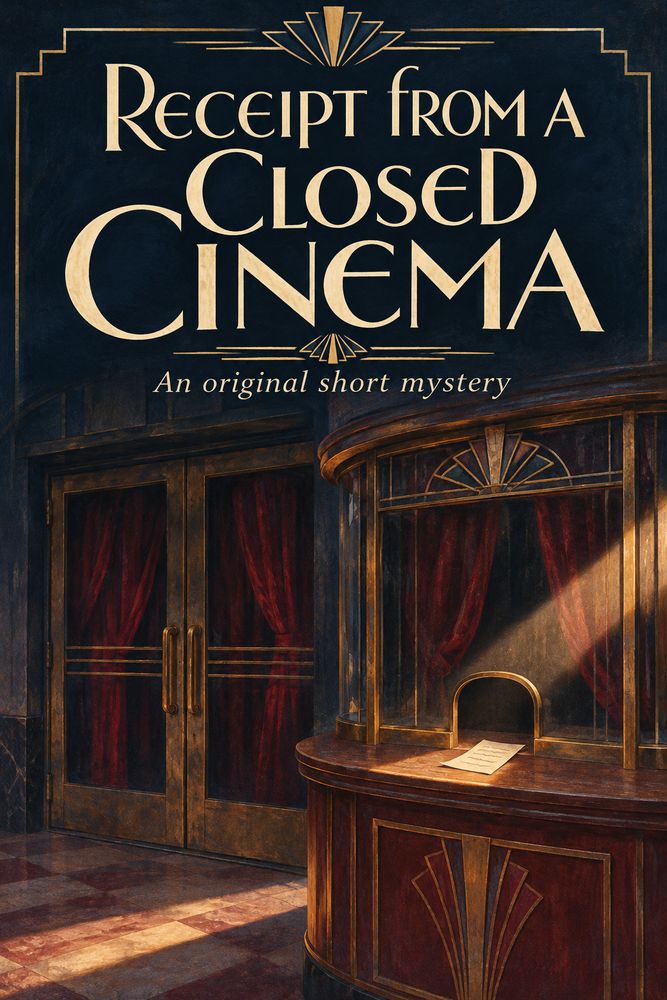
Front cover of Receipt from a Closed Cinema

Mystery, Crime & Thriller

Receipt from a Closed Cinema

By TrendWindow Library

Seven years after the Oriel cinema closed, former projectionist Nessa Vale finds a recent receipt in an old show-time book. A disputed signature leads her through rehearsal bookings, copied paper and misplaced trust. A complete fictional mystery in eight chapters.

Read this complete edition, including its ending and notes. No purchase is required.

About this book

### An original short mystery

This is a work of fiction. Its people, town, cinema, voluntary fund, documents and events are invented. Amounts are in the story's unnamed local currency.

Original complete short mystery prepared with AI assistance. All people, places, fund arrangements, documents and events are fictional; amounts use an unnamed fictional local currency. Not a full-length novel, real case report or financial/legal procedure. Translation meaning reviewed with AI, without independent native-language certification.

1. The grey seam

The Oriel had been closed to the public for seven years when Nessa Vale found a receipt dated the previous week.

She was not looking for money. Adrian Moss, chair of the restoration fund, had asked her to list what remained in the projection room. Most volunteers knew how a cinema ought to look. Nessa, who had spent thirty years upstairs, knew what ought not to be thrown away.

In the margin of her inventory she had written: Do not call everything old rubbish.

The receipt lay inside a hardbound book of show times. Its heading said ORIEL CINEMA. Below it, in a hand she did not recognize, were the words Hall hire: rehearsal 3, the amount 80, and the date 6 November. Number 0471 stood in the corner. The signature appeared to be Tomas Reed's.

A grey seam ran down the page, crossing the signature. Nessa held it nearer the window without pulling it from the book.

Tomas had let her in. Now he stood on the landing with two mugs, keeping clear of the box she had placed outside the door.

“Were there rehearsals here?” she asked.

“Only in Adrian's promises.”

He looked at the page. One mug tilted, and tea ran over his knuckles. He set both down.

“I haven't signed that.”

Nessa had heard those words often in films. In life they did not arrive with music. They left a man standing beside cooling tea, unable to think of a second sentence.

She photographed the open book, then the receipt, with his agreement. She wrote down where and when they had found it. She did not add thief, fraud or proof.

Downstairs, Adrian was sorting a stack of publicity leaflets. He glanced at the photograph and said the choir had held private rehearsals while the building remained closed to audiences.

“Nothing to concern yourself with. The fund has copies.”

“I'd like to understand mine.”

Adrian placed a leaflet precisely on the stack.

“Then speak to Iris. She does the figures.”

Outside, the noticeboard still advertised the Oriel's last film. Rain had taken the faces from the poster, but left the title legible. Nessa had always found that the cruelest part.
2. Six evenings

Iris Bell worked in the back room of the library, where the restoration fund kept its records by arrangement. She was new enough to write down questions that everyone else had learned not to ask.

Nessa showed her the photograph.

“I was going to ask about these at Thursday's meeting,” Iris said.

Six entries appeared in the expense list. Each was for 80, each described as a rehearsal-hall payment. Together they made 480. The claimed dates ran from late October into November. Receipt 0471 was the third of six consecutive numbers, 0469 to 0474.

Iris had the six scanned receipts in the fund's shared folder. All named the Oriel. All appeared to bear Tomas's signature.

“Does that mean he received the money?”

“It means somebody supplied papers saying he did.”

“Who was paid from the fund?”

Iris turned to another page, then stopped with her finger between two lines.

“Let me check the supporting record before I answer that.”

Nessa liked her more for stopping.

Adrian had approved the payments under a temporary arrangement made before Iris joined. He had told the committee that small cash expenses kept the project moving. Nessa remembered nodding at that meeting. The roof estimate had just come in, and everyone had been desperate to discuss something affordable.

“I nodded too,” she said.

“That isn't a receipt.”

“No. It isn't nothing, either.”

Iris made a note of Nessa's discovery and asked her to leave the original where it was until they could agree how to preserve it. They arranged to return with Tomas that afternoon.

In the library corridor, an adult choir was rehearsing behind a half-open door. Someone stopped a phrase halfway through and laughed. Another voice began the troublesome passage slowly.

Nessa waited until they finished. On a table outside the room stood a handwritten sign: Oriel Voices — rehearsal.

She had seen that name on the fund's leaflets. Beneath it the printer had placed a small drawing of the cinema.

A name was a place people could carry with them, she thought. It was not evidence that they had been there.

3. A room with no audience

Tomas met them at the Oriel with the inventory key and the last seven years of suspicion already on his face.

“I have receipts for things I've bought,” he said before Iris had taken off her coat. “Washers. Paint. A replacement lock. You can see them.”

“We're checking these six payments,” Iris replied. “We aren't asking you to account for your whole life.”

They photographed the receipt in position again, then placed it in a clear sleeve, noting the transfer together. Up close, the grey seam belonged to a copied page. The paper carried no obvious fresh pen marks. That did not establish whether the transaction was real; it only meant they had not found the signed original.

Nessa opened the show-time book at its first page. Years ago, she had tucked small maintenance acknowledgments into its back cover because there had never been enough drawers upstairs.

One remained: Tomas had received 12 for repairing a loose cupboard door before the cinema closed. His signature ended in a climbing stroke. Beside it sat a tiny round ink spot.

The same stroke and spot appeared on receipt 0471.

“People sign their names the same way,” Tomas said.

“Not always the same accident,” Nessa replied. Then she caught herself. “But that still doesn't tell us who made this.”

Iris photographed both pages. She would not let a resemblance do the work of an investigation.

They stayed in the areas Tomas had cleared for the inventory. The auditorium was not ready for use. Through its open doorway Nessa could see covered seats and the pale rectangle where a notice had been removed.

No absence of footprints could prove six evenings had not happened. Someone could have tidied a room. Dust was not a witness Nessa could question.

Tomas produced his diary instead. On every claimed date, he had written ordinary things: a delivery, a leaking tap, his sister's visit. None proved the whole day.

“I can't prove I didn't take it.”

“You don't have to invent a perfect diary,” Iris said.

Nessa put the old acknowledgment in a separate sleeve. For years she had saved scraps because they seemed too small to matter. Now the smallness mattered most.

4. The third rehearsal

Lena, the choir's organizer, agreed to meet them after practice. She brought a battered folder and a pencil worn almost to its metal collar.

“Adrian found us the name,” she said. “I found us somewhere to sing.”

Their six rehearsals had taken place in the library room. The library had offered the room without charge. Lena showed Iris the booking confirmations and her messages to the singers. The third booking was 6 November.

Nessa did not ask for the singers' private conversations. Iris recorded the relevant dates with Lena's permission and kept unrelated messages out of the copies.

“Did Adrian say the fund was paying rent here?”

“He said the cinema needed us to be visible.”

“That isn't what I asked.”

Lena looked at the folder for a long time.

“No. He didn't.”

They checked the library's room record with the member of staff responsible for bookings. It agreed with Lena's dates. Nobody claimed that a booking record alone could account for every singer's movements. But the organizer, messages and room record told the same practical story: the rehearsals described on the receipts had been held elsewhere, free.

Lena began to cry angrily.

“We were going to sing at the reopening. We haven't even asked for travel money.”

Nessa had expected to feel triumph when something finally matched. Instead she found herself pushing a clean handkerchief across a table.

On the way out, they met Mara, the printer, delivering library notices. She recognized the cinema heading in the photograph on Iris's screen.

“Adrian wanted that old lettering,” she said. “I made him a new receipt book last month.”

“Did you put signatures in it?”

“Of course not. Blank lines. He wanted the numbers to continue the old sequence.”

Iris asked Mara to keep her order record and arrange a separate conversation. A printing order was not a confession, either. A restoration chair might have a perfectly ordinary reason to order stationery.

But Nessa could now separate two things she had confused upstairs: the cinema's old appearance and the age of the paper carrying it.

5. The expense column

Iris called Nessa the next morning.

“The fund paid Adrian. Six reimbursements of 80. He said he'd first paid Tomas in cash.”

There was no mystery in the bank record Iris was authorized to inspect. The recipient and the expense claims matched. What remained uncertain was whether Adrian had ever paid Tomas as he claimed.

Nessa went to the library. Iris had spread copies in three rows: what the fund paid, what the receipts claimed, where the rehearsals happened.

“Don't merge them,” she said. “That's how a story becomes more certain than its evidence.”

Tomas had denied receiving the money. Lena and the library confirmed a different rehearsal venue. Mara's order connected Adrian to new stationery. The matching signature and ink spot raised a further question. None of those facts needed a secret tunnel or a midnight screening.

Nessa felt embarrassed by how much she had wanted the locked cinema to contain something dramatic.

“It does,” Iris said. “It contains a man's name being used without his agreement.”

They prepared a short account for the committee members who had not approved the payments. Iris listed the remaining uncertainties, including how the copy had reached Nessa's book. They asked Adrian to attend a meeting with the records available. They did not send accusations to the choir's mailing list.

Before leaving, Nessa read her own old committee notes. Adrian's request to simplify small expenses had passed without a question. Her handwriting beside it said Agreed.

She could have argued that she was only the projectionist. Yet she had wanted a say in the cinema's future when the conversation concerned lamps and curtains.

At home she took a pen from the kitchen drawer and wrote what she remembered of that meeting. She included what she did not remember.

For the first time since finding the receipt, she slept without imagining the booth door opening.

The next morning brought a message from Adrian: Could they talk privately first? There was an explanation which would sound worse in a room full of people.

Nessa read it twice. Then she sent it to Iris.

6. A difficult invitation

They met Adrian in the library with two committee members present. Tomas chose not to attend the first part. Iris would give him a written account afterwards.

Adrian arrived carrying a bag of replacement bulbs he had bought for the foyer.

“I've spent years on this place,” he said.

“Today we're discussing six payments,” Iris answered.

He described the choir's goodwill, the roof, the work nobody thanked him for. One committee member tried to help by saying that perhaps the descriptions were merely wrong.

Iris placed the copies on the table.

“Then tell us what each payment was for.”

Adrian said the cash had gone to Tomas.

Nessa did not raise her voice. “For rehearsals in which room?”

“The main room.”

“Which rehearsals?”

“The choir's.”

Lena's booking confirmations lay beside the receipts. Adrian looked at them, then at the bulbs.

Nobody filled the silence for him.

At last he said, “I intended to replace it before the accounts were shown.”

It was not a complete explanation. Iris asked what he meant by it.

He had claimed the six reimbursements without paying Tomas. He had used the money towards a personal debt. When an expense needed supporting paper, he had made the false records. The old maintenance acknowledgment had supplied the signature he reproduced on the copies.

He said Tomas's name had seemed safe because Tomas rarely attended meetings.

Nessa moved her chair back. She needed the space, though Adrian had not moved.

“Safe for whom?”

He could not answer.

The committee recorded what he said and the documents he identified. They would secure the records, stop his access to the fund's payment process, seek independent advice and refer the matter to the appropriate authorities. A promise to repay would not erase the false claims. Nor could the people at the table pronounce the eventual outcome of an investigation.

Adrian asked whether the choir needed to know.

“They need the truth about the money raised in their name,” one member said. “And Tomas needs a correction in his.”

The bulbs remained on the table after Adrian left. Nobody could decide where to put them.

7. What the copies concealed

The original new receipt book arrived with other papers Adrian handed over. It contained blank signature lines and the numbered pages from which his supporting copies had been made. Iris preserved it with the rest of the records.

Adrian also explained the page in the projection room.

He had borrowed Nessa's show-time book while looking for the cinema's old lettering. He had found the maintenance acknowledgment inside. Later, when taking new copies upstairs to compare their appearance, he had left one in the book and forgotten it.

That account fitted the discovered page. Nessa recorded it as his explanation, not as something she had witnessed.

Tomas came to the committee's next meeting. A member read the correction aloud: the six rental payments had not been received by him; the rehearsals had not taken place at the cinema; the fund's money had been reimbursed to Adrian under false claims.

“I want that attached to the accounts,” Tomas said.

“It will be.”

“And sent to the people who were told I'd been paid.”

“Yes.”

He did not ask for applause. When someone began to praise his patience, he said he had not been patient at all.

Nessa walked him to the door.

“I'm sorry I asked you as though the paper knew more than you did.”

“You asked,” he said. “Then you stayed to hear the answer.”

It was more generous than she expected, but it was not permission to forget.

The restoration project slowed while the committee checked the remaining records. Some supporters withdrew. Others stayed. New arrangements required separate checks on expenses and a clear explanation to members. Those changes could not make the lost trust return on command.

Lena moved the choir's sign away from the drawing of the cinema. Beneath Oriel Voices she added: Rehearsing at the library.

Nessa offered to make the lettering neater.

“No,” Lena said. “That will do.”

For once, Nessa agreed. The location was clear. The claim was small enough to be true.

8. The first honest screening

Months passed before the Oriel held another public event. Work was completed, the necessary local checks and permissions were obtained, and the committee announced a modest screening it could actually deliver.

The case concerning Adrian had not acquired a neat ending for the sake of the programme. The fund's reports distinguished money recovered from money still outstanding. Further proceedings belonged in their proper place, not in a speech before a film.

Nessa returned to the projection room as a volunteer. Beside her old show-time book stood a new inventory folder. The original documents from the inquiry remained with the people responsible for them; she kept only a clearly marked copy of her own notes.

Tomas arrived with tea.

“Don't spill it,” she said.

“You first.”

Downstairs, Lena counted the choir into a short opening song. The room was not full. Several seats remained empty, and Nessa felt no urge to adjust the attendance figure.

At the ticket table, Iris gave a visitor a receipt. It described a ticket to that evening's event, with the actual amount and date. A second volunteer checked the tally.

The paper was ordinary. That was what Nessa liked about it.

She had once believed the projection room was where darkness became a story. Now she thought of the narrow window as a responsibility: the people downstairs could only see what someone chose to send through it.

Before the lights dimmed, the committee thanked the volunteers by name. Tomas's name was spoken without an explanation attached. He looked up, nodded once and went back to making sure the foyer door was clear.

The film began.

Nessa listened for a moment to the audience settling: a coat folded, a cough, the small communal silence before the first line. Nothing in that sound could repay the missing money or remove the weeks Tomas had spent defending himself.

Still, it was a real audience, in a real room, on the evening the ticket promised.

When the last visitor had gone, Nessa entered the show time in the book. Under attendance she wrote the number Iris had counted.

Then she closed it without putting anything between the pages.

The end.

Explore more books →