BOOK LIBRARY · Complete books · Purchases disabled
TrendWindow

← Book Library · Complete book

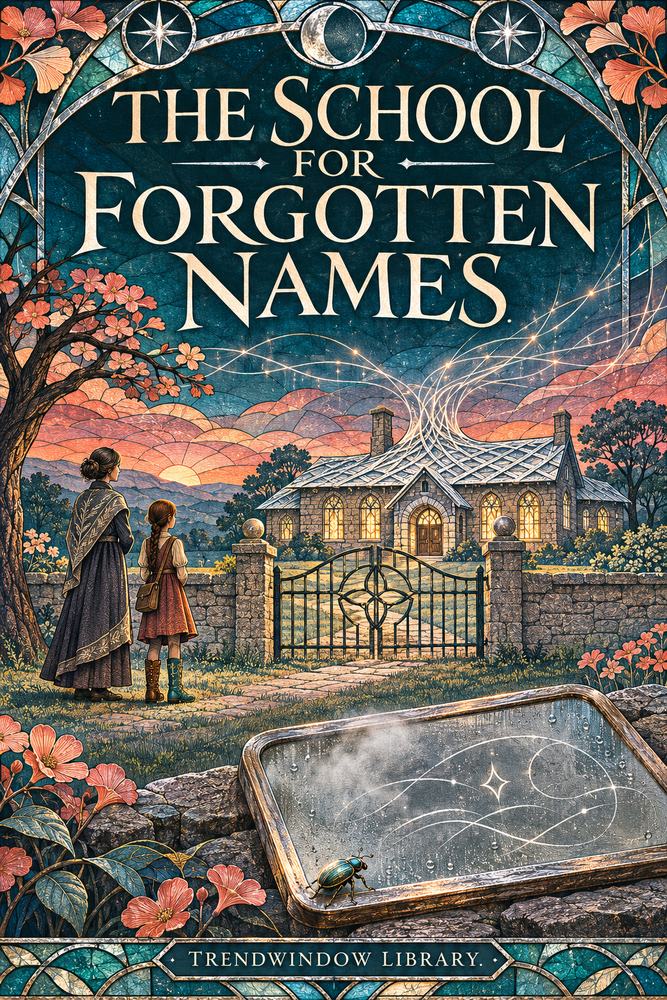
Front cover of The School for Forgotten Names

Fantasy & Science Fiction

The School for Forgotten Names

By TrendWindow Library

A complete original short fantasy in eight chapters. When Miri loses her name, teacher Idra uncovers the secret bargain that repairs their school roof. Restoring one name reveals the truth; freeing the others requires ordinary shelter and adult accountability.

Read this complete edition, including its ending and notes. No purchase is required.

About this story

A complete original short fantasy in eight chapters. Idra, Miri, Corren, Tovan and the city of Vey are invented, as are the school's history and all its magic. This is fiction, not a record of a real school or guidance on education or building safety.

© 2026 TrendWindow Library. Original AI-assisted fiction and translations, reviewed by an AI assistant. No independent human-editor or native-speaker certification is claimed.

1. The empty place in the roll

On the morning her name disappeared, Miri arrived with a beetle in a matchbox and an argument about its legs. Idra counted six with her. The beetle climbed over the teacher's thumb, apparently indifferent to being right.

Then Idra opened the register.

There was a gap between two names. Not a missing line: the lines were still there, and the little ink mark Idra had made beside yesterday's late arrival. Only the name had gone. She looked up at the girl with the matchbox.

She knew her. Eleven years old. Quick to volunteer, slower to surrender an argument. Her father baked the round loaves sold beside the east gate. On wet days she wore two different boots because one of each pair had a hole.

Idra knew her name, too. It sat in her mind as clearly as the girl sat at the second desk. But when she tried to say it, her mouth made a small, useless breath.

The class went quiet.

"It happened to Grandfather," a boy whispered. "They called him Grandfather until the end."

"We will not decide anyone's whole life before the first lesson," Idra said.

The girl shut the matchbox. "Can I still stay?"

Idra nearly answered too quickly. She put the register down, came around the desk and sat in the empty chair beside her.

"Yes. And I will find out why the book has a blank. You haven't done anything wrong."

All over Vey, names sometimes vanished. People remembered the people, the jokes, the debts, the way a particular person knocked. They could not speak or keep a written mark of the missing name. Explanations multiplied where names did not: age, fog, an unlucky remark at supper. Nobody had found a pattern that everyone accepted.

The school offered the unnamed a place. Its sign said so beneath the silver roof. Idra had taught there for nine years, and before that she had been a pupil herself.

She gave the girl fresh paper. The girl wrote carefully. Before the final stroke was dry, every letter withdrew into the page.

"That," she said, "is extremely rude."

Idra laughed once. It helped more than her first promise had.
2. Breath on glass

After lessons, Idra took the register to Headmaster Corren. He ran a hand across the blank without touching it.

"The old misfortune," he said. "We can give her a classroom name. Something she chooses."

"She has a name she chooses. The one she is trying to keep."

He looked towards the window. A torn patch in the silver roof was knitting itself closed. The city had ordinary roofs as well, patched by ordinary workers, but the school had never needed to buy a replacement tile.

"We must keep the place open," he said.

It was an answer to a question she had not asked.

In her classroom, the girl was drawing the beetle on an old glass slate. Such slates had been cut from spare roof glass when the school was built. Nobody used them much now; paper did not break when dropped.

She breathed on the glass to rub out a leg. In the mist, for a moment, letters appeared underneath the drawing.

Idra leaned closer. There was the girl's name, which neither of them could put into ordinary speech.

The glass cleared. The letters vanished.

"Again," Idra said, then stopped. "Would you show me again?"

The girl breathed. The letters returned. They were not ink, not a reflection. Tiny silver strands rested inside the glass.

Her father, Tovan, arrived carrying the day's unsold rolls. Idra told him what had happened. His face changed slowly, as though each part had to hear the news separately. He could still remember the afternoon his mother had suggested the name. He could not tell Idra what she had suggested.

"She is here," he said at last, looking at his daughter rather than the register.

"I know," the girl answered. "I'm hungry as well."

They ate a roll together. Idra kept the slate on the table between them and asked permission to investigate it. Tovan agreed. His daughter agreed too, on condition that nobody replaced her name with Beetle.

3. The first winter

The school's oldest room was not a classroom. It was a cupboard behind the assembly hall, built before the hall had grown around it. Corren opened it when Idra asked for the accounts from the first winter.

He did not ask why she wanted them. That troubled her more than a refusal would have.

Inside were lists of timber, blankets, lamps and flour. Idra had expected a spell disguised as a lesson. She found instead a town trying to keep children warm through a long season of snow. The founders had collected enough for walls and not enough for a roof.

One sheet recorded the offer of a silver-roof maker. No money was required. The school would give a name at each dusk when the roof needed mending. Names of those admitted could be called upon even after they left. A head's renewal would keep the arrangement running for another year.

"A name isn't a person," someone had written in the margin.

Someone else had answered, in smaller letters, "Ask the person."

There was an iron admission seal in the cupboard, shaped like a small closed hand. Idra recognised its mark from old school papers. Every pupil's admission had entered them into the bargain. Their parents had never been shown the page that explained what the mark meant.

Corren stood by the door.

"You knew."

"I knew what the charter said. I told myself the disappearing names might have another cause."

"Did you renew it?"

"Last winter. And the winter before."

Idra wanted him to be someone who enjoyed this. It would have been easier to know how to stand in the room. Instead he looked like a tired man who had practised not finishing a thought.

He found a second sheet. It described a narrow aperture in the outer foundation wall, where a name could be claimed by its owner. The silver maker had left that provision in the bargain. No headmaster could speak on another person's behalf there.

"I never tried it," Corren said.

Idra took copies in ordinary ink. These words stayed on the paper. Only the pledged names were being stolen.

4. A name with a door

The aperture was beside the kitchen entrance, no higher than a child's shoulder. For years Idra had thought it an unfinished letterbox. It opened into a shallow recess, not a passage anyone could enter. Around its edge ran a sentence almost rubbed away:

WHAT IS YOURS MAY ANSWER HERE.

Tovan brought his daughter to see it the next morning. Idra explained what the pages said, including what she did not know. Claiming one name would open its seal. It would also make the bargain audible throughout the school. She could not promise what the roof would do in response.

"Then take everyone out first," Tovan said.

They did. The pupils carried books into the courtyard. Corren told the other teachers what he had renewed. Idra heard the short silence after he said it, then questions he could not answer with a timetable.

The girl stood outside beside the aperture. Her father held the glass slate while she breathed on it. The letters of her name appeared.

"I can see it," she said. "But what if it won't come out?"

"We can stop," Idra said.

"I want to try."

She faced the recess. Her first breath made no sound. On the second she put a hand against the stone, not to push it, only to have somewhere for her shaking fingers to rest.

"Miri."

The name came out as an ordinary word.

"Miri," she said again, louder, delighted and furious.

Something opened inside the wall. Not a door: a long fold of darkness, stitched with silver. The school spoke from its empty classrooms. It recited the founding terms, the names of the heads who had renewed them, and the sentence about a name not being a person.

Then, in Corren's own voice, it spoke the date of the latest renewal.

No one in the courtyard could mistake it for fog.

5. The room that wanted a roof

Miri wrote her name on the back of Idra's copied account. It stayed. Her father touched the ink with one finger and left a floury print beside it.

But the other names had not returned. From the opened fold came whispers without their words, as if a hundred people were remembering what they had meant to say.

The school spoke again. This time its voice came from the assembly hall, where the youngest pupils had left their cushions.

"There will be rain."

Corren looked up. Clouds were gathering beyond the silver ridge.

"There will be winter," the school said.

Nobody argued. Vey did have winters. People needed dry rooms. The founding mistake had not made those needs imaginary.

Idra searched the second sheet with Corren. Ending a renewal required the head to return the admission seal through the aperture at dusk. No new names would be taken; the stored names would be released. The silver roof would unwind. The walls would remain, but the shelter they had counted on would be gone.

"We can't teach fifty-three pupils in a courtyard all winter," Corren said.

"Then we need somewhere else," Idra answered.

He asked whether there might be a lesser bargain. Adult names. Voluntary names. A single valuable name in exchange for all the others.

Miri looked towards Idra, suddenly frightened.

"No," Idra said. "We are not asking who can bear to be the payment."

She did not know whether another bargain would work. She would not leave the children listening while adults tested the price of themselves.

Tovan went to speak to the people who used the old laundry room behind the bakery. Another teacher went to the makers' hall. Corren began telling families exactly why their children were outside.

The school repeated its warning about winter. This time, from the courtyard, a small voice answered, "We heard you."

It was Miri. Her name was on her paper. Her beetle, safely released the previous afternoon, was beyond the school's accounts entirely.

6. Before the dusk bell

By noon they had more offers than usable rooms.

A man offered a cellar that smelled of damp cloth. A shopkeeper offered an upstairs room reached by a staircase too narrow for the crowd. Idra thanked them and said no. Being grateful did not require putting pupils anywhere someone happened to unlock.

The laundry room was dry and had two doors. Its owners agreed to move their stored baskets. The makers' hall could spare its small meeting room in the mornings. Neither place could hold the whole school. The teachers worked out temporary groups and told families where to bring each child the next day. They would have to keep adjusting. They would have to find money for a lasting roof.

Corren wrote the bargain out on a broad sheet for everyone to read. Below it he added his own renewals and the fact that he had concealed the terms. He did not end with a sentence about good intentions.

"Will I still be head?" he asked Idra.

"That is not mine to promise."

He nodded and carried another box of books outside.

The school watched them through its windows. When a chair caught in a doorway, the frame widened to let it through. When Corren approached with the seal, the kitchen door swung shut.

They did not need that door. The aperture was outside.

Near dusk, Miri asked whether her name might disappear again. Idra showed her the exact lines they were relying on. She said they would watch together, and write down anything that differed. Miri folded the account and gave it back. She preferred to keep her own piece of paper.

All pupils were with their families by the courtyard gate. The teachers had checked that nobody remained in the rooms, then counted one another. Tovan stood with Miri beyond the clear space around the building. Idra and Corren waited at the outer wall, beside the shallow opening.

From the hall came the first soft note of the dusk bell.

"Please," the school said.

Corren closed his hand around the seal. Then he opened it.

7. What fell and what returned

The iron hand fitted the recess exactly.

Corren pushed it no farther than the stone allowed. The fingers of the seal unfolded, one by one. On the copied account in Idra's pocket, the words of the renewal drew a dark line through themselves.

The bell stopped after a single note.

A name came out of the aperture. Idra did not know whose it was. It crossed her cheek like a warm thread and flew towards the city. Then another followed, then so many that the air shone between the school and the gate.

They did not strike people or enter the wrong mouths. Each went where it belonged. From the courtyard came cries, then laughter, then the particular silence of someone testing a word they had wanted for years.

Idra heard her own old teacher's name. The woman had moved away long ago; the silver thread rose over the wall and kept going. The charter had reached farther than the city. Its undoing followed the same paths.

Above them, the roof loosened from the ridge. It did not fall in heavy pieces. It unstitched into long, light ribbons that curled upwards and thinned into evening. The ordinary rafters remained bare against the sky.

Idra and Corren stepped away from the wall. No one went back inside.

For a moment the school looked very small. Its high silver shine had made it seem a promise that could not be questioned. Without the shine it was a building with rooms, a wet floor to come, and repairs nobody yet knew how to pay for.

"I kept you warm," it said, almost too softly to hear.

"Yes," Corren answered. "And we let you take what wasn't ours."

He did not ask the building to forgive him. It did not ask him again for a name.

Tovan called his daughter. "Miri!"

She called back, "I'm here!" Then she laughed because, for once, she had not needed to prove that she was.

The first rain fell on the uncovered desks they had not been able to move. Idra watched the dark spots appear. Losing the roof had a cost. It was not the cost they would keep making someone else pay.

8. Classes elsewhere

For three weeks the school met in borrowed rooms. Bread smells interrupted the morning reading. A hammer from the makers' hall interrupted counting, and the youngest pupils accused it of always arriving on the wrong number.

Names returned, but not every hurt disappeared with them. Some families wanted explanations before they would enter any classroom again. Teachers brought lessons to agreed doorsteps. Other families asked for copies of the charter and the renewals. Corren gave them copies.

He no longer directed the school. A temporary group of teachers and families arranged the rooms and spending while a longer decision was made. He helped carry things when asked. An apology did not give him the right to decide how soon everyone trusted him.

Idra wanted to say that she had never known. It was true. It was also smaller than the question of why she had accepted so many blanks as something teaching could not change. She began keeping questions that had no answer beside the register, not underneath it.

The city did not suddenly have enough timber. The first new roof covered only one classroom. The rest of the building stayed closed. When that room reopened, rain drummed on ordinary tiles, and the bill for them was pinned where everyone could see it.

Miri entered in her two different boots. She had drawn a beetle on the cover of a new exercise book. Above it, in black ink, was her name.

"Do you want to read the first line?" Idra asked.

"Not today."

"All right."

Another pupil volunteered. Miri listened, then objected to the story's claim that every dragon liked gold. She thought at least one would prefer a proper meal.

At the end of the lesson Idra closed the register. Beyond the window, part of the old school was still open to the sky. There was work waiting there, and an argument about who would do it, and more than one possible answer.

Inside, when she called Miri to collect the forgotten pencil, the girl turned.

Explore more books →