BOOK LIBRARY · Complete books · Purchases disabled
TrendWindow

← Book Library · Complete book

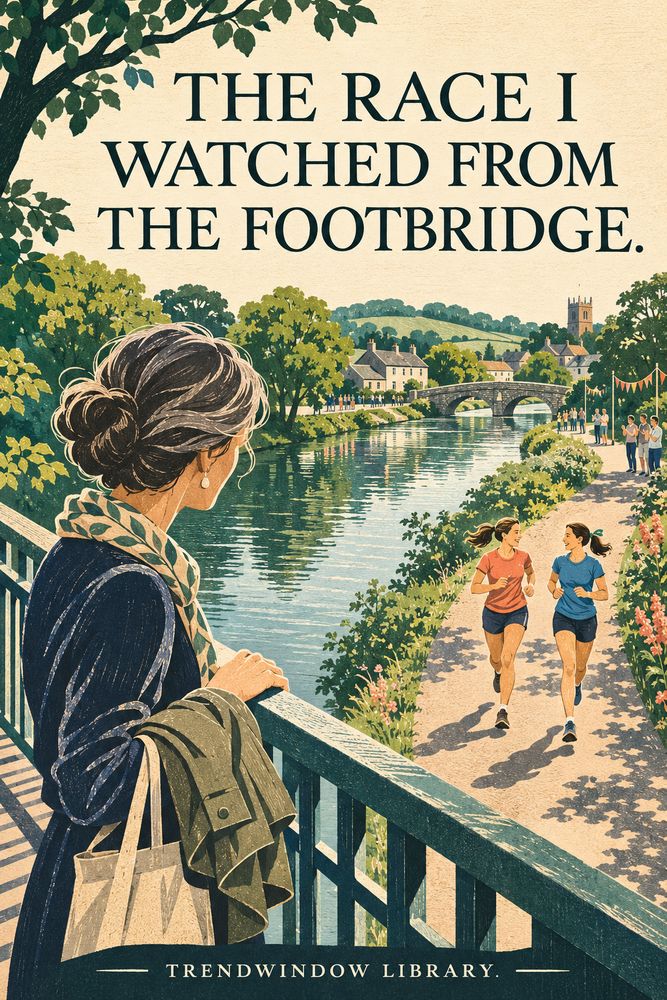
Front cover of The Race I Watched from the Footbridge

Contemporary & Literary Fiction

The Race I Watched from the Footbridge

By TrendWindow Library

A complete original work of first-person literary fiction. Nora remembers her old race time to the second. Her adult daughter Holly wants to finish a first ten-kilometre race with a friend. From a footbridge, Nora learns how to cheer without turning her daughter’s run into her own.

Read this complete edition, including its ending and notes. No purchase is required.

1. My Old Time

When Holly told me she had entered the ten-kilometre race, I found my old result before I asked whether she was pleased.

Fifty-four minutes and twelve seconds. I had written it on the back of a photograph in a hand much firmer than the legs in the picture looked. Holly was five then. She stood beside me holding my medal by its ribbon, as if it were something I had brought home for her.

Now she was twenty-seven, and I was fifty-four. I could still remember the last corner of that race more clearly than the meal we had eaten afterwards.

“You can do better than this,” I told her, tapping the number.

“I haven't done one yet.”

“I know. I'm saying you have it in you.”

She looked at the photograph. My younger face was flushed, delighted and interested in the camera.

“You look happy.”

“I was.”

“That's what I'd like.”

I heard a modest ambition waiting to be improved. It did not occur to me that she had already stated the whole thing.

2. The Things I Sent

I sent her messages. Not constantly. This distinction mattered to me at the time.

I sent the old photograph, a question about her number and a reminder that I could stand near the end. Then I sent my thoughts about the time she might aim for, though she had not asked for one.

She answered the question about the number. She would collect it on the morning of the race. She was running with Jules, her friend from work.

“The whole way?” I asked when she came for supper on Thursday.

“That's the plan.”

“What if you want to go faster?”

“Then I'll speak to Jules.”

She put a fork beside each plate. The movement was familiar enough to make me forget she had a home in which I did not know where the forks lived.

“I only mean you shouldn't hold yourself back.”

Holly stopped arranging the table.

“Mum, I chose to run with her.”

I went to stir something that did not need stirring.

“Of course.”

“And I don't want a target from your photograph.”

The spoon caught the side of the pan.

“I thought you'd like encouragement.”

“I would.”

She waited. I wished she had gone on speaking, so that I could find a smaller point to answer.

“What kind?” I asked at last.

“Come and see me. Call my name. Don't tell me what time I should be doing.”

Her name. I had been given something very simple and found it almost embarrassingly difficult to accept.

3. Where I Could Stand

The race began at ten on Sunday. In the little map Holly showed me, the river path passed beneath a public footbridge near the eight-kilometre point. Spectators could stand on the bridge, apart from the runners, then walk by a short separate path to the finish field.

“There?” she asked.

“I'll find you.”

“You'll see both of us.”

“Both of you.”

I was not being asked to follow her round with advice. I would hold the jacket she wanted afterwards and meet her in the field. Jules had a sister coming too.

On Saturday I took the photograph out again. There was nothing wrong with the woman in it. I had enjoyed being fast enough for my own particular number. I had worked for it. I did not have to make myself ashamed of that to stop handing it to somebody else.

What unsettled me was the thought that Holly could run the whole distance and return with a story in which my result had no part.

I used to think parents feared being needed too much. That evening I saw a less flattering possibility: sometimes we keep offering what we know because we do not know what to do when it is not needed.

I put the photograph back in its envelope. I did not throw it away to make a point. On the kitchen chair, I left an empty tote bag for her jacket.

4. Above the River Path

Holly wore a coral-coloured top. Jules wore blue. They found me before the start, handed over Holly's jacket and asked where the bag would be afterwards.

“With me,” I said.

“Good.”

Jules was twenty-eight and had a small green ribbon tied to her hair. I had known about her for months without asking Holly much beyond whether they worked in the same room.

“Nice to meet you properly,” I said.

“You too.”

There was no time to turn that into a speech about all the things I now understood. They had a race to begin.

I watched them join the other runners, then walked to the footbridge. The towpath ran along one bank below me. Across the river, a dog kept deciding not to enter the water.

The first runners passed. People on the bridge called names, clapped and leaned back from the rail to let others see. I looked at my watch once, then again.

At my old finishing time, Holly had not reached the bridge.

Of course she had not. There were still two kilometres beyond it. I had known the map. Knowing did not entirely remove the old calculation from my body.

I began to prepare a sentence. Something about making up time. Something that would have turned the sight of my daughter into a correction.

Then I saw coral beside blue.

They were coming round the bend together. Holly's mouth was open. Jules glanced towards her, and Holly nodded. I could not know from above what had been said.

“Holly!” I called.

She looked up.

I clapped. I called Jules's name too.

Holly lifted a hand. Neither of them stopped. I did not call a number after them.

5. What I Had Not Seen

I reached the finish field by the separate path and found a place outside the marked finish channel. Jules's sister, Anya, recognised the jacket over my bag.

“You must be Holly's mum.”

“Nora.”

“Anya.”

She offered me a mint. We watched for our two colours.

They crossed the line together. Holly bent forward for a moment, then straightened and laughed at something Jules said. I waited where we had agreed rather than go into the channel to collect her as if she were still five.

When she came over, she put both arms round me.

“I did it.”

“You did.”

Her face was warm against my cheek. I gave her the jacket when she asked for it.

“One fourteen oh six,” she said later, looking at the result on her phone. “A time to start with.”

The old comparison arrived. I noticed it and did not offer it as my reply.

“How was it?” I asked.

She told me about the beginning, when she had nearly lost Jules in the crowd. About a man whose hat kept turning sideways. About a stretch where she had wanted to stop talking, and Jules had understood without making her explain.

“At the bend before your bridge, I asked if we were still together,” she said. “Jules said yes, unless I wanted something different. I said this was what I wanted.”

I had seen the nod. I had not seen what it meant.

I listened to the part after the bridge too. There had been a point where the finish seemed to move away each time she looked for it. Then it had been there.

None of these things had appeared on the little map. None was missing because the time was slower than mine.

Anya took a photograph of Holly and Jules. Holly asked if I would join them for another. I stood where she pointed and let her hold her own medal.

6. After the Finish

We ate at a café away from the field. Holly chose a sandwich, then changed her mind when she saw the soup. Jules laughed because she had done the same. Anya and I moved our chairs so they could sit together.

The medal lay on the table beside Holly's phone. It was neither a lesson for me nor a new family possession. She picked it up when the plates came.

“Would you do another?” I asked.

“Maybe. Not deciding today.”

“All right.”

I managed not to name another race. We talked about the sideways hat instead.

On the way home, Holly asked about my photograph.

“Did you keep the medal?”

“In a box upstairs.”

“You should show me sometime. Not as a target.”

“As mine?”

“As yours.”

That was a place I could put the old time. It did not need to be erased, improved or handed down like an unfinished duty.

The next weekend, I brought the box down. Holly came for tea and looked at the medal. She asked who had taken the photograph and what I remembered after the last corner.

I remembered more than I expected: a dropped safety pin, the friend who had driven me, the ridiculous hunger that had arrived when I sat down. I told her those things. I did not ask whether she would beat fifty-four minutes next year.

Before she left, she showed me the picture Anya had taken. Jules was laughing. Holly's medal had turned backwards, and my jacket was crooked on her shoulders.

“I like this one,” she said.

“So do I.”

After she went, I put my own photograph back with my medal. Her photograph remained on my phone. Two races, two afternoons, nobody required to improve the other.

I had watched her from the footbridge. I could still see her lifting her hand, coral beside blue, her name leaving my mouth with no instruction attached.

Edition Note

This is a complete original first-person work of contemporary literary fiction. Nora is an invented narrator, not the assistant, the owner or a person reporting verified lived experience. Holly, Jules, Anya, the race, route, map, results of 54:12 and 1:14:06, ages and all events are fictional. The story is not a real sports report, ranking claim, training plan, medical guide or statement that a particular pace is safe or suitable. The English original, full translations and original cover artwork are AI-assisted and editorially reviewed, without independent human-authorship or native-human certification.

Explore more books →