BOOK LIBRARY · Complete books · Purchases disabled
TrendWindow

← Book Library · Complete book

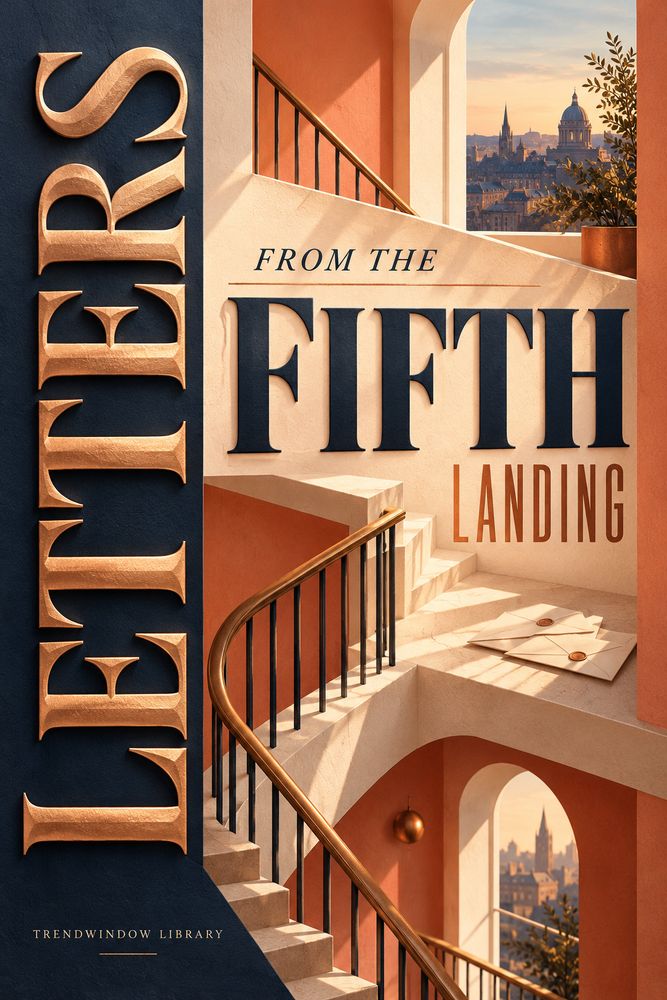
Front cover of Letters from the Fifth Landing

Contemporary & Literary Fiction

Letters from the Fifth Landing

By TrendWindow Library

Mina is moving to another city. Letters help her and Rafe say what their friendship needs next. A complete original literary story with a full departure and reunion by phone.

Read this complete edition, including its ending and notes. No purchase is required.

1. The Saturday Train

Mina told Rafe about the job on a Monday, standing on the fifth landing with a bag of oranges. He took the bag before he understood the rest.

She was thirty-three, he was thirty-four, and they had been friends for eleven years. They had shared the flat behind his door for four of those years. She moved to a place nearer her work two years ago. Sol, now thirty-six, had taken the room.

The new job was in another city. Museum technician. Permanent rather than a short contract. She had accepted it, rented a room and bought a train ticket for Saturday.

'You might have said you were thinking about it,' Rafe said.

'I did. When I applied.'

He remembered the conversation. At the time, it had seemed like one of the things people discussed while waiting for a kettle, not a departure that would require him to do something with his hands.

He opened the flat door. Sol was cooking. Mina put her coat on the hook she no longer used, then moved it to the back of a chair because Sol's jacket was there.

Rafe asked about the salary, the room, the city, the trains back. Each answer made another question possible. He had not yet congratulated her.

Eventually she said, 'I'm not asking you to decide whether it's a good job.'

'I didn't say you were.'

'No. You've just asked me for the case in favour of going.'

She stayed for supper. They talked about ordinary things carefully. When she left, the oranges remained on the kitchen table, bright enough to look deliberate.

2. The Letter in the Drawer

That Monday night Rafe wrote a letter he did not send.

Mina,

You always make leaving sound practical. A room nearer work. A different contract. A train ticket. If I say anything, I become the person who wants you to be smaller.

He stopped there. He could already hear her answer. She had not made him smaller by moving two years ago. He had found a flatmate and continued paying his share. She had continued visiting. They saw each other less often than when they lived together and more often than several friends who still lived in the same street.

He had written an accusation before deciding what he was actually asking her to do.

He folded it and put it in the kitchen drawer beneath the spare batteries. The next morning he went to his warehouse inventory shift and spent his time checking items that were in the wrong place on a screen.

When he came home, Sol asked whether Mina wanted a hand on Saturday.

'I haven't asked.'

'I'll ask her. I'm free till lunch.'

Sol sent a message, received an answer and returned to cutting bread. Rafe was irritated by the absence of difficulty.

Later Mina messaged him: I'm busy packing tomorrow. Could you come at six if you want to talk? Or write, if that would be easier. I don't want another interview about the job.

He read it twice. Writing had been his idea privately and hers openly. That was not a reason to refuse.

He found another sheet of paper.

3. What He Sent

Mina,

I was unpleasant on the landing. I knew I was doing it, which makes the way I kept going harder to explain.

I'm pleased you got the job. I should have said that before I asked about the room. You have wanted work that lasts longer than the exhibition it serves, and I remember that even though I behaved as if the whole thing had arrived without warning.

What I did not know how to say was that I had been counting you as one of the things that would stay. Not in my room, obviously. I know you moved. I mean available in the same city, with a front door I could reach without planning much. I hadn't asked whether you wanted to be counted that way.

The flat changed when you left it. Sol is a good person to live with. That is not the same as nothing changing. For a while I made every cup of tea as if I still needed to make two, and then I stopped. This is the part where I would usually make a joke before it became embarrassing.

I don't think you owe me staying. I do think I will miss you. Apparently I needed several paragraphs to separate those sentences.

I can come at six on Wednesday. If you would rather pack quietly, tell me. I can help Saturday too. I have the day free.

Rafe

He took the letter to Mina's building that evening and put it through her letterbox. He did not add a message asking whether she had read it. Walking home, he imagined three replies and tried not to choose one as the likely truth.

At the flat, Sol had left a portion of food in the fridge. Rafe warmed it, washed the pan and wrote Saturday on his calendar. He left space for a time Mina would actually agree to.

4. Mina's Reply

Mina gave him her reply when he came at six on Wednesday. She had written it before he arrived. She asked him to read it while she finished wrapping two bowls, then she would put the kettle on.

Rafe,

Thank you for saying you are pleased. I wanted to hear it from you. I wasn't sure you remembered why I applied, and I did not want to spend the days before leaving proving that I had a sufficient reason.

I will miss you too. Some of the questions you asked are questions I have been asking myself. The room might be smaller than it looked. I will have to find out which shop sells ordinary bread without being pleased with itself. I don't know anyone I can ask to look at a strange noise in the kitchen and agree that it is strange.

That does not make the job a mistake. It means I haven't lived there yet.

I do not want our friendship to become a timetable of evidence that I still care. Please don't ask me now to promise every Sunday, every holiday or exactly when I will come back. I cannot tell you what ordinary life there will look like before it begins.

I can tell you something smaller. I would like help on Saturday morning, from nine. Sol offered too. Two boxes and the suitcase need to go to the taxi. The other boxes have their own collection arranged. I am not carrying an entire flat onto a train.

And I would like supper with you both on Friday. I have booked nothing grand. We could cook. If that is too much, we can get something.

I am going to leave. I would like to leave with you being my friend, rather than with your permission.

Mina

He read the last lines again. In the next room, she tore a strip of tape with unnecessary force and swore when it stuck to itself.

'I've finished,' he called.

'Good. Come and hold this before I wrap my hand in it.'

He put the letter in his coat pocket and helped with the bowl. They did not discuss every sentence. When she made tea, he congratulated her again without attaching a question.

5. The Room They Had Shared

On Thursday, Rafe took his unsent letter out of the drawer. Its first sentence looked less accurate than it had when he wrote it.

You always make leaving sound practical.

He remembered Mina sitting on their kitchen floor four years ago, trying to assemble a small shelf after a bad week. She had made the wrong parts fit by refusing to admit they were the wrong parts. He had helped dismantle it. They had eaten toast standing up because every chair held a piece of shelf.

He had kept that evening as proof of closeness. Mina might remember the shelf, or only the week that made it necessary. She was not responsible for carrying his version of every room into her next one.

Sol came home with cleaning supplies and asked if the kitchen would be free Friday at six. Rafe said yes. They divided the cooking, then had a short, ordinary disagreement about how many potatoes three people needed.

Rafe had sometimes treated Sol as the person who lived in Mina's old room. Sol had lived there for two years. He had painted the room, changed his work hours and acquired a plant that was doing much better than Rafe expected.

'How's your mother?' Rafe asked.

Sol looked up.

'Fine. She's visiting next month. I told you.'

'You did. Which weekend?'

They talked about it while putting the supplies away. Rafe did not turn listening into a promise that he would now become an entirely different flatmate. He wrote down the weekend and offered his spare bedding.

That evening he put the unsent letter back in the drawer. He did not need Mina to receive everything he had thought.

6. Friday Supper

Mina arrived carrying nothing. At the door she lifted both empty hands as if someone might ask where the oranges had gone.

'No contribution,' she said. 'I'm using up the things that are mine at home.'

Sol let her in. Rafe took the coat and asked where she wanted it. She laughed and put it over the same chair as Monday.

They ate at the kitchen table. There were too many potatoes. Sol said this was a planned provision for tomorrow, and Rafe declined to dispute it.

For a while the evening was easy. Mina described packing something labelled fragile and realising that the box contained only socks. Sol told her about his mother's planned visit. Rafe said he could lend the spare bedding, discovering that he had news to contribute which did not require Mina to remember it first.

Afterwards, Mina went to the fifth landing to answer a call about the taxi. Rafe followed with her coat when the air grew cold.

'I won't stand here and ask if you're sure,' he said.

'I am sure enough to go. I don't know if everything will be good.'

'I know.'

He did not mean it as a request for further reassurance. She put on the coat.

'You can tell me if it's bad,' he said. 'I won't make it a reason you should have stayed.'

She looked at him for a moment, then nodded.

Inside, Sol was wrapping the remaining food. Mina wanted some for the journey. The potatoes finally had a purpose everyone accepted.

7. Saturday at Nine

They reached Mina's flat at nine. Sol carried the two boxes downstairs one at a time while Rafe took the suitcase. Mina checked the rooms and brought her own small bag. The boxes for the separate collection remained where she had arranged them; nobody silently loaded those into the taxi as well.

At the door she returned the keys according to her own arrangements. Rafe did not know every detail, and asked no questions that required her to start the whole explanation again.

The taxi took Mina, the suitcase and the two small boxes to the station. Rafe and Sol had agreed to come and help as far as the station entrance, so they travelled with her. They were not carrying anything beyond what she could manage after they left.

Inside, Rafe began to offer advice about keeping the ticket ready. Mina already had it in her hand. He closed his mouth, then laughed at himself before she had to do it.

They hugged. Sol wished her a decent first week, a more believable blessing than a perfect new life.

Rafe said, 'Send me something when you want to.'

'I will.'

He and Sol stayed until she had gone through the departure barrier, then left. They did not stand at a window until the train pulled away.

On the way home they bought bread. The kitchen would need breakfast on Sunday, whether or not Rafe had decided how to feel about Saturday.

8. The Letter on the Screen

On Sunday evening Mina sent a photograph of a handwritten page. She had arrived Saturday, unpacked what she needed and written after sleeping in the new room.

Rafe,

The room is smaller than the photograph, but the window is good. I bought bread. It was ordinary, which I found encouraging. The kitchen makes a noise when someone opens a particular cupboard. I have met the person responsible and the cupboard is not dangerous, just irritating.

The potatoes survived. Please tell Sol he planned correctly.

I start work Tuesday. Today I went to find the building so I would not have to discover the whole route on the first morning. I got one turning wrong. There is no story in this yet. I am just telling you where I have been.

I miss the way your kettle switches off just after a conversation has become interesting. This one seems to take longer. I am not asking for the old kettle.

You said I could tell you if things were bad. Thank you. At the moment they are unfamiliar. I would like to speak later this week, if you are free. Not a report on whether I have become happy. You can tell me something about your week too.

Mina

Rafe read the page on his phone, then showed Sol only the line about the potatoes, with Mina's permission asked and received by message. He did not pass the whole letter round as evidence that she was doing well.

He wrote a reply on paper at the kitchen table. He told her about Sol's mother's visit, a problem at work he had finally sorted out, and the oranges they had almost finished. Then he photographed his own letter and sent it. There was no need to make paper travel farther than the words.

They agreed to a call on Thursday evening. When it came, Mina talked about her first days and Rafe about his week. Once they both began at the same time, stopped and laughed. The call ended because Mina needed supper, not because either had run out of affection.

On the fifth landing afterwards, Rafe collected a parcel left with the neighbour and went back inside. Sol was watering his plant. The drawer still held the letter he had not sent. The ones he had sent had reached his friend.

9. About This Edition

This complete original short work of contemporary fiction was created with AI assistance for TrendWindow Library. Rafe, Mina, Sol, their homes, jobs and correspondence are invented. Every letter in the story is original fictional writing; none is an actual person's private correspondence or an archival document. The narrative is not a counselling method or a guide to employment, tenancy, transport or postal services. Its particular journeys and arrangements are fictional, not service guarantees.

Eight narrative chapters and this note form nine fixed reading units rather than printed pagination. The original English front and back covers and complete reader translations were created for this digital edition. Translations are compared with English by the assistant; independent native-human certification, human authorship, an ISBN and print-proof approval are not claimed. The complete approved editions are publicly readable. Purchases and all four payment providers remain disabled.

Explore more books →