BOOK LIBRARY · Complete books · Purchases disabled
TrendWindow

← Book Library · Complete book

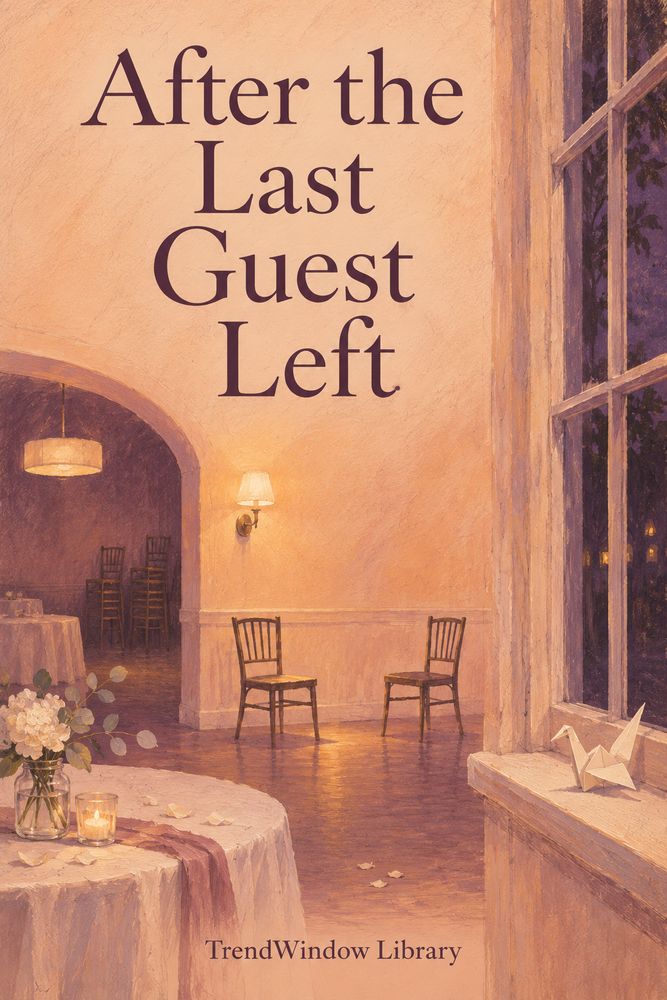
Front cover of After the Last Guest Left

Contemporary & Literary Fiction

After the Last Guest Left

By TrendWindow Library

A complete short literary story in eight chapters. Caterer Mara and her estranged son Ellis share three paid hours clearing a wedding. An old menu and an unasked promise lead them towards a relationship beyond work. Original fiction with a resolved ending.

Read this complete edition, including its ending and notes. No purchase is required.

About this story

A complete short work of literary fiction in eight chapters. All people, places and events are invented. A caterer and her estranged adult son share one paid shift after a wedding, then decide what kind of contact they can offer each other when the work is done.

© 2026 TrendWindow Library. Original AI-assisted fiction and translations, reviewed by an AI assistant. No independent human-editor or native-speaker certification is claimed.

1. The room after celebration

At nine forty, the last guest came back for a cardigan she had been wearing when she left. Mara pointed to her shoulders. The woman laughed, touched the wool as though someone had just put it there, and went out again. Then the room belonged to the people who would empty it. Forty-two places had become a loose landscape of chairs, folded place cards and glasses with different amounts of evening left in them. A paper bird lay beneath the bride's chair. Mara picked it up before the floor crew arrived. It had been folded from a printed menu, and one wing said roasted carrots. She put it on the windowsill, where it could wait without becoming anyone's responsibility.

Her son arrived at five to ten through the service door. Ellis was thirty and carried a jacket over one arm. He looked for somewhere to put it before he looked at her. Mara showed him a hook beside the cupboard. “There's an apron if you want one.” He took the plain maroon apron from the pile. Three years earlier he would have searched for the faded green one with his name stitched inside, but it was no longer here. Mara had taken it home, washed it and put it in a drawer. She had never decided whether keeping it was hopeful or merely the sort of thing she did with usable fabric. He tied the maroon straps around his waist and asked where to start.

She had called him on Thursday because one of her regular workers could not cover the late shift. Ellis had said he could help from ten until one, at the rate she paid anyone else for those hours. Cleanup only. He had his own plans on Sunday. Mara had repeated the terms without making a joke about family discounts. Now she pointed to the linen bags and the stacks of hire boxes. The kitchen crew had finished their separate work. Leon, the venue caretaker, would check the room at one. There was enough to do for two people who knew the place, though Mara had privately imagined they might also talk.

Ellis lifted a tablecloth, shook a paper heart into his hand and put the heart in the rubbish. He did not do it cruelly. It was rubbish now. Mara found that she had been waiting for him to notice the room, the successful meal, the way she had managed the wedding without him. Instead he asked which bag held the stained linen. She answered. His efficiency had once made her proud. Tonight it felt like standing beside a closed door through which she could hear someone moving quite comfortably.
2. What had been agreed

For the first half hour they spoke in numbers. Six glasses in that box. Four cloths left. Two chairs still at the end of the corridor. Mara checked the hire list on a clipboard while Ellis cleared the tables. He had not forgotten the work. He knew how she counted without speaking and which pencil she would lose first. When she reached for it, he slid it across the empty table. That small familiar movement nearly undid her. She looked down at the list until the feeling passed. There was no useful way to tell a man that moving a pencil had made his mother want to cry.

“You look well,” she said. He thanked her. “The job still good?” He worked as a drafter for a small building practice. Mara knew the name because she had looked at the card he sent her when he started, three years ago. He said the job was mostly good. He had recently spent two days correcting a set of drawings after a client changed a doorway. “That must be frustrating.” “Sometimes. Sometimes the new doorway is better.” She waited for more. He put the last glass into its compartment and asked her to check the count. She checked it. There were six.

At half past ten she asked whether he could look at her booking form when they finished. Only quickly. He stopped folding a cloth. “Not tonight.” She said it was just a small thing. “I know. But I said cleanup.” The word seemed unnecessarily formal between them. She heard herself reply, “You always used to notice what needed doing.” He laid the folded cloth down carefully. “I still notice. That isn't the same as agreeing to do it.” Mara took the bag from him before it needed taking. For several minutes the linen made more noise than either of them.

She wanted to explain that she was tired, that asking was not the same as ordering, that a mother should not need a written appointment to speak to her child. Each explanation contained enough truth to be tempting. None dealt with the form she had already tucked into his jacket pocket, ready for him to find. She went to the hook and removed it. Ellis saw her do it but did not thank her. This annoyed her, then embarrassed her. She put the form into her own case. The next cloth had a damp ring in its centre. They held opposite corners and folded it without discussing the ring.

3. The chair against the wall

Leon came in carrying a short stool and a roll of tape. He had found a chair with a loose back beside the entrance and wanted it kept separate from the others. Mara immediately looked at Ellis. He was nearest the stack. “I didn't put that one there,” he said. “I wasn't saying you did.” But she had been about to ask what had happened to it. Leon turned the chair and showed them an old strip of tape underneath. It had been marked before the wedding. He had moved it out of the guest area that morning. The chair belonged to the venue, and the repair was already on his list.

After Leon left, Mara said, “I looked at you because you were standing there.” Ellis nodded. “You did that when I worked here too.” “Looked at you?” “Started with me.” He kept his voice level, which she found harder than anger. If he had shouted, she could have objected to the shouting. She remembered a missing tray, a late delivery, a stain on a wall. Sometimes he had been responsible. Sometimes he had only been available. “I relied on you,” she said. He leaned both hands on the back of a good chair. “I know. I didn't always know when relying on me became deciding for me.”

The chair stack stood between them like something they had built by accident. Mara moved around it. She did not touch him. “I'm sorry I started with you.” It was an apology small enough to say without a speech. Ellis accepted it with another nod. She could not tell whether that was enough, and for once she did not ask him to make it look enough. They carried the remaining chairs together, two at a time, leaving the marked one where Leon had asked. Its absence made the row uneven. Mara resisted the urge to fill the gap with a chair from somewhere else.

The room was cooling as the evening heating ended. Ellis put his jacket on over the apron. He asked if she wanted hers. It was in the van, so he fetched it. In the pocket Mara found a supermarket receipt, a button and a mint she did not remember putting there. Ordinary evidence of a life that had continued during the years they barely spoke. She offered him the mint. He declined. She ate it herself and returned to the hire list. There was one cake knife missing, and neither of them could remember seeing it after the cutting of the cake.

4. A name on an old menu

They checked the cleared tables and the boxes that were still open. Ellis found a bundle of old sample menus in the case beneath the clipboard. Mara had lined the bottom of the case with them after a spill months earlier. On the top sheet, under her business name, were the words Mara and Ellis: a family kitchen. He held it still for a moment. “I thought you'd thrown these away.” “They're scrap paper.” “I can see that.” Neither of them moved to take the sheet from the other. It was not an important document now. That had never been the problem with it.

Three years earlier, Mara had shown that menu to a customer without Ellis having agreed to join the business. He had been doing temporary shifts while applying for drafting work. She knew about the applications, but she had treated them as a period he would grow out of. When the offer came, she asked why he had let her make plans. He asked why she had made plans without him. Their argument began at a kitchen table and spread, over the following months, into birthdays, short calls and invitations declined with careful excuses. Her husband David had died six years ago. For a long time she had believed the business was the thing that kept what remained of the family together.

“I thought we were building something,” she said now. Ellis looked at the menu. “You were. I was working for you while I looked for something else.” She wanted to say he had enjoyed some of it. He had. They both knew he had. Enjoying a Saturday was not a promise to spend his life there. “I made your name part of an offer you hadn't made,” she said. He put the paper back into the case. “Yes.” It was the first answer that evening that seemed to come from the place she had been trying to reach. It did not make her feel better immediately. It made the room much harder to tidy.

She began, “Your father would—” and stopped. Ellis waited. “I don't know what your father would say,” she finished. “I know what I want him to say.” Her son sat on the short stool Leon had left. He said he missed David too, though he did not miss him in the same places she did. Sometimes it happened in a hardware shop, sometimes halfway through a joke. Mara had imagined his absence from the business as an absence from grief. She sat on a chair she had already counted. For two minutes they let the room remain unfinished. Then Ellis asked whether the knife might have gone home with the cake.

5. The work still waiting

Mara checked the collection note. The bride had taken the cake knife in a blue presentation case; it was hers, not part of the hire inventory. Mara had copied the item onto her own return list by mistake. She crossed it out. Ellis smiled, not at the mistake but at the familiar way she pressed the pencil so hard that the mark appeared on the sheet beneath. “You always do that.” “I like a thing to stay crossed out.” “I remember.” It was the first time that night that remembering had not sounded like bringing evidence against someone.

At twelve fifteen they had boxed the hired glasses, bagged the linen and cleared every table. Three crates of Mara's own display pieces still needed to be taken to the van. The van already held equipment from the kitchen, and she could see that another trip would be necessary. Usually she would have kept going until the whole job disappeared. She almost asked Ellis to come with her on the second journey. Instead she asked Leon whether the crates could remain in the locked store until morning. He checked his schedule and offered a collection time of ten thirty. She wrote it down. He was not granting forgiveness or teaching her a lesson. He was arranging access to a cupboard.

Ellis said he should have told her sooner how angry he had remained. “I kept waiting until I could explain it without getting angry. Then I just stopped explaining.” Mara did not seize the admission as a balance against her own. He said he had also cancelled a lunch last year because he expected a request for work. She had meant it as lunch. He had never asked. “I'm sorry about that,” he said. Mara remembered the two portions she had made and the foolishness she had felt eating one alone. She told him she had been hurt. He listened. They did not try to decide which hurt had begun first.

There was no plan for the business hidden inside the conversation that followed. Mara said she would need to take fewer large bookings until she had reliable paid cover. Ellis did not offer himself as the missing person. He asked if she wanted him to listen or think through options. “Listen, tonight.” So he listened while she admitted that reducing the work frightened her almost as much as being unable to finish it. She had called it loyalty when she meant fear of doing something smaller. Across the room, the paper bird had fallen from the sill. Neither noticed until Leon came in and put it back.

6. One o'clock

At twelve forty-five, Mara wrote Ellis's three hours on the payment slip and paid the agreed amount. He counted it and put it away. She had once disliked that: a son counting his mother's money as though she were a stranger. Tonight she understood that checking the agreement allowed them to finish it. The shift had a beginning and an end. The payment did not settle the years between them. It settled three hours of work. There were fifteen minutes left, and they used them to check the cupboard labels, collect their remaining things and walk through the room with Leon.

The caretaker signed off the cleared room at five to one. The three crates were in the locked store, marked for collection at ten thirty. The damaged chair remained separate. The linen bags and hire boxes were ready where the collection crew expected them. Mara looked around for the small extra task that would keep Ellis beside her. There was always one. A window ledge to wipe again, a folded list to copy, a conversation that could be made to sound like work. She put the clipboard away. “Thank you for the shift,” she said. He untied the apron. “You're welcome.”

At the service door she asked whether he would have coffee with her. He checked that she meant coffee rather than the booking form. The question stung, but it was a question she had earned. “Just coffee. Somewhere I don't own the cups.” He suggested the little café beside the bus station on Wednesday at four. Mara took out her phone and entered it. She read the place and time aloud. Ellis said that was right. They did not hug. She wanted to, but could not yet tell whether she wanted to offer comfort or receive proof. She kept her hands in her coat pockets.

He left at one. Mara watched him cross the car park and turn towards the main road. Then she returned for her case and found the paper bird on the windowsill. She put it into the empty compartment where the missing knife had never belonged. The room did not look tragic after everyone had gone. It looked ready for someone else to use. She turned off the lights Leon had left for her and locked the service door as arranged. On the drive home she rehearsed things she might say on Wednesday, then stopped when she missed a familiar turning. She took the next road and came home the longer way.

7. A table for two

On Sunday she collected the three crates at ten thirty and paid a regular worker for the time needed to help unload them. It cost more than doing everything herself. She entered the cost in the job record instead of calling it an unusual expense. On Monday she declined a large event she could not staff properly. The caller found someone else. The world did not reward Mara for making a sensible decision; she lost the booking and worried about the money. But she did not send Ellis a message about it. He was not a ledger in which she could record the price of respecting his choice.

On Wednesday she reached the café at ten to four. She chose a table with two equal chairs, then felt ridiculous for noticing that they were equal. Ellis arrived at four with rain on his sleeves. He had come straight from work. Mara asked what he wanted and waited while he decided. They ordered at the counter and paid separately. For a moment she feared the arrangement meant he was keeping a distance. Then she remembered that a person could pay for his own coffee and still have chosen to sit with her. She asked about the drawing with the changed doorway.

He showed her a photograph of a finished model on his phone. She did not understand every part of it, and he did not expect her to. She asked which piece he had worked on. He pointed to a small entrance and explained the decision that had taken the most discussion. Mara listened without finding a catering example to match it. Later he asked about her garden. She told him a plant she had thought dead had simply been hidden behind a larger pot. They laughed at that. It was not a sign of anything except that the pot had been in a foolish place.

The coffee lasted forty minutes. There were pauses, one uncomfortable question about Christmas and a short conversation about David that neither tried to finish. Mara said she would like to meet again. Ellis said he would too, but could they decide a date next week rather than turn it into a standing obligation today? She agreed. Outside, he touched her shoulder before leaving. It was brief enough that she might once have asked for more. This time she said goodbye and let the touch be what it was. She walked to her van without inventing a story in which the whole family had been repaired in a café.

8. The next ordinary thing

A month later, Mara worked a smaller wedding with two paid assistants. Ellis was spending that Saturday elsewhere. He had told her about his plans because they had begun speaking again, not because he needed to justify his absence. She did not ask him to keep his phone nearby. The event finished on time. One assistant asked whether a final task belonged to her shift, and Mara checked the agreed list before answering. She was not suddenly easy to work for. She still wanted things done her way and sometimes heard impatience in her own voice. When she did, she had begun to stop the sentence before making another person carry it.

The old sample menus were gone from the case. She had replaced them with clean packing paper. At home, she took Ellis's green apron from the drawer and asked him in a message whether he wanted it. He said no, thank you; she could give it to someone who would use it. She removed the name label and kept the apron in the spare pile. She did not keep the label. There was no ceremony. The stitching left a pale rectangle in the cloth, which would matter to nobody who put it on to wash up.

Their second coffee became a walk because the café was closed. Their third meeting was lunch at Ellis's flat. Mara brought the bread he asked for and nothing he had not asked for. He had other things on the table: soup, a bowl of fruit, a book left open beside his chair. She recognised one of David's old mugs on the shelf. She had given it to Ellis years before and forgotten. His life had kept things she could not see from her own kitchen. He asked her to sit while he found another spoon. She sat. The soup was a little cooler than she would have served it. She ate it without making the observation into advice.

Before she left, Ellis asked if she would send him the name of the person who had repaired her kitchen window. He had a window that stuck. For an instant she felt the old pleasure of being necessary, then the quieter pleasure of being asked for one thing she could actually give. She sent the name when she got home. He replied with thanks and a photograph of the bread crust he had saved for later. Mara put down her phone. The paper bird from the wedding still stood on the shelf beside her keys, one wing beginning to sag. She left it there, took off her coat and made a cup of tea for one.

Explore more books →