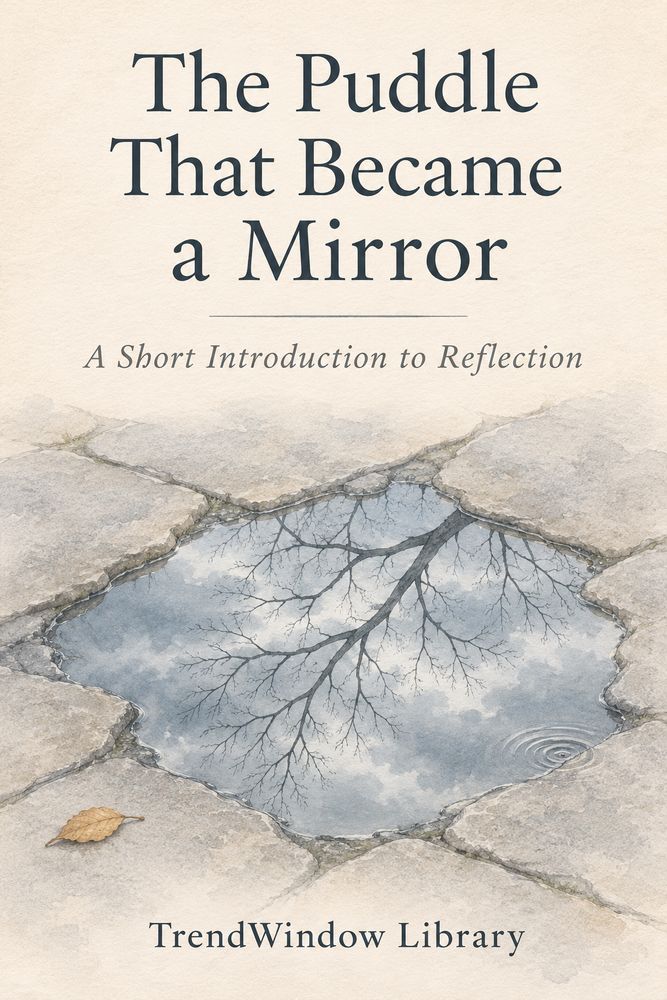
Return to the dry path in our opening scene. The observer no longer needs to imagine a second tree below the paving stones. Three objects and one connected route are enough to begin: branch, water, observer; light from one meeting the second and reaching the third. The ordinary scene has acquired structure without losing its strangeness.
Now the observer can ask a question that admits a check: given this flat patch, this object point and this viewing position, where would the reflected route meet the surface? Marking a virtual point, drawing the construction line and checking the patch boundary supplies an answer within the model. If the candidate lies outside the water, the honest result is that this patch cannot provide that route under these assumptions.
A moving surface asks for local normals. A submerged stone asks for a transmitted route. An uncertain photograph asks for missing context. These are not failures of one grand explanation; they are reasons to choose an explanation appropriate to the question. The book has kept its scope small so that the reader can see those choices happen.
For a final paper exercise, write two captions for the same imagined puddle. The first should describe an appearance without claiming its cause. The second should propose a route and state an assumption. Compare them with the original sentence about a tree under the ground. The difference is not that the later captions sound more technical. It is that they make fewer hidden promises.
The notebook closes with a blank observation line and a completed drawing. That is a proper ending for an investigation conducted on paper. Nothing has been measured, but a careless claim has become a testable question. The puddle did not need to become something else. We needed to become more exact about what we were asking it to show.
Source guide: [S1] OpenStax, Physics, “16.1 Reflection”: https://openstax.org/books/physics/pages/16-1-reflection. [S2] OpenStax, Physics, “16.2 Refraction”: https://openstax.org/books/physics/pages/16-2-refraction. These are educational explanations of established physics, not new experimental reports. [S3] NASA Earth Observatory, “The Subtleties of Sunglint,” 14 June 2023: https://science.nasa.gov/earth/earth-observatory/the-subtleties-of-sunglint-151456/. The NASA example supports the limited caution about viewing geometry; its images and detailed findings are not reproduced. All references checked 16 November 2026. The garden scenes, notebook framework and exercises are original hypothetical teaching material. Wave optics, polarization, quantitative reflectance and full refraction calculations remain outside this short book.