About this book
An original fictional short story. People, documents and events in this story are invented. AI-assisted writing and translations; no independent human-editor or native-speaker certification is claimed.
← Book Library · Complete book
Romance & Relationships
By TrendWindow Library
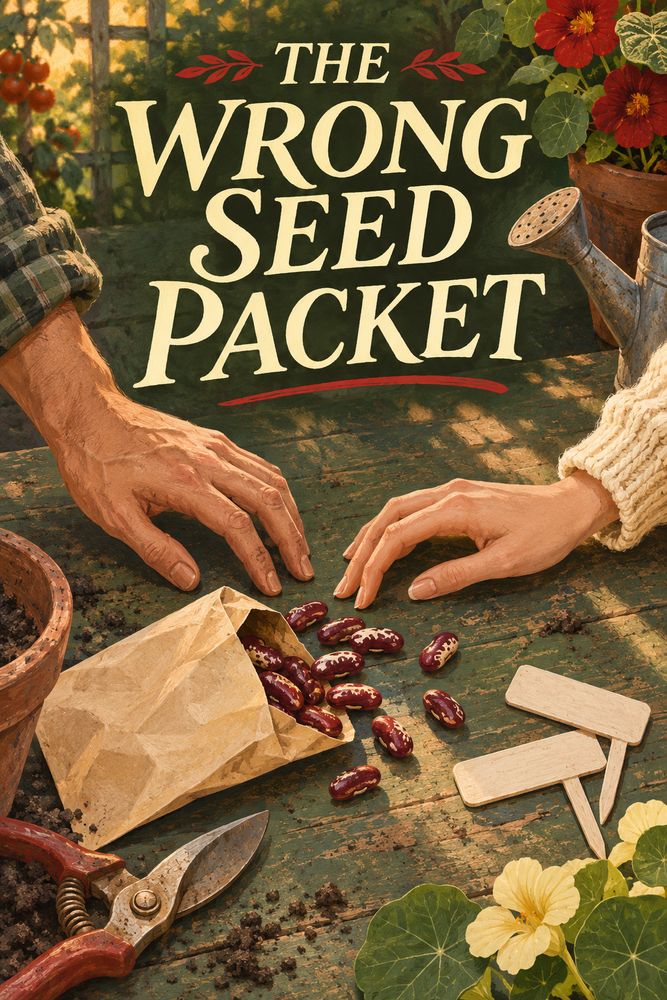
A swapped seed packet brings Mara and Theo into a shared garden. Twelve treasured beans, a misplaced label and an unclaimed watering day force them to learn the difference between helping and asking.
Read this complete edition, including its ending and notes. No purchase is required.
An original fictional short story. People, documents and events in this story are invented. AI-assisted writing and translations; no independent human-editor or native-speaker certification is claimed.
On the first Saturday in March, Mara found a packet of beans in the pocket where she kept the key to the allotment gate. She knew they were beans because one had broken through the paper and lodged in the seam. It was dark red, with a mark like a thumbprint. On the packet, in her own handwriting, it said *dill*.
She emptied the packet onto the table. Eleven beans rolled toward the sugar bowl. The twelfth stayed in her pocket.
She had come home from the seed swap with a cardboard box full of packets. It had been a crowded morning. People had set down their cups on the sign-in sheet and picked up one another's pencils. Twice she had seen Theo Bell move a packet from one end of the display to the other. The second time she had asked him to stop.
“Someone will go home with the wrong thing,” she'd said.
“They're sorted by who brought them.”
“They're supposed to be sorted by what they are.”
He had looked along the tables. “Then why are your flowers next to the cabbage?”
Because she'd put them there herself when a late arrival needed space. She had gone to find another table. When she came back, Theo was carrying two out of the storeroom, one in each hand. He had made it impossible to stay angry without feeling a little ridiculous, which was one of the things she disliked about him.
At the allotment gate he was trying to level a board across two upturned buckets. He raised his chin when he saw her.
“Did you take home any dill?” she asked.
“I thought I took beans.”
“How many?”
“Twelve. My aunt counted them out.”
Mara put the packet in his hand. The word *dill* faced up between his muddy fingers. He gave it a little shake.
“Eleven,” she said. “There's one in my coat.”
He didn't laugh. “She only gave me twelve because she wasn't sure she'd get to grow them again.”
Mara had been ready to tell him how easy it would have been to leave her table alone. Instead she asked what had happened to his aunt.
“She moved,” he said. “She's fine. The new place has a view of the river and nowhere to put a pot.”
He held the packet out to her. For a moment she thought he wanted her to take it away.
“Can you get the last one out?” he asked. “I don't like losing things when I know where they are.”
Mara worked the bean out of the seam. Theo opened the packet while she held it above him. It landed without a sound.
The allotment secretary, June, found them at the gate. She had a folding ruler in one hand and a notice in the other. Plot Nine had lost its water pipe when a truck backed over the stand. The plumber could come in three weeks. Until then the committee was lending the gardeners of Nine the demonstration plot, provided they could agree on who would water it.
“I've put both your names down,” June said.
Mara owned the lowest half of Nine. Theo's beds ran along the upper edge. A path no wider than a board separated them. Over the winter the board had shifted downhill. Mara had moved it back every time she saw it out of line. Theo had stopped moving it when he noticed how often she did.
“How much of the demonstration plot?” Mara asked.
“All of it.”
“For both of us?”
June folded the notice around the ruler. “That's what both means.”
Theo walked with Mara to look. The demonstration plot had once been used for school visits. The gate was low enough for a child to open. A blue enamel basin sat under the tap, and someone had painted a crooked sunflower on the shed. The only spot with full sun was a strip down the middle, just wide enough for two long rows if neither gardener wanted to walk between them.
Mara took a piece of string from her bag. Theo held one end without asking why. She drew it down the center and looked at the two sides it made.
“If we split it here,” he said, “both sides lose the middle.”
She looked again. He was right.
She pulled the string toward the path instead. That left a shared working strip where both could reach the plants without stepping among them. Theo carried the blue basin to the shed and put it upside down. Beneath it was a dry circle on the ground, the first dry place she'd seen all morning.
“My aunt used to say a shared bed was a good way to find out what you were like when the other person was late,” he said.
“What were you like?”
“She usually had to tell me to go home.”
Mara drew a new line in the dirt with the point of a stick. “Then take Tuesdays,” she said. “I can do Thursdays.”
They stayed until the next people came for water. By then they had written down who would come on six different days, and the one day neither could promise had a question mark instead of a name. Mara left the question mark there.
For three weeks they took turns clearing the demonstration plot. The damaged pipe was repaired, but June asked whether they would finish what they had started. A class was coming in June and she wanted children to see something taller than the labels. Mara agreed before asking Theo. She caught herself doing it and went to find him.
“I said yes for me,” she told him. “June might have heard it as yes for both of us.”
“Did you want me to say yes?”
She looked at the basin. He had set it right side up again and it had collected enough rain to reflect a small square of sky.
“I was hoping you would.”
“All right,” he said.
They waited until the weather had warmed to sow the beans. Theo put them in a shallow row where the soil stayed dry longest after rain. He used nine and saved three. Mara brought a new packet of dill, wrote the date on the label, and gave him a pencil to write the bean label himself. He put *Ida* on it.
“Is that the variety?”
“It's my aunt.”
The first leaves came up in May, on a week when neither of them could manage Sunday. Mara was due to drive her father to visit his sister. Theo had promised to help Ida empty the last of her old shed. They could have asked June. Instead Mara said she might make it back before dark, and Theo said he would try too. Neither put a name in the space on the board.
Mara arrived after dark with her father's uneaten sandwiches in the car and a headache that seemed to have started in her left shoulder. The soil was damp. She found a bean label in the row where she had planted dill. The label in the bean row was gone. A hand torch showed *Ida*, in Theo's untidy writing.
She was so tired that she could hear herself getting angry before she knew exactly what he had done. She took a picture of the label and sent it to him.
*You could have asked.*
A reply came while she was closing the gate.
*I thought I was helping.*
She turned around and pulled the label out of the soil. There were seedlings in the row and she could not see what they were by torchlight. In the morning she could ask. That was the sensible thing to do. She took the label home anyway.
Theo was at the demonstration plot the next evening, untangling string from the handle of a spade. He set the spade down when she came through the gate.
“Did you dig up the dill?”
“No. The bean label had fallen. I put the replacement in the wrong row.”
“You wrote a new one.”
“The old one split. Look.”
He pulled a strip of wood from his jacket. The name on it ended in a jagged edge. Mara had carried the replacement around all day, stiff against her leg. She took it out and laid the two labels together on the bench.
“I could have asked what happened,” she said.
“Yes.”
“You could have said what happened instead of telling me you were helping.”
“Yes,” he said again. “I thought you meant the watering.”
He picked up the old label, then put it back.
“I got here first,” he said. “Then I went round to your bed on Nine. The new pipe works, so I used it. I watered your trays too.”
She had forgotten those trays entirely. What she felt first was relief. It made the anger look worse, as if the two things had arrived at the gate together and only one had been allowed in.
“I wish you'd told me,” she said.
“I wish you'd asked me to do it. I would have said yes.”
“Why didn't you tell me you'd be here?”
“I didn't know if I would. I didn't want you planning around me.”
Mara put the labels back on the bench. At first she had thought Theo took too little care with things. Now she wondered how much he did that no one had agreed to ask of him. He had carried the tables out at the seed swap while she was still deciding where they should go. That had helped. It had also left her no way to say she would rather do it differently. She could see both things at once, now that they were standing on different sides of the bench.
“I don't want to spend the summer guessing which parts of my life you've quietly handled,” she said. “And I don't want to pretend I never need anything.”
Theo leaned his elbows on the edge. “What do you need on Sunday?”
“An afternoon with my father that doesn't end with me driving back to check a patch of dirt.”
“Ask June about this Sunday. She likes the plot.”
“You don't want to do it?”
“I want to take Ida to see the river from the other side. I keep offering to fix her shed door as if she still has a shed.”
Mara smiled before she meant to. Theo did too. Then she went to look at the seedlings. The dill was there, exactly where she had put it. She stuck the replacement label back beside the beans and left it a little crooked.
On Sunday, June sent a photograph of a wet path and her thumb. Mara showed it to her father at a café, and he said he liked the thumb best. They stayed for another cup.
The first time Ida came to see the plot, Theo brought her in through the low gate. She had on a white blouse and shoes that were already damp. She bent down to read the label and stayed there a moment without speaking.
“I didn't call them Ida,” she said at last.
“No,” Theo said. “I did.”
She straightened up and looked at Mara. “Did he tell you I had nowhere to grow them?”
“He did.”
“I have a neighbor with a balcony. I hadn't asked.”
Mara fetched a chair from the shed. Ida sat down and asked Theo for a pencil. He gave her the one Mara had handed him in March, shorter now from being sharpened with a pocketknife. On the back of the label Ida wrote *for next year*, and pushed it back into the dirt.
When the class came, the children took turns bending close to the bean flowers and counting the colors. Later, on harvest day, June set up a table by the gate. Mara brought the sugar bowl from her kitchen, emptied and washed. The saved beans went in it. Ida took some home for her neighbor and left the rest for whoever came next.
Theo waited while Mara stacked the folding chairs. When she reached for a second chair, he did not take it from her.
“Can I help with those?” he asked.
“You can take that one.” She pointed with her chin. “And I'd like you to come to dinner on Friday.”
He folded the chair and set it against his leg. “With your father?”
“Just me.”
“All right,” he said. “I'd like that.”
On Friday she put two plates on the kitchen table. Theo brought bread from the bakery, which stayed open late in the summer. There was dill in the salad. Before they ate, Mara shook out the coat she had worn to the seed swap, certain some small thing must still be caught in the lining. Nothing fell. She hung it up and came back to the table. Theo had waited to cut the bread. She moved her chair closer and told him to start.