BOOK LIBRARY · Complete books · Purchases disabled
TrendWindow

← Book Library · Complete book

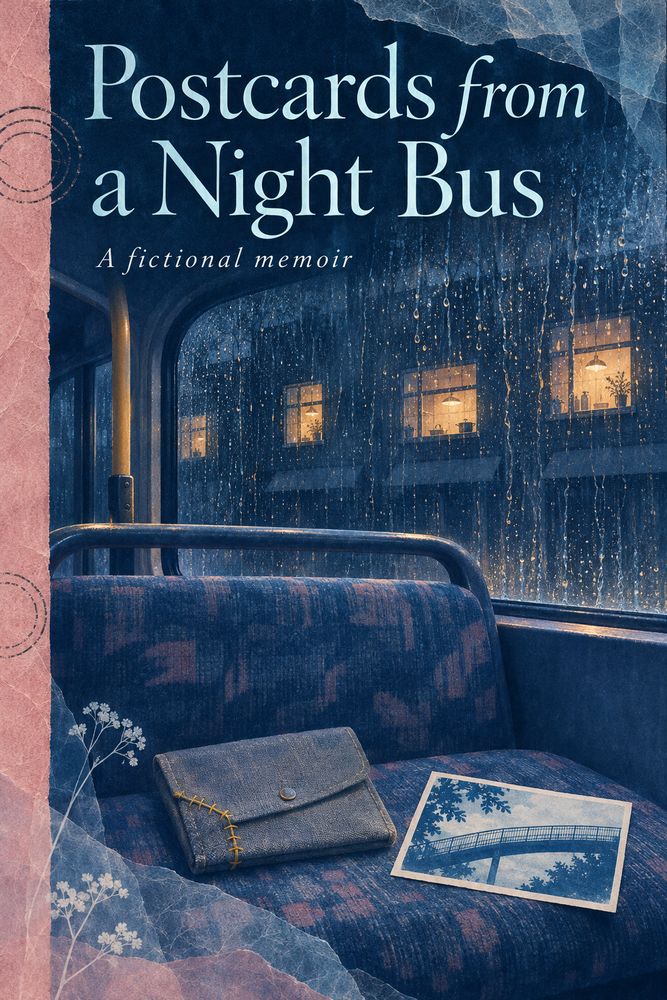
Front cover of Postcards from a Night Bus

Biography & Memoir

Postcards from a Night Bus

By TrendWindow Library

After twenty-eight years driving nights, Mara prepares for a day route. Five found postcards, a missing sixth and a card kept for eleven years change how she tells her own story. A complete fictional memoir in eight chapters.

Read this complete edition, including its ending and notes. No purchase is required.

About this book

A fictional memoir in eight chapters

Mara, Bellwick, route 47 and every event in this book are invented. This is an original story written in the form of a memoir, not a claim of lived human testimony. Its depot arrangements belong to the fiction and are not instructions for operating a bus or handling property in a real transport service.

Original short fictional memoir prepared with AI assistance. Mara, Bellwick, route 47, the family and all events are invented; this is not lived human testimony, transport guidance or a real operational record. Translation meaning reviewed with AI, without independent native-language certification.

1. Five views of a city

In my last month on nights, I began finding daylight in the bus.

Not actual daylight. At half past two, Bellwick was still a row of lit kitchens above closed shops. What I found, after parking at the depot and finishing the required checks, was a small grey wallet containing postcards.

It lay between the last seat and the side panel. The wallet had a repaired seam in yellow thread. Inside were five views of buildings I knew mostly by their illuminated windows: a library, a market hall, a swimming pool, a railway waiting room and the municipal glasshouse.

I had driven the 47 for twenty-eight years. I could tell you where the bus shivered over an old repair in the road. I could not have told you the colour of the glasshouse door in sunshine.

Basil was still at the lost-property desk, drinking tea that had developed a skin. We counted the cards together without turning somebody else's possessions into an evening's entertainment. They were unaddressed. We recorded the wallet and what was in it, with the finding place and time, then put it in the depot's usual secure storage.

“Somebody has been on holiday,” I said.

“Possibly,” Basil replied.

He had worked with drivers long enough to know that a journey invited an explanation even when it did not supply one.

I signed where I was supposed to sign. Then I stayed looking at the library picture. Its steps were empty. In the nights I knew, somebody was almost always sitting there, even when it rained.

“You're changing shifts, not leaving the city,” Basil said.

“I know.”

My day-route assignment began in three weeks. I had asked for it myself. Still, I had started behaving as if every ordinary object were bidding me farewell.

Outside, Noura was moving her cleaning trolley toward the bus. I told her about the wallet and its location. She nodded, already looking at the floor rather than my face.

At home I opened the drawer where I kept old rosters, spare buttons and the things that had not acquired a better place. Beneath a folded scarf lay another postcard. I had not put that one in the depot's storage.
2. The blue bridge

I had kept it for eleven years.

For a long time, I told myself I was keeping it until I could return it. Eventually I stopped adding the last part of that sentence, though I still enjoyed its permission.

The picture showed Bellwick's blue footbridge before the new railings. Two figures crossed it. In my memory, one wore a red scarf. When I took the card to the kitchen window, the scarf was yellow, or perhaps a patch of sunlight. The photograph was too small to settle the matter.

On the back, in pencil, someone had written: “We can begin again.” No address. No signature. Those four words had done an unreasonable amount of work in my house.

I found the card on a seat during a difficult winter, when Elin was fifteen and I was taking every additional shift I could manage. I imagined a passenger who had decided to forgive someone. Sometimes I imagined the person had been forgiven. The difference depended on what I needed that day.

I had no basis for either story.

At first I carried the card in my work bag. I expected the owner to return on my bus and ask for it. That expectation let me avoid the more useful act of handing it in. A city contains many buses. A passenger does not owe a particular driver a second encounter.

Once, I asked a woman in a blue coat whether she had lost a postcard. She said no. I remember feeling disappointed in her, an absurd feeling that I can describe more honestly now than I could then.

When the bag split, the card went into the drawer. Eleven years passed through the house in other objects: school letters, an adult daughter's spare key, a repaired radio. The bridge remained available whenever I wanted a small, borrowed sentence.

Now I placed it beside my unsigned shift-change form. I had already agreed the change; the form merely needed returning. I had made another little delay look like reflection.

The new wallet was safely at the depot. This old card was not. I could not make those two facts equivalent by telling the second one beautifully.

3. Six, she said

The young woman came to the office on Thursday afternoon, when I had arrived early for a staff meeting. Basil asked me to stay only long enough to confirm where I had found the wallet.

Her name was Ada. Before seeing it, she described the yellow repair across the lower seam, a missing press-stud and the cards inside. Basil completed the checks required by their process. I did not decide she was the owner because she seemed kind or because I liked her account.

“Five cards,” he said, placing them on the desk.

“Six,” she said.

We counted again. There were still five.

The sixth was the old bus depot frontage. Ada described a crease near one corner and a little drawing on the back. It was not among the contents we had recorded.

“I can check the bus when it's back and safe to inspect,” I said. “I can't promise we'll find it.”

I wanted to promise. The desire arrived faster than the words I chose instead.

Ada took the wallet and the five cards through the normal collection process. Basil noted the report of the missing sixth card and the agreed way to contact her if it turned up. She did not leave her number with me personally.

“What are the pictures for?” I asked.

“A drawing project.”

I waited for a larger answer. She did not supply one.

When she had gone, Basil moved his cup away from a ring on the desk. I began telling him about the blue bridge card. I got as far as “There was another one, years ago,” then stopped.

“Did you hand it in?” he asked.

“No.”

He waited. It was not a harsh silence. It was the absence of an excuse he was willing to invent for me.

“I still have it.”

“Then bring it,” he said. “We will record what actually happened.”

He did not offer to write that I had found it yesterday. I had not asked, but I noticed the small part of me that would have been relieved if he had.

4. The place where a card could go

A missing postcard is thin enough to make a whole bus seem possible.

I found myself looking at every seam as if attention alone could force the card out. Noura waited until I had stopped narrating the search.

“Which side of the wallet?” she asked.

“I don't know.”

“Was it open?”

“I remember it closed.”

“Remember, or wrote down?”

I looked at the finding note. We had recorded its place and contents. I had not recorded whether the flap was fastened.

“I remember,” I said.

She nodded without accusing me of anything. Then she checked the accessible spaces in the parked vehicle as part of the authorised search. Neither of us took fittings apart. Anything requiring that work belonged with the appropriate depot staff, not with my wish to produce a good ending.

We did not find the card that night.

Noura had another vehicle to clean. I had work to prepare for. We recorded the search and left the report open. The absence of a result was not a result to improve with a confident sentence.

On the first run, I passed the old depot building, now used for other municipal work. One wide doorway still had the proportions of a bus. I had entered it during my training, before our service moved to the current depot. Until Ada named her card, I had not thought of that doorway in years.

I could make a story from this: the old driver, the old building, a final lost image waiting to be restored. It would be a satisfying story. It would also make Ada's property serve a purpose she had not chosen.

At the terminus, while the bus was secured and I was on my break, I wrote a line in my own notebook: “I want to find it partly because I want to be the person who finds it.”

That was less flattering than calling myself helpful. It was not the whole truth either. I did want her to have her card back. Two reasons can sit on the same seat without becoming the same passenger.

5. What Elin remembered

Elin came for lunch on Sunday with oranges and a bag containing the saucepan she had borrowed three months earlier.

“You can stop asking now,” she said, placing it on the stove.

“I asked twice.”

“Three times. The third was disguised as a question about soup.”

She was twenty-six. I still sometimes counted her age by subtracting things I had missed.

I showed her the bridge postcard and told her I intended to hand it in. She read the pencil sentence without offering me its meaning.

“I kept it the winter of your concert,” I said. “The one I missed.”

“You came to the concert.”

“The rehearsal, then.”

“Yes. The rehearsal I asked you to come to.”

I began to say that I had needed the shift. It was true, and too ready. She did not ask me to deny the money. She wanted the small event named correctly.

The rehearsal had mattered because she was trying a solo she had not yet dared to sing in front of anyone from home. I had reduced it to the preliminary part of an event I eventually attended. Later, in my private account of sacrifice, I had enlarged it into a whole missed concert. Both versions had made her actual request harder to see.

“I'm sorry I wasn't there when you asked,” I said.

She peeled an orange. A thread of white pith stayed on her wrist.

“I know you worked,” she said. “I also know you weren't there.”

We ate. She told me about a colleague who kept labelling every kitchen container with his initials. I told her about the new route. She wanted to know whether I would finally learn which bakery sold the round loaves she liked.

There was no scene in which a daughter granted a mother a clean account of the past. There was lunch, the return of a saucepan and a more accurate sentence between us.

Before she left, she asked whether the words on the card had been meant for me.

“No.”

“Then write your own.”

She said it lightly, putting on her coat. I almost spoiled it by making it profound.

6. A late entry

I brought the old card to Basil in an envelope with a note giving the approximate year, the route and what I actually remembered. Where I was uncertain, I wrote uncertain. I did not turn eleven years into an exact finding date I could not support.

Basil read the note. He entered the present handover date and recorded that I had retained the item rather than submitting it when found. He kept my account with the card and followed the depot's process for deciding what could be done next.

“This doesn't guarantee anyone will claim it,” he said.

“I know.”

Nor did handing it over undo the years. I had deprived the owner of whatever chance the normal process might have offered then. I could not calculate that chance now. I could stop making possession sound like care.

For a moment I wanted Basil to say that everybody kept something. He did not say it. He asked whether I had anything else to report. I checked my bag and later the drawer at home. There were no other passengers' possessions there. The scarf and buttons were mine. That was a modest fact, and sufficient.

The card would not become a photograph on my social page, a display for my final night or a story told at a passenger's expense over the depot microphone. Its return to the proper process was quieter than the life I had built around it.

On the bus that evening, a man asked whether the old market stop was still being served. I answered the actual service question. I did not tell him what the market had meant to me in 1998, when the stalls stayed open later.

At home, the drawer looked almost exactly the same. One rectangle had gone. I placed the signed shift form on top of my bag so I would deliver it on my next afternoon at the office.

I had expected confession to feel like a door swinging open. Mostly it felt like putting something where I should have put it, then having to make dinner.

That was not a disappointment I needed to repair.

7. The sixth view

Noura found the card two nights later.

It had slipped beneath the edge of a removable mat at the rear entrance, a place the depot staff could inspect safely during the scheduled cleaning work. She handed it in and gave the finding details. My name was not the name beside that discovery.

The little drawing on its back matched Ada's description: a crooked square with two windows and a very tall chimney. The face showed the old depot. A crease ran inward from the corner.

Basil arranged the return through the recorded contact method. Ada came on my next afternoon at the office and completed the collection. I happened to be there delivering my shift form. Her property was returned because the process had worked, not because the city had arranged a reunion for me.

“Your drawing project,” I said. “Is it about places that disappeared?”

“Places where you can sit without buying anything.”

The library steps, the market benches, the pool's public entrance hall, the railway waiting room and the glasshouse made a different set when she named that purpose. The old depot card was a starting point for asking what public space remained around the building now. She was working with a small drawing group, comparing the pictures with what they could actually see.

“And the chimney?”

“My nephew drew that. He thought every important building needed one.”

There was no dying relative, no last message and no lost inheritance. There was a nephew's drawing that she wanted to keep. That was enough reason to return it.

I told Noura that Ada had collected the card. She smiled and asked me to move my bag off the chair she needed. I moved it.

Later, I walked past the library in daylight. The steps were not as pale as their postcard. Somebody had left a shopping bag between their feet while eating a sandwich. I did not photograph them. I sat at the other end of the step and ate the orange Elin had put in my coat pocket.

I could not remember her putting it there. I did not need to invent a scene of her doing it to be grateful.

8. My own address

On my last Friday on nights, nothing extraordinary happened.

A passenger left an umbrella and retrieved it before departure. Two friends disagreed about which stop they needed. The radio in the staff room lost its signal during a song everybody claimed to dislike and nobody switched off.

I completed the shift and the depot checks. There was no postcard waiting for me on the last seat. I felt a brief, ridiculous sense of being overlooked by the story I had been telling myself.

Noura wished me luck with mornings. Basil asked whether I had returned the shift form.

“You saw me return it.”

“I like accurate records.”

At home, before sleeping, I took out a blank postcard I had bought from the stationery shop. On its front was not a famous building but a blue rectangle printed slightly off centre. I liked that it did not insist on representing a place.

I wrote to Elin: “I remember the orange you left in my pocket. I don't remember you putting it there. Thank you. Would you like breakfast on my first free Sunday after the change?”

I read it again. It did not ask her to forgive an entire childhood. It did not tell her what she ought to remember. It offered a morning she could accept or decline.

I addressed it with the address she had given me and posted it when I woke that afternoon. This was my card, my sentence and an ordinary use of a postbox. I did not need to borrow somebody else's beginning.

The bridge postcard remained with the depot's records. I never learned who had written its four words. Ada had all six of hers. Those were different endings, and I could leave them different.

On Monday, I arrived for the day assignment with a clean flask. Bellwick looked less like a revelation than a place where people were trying to get to work. The glasshouse door was green. I noticed it while the bus was stopped, then turned my attention back to the service.

At the first terminus I opened my own notebook. Under the date I wrote: “Day one.”

There was plenty of space beneath it. For once, I did not fill that space with somebody else's story.

### Fiction and scope

This complete short fictional memoir has an invented narrator, family, city and transport service. No historical, autobiographical or real operational record is claimed. Its ending leaves an unknown owner unknown; it does not claim that every misplaced object can be returned or that a corrected account erases a past failure.

Explore more books →