BOOK LIBRARY · Complete books · Purchases disabled
TrendWindow

← Book Library · Complete book

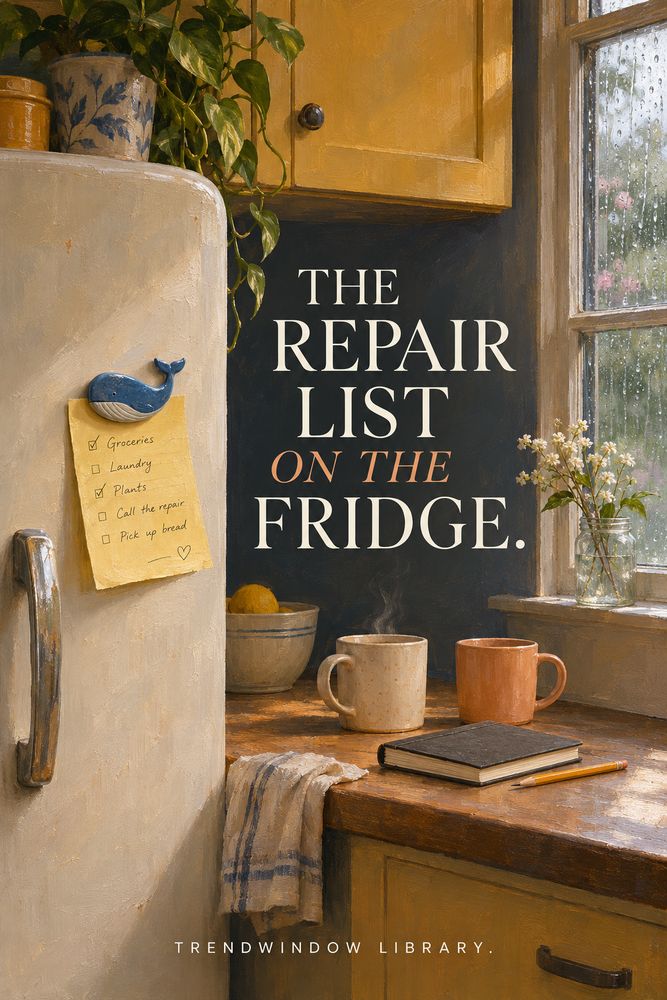
Front cover of The Repair List on the Fridge

Contemporary & Literary Fiction

The Repair List on the Fridge

By TrendWindow Library

A complete original work of contemporary literary fiction. Nina wrote the household list. Paul wants to help. A cupboard hinge and an unbooked drawing class bring an eighteen-year marriage to a conversation about who remembers what is left.

Read this complete edition, including its ending and notes. No purchase is required.

1. The Whale Magnet

The paper had been on the fridge long enough for the blue whale magnet to leave a clean patch beneath its tail.

Nina had written HINGE, BATHROOM BLIND and HALL PAINT in capitals. Below them, in smaller writing, were Return Dan's drill, Ask May about Sunday and Potatoes.

The potatoes were new. The hinge was not.

On Friday evening Paul stood in front of the list with his work bag still over one shoulder.

“I'll get through that tomorrow,” he said.

Nina looked up from the table. She was forty-four, he was forty-six, and they had been married for eighteen years. She knew the generous feeling behind his sentence. She also knew how many questions could fit inside tomorrow.

“All of it?”

“Make a proper day of it.”

He took the bag upstairs. Nina put the potatoes on to cook.

There was a folded leaflet in the kitchen drawer beneath the takeaway menus. Saturday drawing, ten until twelve. Beginners welcome. She had carried it home three weeks earlier and had not booked a place.

She had told Paul she wanted a Saturday to herself. She had not told him about the class. Somehow she had begun to wait for the house to have no remaining needs before giving the morning a name.

The house had not obliged.

2. A Proper Day of It

By nine on Saturday, Paul had put a screwdriver, an old cloth and a mug of tea on the counter. Nina made coffee and opened the back door to let the cooking smell out.

“Which hinge?” he asked.

She pointed to the cupboard that had been catching her sleeve for a month.

“Right. Thought it was that one.”

He worked on it while she answered a message from May, his sister. May wanted to know if Sunday lunch was still possible. The question had come to Nina because the last three answers had come from Nina.

Paul finished the hinge. The door shut cleanly. He opened it and shut it again.

“There.”

Nina was pleased. It was a small relief she had been expecting too long.

“Thank you.”

“Blind next. Have we got the measurements?”

“No.”

“Could you find the tape?”

She put down the phone.

The tape was in the drawer where Paul had left it after measuring a shelf. He found it before she stood up. Then he asked which shop she thought would have the right blind.

“I haven't looked.”

He glanced at her. She could see him trying to work out whether this was an answer about the shop.

At eleven, the hinge was finished. The blind lay untouched. Nina had found Dan's number for Paul, replied to May that they would get back to her, and located the paint sample cards.

Her coffee was cold. She had not sat down with it.

3. What the List Left Out

Paul came back from the hardware shop with a small packet and no blind. He had decided not to buy one until they knew what fitting would be needed.

“They can arrange someone to measure and fit it,” he said. “You'd have to phone.”

Nina put the paint cards down.

“Why would I?”

“You know when you're here.”

“So do you.”

They stood on opposite sides of the kitchen table. Outside, someone was dragging a bin over uneven paving. The noise lasted much longer than seemed necessary.

“I'm trying to help,” Paul said.

“I know.”

“If you tell me what needs doing, I'll do it.”

She pointed at the fridge.

“I did.”

He looked at the list, then at the paint cards she had brought out.

“You mean I keep asking.”

“I mean I still have to hold the whole thing. Which door, which shop, whose number, what time, whether anyone has replied. Then I have to remember what's left.”

Paul sat down. He moved the packet from the middle of the table without opening it.

“I didn't think of that as part of it.”

“It is part of it for me.”

She had wanted to say this neatly. Instead, she heard the tiredness in her own voice and felt irritated that even the sentence had come out with something to apologise for.

“The hinge is better,” she added.

“It was bad.”

“It was. I'm glad you did it. I'm not saying you do nothing.”

He rubbed the edge of the packet with his thumb.

“But you don't want to give me a job and then supervise it.”

“No.”

4. The Unbooked Morning

Nina took the leaflet from the drawer. Paul read the first line, then looked at the clock.

“Was this today?”

“They run it every Saturday. I haven't booked.”

“You could have told me.”

“Yes. I could. I didn't want to make a case for two hours.”

He began to answer, stopped and tried again.

“I wouldn't have said you couldn't.”

“I know. But I wanted to go without arranging everything around it first.”

She sat opposite him. The class had not been a secret test he was meant to pass by guessing. She said that too. He could not have known the name of an outing she had not mentioned.

“I want next Saturday morning,” she said. “For this.”

“All right.”

“Not after we finish the list.”

“All right.”

For a while they looked at the leaflet between them. It showed a charcoal drawing of an ordinary jug. Nina liked that nobody had made the jug more interesting than it was.

Paul took his phone out.

“I'll speak to the shop about the blind. I'll arrange the appointment and be here. If there's something we need to choose together, I'll ask about that.”

Nina nodded.

“And Dan's drill?”

He looked towards the cupboard under the stairs.

“I borrowed it. I can find Dan.”

“You can.”

His mouth moved into a small, uncomfortable smile. It was not quite a joke, but she smiled back.

“May is my sister,” he said.

“I remember.”

“I can ask what she wants to do.”

“We can have her for tea tomorrow. I don't want to cook a lunch.”

“Tea, then. I'll check with her.”

He did not hand Nina the phone to finish the conversation.

5. Things That Happened

The rest of that Saturday did not become a demonstration.

Paul found the drill where he had put it, underneath a bag of winter scarves. He called Dan and arranged to return it on Monday evening. Nina did not put the arrangement in her diary.

May said tea would suit her. Paul bought a cake and remembered to say that Nina had wanted a quiet Sunday morning. May arrived at three, talked about her neighbour's enormous new fence and left the cake tin behind. The visit was pleasant without becoming proof of anything.

On Monday, Nina booked the Saturday class. She put the confirmation in her phone and told Paul the time.

“I'll be out before ten.”

“Have a good morning.”

The blind appointment was Wednesday afternoon. Paul changed his own work arrangement so he could be home. When the shop needed a choice of colour, he brought Nina the two available samples.

“Either is fine with me,” he said. “Have you got a preference?”

She chose the warmer one. That was a question about their room, not a request for her to run the appointment.

The new blind went up on Wednesday. Paul put the receipt away and cleared the packaging. Nina noticed the empty floor before she noticed the blind.

The hall paint remained undecided. Neither of them loved the colours on the cards. They agreed to leave it for a month rather than call it a task that would somehow happen next weekend.

She had expected to feel only delighted. There was some awkwardness too. Eighteen years had given them habits that did not disappear because they had spoken about them once.

On Thursday Paul asked where the spare bin bags were. Nina told him. A house did not become a place where nobody could ask a question. Later, he found the next packet without asking her to remember when to buy it.

6. A Line of His Own

At the drawing class, Nina sat beside a woman who had brought six pencils and no rubber. Nina had brought one pencil and two rubbers. They laughed and shared.

The tutor set the same jug from the leaflet on a low table. Nina's first drawing made its handle too large. She tried another. By half past eleven, she had stopped wondering whether Paul had managed at home.

When she returned, he was reading in the kitchen. There was no newly painted hall, no cleared wall for her drawings and no expensive set of pencils waiting as a surprise.

“How was it?” he asked.

She opened the sketchbook herself.

“This one's nearly a jug.”

He leaned over the page.

“I can see the improvement.”

“From what?”

“The one beside it.”

She laughed. He had actually looked.

Two weeks later, the whale magnet still held the paper. HINGE and BATHROOM BLIND were crossed out. Dan had his drill. May's question no longer sat there waiting. The potatoes had been bought and eaten. HALL PAINT had a month written beside it, not a hopeful question mark.

Below Nina's writing was a new line in Paul's hand: Loose kitchen chair. Ask repairer Monday.

“I noticed it yesterday,” he said when she looked at the page. “I've put a note in my phone.”

“Which chair?”

He pointed. She sat on the other one.

The question had not made either of them the manager of the room. It had simply given her information she did not have.

There would be days when they fell back into the old exchange. Nina knew she could still say yes too quickly, and Paul could still mistake willingness for attention. She did not cross those things off as repaired.

But on the following Saturday, she took her sketchbook from beside the door and left at half past nine. Paul had already called the repairer about the chair. The appointment was in his phone, and he would be there.

Outside, the morning was damp. Nina walked past a café opening its shutters and thought about how she might draw the angle of the door.

At home, the cupboard closed without catching. The list stayed on the fridge. For those two hours, Nina did not carry it with her.

Edition Note

This is a complete original work of contemporary literary fiction. Nina, Paul, Dan, May, the household, jobs, class and events are invented. The story makes no claim to describe every marriage, establish a psychological finding or provide therapy, household-repair, employment, legal or financial advice. The English original, full translations and original cover artwork are AI-assisted and editorially reviewed, without independent human-authorship or native-human certification.

Explore more books →