BOOK LIBRARY · Complete books · Purchases disabled
TrendWindow

← Book Library · Complete book

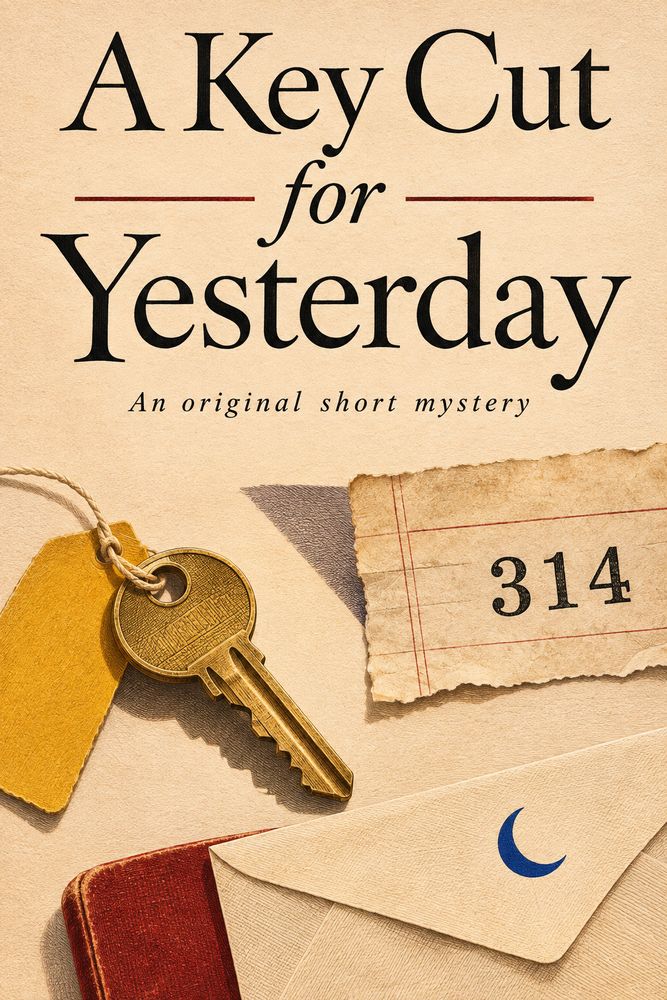
Front cover of A Key Cut for Yesterday

Mystery, Crime & Thriller

A Key Cut for Yesterday

By TrendWindow Library

A receipt dated the afternoon of a closed workshop and a missing red notebook bring Mira Venn into a dispute over an entrusted key. An eight-chapter short mystery about records, permission and the limits of proof.

Read this complete edition, including its ending and notes. No purchase is required.

About this book

An original short mystery

This is a work of fiction. Its people, town, businesses and events are invented. The story concerns trust and records; it does not provide instructions for defeating locks, copying restricted keys or investigating a real person.

Original short fiction prepared with AI assistance. Characters, places and events are invented. No legal procedure, forensic certification or lock-manipulation instructions are asserted. Translation meaning reviewed with AI, not independently certified by native-language professionals.

1. The hour that did not belong

At nine on the morning of 15 October, Elin Ward laid a receipt on Mira Venn's counter and kept two fingers on it, as though the paper might escape.

VENN — KEYS AND REPAIRS, it said. Below the name stood a date, 14 October, and a time, 16:20. The item was one spare key. The serial number was 314.

“You were closed yesterday,” Elin said.

“From noon.”

“My key apparently wasn't.”

Mira had spent the afternoon at her father's funeral. The workshop had been locked, the shutters down, and the only receipt book she currently used had remained in a drawer. She did not tell Elin about the funeral immediately. An alibi would not explain the paper between them.

The receipt had no year. Its corners were soft, and the telephone number contained four digits. At the bottom, partly hidden by Elin's hand, was an address Mira knew but had never worked at: Old Bridge Road.

“Where did this come from?”

“From the envelope in which Tomas returned my spare.”

Tomas Bell collected the maintenance payments at Alder House, where Elin occupied the fourth flat. He had asked a neighbour for her key the previous afternoon to check a reported leak. Elin had been away at a clinic. Her neighbour Rafi had arranged the handover.

When Elin came home, the spare was waiting in its envelope. Her red account notebook was not waiting on its shelf.

“Tomas said the receipt was already with the key when it reached him. He thought I should know somebody had ordered another.”

“Did he say he saw another key?”

“No.”

Mira turned the paper over without lifting Elin's fingers. The back was blank. There was a small crescent of blue at one corner, as if it had once rested against something damp.

“My father used this heading,” she said.

“So it can be real?”

“It can be real without being recent.”

Outside, a delivery van blocked the narrow street. Someone sounded a horn, then stopped. Elin moved her fingers.

“The notebook lists the roof money. What we paid, when, and what was supposed to happen. The residents are meeting tonight.”

Mira looked at the date again. Yesterday was present in two neat figures. The year, which could have changed everything, was absent.

“I can establish what my shop issued,” she said. “I can't tell you who entered your home from a piece of paper.”

“Then start with the part you can.”
2. A second number 314

The current receipt numbered 314 concerned a repaired suitcase handle in February. Its duplicate was still in Mira's book, between 313 and 315. Elin read the three entries herself.

“Two receipts with the same number?”

“Two books can begin again. A number needs its book.”

Mira's father, Ivo, had kept old duplicates in biscuit tins because he distrusted cardboard. When the shop moved from Old Bridge Road, he had labelled the tins in pencil. Mira had meant to catalogue them after his retirement. Now retirement was a word that had lost its future.

She brought the tin marked OLD BRIDGE — LAST AUTUMN from beneath the bench. Inside were repair slips, rent receipts and a folded order for replacement stationery. The order was dated 1998. It named the four-digit telephone number printed on Elin's paper.

“That narrows it,” Mira said. “It doesn't date every sheet.”

They found the matching duplicate under a rusted paper clip. Serial 314. 14 October. 16:20. One spare key, paid for by Mrs L. Ward.

The faint pressure marks and arrangement of the writing matched Elin's receipt. On the same bound sequence, an entry a few pages earlier included the year 1998 in full. Mira photographed the open sequence with Elin's permission and left the original pages together.

“My mother,” Elin said. “Lydia.”

“Was she at Alder House?”

“Before me. She liked keeping the receipts for things nobody expected to need explaining.”

Mira remembered Lydia Ward only as a woman who brought her father pears in a shopping bag. She had not known where the woman lived. A memory could be warm and still prove very little.

Elin fetched her phone. In a photograph of the returned envelope, the key lay beside the old receipt. Printed across the envelope was a blue crescent, the mark of a long-closed stationer.

“I've seen that envelope in my mother's drawer,” she said. “Not in Rafi's kitchen.”

“Can you be certain?”

“Certain enough to look. Not certain enough to accuse.”

The discovery did not identify a thief. It removed a false explanation: the receipt was not evidence that Mira had made a spare yesterday. It documented an older transaction.

At the door Elin hesitated. “I'm sorry about your father. Rafi told me this morning.”

Mira closed the tin carefully. “He kept the page. Today that helps.”

She wrote the date of her examination on a separate sheet. She did not add a year to the old receipt.

3. Three people and one afternoon

Rafi lived opposite Elin, with a fern that occupied more of the landing than the building rules probably intended. When Mira and Elin arrived, he moved it inside without being asked.

“I should have called you before I gave it to anyone,” he told Elin.

“We'll come to that. First, exactly what happened?”

Elin had left the spare with him on 12 October, attached to a yellow tag. She had asked him to let in the heating engineer if the appointment fell during her clinic visit. On the morning of the fourteenth, his sister called: she needed him at her house. Before leaving, he gave the tagged key to Ada Lin in the flat downstairs.

Ada joined them with a school exercise book. She used the last pages for things she would otherwise forget. There, beneath a grocery list, she had written: Rafi — Elin key — 10:15.

“Tomas came at three,” she said. “He said the leak couldn't wait. I asked whether Elin knew. He said he'd spoken to her.”

“I hadn't,” Elin said.

Ada did not try to turn her mistake into a better memory. She showed them a message she had sent Rafi at 15:06: Gave Elin's key to Tomas for leak. He says agreed.

Rafi had replied at 15:11: Thanks. I thought Elin had arranged it.

Two people had each assumed the third possessed permission. Between the two assumptions, Tomas had received a key.

At 16:45 he returned it to Rafi, who was home by then. It was in the blue-crescent envelope. Tomas said he had discovered an old-looking receipt with the spare and wondered whether someone else had used it.

“Was the key in an envelope when you gave it to Ada?” Mira asked.

“No. Just the tag.”

Ada nodded. “The same when I handed it over.”

Rafi looked at the floor. “I put the envelope through Elin's letterbox. I didn't open it.”

Mira wrote down who had said what, and let each person correct the wording. She separated remembered times from the times on the messages. The page showed a chain of custody, but not an unbroken film. No one had watched the key every minute.

Elin read it twice.

“This shows how the key travelled,” she said. “Now I want to know why the envelope travelled with it.”

4. The drawer with the crescent

Elin invited Mira into the fourth flat. The room smelled of the oranges Elin had bought before the appointment. A clean bowl stood beneath the stain on the ceiling. There had been a leak; the reason for concern was not invented.

The red notebook usually stood between a gardening guide and an atlas. Its empty space was narrow enough to miss unless one knew it. Nothing else obvious had gone.

Elin opened a drawer in the writing table. Inside lay old cards, a packet of photographs and three envelopes from the stationer with the blue crescent.

“My mother's household papers.”

She held one against the returned envelope. The printed marks matched in design and size. That did not prove this particular envelope had come from the drawer. The stationer had sold more than one packet. Mira said so before Elin could mistake similarity for certainty.

But another detail was less general. Lydia had written a list of curtain measurements on the back of the returned envelope. Elin found a photograph she had taken while sorting the drawer the previous winter. The envelope appeared beneath a birthday card, with the same measurements and a small torn corner.

“I kept the photograph to ask my cousin about the handwriting,” she said.

The image supported the envelope's presence in the flat before yesterday. It did not show who had taken it out. Mira placed it beside the handover notes and resisted the temptation to draw an arrow longer than the evidence allowed.

“Was the spare ever kept in that drawer?”

“Years ago. My mother used the envelope. I took the key out when I gave it to Rafi. The receipt stayed behind.”

Now Tomas's account had a problem. He said the receipt had arrived with the key. Rafi and Ada said the key had travelled without any envelope. The photograph and Elin's account put the envelope elsewhere.

Elin found a pale square on the shelf where the notebook had stood.

“I thought keeping the figures myself would prevent arguments.”

“It may still help.”

“Only if we find it.”

“Did you ever send anyone a page?”

Elin looked towards the atlas. Then she reached for her phone again.

“I sent Anika the last two pages on Sunday. She couldn't attend the planning discussion.”

For the first time that morning, the missing object was no longer the only place the missing information could live.

5. Seventy-three

Anika Vale chaired the residents' informal committee. She came to Elin's kitchen with the page photographs already open. They showed payments made for the roof, a list of promised work and a difference of seventy-three pounds between two sets of figures.

The number was small beside the total. That made it useful. Anika had asked about it in a message to Tomas, but had not sent him Elin's page. His reply said the records were complete and the residents could review everything at the evening meeting.

“The missing notebook is not our only record,” Anika said. “But it's hers. Taking it would still matter.”

Mira agreed. Recovery of information did not cancel entry into somebody's private space.

They asked Tomas to meet them in the ground-floor office. He arrived carrying a ring of building keys that he set down loudly, although nobody had asked for them.

“I don't know what this has to do with me.”

Elin put a copy of the handover notes before him. “You had my spare yesterday.”

“For the leak.”

“You told Ada you'd spoken to me.”

“I meant Rafi.”

“Rafi isn't me.”

Tomas sat. Mira showed the dated sequence from her father's receipt book.

“The receipt is an older transaction,” she said. “It doesn't show a new key made yesterday.”

“I never said it proved anything. I passed it on.”

“You said it arrived with the spare.”

“That is how I remember it.”

Anika asked about the roof accounts. Tomas looked at the photographs in her hand.

“I'm not having all this over seventy-three pounds.”

No one spoke for a moment.

Mira felt the pull of a perfect revelation. But Anika had already asked him about that amount. His knowledge of the figure was not secret knowledge, and pretending otherwise would only create a second false case beside the first.

“You knew that number from Anika's message,” Mira said. “It doesn't tell us where the notebook is.”

Tomas looked at her, surprised to be spared an accusation.

“What does tell us,” Elin said, “is whether you can explain the envelope. It was in my drawer. The key wasn't inside it when either neighbour handed it on.”

She placed the winter photograph on the desk. Tomas did not answer immediately. Silence was not a confession, either. They waited for words.

6. What the office held

Tomas rubbed the edge of the photograph but did not pick it up.

“I went into the flat. I checked the bowl.”

“Then?” Elin asked.

“I saw the notebook.”

“On the shelf.”

“Yes.”

His first account made the rest sound like an administrative errand. He had wanted to compare figures before the meeting. He had thought a brief loan would save embarrassment. He would have returned it.

“You didn't ask,” Elin said.

“No.”

“Where is it?”

“In the cabinet.”

The cabinet belonged to the committee, but Mira did not touch it. Tomas stood, opened it himself and removed the red notebook from beneath a folder of maintenance quotations. He put it on the desk.

Elin checked the cover, the pages she remembered and the last written entries. Anika compared the photographed pages with the originals. They appeared unchanged. That was a limited inspection, not proof that no page anywhere had been altered. Elin kept the notebook with her.

“And the envelope?” Mira asked.

Tomas leaned back. “I looked in the drawer for something to carry the book in. I saw the receipt. Same date.”

“Different year,” Mira said.

“I didn't know that.”

He had put the receipt with the returned key, he admitted, because he wanted Elin to consider another explanation if she noticed the notebook missing. He had said it came with the spare because admitting he found it in her drawer would place him inside the flat.

The intention was uglier when spoken without the word administration.

“Did you have another key made?” Elin asked.

“No.”

Mira did not turn that answer into a certification. Her records disproved this receipt as evidence of a new key; they could not establish that no copy existed anywhere. She explained the distinction plainly.

Anika asked Tomas to write his account while they were present. He did. The page included the notebook, the drawer and the receipt. Each person kept a copy of what was written, with Tomas's knowledge. Elin would decide what further action to take about the entry and removal; nobody offered a private promise of silence.

The notebook was back. Trust was not. They were separate objects, and only one had been lying in the cabinet.

7. The meeting without a shortcut

At the evening meeting, the residents did not begin by debating whether Tomas was a good man. Anika put the accounts on the table and explained what had been recovered, what Tomas had acknowledged and what still required checking.

The seventy-three pounds concerned an invoice entered at one amount and copied into a summary at another. Tomas called it an error. The available documents supported the difference, not an immediate conclusion about its cause.

A larger question remained: several promised roof repairs had no completion record in the folder. Missing paperwork was not automatically proof that no work had happened. It was reason to obtain the relevant invoices and confirmations before approving the next round of spending.

The committee agreed that Tomas would no longer be the only person receiving payments and maintaining the record. Two residents would review the documents together. The story of the key did not grant Mira authority over the building's money, so she stayed out of that decision.

Elin spoke after the financial discussion.

“I gave a spare to a neighbour for a particular visit. It became general permission while it travelled. Each person thought the permission was somewhere ahead of them.”

Rafi and Ada apologized without asking her to call the matter small. She accepted the apologies, not the old arrangement.

They wrote a simpler plan for entrusted keys: a named holder, a stated purpose, contact with the resident before a change of holder or purpose, and a recorded return. If the resident could not be reached, they would not invent consent for an ordinary maintenance visit. Actual emergencies would follow the building's appropriate emergency arrangements, not an improvised rule from tonight's argument.

Elin asked Mira for an authorized appointment to review her own door's security. They arranged it privately. Mira did not promise that a paper receipt could settle the physical question, and she did not discuss technical details at the meeting.

Before leaving, Rafi returned the yellow tag. There was no key attached.

“I don't need you to stop being my neighbour,” Elin told him. “I need you to stop deciding what I must have agreed.”

He nodded. The gesture was brief; living up to it would take longer.

8. The year written separately

The following morning, Elin came back to the workshop. She brought pears in a paper bag and the blue-crescent envelope, now empty.

“I thought you'd like to see the measurements properly,” she said.

Mira spread the envelope on the counter. Lydia's handwriting ran around the torn corner with the patience of someone who intended to use every remaining inch of paper.

“Do you want me to keep it with the duplicate?”

“No. It's mine.” Elin smiled. “But you may photograph it.”

Mira did, with permission. She attached the new photograph and the examination note to a separate folder, leaving the old receipt and its duplicate unaltered. The folder explained the connection to the 1998 sequence and the limits of what had been established.

Outside, a customer waited with a loose cupboard handle. Ordinary work was returning, indifferent to the fact that the workshop had contained a small courtroom the day before.

“Will the roof be fixed?” Mira asked.

“The documents are being checked. We haven't made the missing work appear by finding my book.”

It was an answer Mira respected. Solving one deception did not complete every task that deception had interrupted.

After Elin left, Mira opened her current receipt book. She added the year to the date on the next receipt she issued, then read the item back to the customer before handing it over. This was not a cure for dishonesty. It was one fewer gap in which an honest record could be made to tell a dishonest story.

At noon she put the old biscuit tin back beneath the bench. She could hear her father's objection to her new folder: the tin had always been perfectly good. For the first time since the funeral, the imagined objection made her laugh rather than turn away.

She had not recovered him. She had found something he had done carefully enough to survive him.

The key in Elin's possession belonged to the present. The receipt belonged to an earlier October. Between them lay a day of borrowed authority, finally named for what it was.

Mira lifted the shutters the last few inches. Light reached the counter where Elin's fingers had held down yesterday.

### Fiction and scope

A complete original short mystery. All characters, places, records and financial events are invented. The story deliberately distinguishes a document's date from its missing year, a limited inspection from proof, and a neighbour's possession from an owner's permission. No real-world legal procedure, forensic certification or lock-manipulation instruction is asserted.

Explore more books →