BOOK LIBRARY · Complete books · Purchases disabled
TrendWindow

← Book Library · Complete book

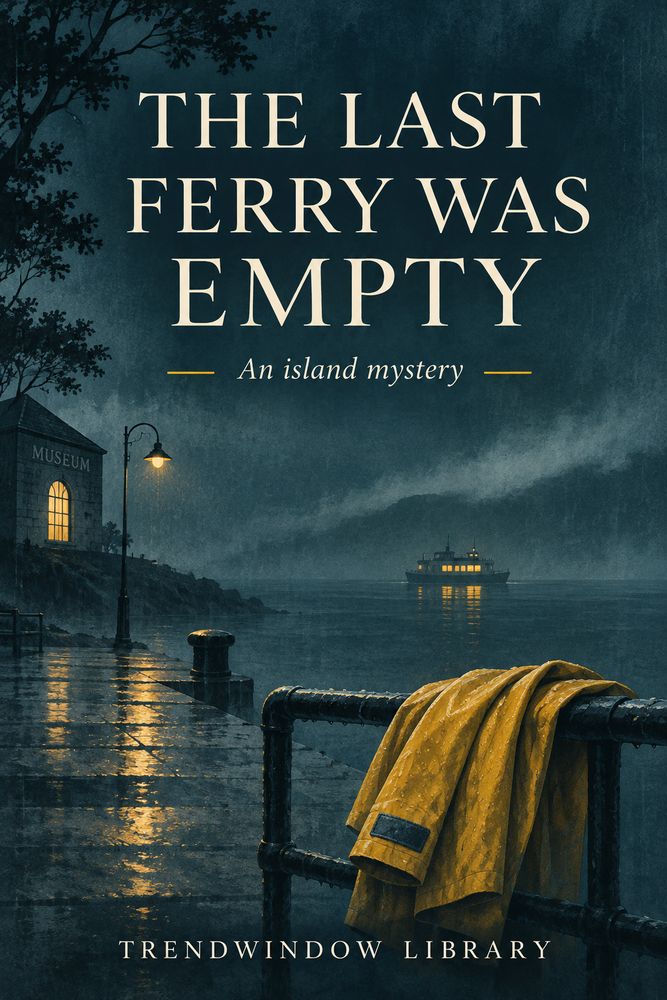
Front cover of The Last Ferry Was Empty

Mystery, Crime & Thriller

The Last Ferry Was Empty

By TrendWindow Library

When a curator and a brass chronometer vanish, a ferry ticket points away from an island. But the last boat carried no passengers. Photographer Anya must separate sightings from assumptions to find her uncle.

Read this complete edition, including its ending and notes. No purchase is required.

About this story

An original island mystery

This is a work of fiction. The island, museum, people, ferry arrangements and investigation are invented. It is not an account of a real disappearance or a guide to maritime operations or police procedure.

Original AI-assisted fiction and translations, reviewed by an AI assistant. No independent human-editor or native-speaker certification is claimed.

1. The coat on the quay

At half past nine, the museum clock was still ticking inside an empty case.

The sound came from the wall above it. Anya knew that, but for a moment she heard the missing chronometer instead: the expensive little brass instrument her uncle Milo wound each morning with a care he rarely extended to himself. Tonight its velvet recess held only a rectangle of cleaner fabric.

Milo's office light was on. His telephone lay charging beside a cup with a skin of cold tea. A ferry ticket rested beneath the cup's handle, clean and dry, with a sailing time of seven twenty printed across it. Outside, rain rattled the museum's glass porch.

Rafe, who ran the quay café, had called Anya because she photographed the collection and had a spare office key. He stood in the doorway, keeping his wet shoes off the rug.

“I saw him going towards the boat,” he said. “About seven. His yellow coat. I thought he'd finally taken a day off.”

“With his telephone here?”

Rafe looked at the empty case. “Perhaps he didn't want calls.”

Anya telephoned the island constable, Amal, and gave her the facts she could see. She did not say her uncle had stolen the chronometer. By the time she finished, Rafe had stopped looking at the case and begun looking at Milo's chair.

The chair was tucked in neatly. That disturbed Anya more than the cold tea. Milo always left it sideways, as if expecting to return before anyone noticed he had gone.

2. A departure without a passenger

Amal arrived with Lotte, the museum's chair, who had been at a meeting in the village hall. Lotte asked whether the chronometer had been sent for repair. Anya knew of no arrangement. Amal asked them to leave the office as it was while she checked.

The ferry skipper answered her call from the mainland. Anya heard only Amal's half of the conversation: a question, a long silence, then the same question with a different emphasis.

“No passengers at all?”

The last crossing had been a positioning trip. Passenger service had been cancelled that afternoon because a fault had closed the island boarding ramp. The vessel had left its berth by another arrangement, without taking anyone aboard. The skipper had no passenger named Milo—or any other name—to report.

Rafe's face reddened. “I saw the coat.”

“You saw someone walk towards the quay,” Amal said. “That's useful. It isn't the same as seeing him board.”

Anya went to the porch and looked through rain at the dark water. The ticket had seemed such an ordinary explanation that she had nearly stopped asking questions. It promised a tidy direction: missing man, missing object, departed boat.

But the boat had gone empty.

Lotte remembered an argument with Milo that morning. He wanted to cancel an exhibition loan; she wanted another week to decide. She offered the disagreement before anyone asked. Anya could not tell whether that made her candid or careful.

Amal began arranging a search on the island. She asked Anya for Milo's usual places, not her favourite theory. Anya named the museum, the harbour archive and the old signal house above the eastern path. At the last name, Lotte glanced at the desk calendar.
3. Seven at the signal house

The calendar was open to Thursday. Beneath a crossed-out dentist reminder Milo had written, in his small impatient capitals, “SIGNAL HOUSE 7 — D. LEDGER.”

Dorian kept the museum's stores and helped with exhibition transport. He arrived before Amal called him, carrying a covered tray from his mother's kitchen. Someone at the café had told him there was trouble.

“He wanted an old shipping ledger,” Dorian said, reading the calendar from the doorway. “I told him I'd look tomorrow.”

“Did you arrange to meet him there tonight?” Amal asked.

“No. He must have misunderstood.”

His mother was ill, he explained. He had stayed with her all evening, apart from collecting bread before seven. Anya noticed that he supplied the exception himself, as though putting one small gap in an account would make the rest easier to trust.

There were other reasons not to trust an account. Milo could write an appointment before anyone accepted it. He could leave his phone and lose track of time. He could decide that a shipping ledger mattered more than answering a worried niece. None of those possibilities put the chronometer back in its case.

Lotte said Dorian held the signal-house key. The building stored old collection boxes awaiting assessment; it was not open to visitors. He had signed the key out on Tuesday for an inventory.

Dorian set down the tray. “I'll come with you.”

Amal asked him to stay while a colleague spoke to him. She sent a local response crew to the building and told Anya to wait at the museum. Anya wanted to object. Instead she gave them the photograph she had taken of the entrance last month, with the steep step visible in full.

4. What the photograph actually showed

Waiting made every sound too distinct: rain, the wall clock, Rafe taking a breath before deciding not to speak. Anya opened that afternoon's photographs on her laptop. She had been photographing the museum's new sign from across the lane at six forty-eight.

In the edge of the third frame, Dorian walked towards the harbour. He carried a yellow coat folded over one arm. A dark rectangular patch showed near its cuff.

Anya knew the patch. She had sewn it onto Milo's coat after he caught the sleeve on a cabinet handle. In the photograph, the coat was being carried, not worn. She showed Amal the whole frame and the neighbouring photographs, keeping the originals unchanged.

“He could have been returning it,” Amal said.

“Yes.” Anya disliked how quickly she had wanted the image to mean more.

Rafe leaned closer. He had seen the yellow figure through his kitchen window while clearing plates. The person had passed the corner towards the quay. He had not seen a face. Asked about the time, he could say only that it was after he started closing and before the café clock struck seven.

That changed the shape of his certainty. He had seen a coat worn by someone later than Anya's photograph, or perhaps remembered a carried coat as a worn one. He could not now honestly choose between those possibilities.

Amal wrote down the distinction. The photograph connected Dorian to the coat before seven. Rafe's account established neither its wearer nor a boarding. A correct colour could still carry a false conclusion.

Then the telephone rang. Someone had answered from inside the signal house.

5. The man behind the inner door

Milo was in a ground-floor storeroom behind an inner door that had been fastened from the other side. The response crew opened it. He was cold, frightened and furious, with a scraped hand from trying to attract attention through a narrow opening. They brought him somewhere warm and arranged for his condition to be checked.

Anya did not receive the story all at once. First came a message that he was alive. Then his voice, thin over someone else's telephone, saying, “Don't tell me I should have taken my mobile.”

She sat down so abruptly that Rafe caught the back of her chair.

Later, when Amal could speak with him, Milo described a meeting with Dorian. Dorian had said that the ledger was in the lower room and asked Milo to identify it. Milo went in. The door closed. At first he thought the catch had slipped; then he heard Dorian refuse to open it.

“He said he'd be back before morning. He said I only had to keep quiet for one night.”

Milo had left his yellow coat at the museum. Dorian had told him the signal house would be warm enough and the walk would be short. Milo remembered being annoyed by the fuss, then pleased that someone else had thought ahead.

That memory hurt him more than he wanted to admit.

Amal did not ask Anya to confront Dorian. Her colleague kept him at the museum while she checked Milo's account. Anya remained beside the laptop, staring at the folded yellow cloth in the photograph. A borrowed kindness could be part of a trap. That did not make kindness itself the evidence; her uncle's account still needed to be tested against what they could find.

6. The box that had not left

The missing chronometer was found in Dorian's transport van, packed in a plain collection box. Amal handled the search and the object; Anya was not invited to open anything. Later she was asked to identify a small dent in the brass rim from an older collection photograph.

The dent matched. So did the collection number recorded beneath the stand. The object had not reached the mainland, and nobody had to guess its identity from a polished surface alone.

Dorian's first explanation was an authorised move. Lotte said she had approved no such transfer. The museum's existing movement record contained no entry for it. An absent entry could be a mistake, Amal said, but it did not settle the matter in his favour—particularly beside Milo's account and the planted ticket.

The ticket had been bought at the café earlier that day. Rafe remembered selling it to Dorian, who said he was collecting it for Milo. Rafe had not known the afternoon service change when he sold it. Later, seeing yellow near the quay, he had supplied the missing journey in his own mind.

Amal put those facts to Dorian separately. He stopped insisting that everything was an ordinary collection move. He admitted taking the chronometer and leaving the ticket on Milo's desk. He had intended to depart with the van on the next morning's crossing, after the island spent a night looking elsewhere.

The plan had depended less on an empty ferry than on a full story: a troubled curator, an expensive object and a ticket everyone knew how to read. The story failed when someone asked whether the journey had happened.

7. What an explanation does not repair

Dorian said he owed money. He said the chronometer had been insured. He said Milo would have been released before anyone suffered lasting harm.

Milo listened to that last claim from a chair in his own office the following day. His hand was bandaged. He had slept badly and kept turning whenever the door moved.

“He doesn't get to choose what lasted,” he said.

Amal had taken Dorian away for further questioning. What would follow belonged to an investigation and decisions beyond the museum, not a verdict that Lotte could announce over tea. She told the trustees what had been established and what remained pending. She did not call the recovered object proof that nothing serious had happened.

Rafe came with fresh bread and an apology. He had repeated the ferry story to two people before calling Anya. He would correct it with them. Milo accepted the bread, but did not make Rafe's embarrassment his own task to soothe.

Anya gave her uncle a copy of the photograph. He looked at his folded coat and asked whether she could photograph the patched sleeve another day, when it was simply a sleeve again.

They left the chronometer out of its case while the museum dealt with the investigation and its records. Lotte also postponed the exhibition loan. This time she and Milo discussed what was needed before setting another date.

Nothing became perfect because the right object returned. But the names attached to the night's actions were no longer borrowed from a coat or a printed ticket. That was a beginning they could trust more than the first neat explanation.

8. The morning crossing

On Saturday, Anya walked with Milo to the quay. He was wearing the yellow coat. The patched cuff brushed her hand when he reached past her for the railing.

They were not leaving the island. Milo wanted to watch the morning boat arrive, though he had taken the same view for granted for thirty years. Anya brought no camera. For once, he did not ask why she was wasting a good light.

The boarding ramp had reopened. People waited with bags, a folded pushchair and a bunch of flowers wrapped against the wind. The skipper called to someone he recognised. A woman stepped down, looked around and waved at a man who had been trying not to look impatient.

Milo stood a little away from the crowd. “I keep thinking I should have known.”

“You knew you were meeting someone you worked with.”

“That's what I mean.”

Anya did not turn the sentence into advice. She stayed beside him until the last passenger had passed. Then they walked towards Rafe's café, slowly enough that they were late for its quietest hour.

Behind them the ferry prepared to leave again. This time it carried people whose feet had crossed the ramp, whose bags stood beside them, whose destinations belonged to the journey they were actually making.

The empty crossing of Thursday night would remain in the record. It would not become the crossing Milo had taken, no matter how convincing the ticket looked. Anya thought of the space in the display case and of the man now choosing which table to sit at. The object had been recovered. Restoring her uncle's sense of safety would take longer. She followed him inside and let him choose a chair facing the door.

Explore more books →