BOOK LIBRARY · Complete books · Purchases disabled
TrendWindow

← Book Library · Complete book

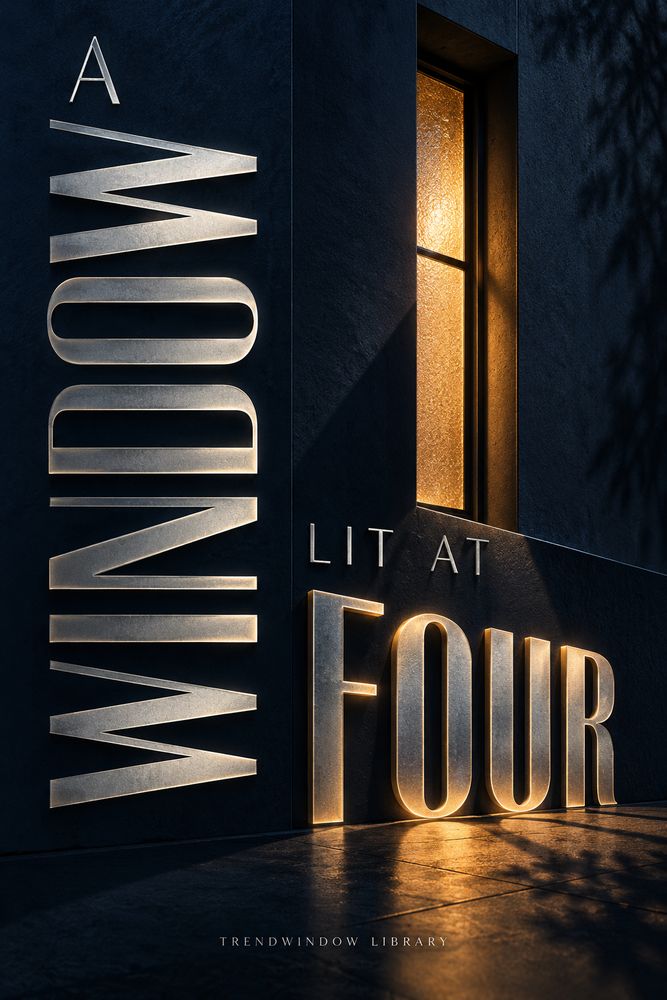
Front cover of A Window Lit at Four

Mystery, Crime & Thriller

A Window Lit at Four

By TrendWindow Library

A light before dawn and a cryptic note lead Noa through a closed cinema, a misplaced film and the working voices left unheard. A complete original mystery.

Read this complete edition, including its ending and notes. No purchase is required.

1. Before the Bread

At four in the morning, the little window above the cinema exit was full of amber light.

Noa stood outside the bakery with the keys to her new flat in her pocket and a bag containing everything she had bought for breakfast. The bakery would not open for another hour. She had mistaken the beginning of work for the beginning of service.

Across the road, the Oriole Cinema had been closed for eleven years. Its poster cases contained paper browned to the colour of weak tea. Above the side exit, a narrow window seemed to belong to a room that someone was still using.

A bus passed between her and the building. The light appeared to slide sideways, then settled again.

She would remember that later. At the time she thought someone had moved a lamp.

Her appointment at the cinema was for nine. Hugh Mercer, its owner and former manager, had hired her to inventory the projection equipment before the building sale. She had worked there for one summer at nineteen, threading nothing more complicated than ticket rolls into the box-office printer. Since then she had catalogued collections for people who were moving, divorcing or clearing a parent's house. It was a practical occupation for someone who liked things to have names.

When she returned at nine, the window was dark.

Hugh met her with two paper cups of coffee. He had put three keys on a red ribbon so that she could not mistake them for her own.

'No one uses the upper rooms,' he said. 'Don't bother looking for anything there. We emptied them when we closed.'

'I saw a light this morning.'

'In here?'

'Above the side exit. About four.'

He looked across the foyer toward the stairs.

'Impossible. Everything's off.'

Then he handed her a printed list, as if the list settled it. At the bottom, in the section marked COMMUNITY FILMS, one title had been crossed through: Before the Doors.

Beside it he had written: Original missing. Silent viewing copy only.

2. The Working Print

The viewing copy occupied a grey can in a cupboard behind the old sweet counter. Noa did not try to run it through a machine. She recorded the label, photographed the container and arranged for a local moving-image archivist to examine the material before anything was handled further.

There was also a digital viewing file on the office computer, made several years earlier. Hugh opened it for her. It showed the town before most people were awake: a delivery trolley, the cinema steps being swept, flour shaken from an apron, a woman carrying a stack of clean towels through a back door.

The women did not speak. A little piano music played under the images.

Noa recognised her mother's hands around the mop bucket before she recognised her face.

'Ruth,' she said.

'Yes. She helped us with that one.'

Her mother had cleaned the cinema for eight years. Noa knew the hours because she had complained about them: the evening meal kept warm, the weekend mornings spoken for, the familiar sentence that she would have to ask Mum what time she finished.

On screen, Ruth smiled briefly at someone outside the frame. Her lips moved. The piano carried on.

'Was there an interview?'

'We filmed bits of conversation. It didn't suit the finished piece.'

The file ran for thirteen minutes. At the end, a credit named Hugh as director. Under SPECIAL THANKS were five women's first names.

'What happened to the original?'

'Alma took things home sometimes. We never got everything back.'

'Is that a record of what happened, or what you think happened?'

Hugh turned down the volume, although the film had finished.

'What I remember. It was a long time ago.'

Noa entered that distinction beside the crossed-out title. She listed the digital file as a viewing copy, not a complete account of the original material.

When she returned to her flat that evening, a white envelope lay under the door. Inside, in blue ink, someone had written: Please don't sell the silence.

3. The Key That Opened Nothing

Noa carried the note to Hugh the next morning. He read it twice and said it sounded like Alma.

'Who is Alma?'

'Used to clean here with your mother. She helps at the bakery now. I wouldn't turn this into a mystery.'

'You said she took the original film.'

'I said she took things home.'

He was right about his words. Noa was right about the implication. Neither correction made the room more comfortable.

She asked to see the space behind the lit window. Hugh fetched a key labelled UPPER STORE. It opened a cupboard full of folded display boards. The room beyond the side stairs was unlocked and empty except for a broken office chair.

There was no window in the wall facing the road.

Noa went down again, walked outside and counted the bricks above the exit. The bright rectangle belonged over a shallow canopy, below the floor of the room she had just visited. From the pavement it had seemed higher.

'What is that opening, then?'

'An old display recess. We used to put a lamp and a poster there.'

'Can I look inside?'

'The panel is accessed from the foyer. Ask the building surveyor to open it. I don't want you levering things off on your first week.'

She did not want that either. She photographed the outside and wrote: Display recess, not occupied room. Its exact relation to the light remained a question, not an answer.

At the bakery, the woman filling paper bags looked up when Noa asked for Alma.

'I'm Laila. Alma's at the back. She'll come when she's washed her hands.'

Noa bought a loaf while she waited. It was an easier way to stand there than holding a mysterious note over the counter.

Alma emerged wearing a cardigan beneath a flour-dusted apron. She looked at the envelope and said, 'I wondered if you'd ask him first.'

4. Five First Names

Alma had delivered the note. Noa's flat was above the old florist; the letting agent had told half the street that Ruth's daughter was back. Alma had knocked, heard nothing and left it under the door.

'You could have put your name on it,' Noa said.

'I could. I wasn't sure I wanted the conversation once I'd started it.'

They sat at a little table beside the bakery's spare sacks. Laila brought tea and went back to work.

Before the Doors had been made in 2004 for a community weekend. Hugh filmed people whose work happened before customers arrived. There were five interviews. The women had asked to hear them together before deciding what could be used publicly.

'We signed for that,' Alma said. 'Not for him to sell a film of all of us talking. Not for a stranger to decide the rest.'

'Where is the original?'

'I don't know where his film is. I have our sound recordings.'

The difference was precise enough to stop Noa's next question.

Hugh had given Alma the recordings to arrange a listening afternoon. Her husband had gone into hospital that week. The meeting had been postponed. Later Hugh told them the public version was ready without the voices. At the community screening, they had watched themselves work under piano music.

'Your mother said we looked very efficient,' Alma said. 'She didn't mean it as praise.'

'Why keep the recordings all this time?'

'Because we were still in them.'

Alma did not produce a secret box at once. She asked what Noa intended to do with anything she heard. Noa said she did not know yet. She wanted the sale inventory to say accurately what existed and what did not belong in an unrestricted sale.

'Then come tomorrow, after the first bread goes out. Four is quiet here.'

Noa looked across the road at the dark recess above the cinema door.

'Do you switch something on over there?'

Alma followed her glance.

'We don't have a key to the cinema. You ought to ask why a light means a person to you.'

5. The Lamp Behind Her

At four, Noa stood in the same place as on Sunday. The amber rectangle had returned.

This time Laila was behind her in the bakery doorway. Above Laila's shoulder hung a long narrow lamp over the packing bench.

Noa moved three steps left. The light in the cinema recess moved too. She moved back. It returned. From near the corner, the rectangle disappeared although the bakery lamp remained on.

'It isn't inside,' she said.

'No,' Laila answered. 'It catches us when we put the packing light on. Depends where you're standing.'

Later that morning the building surveyor opened the display panel with Hugh present. Behind its front glass was a tilted piece of mirrored material left from an old promotional display. It reflected the bakery lamp toward a small section of pavement. There was no occupied room, no secret early visitor and no lamp moving through the cinema.

The surveyor recorded the recess in the building notes and closed it again. Noa did not turn the discovery into evidence of who had entered at other times. It answered what she had actually seen.

'I should have remembered that display,' Hugh said.

'Neither of us did.'

It was easier to say than to accept. Noa had built a room around a light. Then she had put a person in the room and given that person a reason to be there.

The note had been real, but it had not mentioned the window. She had joined the two because they arrived together.

She added a line to her inventory notes: Morning light is a reflection from the bakery. No evidence of occupancy from this observation.

At the back of the bakery, Alma waited with a canvas bag. On the table lay five paper sleeves, each with a full name written across it. One said Ruth Bell.

6. The Missing Half

Alma had asked permission from the surviving speakers before arranging the listening session. Ruth was dead; the note she had left with her own recording expressly allowed her daughter to listen privately. Noa read it slowly, then read it again. That was the permission she had, not permission to publish her mother's voice wherever she liked.

The archivist, Mina Shah, had checked the recordings and prepared listening copies with the agreed limits. She joined them at the bakery table with a small player. Alma sat beside Noa, not opposite her as if waiting to judge a reaction.

Ruth's voice sounded younger than Noa expected.

She talked about the cinema carpet, which looked dark green in daylight and almost black when the house lights went down. She talked about going home past the bakery and smelling bread she was too tired to queue for. She laughed at a question that had not been included in the viewing film.

Then she said, 'People think an empty building has done the work itself. I suppose that is how you know you've cleaned it well.'

Noa had come ready to discover a grievance. What she heard was a person: funny in one place, tired in another, pleased about a small practical improvement that nobody else had thought to ask her about.

The recording ended with Ruth naming the other women and asking when they would all listen together. The meeting never happened.

'Why did he say you took the film?' Noa asked.

'Perhaps because I took these. Perhaps because that became easier to remember. You'll have to ask him.'

Mina showed them the list accompanying the sound recordings. The picture original had been sent back separately to the cinema after editing. Its return label said FOYER DISPLAY MATERIALS, not COMMUNITY FILMS.

Noa remembered the upper cupboard full of folded boards. It was the only place Hugh had opened with a key during their first visit upstairs.

7. The Box Behind the Boards

Noa returned to the cinema with Hugh and Mina. She explained what the return list said and asked to check the cupboard together.

Behind the folded boards sat a plain storage box. On its side, almost hidden by an old parcel label, were the words BEFORE THE DOORS: PICTURE ORIGINAL. The container inside matched the return reference. Mina examined the labelling and condition before agreeing what could be verified. Nobody put old material through a machine merely to produce a dramatic moment.

The supposed missing original had not left with Alma. It had been stored under a different heading and then omitted from the later inventory.

Hugh sat on the closed ticket stool.

'I remember putting that away,' he said.

'You didn't remember it when you mentioned Alma.'

'No.'

Noa asked why the public film had no voices.

'We had an opening night. We had a running time. The interviews needed another session and people were busy. I could finish the pictures with music, so I did.'

'You could finish a version.'

He pressed his palms against his knees.

'Yes. A version.'

He had not secretly sold their interviews. He had taken the route that allowed him to declare the project finished without waiting for the people whose project it was supposed to be. Over time, he had remembered the lack of a meeting as lack of interest. He had remembered Alma's bag of recordings as material never returned. He had stopped looking in a cupboard he believed empty of anything relevant.

Noa wrote down his account without improving it into a confession to a crime or softening it into an unfortunate misunderstanding. Hugh read it and changed one phrase: not that the women were unavailable, but that he had not arranged another date.

That correction was his own.

8. What the Buyer Would Get

The buyer's representative arrived on Thursday expecting a short meeting about seats and fittings. Noa set out separate lists for equipment, viewing copies and original community material.

Hugh said the community recordings and picture original would be excluded from the sale while their custodianship and any future use were agreed. He did not promise rights that he had not checked. Mina would prepare a description and preservation proposal. The existing viewing copy would be identified as a version with the interviews omitted, not described as the complete project.

'Will there be a new film?' the representative asked.

'Possibly,' Hugh said.

Alma shook her head.

'Not a promise today. Today we're deciding what doesn't get bundled into a building sale.'

Noa was glad Alma had said it. She had been about to make the future sound tidy.

The buyer accepted the exclusions in the revised list. That settled the immediate question. It did not make the building a cinema again. The planned conversion would go ahead, and the last rows of seats would be removed by the people already contracted to do so.

Hugh wrote to Alma and the surviving participants correcting his statement that she had taken the picture original. He gave Noa a copy for the catalogue record. It was a direct correction, not a request that she reassure him he was a good man.

Alma read it in the bakery and folded it once.

'I'll keep this,' she said.

She would keep the sound materials only until the agreed archive transfer. Mina had arranged for each participant, or the person expressly authorised in the existing permissions, to receive information about what could be heard and what could be shared. Noa's private listening copy of Ruth would remain private.

At the door, Hugh asked if Alma wanted to see the auditorium before it was cleared.

'Yes,' she said. 'But in daylight. I've seen enough of that carpet before opening.'

9. A Seat in Daylight

They met on the final Friday. Noa, Alma, Hugh and Mina sat halfway down the auditorium while daylight entered from the open foyer. No one tried to make the old projector work. There was no need to risk the material or pretend a screening had been arranged.

Alma described where she used to leave her bucket. Hugh remembered complaining when the handles caught the edge of a row. For a moment they were neither reconciled nor arguing. They were two people who had worked in the same room and carried away different versions of it.

Noa took a photograph of the empty seats for the inventory, then lowered the camera.

'Would you like a photograph together?'

'Not today,' Alma said.

'All right.'

The answer did not make the morning fail.

Mina confirmed the transfer arrangements and the description of the recovered original. The missing object had been found. The note had an author. The light had a source. Hugh had corrected the account that placed suspicion on Alma, and the sale list no longer treated their voices as unexamined contents of a building. Those were completed things. A future public film was a separate decision.

Noa handed Hugh the keys on the red ribbon. He paid the final catalogue fee by the agreed ordinary method. She put the receipt in her bag without thinking it was the most important paper she had received that week.

At four the following morning, the bakery packing lamp filled the narrow rectangle across the road. Noa knew where the light came from now. She also knew that knowledge had not made the street less interesting.

Laila opened the bakery door.

'Too early for customers,' she said.

'I'm here to carry the empty trays. If you still want help.'

'Apron's on the hook.'

Noa left her bag in the back room. Inside it was the small listening copy she was allowed to keep. She would play it another day, when she could give her mother's whole ordinary voice the time it needed.

For now, there were trays to carry and someone waiting to tell her where they went.

10. Edition and Story Notes

This is complete original short digital mystery fiction. The Oriole Cinema, its surroundings and community film, all people, documents, recordings, permissions and conversations are invented. No actual film collection, working interview, private recording, property transaction or archive inspection was used. The fictional reflection is a plot observation, not a claim to survey a real building or instructions for opening panels or handling film.

The central questions are answered: the apparent occupied window reflected a bakery lamp; Alma wrote the note; the picture original remained in a wrongly categorised cupboard; separate sound recordings survived; and Hugh acknowledged omitting the interviews and corrected the suggestion that Alma took the original. The sale exclusion and agreed archive transfer complete the immediate problem. A future public screening is not required to finish this story. Private listening permission is deliberately distinguished from unrestricted publication; no general legal advice or rights-clearance service is supplied.

English is the canonical original. Writing, reader translations and editorial review are AI-assisted, without a human-authorship claim or independent native-language proofreading certification. Both original built-in generated covers remain English conceptual artwork. No photograph of a real cinema, ISBN or print proof is claimed. Nine narrative chapters and these notes form ten fixed digital content units, not printed pagination.

The complete approved book, including its ending and notes, is intended for public reading in all six aligned editions. Purchases and all four payment providers remain disabled. Translation review preserves the distinction between an inference and an observation, the two kinds of film material, each person's consent, the direct correction and the finished ending.

Explore more books →