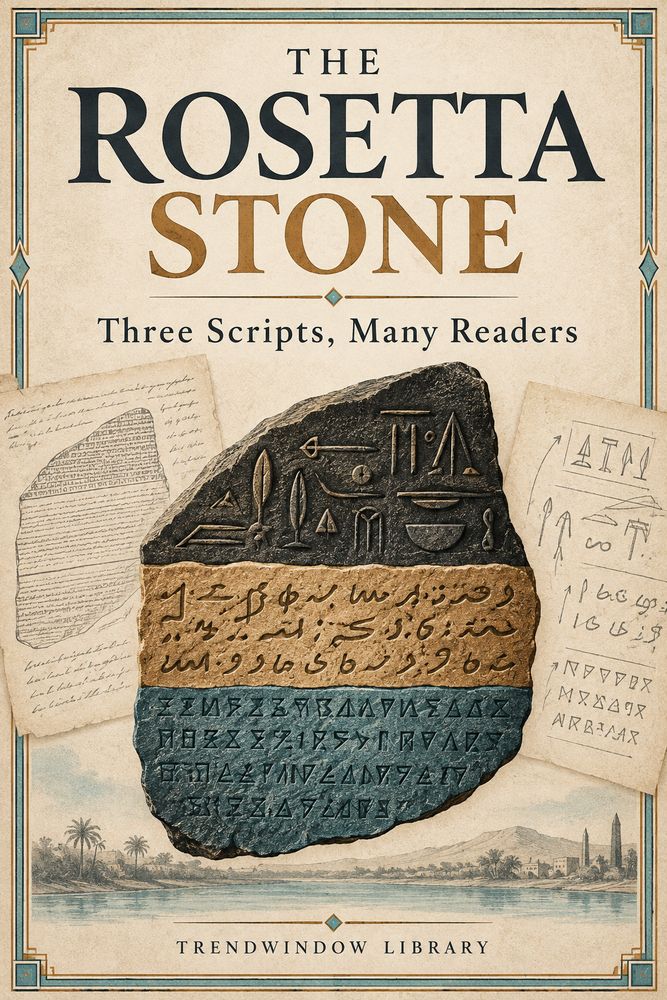
1. Before It Was a Key
The Rosetta Stone is often introduced as a key. A familiar language helped scholars approach writing they could no longer read. That is an important part of its later history, but it is an unusual place to begin the life of a public decree. Its makers were addressing the concerns of their own world, not setting an exercise for nineteenth-century Europeans.
Musée Champollion identifies a decree of 196 BCE associated with an assembly of Egyptian priests at Memphis. It connects privileges for temples with honours for the young ruler Ptolemy V. [1] The surviving inscription therefore belongs to a relationship between religious institutions and royal authority. Before it became evidence in decipherment, it was an instrument of public communication.
That change of purpose gives this short history its organising question: what happens when an object acquires readers whom its first makers could not have anticipated? A proclamation becomes a fragment, a military acquisition, an object copied for study and a familiar image of discovery. Those roles overlap without becoming identical.
This book follows that sequence through public records from museums, a national library, university collections and the French national archives. The sources and research date appear in Unit 10. No firsthand examination, new translation of the decree or legal judgment about ownership is claimed.
We will keep the object and the explanation together. The Stone mattered because people could compare its inscriptions; comparison mattered because people brought languages, earlier scholarship and other evidence to it. A key is useful, but it still needs someone who knows how to turn it.