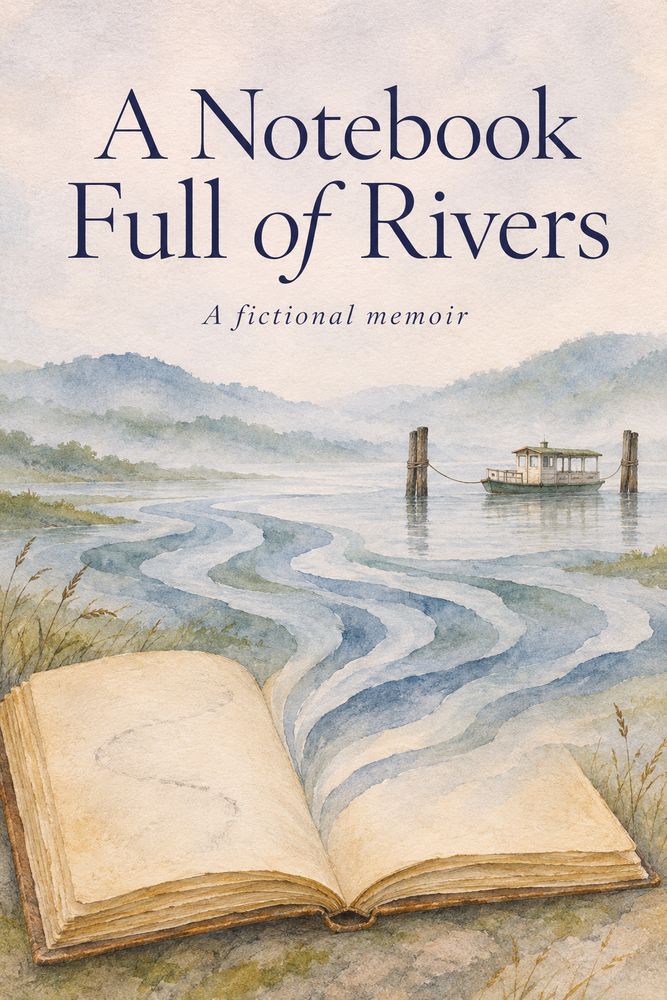
Anik met me outside the archive, which occupied one room beside a tailor. He was younger than I had expected and wore no expression of historical importance. He apologised for the electric kettle, which had stopped working.
The display consisted of three boards, a table and more gaps than photographs. He showed me where he hoped to place the ferry picture. Under it, a pencilled label said: Survey team, date uncertain.
“I thought you might solve that,” he said.
“I thought so too.”
We walked towards the river by the new road. A bridge stood upstream. At the former landing, reeds grew around two remaining posts, and a sign kept visitors off the broken steps. We stayed behind it. I had no wish to turn a visit into proof that I was still capable of clambering over things.
The store had become a repair shop. The patch of ground beyond it was fenced. I tried to fit the old curve of the path onto the present place, moving my notebook left and right as though an angle of viewing could supply twenty-eight missing years.
Anik said the current walking route went around the other side. He offered to show me. I asked whether that was Parul's path.
“Parul would know what she called it.”
She lived two streets away. He had already told her I was coming, with my permission, but had not promised that she would meet us. At her door she looked at my face, then at the notebook, and recognised the book first.
She brought three chairs into the yard. She had stopped ferry work years earlier. I wanted to ask why, but she was looking at the photograph.
“That boy is my brother,” she said. “Not a passenger. He was helping me.”
I had assumed he was a schoolchild because of the bag at his feet. The bag, she told me, held their food.
For a moment the photograph seemed to alter without any part of it moving. I had supplied a journey for that boy which he had never made. Parul named him, Arun, and I wrote it on a new sheet. I did not squeeze it into the old page.