BOOK LIBRARY · Complete books · Purchases disabled
TrendWindow

← Book Library · Complete book

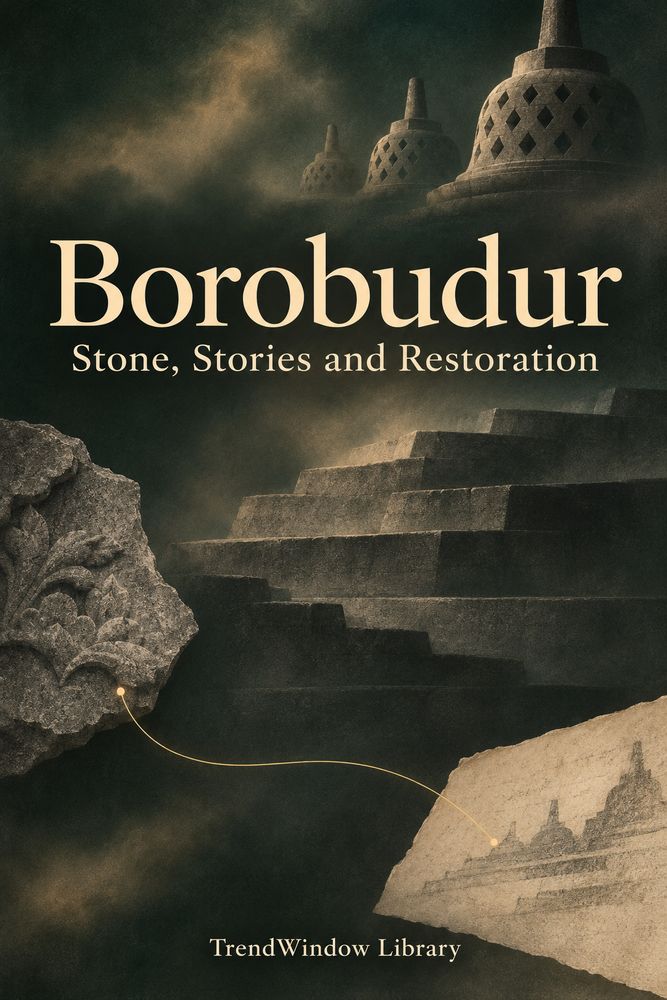
Front cover of Borobudur: Stone, Stories and Restoration

History & Culture

Borobudur: Stone, Stories and Restoration

By TrendWindow Library

An original complete short cultural history of Borobudur. Follow the monument and its neighbours, carved stone, the restoration of 1973–1983 and the archives that record the work of care. Primary sources distinguish the temple compounds’ World Heritage recognition from the later registration of their documentary heritage.

Read this complete edition, including its ending and notes. No purchase is required.

1. A Monument with Neighbours

Borobudur stands in the Kedu Valley of Central Java, Indonesia. UNESCO's heritage record dates the Buddhist monument to the eighth and ninth centuries and associates it with the Syailendra dynasty. Its location gives this history a beginning in a landscape, rather than in the modern photograph of a monument isolated against the sky.

The World Heritage entry is named Borobudur Temple Compounds. It includes Borobudur and the smaller temples of Mendut and Pawon. The plural matters. A famous name can draw attention to one structure while its neighbours retreat from the story. Keeping the compounds in view allows a reader to distinguish the principal monument from the property recognised in 1991.

This is not an account of a traveller arriving at dawn. No visit is claimed. Instead, the route follows selected institutional records: the building's form, the relationship between carved stone and stories, the restoration project of 1973–1983 and the documents that restoration created. The story reaches a second kind of recognition in 2017, when the conservation archives entered UNESCO's Memory of the World Register.

Two recognitions will therefore appear, and they should not be confused. The 1991 entry concerns the temple compounds as World Heritage. The 2017 registration concerns documentary heritage. Neither date is the date the temple was built. Starting with these distinctions prevents the modern history of care from swallowing the much older history of the monument.

The chapters ahead treat restoration as work with consequences and records, rather than as a single word meaning that everything was made new. They also leave the monument's Buddhist identity visible without pretending that a short cultural history speaks for every Buddhist reader or settles all interpretations of the architecture.

2. Carved Stone and the Space between Scenes

The heritage record describes square terraces, circular platforms and a large stupa at the summit. It also identifies low reliefs on walls and balustrades. These are different aspects of a built work: an overall form, spaces within that form and carved surfaces that reward closer attention. One does not have to disappear when another comes into focus.

Stories carved in stone invite a different pace of reading from a sentence on a loose sheet. A reader can attend to a scene, but also to its relation with neighbouring scenes and with the surface carrying it. This observation is offered as a way of approaching visual narrative, not as a claim to have personally traced every relief or identified every carved figure at Borobudur.

Try an original exercise with any properly attributed image of a relief available to you; this edition supplies no copied archival image. Write two headings: “What I can describe” and “What I would need a source to identify”. A visible arrangement belongs in the first. A named story, figure or symbolic meaning needs the second. The distinction can make looking richer, because it allows a question to remain a question long enough to be investigated.

The same care applies to the monument's larger form. Square and circular arrangements can be described, but geometry alone does not settle every religious or historical interpretation. This book does not assign a definitive meaning to every level, or turn an institutional summary into the voice of an entire tradition. Its subject is the relationship between surviving stone, cultural interpretation and later care.

At the end of the chapter, the relief is neither a mere decorative surface nor a transparent page whose every meaning is already known. It is part of a building with a history. That is enough to make the task of keeping the stone in place matter, while leaving room for the specialist work needed to identify and interpret particular narratives.

3. Restoration Was a Project, Not a Moment

UNESCO's record identifies a major restoration phase in 1973–1983. It describes the use of predominantly original materials, together with additions for consolidation and drainage. The physical result is therefore not accurately described as either a wholly new monument or a structure untouched since its first construction.

Drainage is a useful word to retain in a history of stone. It points beyond the surface that a photograph makes most visible. A restoration project can concern the conditions under which parts of a building remain together, not simply the appearance of those parts. This book gives no repair design or instructions for intervening in the monument.

The Indonesian nomination for the conservation archives describes a project involving the national government and international cooperation. It identifies a restoration bureau established in 1971 and describes several areas of work, including documentation, archaeology and administration. These records resist an account in which foreign help acts alone while Indonesian responsibility disappears.

A project also needs coordination. The nomination describes a consultative committee with Indonesian and international participation. Naming that structure is not the same as claiming to have read every meeting record. It establishes that the restoration had an organised process whose activities left documents behind.

That is the chapter's turn: the project did two things worth distinguishing. It worked on a monument, and it generated evidence of its own work. The first concerns stone, structure and care. The second concerns the ability of later people to ask what was done, by whom and through which decisions. A finished phase of restoration does not make either kind of work irrelevant afterwards.

4. Giving a Stone an Address

The Indonesian archival nomination describes coding dismantled stones and producing drawings and maps by hand. These details make recording part of the restoration itself. A stone that has been moved cannot be understood only as a loose piece of material; its relationship to a position has become a practical question.

“Giving a stone an address” is this chapter's metaphor, not the project's official terminology. It helps distinguish a physical piece from the record connecting it to a place. A code can be small, but the relationship it preserves may be large. A drawing can seem less substantial than stone, yet matter to understanding where a stone belongs.

The nomination also describes local people receiving training and participating in conservation. That makes skill part of the project rather than something supplied only from elsewhere. This book does not invent a worker's dialogue or a classroom scene. It recognises the recorded participation without turning unnamed individuals into fictional characters.

An original exercise can clarify the recording problem without pretending to teach monument restoration. Place three words on paper: “piece”, “position” and “record”. Draw a line between each pair and ask what would be lost if that connection vanished. The exercise uses no temple fragment and involves no handling of heritage objects. Its purpose is to make the relation visible.

The chapter closes with recording understood as an action, not a decorative appendix. A project can move and conserve material while also preserving relationships in another medium. The stone remains stone, and the drawing remains a drawing. Their difference is precisely why keeping them connected can matter.

5. An Archive beside the Monument

UNESCO's Memory of the World record lists photographs, drawings, glass negatives, slides, films and project documents among the conservation archives. Their variety matters more here than a large total. Different media can preserve different aspects of work; a photograph and a project report need not answer the same question.

The registration year is 2017. That is a documentary-heritage milestone, distinct from the 1991 World Heritage inscription of the temple compounds. Recognising the archive does not mean that this edition has examined every item in it. The account has reviewed the register description and selected text of Indonesia's nomination, not all the underlying photographs, plans or reports.

The nomination includes an especially useful limit: at the time it was prepared, the new catalogue did not contain complete descriptions of all the archives. It connects that difficulty with a transition between the restoration generation and later staff. This is a statement in that historical nomination, not a fresh claim that the same catalogue gap remains unchanged in 2026.

Keeping the date attached changes the lesson. An incomplete description can show why a surviving record may still need work before another person can use it well. But a writer should not freeze an institution at an earlier problem merely because the description is available online. The history of a catalogue can continue after the document discussing it.

This chapter therefore ends with two kinds of care. The monument requires attention to its materials and setting. The records require attention to their media, descriptions and connections. Documentary recognition adds another object of responsibility; it does not replace the building or make all future care unnecessary.

6. A Complete Ending with Work Still Visible

We began with a monument and its neighbours, then moved from carved surfaces to restoration, recording and documentary recognition. The route closes with the archive's 2017 registration and the selected records consulted for this edition in 2026. It is a complete ending for this short history, not a declaration that Borobudur's history or conservation has ended.

The route has kept three relationships in view. Borobudur belongs to the temple compounds rather than standing for the entire recognised property by itself. Original material and later conservation belong to the same surviving monument without becoming the same event. Stone and its records can support one another without becoming interchangeable.

Those relationships leave room for work. Ancient making does not need to be replaced by a fictional architect's speech. Indonesian responsibility and international cooperation do not need to compete for a single sentence of credit. Local training does not become less important because this book declines to invent the private memories of people involved.

For a final original reading prompt, choose one date in this history and name what it dates. Construction period, restoration phase, site inscription and archive registration describe different things. Then ask which record supports your answer. This small exercise is ours, not an official visitor route, religious practice or conservation procedure.

The last image offered here is conceptual: a stone and a record kept in relation. The record cannot replace the stone. The stone cannot explain every action later taken around it. Together they help a reader understand a monument whose visible form has been sustained through acts of making, study and care. Borobudur's stories remain more than a finished picture, and restoration remains a history of work that can be remembered with precision.

Sources and Edition Note

Research checked 7 November 2026, Asia/Dhaka. This complete original short cultural history contains six chapters and a chosen documented ending. It is not an exhaustive relief catalogue, a statement of all Buddhist interpretations, a visitor guide or a restoration manual. Exercises and connective interpretations are original; no visit, ancient private speech or modern worker's memories have been invented.

UNESCO World Heritage Centre, Borobudur Temple Compounds: https://whc.unesco.org/en/list/592 . The actual page was read for the setting, selected architectural features, the three-temple property, the 1973–1983 restoration and 1991 inscription. Its older management and future-planning language is not treated as a fresh 2026 legal or visitor-access report. Descriptive prose and maps are not copied, and this book does not settle debated symbolic readings.

UNESCO Memory of the World, Borobudur Conservation Archives: https://www.unesco.org/en/memory-world/borobudur-conservation-archives . Read directly as the register's own record of the 2017 registration and media types. The collection's registration is distinguished from the temple compounds' World Heritage inscription. No claim to have read or viewed the entire underlying archive is made.

Indonesia, nomination 2016-84 for the International Memory of the World Register: https://media.unesco.org/sites/default/files/webform/mow001/indonesia_borobudur_eng.pdf . Selected extracted text from the nine-page nomination was actually reviewed, particularly its sections on provenance, recording, participation and catalogue limitations. This is the nominating institutions' account, not an independent inspection of every project file. The nomination states that the state owns copyright. No archival photograph, drawing, film frame or map is reproduced here. Claims of universal technological priority and the broad statement that every stone was dismantled are not repeated as independently verified conclusions.

The date of a historical description is kept separate from the research date. Facts are briefly paraphrased and attributed; no third-party prose or modern story retelling is copied. The English front and back covers are original conceptual illustrations rather than architectural surveys or authenticated reconstructions. Writing and all translations are AI-assisted with editorial comparison; no independent human-authorship or native-human certification, institutional endorsement, assigned ISBN or print proof is claimed.

Explore more books →