BOOK LIBRARY · Complete books · Purchases disabled
TrendWindow

← Book Library · Complete book

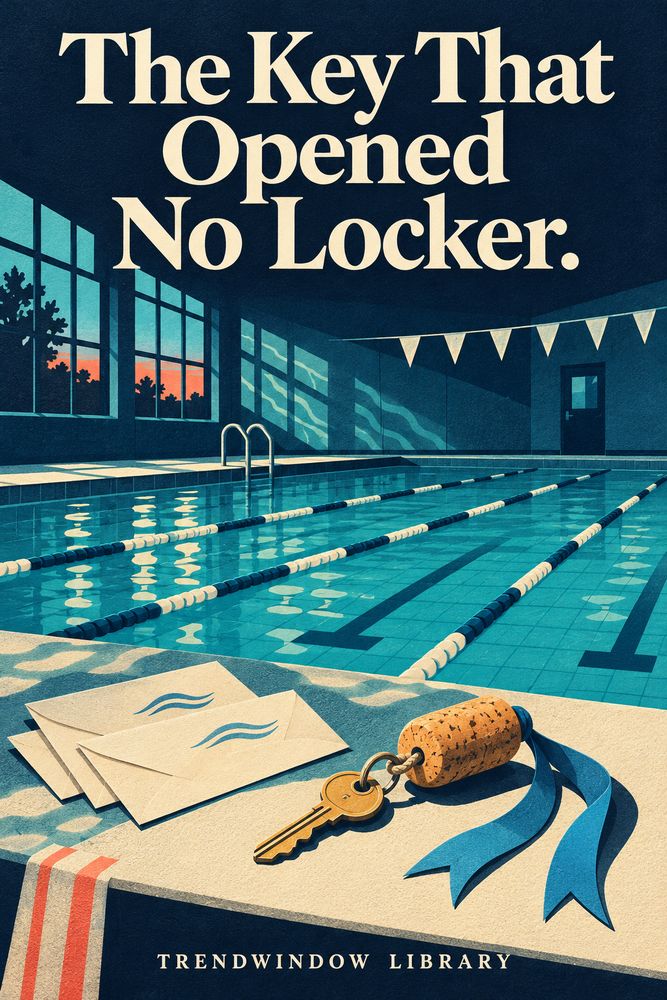
Front cover of The Key That Opened No Locker

Mystery, Crime & Thriller

The Key That Opened No Locker

By TrendWindow Library

A complete original short mystery in eight chapters. At Alder Swimming Club, Nessa follows a misplaced key, two collection times and three substituted prize envelopes, then must correct a suspicion of her own.

Read this complete edition, including its ending and notes. No purchase is required.

About this story

A complete original short mystery in eight chapters. All characters, the Alder Swimming Club, its donor shop, documents and events are invented. This is not a true case or a guide to investigating crime. The story takes place on one Saturday, with an ending the following week.

© 2026 TrendWindow Library. Original AI-assisted fiction and translations, reviewed by an AI assistant. No independent human-editor or native-speaker certification is claimed.

1. A key on the welcome table

At five minutes past six, Nessa found a key beside the swimming club's raffle bowl. It had a cork float, a split blue ribbon and a paper label bearing the number four. She lifted it as though she had found the missing beginning of a sentence.

Three prize envelopes were wrong. That was the sentence she already had.

The presentation was due at quarter past six. Beyond the glass doors, swimmers were drying their hair and parents were balancing paper cups on their knees. On the welcome table lay three plain grey envelopes. Each contained a certificate thanking its recipient for taking part. Each should have contained a credit for eight beginner lessons, donated by Leah's little sports shop for the club's adult learners.

Nessa had opened the envelopes with Jo, the chair, to put the winners' names on the enclosed cards. Neither had expected to find money. The promised prizes were lesson credits, usable through the club's arrangement with the shop. But the grey certificates promised nothing at all.

Eli, the sixteen-year-old volunteer, had been sorting lost property at the same table. Nessa remembered him shaking the key beside his ear, listening to the cork tap its metal ring. Now he was folding the last of the spare chairs.

“Which locker is four?” she asked.

“There isn't a club key for the lockers,” he said. “People bring their own padlocks.”

She heard the quickness of his answer before she heard what it meant.

Martin, the prize secretary, returned from the office carrying the programmes. His sleeves were rolled carefully to the same height. He said he had collected the prizes at twenty to six, brought them straight here and left them on the welcome table. The programme collection, he added, had been part of the same trip.

“So they were changed here,” Nessa said.

She looked towards Eli. He stopped folding his chair.

Jo put her hand flat on the envelopes. “We know these are wrong. We don't yet know where anything changed.”

Nessa lowered the key. Its cork was dry, and its label said four. Neither fact told her what she had made them tell her.
2. Two collections

The sports shop was two doors beyond the pool. Leah was still there, taking down a display of swimming caps. Jo asked her to come over with the prize paperwork. Nessa stayed by the welcome table, where the clock was now seven minutes past six.

Martin checked his watch and said the presentation should not be delayed over a printing mistake. He could explain that the real prizes would follow.

“Are these the ones Leah gave you?” Jo asked.

“They're the envelopes I collected.”

It was not quite the same answer, though Nessa could not yet say why it mattered.

Leah arrived with a notebook and a sample card. The sample described eight beginner lessons and had a blue wave drawn along its lower edge. Her sister had painted the wave for the shop's window display. Leah had copied it onto three envelopes so the prizes would be easy to recognize.

“Martin collected them at ten past five,” she said.

“Twenty to six,” Martin replied. “You were putting the caps away.”

“I was putting them away both times.”

Leah turned to her notebook. There were two entries for Martin: 17:10, three prize envelopes; 17:40, programme packets. A short line between them said that a customer had asked for a different cap size.

Martin pointed to the entries. “You filled that in later.”

“I did. I wrote both after you left the second time.”

Nessa felt the neat answer wobble. A written time was still somebody's remembered time. Leah did not pretend otherwise. She had checked the shop clock on the first visit because she was waiting for her sister; the second coincided with a call arranging the next day's opening. The notebook recorded her account. It did not independently prove every minute of it.

Jo asked Martin whether he had visited once or twice.

“Twice, perhaps. But I collected what was ready.”

Leah laid the sample card beside the grey certificates. “The lesson prizes were ready on the first visit. All three.”

From the pool came a burst of applause for someone still in the water. Here, nobody moved.

3. The grey prize

Nessa had seen the grey certificates before. The club kept a stack for open afternoons: a name, a date, a line of thanks. She had printed the latest batch herself. They were not defective prize cards. They were a different thing doing exactly what they had been made to do.

That distinction embarrassed her. She had called them wrong before asking what they were.

Jo delayed the presentation by at least ten minutes and told the waiting adults only that the prize cards needed checking. She did not mention Eli, the key or a suspected thief. Nessa was grateful, then ashamed that her gratitude was mostly for herself.

Eli brought over the lost-property tub. He had found the key in it, attached to its cork, before the afternoon sale. The number four was the sale lot, not a locker number. A faded card tied to a pair of goggles also said four because the goggles and key had been grouped as miscellaneous pool items. Nobody had bought the group.

“Why was it beside the prizes?” Nessa asked.

“I put it on the spare programmes. They kept lifting when the door opened.”

“You used it as a paperweight?”

He nodded, watching her carefully now.

The explanation was ordinary enough to be easy to overlook. It also did not explain the grey envelopes, and Nessa wanted the key to explain those. She had already spent several minutes on it. Abandoning it felt like wasting them.

Jo asked what anyone had actually seen. Eli had seen Martin put three envelopes under the raffle bowl shortly before six. He could not say whether they were blue or grey; Martin's hand and the bowl had covered them. Nessa had seen the grey ones when she arrived at the table after six. Neither observation filled the space between the shop and the club.

Martin said Eli had been alone at the table.

“Not all afternoon,” Eli answered. “And being there isn't the same as changing anything.”

Nessa heard in his voice the answer she ought to have given herself.

4. What the photograph leaves out

A club member named Pru had photographed the welcome table at twenty-four minutes past five. She had sent the picture to Jo then, asking where to put a vase. Jo showed the message with Pru's permission. Its time belonged to the message; Pru remembered taking the photograph immediately before sending it.

At one corner of the picture, the key lay on a stack of old programmes. Nessa could see its cork and the corner of its label. This was before Martin's second collection. The key had not arrived with the prizes at twenty to six, as she had begun to imagine.

But the photograph did not show the whole table. A tall paper bag hid the place beneath the raffle bowl. It could not tell them whether prize envelopes were there then. Jo said that before Nessa could turn a useful photograph into a complete witness.

Pru remembered Martin asking for three spare grey envelopes earlier. He had said he needed them for certificates. That was plausible; he often helped with club paperwork. She had given them to him without looking inside anything he carried.

Martin rubbed the side of his watch. “We use envelopes every week.”

“Yes,” Jo said. “Asking for them doesn't settle this.”

Leah, looking at the picture, noticed a brown carrier beside Martin's chair. It was the shop's bag. She had put the three blue envelopes into it at the first collection, together with a spare sample card.

“The bag could have been reused,” Martin said.

“It could,” Leah agreed.

Nessa disliked the growing number of things that could be true. She had wanted one bright clue, something as compact as the key. Instead, every honest answer seemed to make the room bigger.

Then Pru said that Martin had asked her when the club's parcel collection was due. His question had concerned a tote marked for his niece. The tote was still on the outgoing shelf by the office door.

This time, Nessa did not announce a conclusion. She asked Jo to check the arrangement.

5. The second visit

The club sometimes let members leave parcels for its volunteer delivery round. That Saturday's round had been postponed until the following morning. Jo knew because she had arranged it herself. Martin's tote, with his niece's name on a card, stood on the shelf among two returned club banners.

Jo did not open it. She asked Martin what it contained.

“Some things she left at my house.”

“Does it contain the lesson prizes?”

“No.”

For the first time, the answer was short enough to leave nothing behind it.

Nessa asked Leah to describe the first collection without using a time. Leah had handed over three blue-wave envelopes in a brown carrier. Martin had read one card, said that his niece was learning to swim, and put the card back. Then he had left without the programmes because they had not yet arrived from the person printing them.

On the second visit, he had collected the programme packets. The brown carrier was no longer in his hand. Leah remembered that because he had asked for a second bag and she had given him a white one with a torn handle.

The programmes on the welcome table had come out of that white bag. Its torn handle lay beneath them.

Martin's first account had folded two visits into one: three prizes at ten past five, programmes at twenty to six. The second visit did not explain where the prizes had spent the half hour between. Nor did arriving with programmes prove that the prizes had arrived unchanged.

Jo asked him to open his tote himself, with her and Leah present, or leave it closed while they decided what further help to seek. She made no move to take it from him. Nessa stepped away from the doorway.

Martin looked at the pool clock. The hands were approaching half past six.

He brought the tote to the table. “I was going to talk to you about the prizes later,” he said.

“Then talk to us now,” Jo replied.

6. Three blue waves

Martin opened the tote. Above a folded sweatshirt lay the brown shop carrier. Inside it were three blue envelopes, each containing a credit for eight lessons. Leah checked the cards against the three entries on the shop's donation sheet. The codes and amounts of lesson credit matched. The fourth card in the bag was the sample, marked SAMPLE across its face.

The originals had not been lost in a locker. They had not been misprinted. They had been kept out of the presentation.

Martin said he had planned to give all three to his niece. She had stopped attending lessons when her work hours changed, and now she could not afford the new course. He had told himself the adult prize winners already had enough. He would ask the shop for something smaller for them during the week.

“Did Leah agree to that?” Jo asked.

“No.”

“Did the club?”

“No.”

He had put the ordinary certificates into grey envelopes and left those on the table. He had intended to say the shop would send the lesson cards later. When the missing credits were noticed early, he had relied on the later programme collection to make the time before arrival seem shorter.

Nessa looked at the three blue waves. The explanation was smaller than the one she had built around a stranger's key, and meaner in a more familiar way. Martin had decided who deserved a gift that was not his to give.

His niece, he said, knew nothing about it. Jo recorded that as his statement, not as something the rest of them could certify. There was no need to put her name into the announcement.

Leah took the cards back long enough to note that all three had been returned. She then handed them to Jo for the named winners. She made no claim about other records she had not checked. What they could see and confirm was enough: the three promised cards were present, matched the donation sheet and could now be presented.

Martin sat down. Nobody thanked him for returning what he had taken.

7. A correction before the applause

Before Jo went to the microphone, Nessa found Eli stacking cups by the window.

“I thought you had something to do with it because I saw you with the key,” she said. “I was wrong.”

“You asked me which locker.”

“I did. As if that proved there was one.”

He kept the cups in his hand. She waited for him to tell her it was all right, then realized she was asking for another piece of unpaid work.

“I'll tell Pru and Jo I made the mistake,” she said. “I won't leave you to explain it.”

“Pru already knows about the key.”

“Then I'll tell her about what I said.”

Eli set down the cups. “All right.” It was permission to make the correction, not permission to forget it.

Jo kept the presentation brief. The donated lesson credits had been withheld and replaced with ordinary certificates, she said. They had been recovered before the awards. The club would discuss Martin's role separately, with a written account of what had happened. She did not turn the winners into an audience for every private detail.

The first recipient opened her blue envelope and asked whether she could start with the next beginner group. Jo promised to check the arrangement with her after the presentation. She did not improvise a timetable to make the evening sound repaired.

Martin stayed seated at the back. Nessa did not know whether he was ashamed of the act, the discovery, or both. She left that question unanswered.

Afterwards, Jo asked Nessa to write down her own observations, separately from Leah's and Pru's. Nessa included her first claim that the envelopes must have been changed at the club. Beside it she wrote: I had no basis for saying this.

She could have omitted that sentence. No form required it. She wrote it before she wrote anything about the key.

8. An unlocked explanation

The following Saturday, the welcome table had three shallow trays: programmes, prizes, lost property. Nobody suggested that trays could prevent dishonesty. Jo wanted fewer opportunities for ordinary confusion, not a piece of furniture that promised to improve people.

Martin had stepped down as prize secretary while the club considered his continuing involvement. The record included his account, the returned cards, the two collections and the correction of Nessa's suspicion. The story of the evening had an ending without requiring everyone in it to become a different person.

Eli brought the cork key to Nessa. “Still no buyer.”

“Still no locker.”

He put it on a loose programme to stop the breeze lifting it. For a moment she thought he was making a joke at her expense. Then he smiled, and she let the joke belong to him.

The three winners had received their cards. Leah had confirmed the lesson arrangements directly with them during the week. Martin's niece had not been made part of the public story. Nessa had corrected what she had said to the people who had heard it. None of this restored the evening exactly as it might have been. It did finish the work the discovery had made necessary.

On her copy of the account, Nessa underlined two phrases: collected the prizes; collected the programmes. The same person had done both. The objects and the times were different. A sentence that joined them had concealed the space in which the switch had happened.

She turned the page over. There was no secret on the back, no last revelation waiting for better light. She wrote next Saturday's list there, beginning with cups.

At the door, a new volunteer asked what the little key opened.

“We don't know,” Nessa said.

It was the first answer she had given about it that she trusted.

Explore more books →