BOOK LIBRARY · Complete books · Purchases disabled
TrendWindow

← Book Library · Complete book

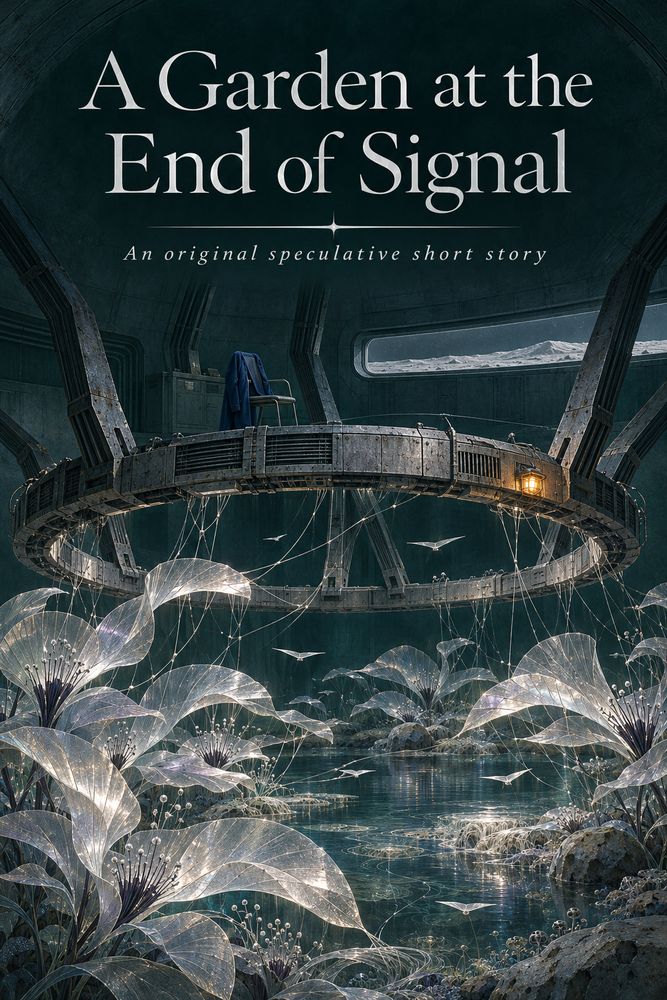
Front cover of A Garden at the End of Signal

Fantasy & Science Fiction

A Garden at the End of Signal

By TrendWindow Library

As an obsolete lunar relay shuts down, Sera Taal and Niko Sen notice a hidden ecosystem beneath its platform. Protecting the unfamiliar place requires patient observation, a changed removal plan and a promise with an end date. A complete speculative short story in eight chapters.

Read this complete edition, including its ending and notes. No purchase is required.

About this book

### An original speculative short story

This is fiction. The moon, people, station, technology and ecological mechanisms are invented. The story's observations are events within its imagined world, not claims about real organisms or communications equipment.

Original complete speculative short story prepared with AI assistance. Moon, characters, station, technology and ecological mechanisms are invented. Not a full-length novel or scientific guide. Translation meaning reviewed with AI, without independent native-language certification.

1. The last scheduled message

For eight years, Sera Taal had told people when their voices could leave the moon.

At Kestrel Station, on the small moon Pel, she allotted the old relay's windows, apologized for delays and listened to messages that were not hers. She had heard births announced, contracts abandoned and arguments resumed after journeys longer than the arguments deserved.

Now the replacement route was working. The old carrier would fall silent at noon. On the third day of the shutdown work, a collection crew would dismantle the obsolete platform and take Sera and Niko Sen home.

Sera had already packed her blue coat.

She transmitted the final scheduled message, a routine confirmation that the western settlement had received its supplies. Nothing poetic. She was grateful for that.

Niko stood beside the console with the shutdown sheet.

“Ready?”

“I've been ready for two years.”

“That wasn't the question.”

She checked the authorization, completed the sequence and watched the carrier indicator go dark. The station's ordinary lights remained on. Its roof still held the inhabited rooms apart from Pel's thin, hostile outside. The replacement communicator worked from a different room and did not use the old platform.

For the first time in her employment, Sera could hear a loose cup trembling on a shelf without the relay's low note beneath it.

She lifted the cup and set it on a cloth.

“There,” she said. “My last improvement.”

Then something tapped under the floor.

Niko looked down.

“Cooling hardware?”

“Probably.”

They had both spent years saying probably when an answer could wait until morning.

This time the sound came again: three delicate contacts, then a scrape. It was beneath the disused service boards around the relay's central ring, inside the station's sealed lower chamber.

Niko checked the access display. No person was down there. No maintenance unit had been assigned to it.

Sera took her coat out of the packed bag, then put it back. The room was not cold.

“Let's look before we call it nothing.”

2. Under the dead boards

The lower chamber had been omitted from the station photographs for good reason. It held the parts that made the rest look clean.

Niko opened the inspection shutter. Neither of them entered. A fixed camera showed old support ribs, inactive boards and a shallow layer of silver material that Sera first mistook for damaged insulation.

Then one silver strip uncurled.

It had a dark centre and a transparent edge. Another opened beside it, touching the first. Between them moved something smaller than Sera's thumbnail, a flat shape that folded itself through a crack.

“That's not insulation,” she said.

“No.”

Niko brought up the older inspection images. The silver layer was there in all of them, folded close against the platform. The technicians had described it as surface accumulation. Nobody had marked movement.

Sera wanted to say they had discovered a species. Instead, she said they had discovered that their description was inadequate.

Over the next hour, the camera watched a patch expand around a shallow pool. Fine threads joined several larger folds. Tiny gliding shapes moved along the threads and disappeared underneath.

A garden was the word Sera thought of. It was also the word she distrusted. Gardens belonged to people who planted them. She had no idea who, if anyone, had planted this.

They checked the station history. The lower chamber had been built over a sheltered depression, its original floor left in place beneath the relay supports. Nobody had claimed the depression was empty. The planning note merely called it non-operational ground.

“That is a very efficient way of not looking,” Niko said.

They did not collect a sample. They sent the images and existing records to the regional ecology desk through the replacement communicator.

The automatic acknowledgment promised a person would review them.

Under the shutter, the silver folds opened further. Sera noticed her own reflected face in the monitor and moved aside.

For once, the most interesting thing in the room was not waiting to be transmitted.

3. A reply without words

The old relay tried to wake once that afternoon.

A scheduled maintenance check, left in a queue, requested a brief carrier test. Niko saw the request only as the old indicator came on.

In the lower chamber, the silver folds contracted. The gliding shapes vanished into their seams. The movement happened during the same short interval as the carrier's return.

Niko stopped the check and removed the remaining automatic requests from the authorized decommissioning queue.

They did not repeat the event to make the pictures more convincing.

“That could be the signal,” Sera said.

“Or something that changes with it.”

Heat, vibration, some feature of the machinery neither of them understood: they wrote possibilities, not a conclusion.

The ecologist who answered was called Evin. Their image appeared as a small, tired face in the new communicator.

“Keep it shut down. Keep the chamber conditions steady. Observe from where you are. Don't try to make it answer you.”

“We weren't going to,” Sera said.

Then she admitted that she had counted the taps.

Evin did not laugh.

“Pattern can be movement. It doesn't have to be speech.”

Sera had spent eight years believing that anything important would eventually become a message. The thought that this place might need no listener at all unsettled her more than an alien voice would have.

By evening the folds had reopened. Several flat creatures crossed a thread, paused at a pool and moved on. Nothing bowed towards the camera. Nothing arranged itself into a symbol.

Sera wrote: Reopening observed after test stopped. Cause not established.

She was about to add It recovered, then deleted the words. She did not know what injury would look like here, or what recovery would require.

When Niko brought supper, she showed him the record instead of the most beautiful image.

“You're learning a different sort of silence,” he said.

“It has an exhausting amount of paperwork.”

4. The cost of staying

Vey, the dispatch coordinator, answered at the start of the next shift. Their collection schedule still showed three people, a lifting frame and one full day to clear the platform.

Sera explained the lower chamber.

Vey looked at the images.

“I can pause the removal of the central ring. I can't declare a protected reserve on a call.”

“We haven't asked you to.”

“You are about to.”

She smiled reluctantly.

The collection crew could remove the outer equipment already known to stand clear of the depression. The central ring, its supports and a marked buffer would remain. Nobody would grade the chamber floor. Any further work there would wait for a separate review.

That solved the immediate destruction, not the watch.

Evin wanted a longer record. The regional office could fund a six-week observation assignment while arranging a qualified replacement team. Someone familiar with the station had to stay until the handover.

Niko's daughter was finishing her apprenticeship. He had already missed its opening ceremony.

“I won't ask you,” Sera told him.

“You can ask. I can still say no.”

“All right. Will you stay?”

“No.”

He said it quietly, without offering a history of his love for his daughter as evidence.

Sera looked at her packed coat. A room was waiting for her in the city. So were an appointment, a friend who had cleared a weekend, and the ordinary pleasure of buying fruit without choosing from a shipment list.

Staying would cost real things. Calling it destiny would not make them free.

She asked Vey for the assignment in writing: six weeks, pay, supplies, a named handover plan and a departure booking. She did not offer to remain indefinitely because nobody else had yet arrived.

Then she called her friend.

“I need to change the weekend.”

Her friend was disappointed. Sera let the disappointment exist.

Only after the arrangements were confirmed did she unpack the coat.

Niko made tea.

“You don't have to make this look easy,” he said.

“I was hoping to make it look temporary.”
5. The uncovered ring

On the second day, the collection lead sent a revised drawing.

The old platform appeared as neat shapes: remove, retain, do not enter. Around the lower chamber was a generous blank margin.

Sera compared it with the camera view. A fine thread extended beyond the edge they had marked the evening before.

She called Niko. They checked the image against fixed features in the chamber, not against the changing camera crop. The thread had indeed reached farther.

It did not mean the whole station was alive. It meant their chosen boundary had been based on too little observation.

They expanded the buffer and sent the change to the collection lead. One outer panel would now remain as well.

Vey asked whether the revised plan would still permit departure.

“Yes,” Niko said. “Less cargo. Same two passengers from the station?”

“One,” Sera corrected.

He nodded. The word had not yet become ordinary.

That afternoon they found the source of the tapping. A flat creature lifted one edge of a rigid silver fold and let it fall against a support. Another moved into the opening beneath it.

No greeting. No distress code they could read. Just one body changing the space another could use.

Sera watched the action several times as it occurred naturally. She did not touch a support to invite a repeat.

She thought of all the messages she had sent through the old relay, each demanding priority because someone far away needed to be heard.

Beneath them, the chamber had held its folded world.

“Do you think we kept it asleep?” she asked.

“I think we don't know how long it can wait.”

That was harder to forgive than a clear accusation. There was nobody to argue with, no statement to refute. Only a question their tidy station records had never contained.

Sera added the new boundary to the observation plan. Then she wrote a second note: Leave room for what has not opened yet.

6. A smaller farewell

The collection crew arrived on the third day.

Their lead, Aro, walked the revised plan with Niko before anyone moved equipment. The retained ring and buffer were marked in the station's work record and on the floor above. The inspection camera stayed in place.

The crew removed less than originally scheduled. Nobody posed for a photograph holding a silver leaf. Nobody called the retained equipment wasted cargo space.

When the outer panels were gone, the old console looked absurdly small. For eight years it had seemed to Sera like the mouth of the moon.

Aro asked whether she wanted the station-name plate.

“No. It still names this place.”

Niko's bag waited by the exit. He checked that Sera had the revised contact list, then stopped himself from checking it again.

“You know how to call.”

“I used to do it for a living.”

He laughed.

At the transport entrance, he offered her a packet of dried orange peel. She had complained about its bitterness for years.

“Why would I want that?”

“So you can complain accurately when we meet again.”

They hugged. It was not the farewell Sera had prepared for: no shared journey, no first meal in the city. She did not pretend it was better. It was simply the farewell they had.

After the vehicle left, she returned to the lower-chamber monitor. The folds were open, their edges catching the inspection light. She recorded the day's movements and the changes to the equipment above.

Then she switched to the window beside her desk.

Pel's plain lay beyond the station roof, empty-looking and pale. She knew better now than to trust empty-looking.

She ate supper in the quiet room. Niko's chair remained where he had left it.

Before sleeping, she opened the new communicator and listened to his brief arrival message. He had reached the transfer port. He expected to be home in time.

Sera answered without giving it a priority code.

7. The station that listened

The six weeks did not become a continuous revelation.

On some days the silver folds moved. On others, almost nothing changed. Sera logged both. She cleaned her room, spoke to her friend, checked supplies and read a book she had packed for the journey home.

Evin reviewed the observations at agreed intervals. They identified differences worth tracking and questions the camera could not answer. The little bodies appeared to use the threads as routes. Whether they fed the folds, fed on them or did something else remained uncertain.

Sera resisted the temptation to give every creature a personal name. She did name one particular camera angle The Place Where I Nearly Assumed.

The assignment had an end date. As it approached, she asked about the replacement team before anxiety could turn into a private promise to stay.

Two researchers were coming. They had received her records, the retained-hardware map and the list of things not to infer from a beautiful image.

Their arrival was delayed by a day. Vey told her, provided a revised departure booking and confirmed the extra day's assignment. It was an inconvenience, not a test of devotion.

When the researchers arrived, Sera showed them the station before the garden. The water supplies. The ordinary alarms. The shelf where a cup rattled if left without its cloth.

A place could not be cared for only in the moments when it was astonishing.

At the lower chamber, one researcher asked what Sera called the silver growth.

“Folds, in the record. Garden, when I'm being careless.”

“Or hopeful.”

“Sometimes both.”

They watched a small body lift a leaflike edge. The sound travelled faintly through the support.

Sera did not count it.

For the first time, she was pleased that someone else was taking the notes.

8. A place left open

Sera left Kestrel with the blue coat over her arm.

She carried no specimen. Her bag held a copy of her own journal, the orange peel and a small drawing Niko's daughter had sent after her ceremony: a moon with a window, and something green beneath it.

The drawing was not scientifically accurate. Sera had thanked her without improving it.

Before departure, she stood once more at the old console. Its indicator was dark. The empty socket where a removable panel had been was covered; the retained platform remained identified in the station records.

The place was no longer a relay in the old sense. It was not yet a reserve with all its questions answered. For now, it was a staffed station with an ecosystem they had decided not to destroy while learning what it was.

That sounded insufficiently grand for a farewell.

Sera found she could live with that.

Through the camera, the folds made their slow changes. Somewhere beneath them, small bodies moved along routes no person had designed. The garden did not pause because she was leaving.

She told the new team where she had left the spare cloth for the rattling cup.

Then she boarded.

In the city, her friend met her with a bag of fruit and a complaint about how many times the weekend had been rearranged. Sera took the bag, apologized and asked which of them would choose dinner.

Later, a report arrived from Kestrel. The researchers had found a second layer of folded growth beneath the first. They had not yet determined how the layers depended on one another. The buffer remained.

Sera read the report twice, then closed it.

Outside her window, people were going home. Someone laughed in the street. A bicycle bell sounded once, and for a moment she thought of Niko.

She had not saved a world by understanding it. She and others had stopped one planned action long enough for understanding to begin.

The last scheduled message had not come from the garden. It had been an ordinary supply confirmation.

What came after it belonged to the place that had finally been allowed to remain.

The end.

Explore more books →