BOOK LIBRARY · Complete books · Purchases disabled
TrendWindow

← Book Library · Complete book

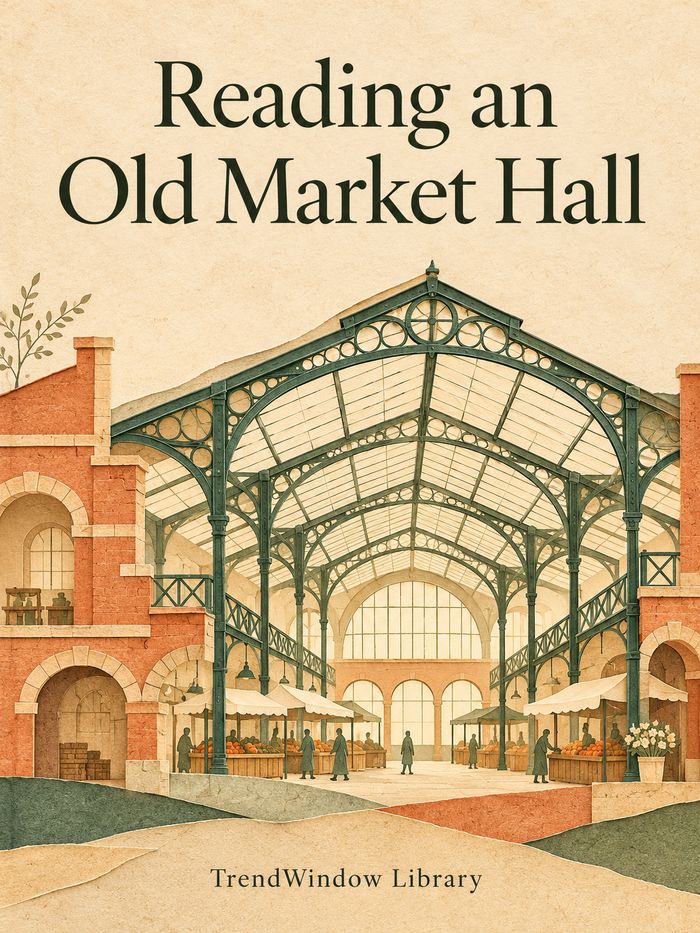
Front cover of Reading an Old Market Hall

History & Culture

Reading an Old Market Hall

By TrendWindow Library

A complete short guide to reading old market halls through five carefully bounded sources and original exercises. Eight chapters separate buildings, trade and people, with practical ways to question dates, photographs and records.

Read this complete edition, including its ending and notes. No purchase is required.

About this study

A complete short guide to looking, questioning and writing about market buildings. The examples from Leeds and Covent Garden are selective, not a history of all markets. The named institutions support the limited historical facts marked [S1]–[S5]. The proposed exercises and unnamed scenes are invented teaching examples, not reported visits or interviews. Research was checked on 16 November 2026. This is a cultural study, not advice on structural safety, property rights or conservation work.

© 2026 TrendWindow Library. Original AI-assisted study and translations, reviewed by an AI assistant. No independent human-editor or native-speaker certification is claimed.

1. Begin with a question, not a date

Imagine a visitor standing outside an unnamed market hall. Above the entrance is a year. Inside, a café occupies one side of a large room; another part contains stalls. The visitor writes, “This market began in the year on the wall.” It is an attractive opening sentence, and it may be wrong in several different ways. The inscription might mark a rebuilding, a gift, an extension or a ceremony. The trading institution might be older than the doorway. The word “market” might describe a building, a business arrangement or the activity that happens there.

This scene is invented. Its purpose is to make a small distinction usable. Before collecting dates, choose what you are trying to date. An early reference to trading does not establish the age of a roof. A dated plan does not by itself show that its design was built. A photograph of an opening ceremony does not establish when the first customer bought something. Keep these as different questions, even if one brochure places them in a single paragraph.

Covent Garden’s estate history attributes its market building to Charles Fowler and dates its opening to May 1830. [S2] Treat that as a specified building event, not permission to date every feature or every kind of commerce in the district to that month. The useful next step is to write a small chronology with a column for the event and another for its evidence. Leave a blank where the evidence does not answer your question. A blank is more informative than a confidently borrowed date.

A manageable investigation might ask: “Which parts of this hall belong to different building phases?” Another might ask: “How did goods reach the stalls?” A third could examine how the building has been described after its original trade changed. These projects need different records. Choosing one gives you a reason to collect something and a reason to leave something else aside.

At the top of your notebook, write the building’s name, its location, the date of your own observation and your question. A later reader should be able to distinguish the age of the object from the age of your account. That reader may be you, returning after an enthusiastic afternoon has blurred several dates together.

2. A doorway is a clue, not a verdict

Begin with a description that another person could check. “There are two openings on this elevation, one wider than the other” is different from “The rich entered here and the workers entered there.” The second sentence assigns social meaning to a physical difference. It may become supportable, but the doorway alone has not supplied that evidence. Avoid giving every opening a romantic role simply because a story would make the façade easier to remember.

Use three columns: what is visible, what you think it might mean, and what would help decide. In our invented hall, the wider opening suggests a route for goods. A dated plan showing a loading entrance would support that interpretation. A photograph with a cart there would support use at that moment. Neither would automatically tell you which people were allowed through it in every decade. Write the range of the claim beside the evidence, not several pages later in a disclaimer.

Change complicates appearances. A door may have been blocked, widened or restored. An interior partition can turn an old entrance into an apparently pointless recess. Do not scrape surfaces, move fittings or enter restricted rooms to solve the puzzle. Describe what can be seen from an allowed position. If a detail cannot be examined, record that limit. Observation does not become more rigorous when it becomes intrusive.

Make a simple sketch rather than trusting a handsome photograph to remember everything. Mark your position, the openings and the edges you could not see. The sketch need not be an architectural drawing. Its job is to preserve the relationship between your viewpoint and your claim. If you later compare it with a plan, distinguish your rough proportions from measured dimensions.

A productive result may be modest: “The side opening could have served deliveries, but I have not found a dated record of its use.” That sentence has more historical value than a vivid account of imaginary porters. It preserves a question that someone else can answer, and it avoids making invented labour look like recovered testimony.

3. The roof and the work beneath it

Historic England’s entry for Leeds City Markets dates the principal hall to 1904 and secondary rear ranges to about 1875. [S1] The word “about” belongs to the evidence and should survive your retelling. A guide that removes the uncertainty has not improved the source. Nor should one date become the birthday of every space a visitor can enter under the same market name.

Think of a building as a set of relationships before thinking of it as a single style. In a hypothetical hall, columns divide the floor, upper glazing admits light and a gallery overlooks stalls. From those observations you can ask how a person might see, move or work. You cannot calculate the original business success of a stall from the elegance of the structure above it. An attractive room and an easy working day are separate propositions.

For an exercise, draw two paths through an invented plan. One belongs to a customer finding a stall. The other belongs to someone bringing in a crate and taking out empty packaging. Where do the paths meet? Where would a door, a step or a narrow turn matter? These are questions about a model, not claims that you have reconstructed an actual day. Label the drawing accordingly. The exercise helps identify which historical photographs or plans would be useful next.

A description of light should be equally careful. You may observe brightness at one hour under particular weather. Do not convert that into “The hall was always well lit.” Earlier glazing, surrounding buildings, stall coverings and working hours could alter the comparison. You do not need to invent those conditions. You need to recognise that your present observation leaves them unresolved.

Architectural vocabulary is useful when it makes a feature more precise. It is less useful when it substitutes for seeing. If you cannot confidently name a decorative element, describe its shape and location and check the term later. This book cannot assess a roof’s condition or a column’s strength. Reading a building historically is not certifying that it is safe, and a photograph is not a structural inspection.

4. What a market record can establish

A record deserves a question about its making. Who produced it, when, for whom and for what purpose? A rent ledger, a public notice and a speech may all concern the same hall without describing the same part of its life. The neatness of a document is not a measure of how completely it represents everyone who worked there.

Consider an invented ledger headed “Stall rents received.” One line names a tenant and an amount for a particular quarter. If the heading and entry are clear, you may have evidence of a recorded payment. You do not yet have the tenant’s profit, the wages of an assistant or the number of customers. Even the difference between rent due and rent received matters. Copy the heading as carefully as the interesting name; otherwise the number can change meaning in your notes.

In the Commons debate of 7 December 1960, minister Christopher Soames discussed traffic and loading problems at Covent Garden. [S5] This is a contemporary policy argument. It tells us what that speaker presented in that setting. It is not a survey of every worker’s opinion. Read the speaker’s role and the exchange around an assertion before turning it into the anonymous voice of “the market.” The opening passage was consulted for this book, not the entire debate.

Keep a record’s identifier or stable link beside your transcription. Distinguish a photographed original from a typed catalogue description and from your own summary. If a word is unclear, mark it as unclear instead of quietly replacing it with the word your argument needs. If the catalogue describes a file you have not opened, say you found the description. Do not claim to have read the file.

Finally, compare like with like. Two figures with different periods, boundaries or purposes may not show growth or decline. A hypothetical annual total cannot be compared directly with a quarterly payment merely because both contain currency. Write the unit and period before making a calculation. A careful account can remain readable while refusing a dramatic number that its evidence cannot carry.

5. The people outside the frame

A market photograph may be most memorable for its roof, but a roof does not explain a working life. Look at the framing before telling a story about the people inside it. Which direction does the camera face? What lies beyond the edge? Do you know the date and the caption’s author? A crowded image establishes that the recorded space looked crowded at that moment. It does not provide a count for the whole day.

In an invented photograph, one person carries a parcel while another stands beside a counter. Calling the first a porter and the second an owner may feel natural. The image might not establish either role. Clothing, posture and position can suggest questions, but they are not reliable substitutes for names or corroborating records. You can describe the parcel without assigning the person an occupation, income or emotional state.

Missing voices require similar restraint. An account that names a designer but no cleaners leaves cleaning work undocumented in that account. It does not prove that nobody cleaned, and it does not tell you how any cleaner felt. A researcher can ask what other records might help without manufacturing a representative worker to fill the silence. If you use an invented character to explain a problem, identify the invention where the character appears.

A reminiscence has its own value and limits. If a published speaker remembers a particular stall, preserve the speaker’s perspective rather than turning the memory into everybody’s experience. If you conduct an interview in a separate project, obtain permission for recording and use; a friendly conversation is not automatic permission to publish someone’s name or words. No interviews were conducted for this guide.

Try a caption exercise. Write one sentence describing only what an imaginary image visibly contains. Then write a second sentence stating the question it raises. Stop before answering that question with atmosphere. This is not an instruction to remove people from history. It is a way of making room for evidence about them, instead of letting your own fluent story speak over a life you have not researched.

6. When the trade moves away

New Covent Garden Market’s operator distinguishes trading from 11 November 1974 and the royal opening on 26 June 1975. [S4] Those are different events. An inauguration date can be accurate while being the wrong answer to a question about the first working day. The source notes saved with this study also distinguish the article’s publication label from the anniversary day mentioned in its text.

A move also tests the meaning of continuity. Imagine a trade relocating while an old hall takes on new shops. The building remains in one place and the commercial activity continues somewhere else. An account can follow either, but it should tell the reader which it is following. “The market disappeared” may erase a continuing community of businesses. “Nothing changed” may erase a substantial change of use. Neither slogan is adequate without a defined subject.

Draw two timelines in this hypothetical exercise. Give the first to the physical site and the second to the trading organisation. Add only events for which you have evidence. A third line, for the experiences of workers and neighbours, may be much less complete. Do not fill it by borrowing conclusions from the first two. A new location, a surviving façade and a successful individual livelihood are not interchangeable outcomes.

Reuse invites judgment, but judgment needs declared criteria. Are you discussing preservation of fabric, affordability, public access, employment, or the continuation of a particular trade? A project might do well by one criterion and poorly by another. You can admire a restored interior while asking who can use it. You can value an old business without assuming every former working arrangement should be recreated.

The point is not to make every conclusion hesitant. It is to make conclusions answerable. A clear statement about a particular change is stronger than a total verdict about a district. The old hall need not stand for everything that was lost, and the new market need not stand for everything that was gained.

7. Access and a building still in use

Leeds City Council records the fire on 13 December 1975, the survival of the 1904 Hall and a replacement hall opening in 1976. [S3] A surviving part is not the same as an unchanged whole. Equally, a story of destruction should not erase a part that remained. Use the scale of the source’s claim: a hall, a section, a site. Do not enlarge it merely to give the paragraph a more dramatic ending.

When looking at a working market today, remember that your interest in history is one use among others. Check the operator’s current information before a visit; this book supplies no opening hours, access guarantee or permission to enter service areas. Keep deliveries, customers and people working at counters in mind. A viewpoint that produces a good photograph may still obstruct an ordinary task.

Access is also a useful subject for a bounded observation. In an invented visit, one entrance has a step and another is level. Recording only the first might misdescribe the available route; recording only the second might conceal a difficulty elsewhere. Note which route you actually followed, what you did not test and the date. Do not announce universal accessibility from a brief look or assume that a historical designation answers present practical questions.

A building that changes can still deserve historical attention. A removable sign, a repaired floor or a new arrangement of stalls may complicate your preferred view without making the place meaningless. Ask what the change allows, what it conceals and whose account could explain it. Avoid treating current users as intrusions into a photograph you wish were empty.

For a small research project, set a respectful stopping point. If a door is closed, record it. If a person does not want to be photographed, put the camera away. If you need a plan, find out whether a public copy exists rather than demanding access to a workplace. An honest incomplete observation is more useful than an account obtained by disrupting the activity it claims to understand.

8. A careful account to take home

Return to the invented visitor at the entrance. The year above the door is still there, but it no longer has to carry the whole history. The visitor can describe an inscription, distinguish the possible events it marks and name the evidence still needed. The result is not a smaller curiosity. It is a curiosity with somewhere to go next.

Write a short account in four movements. First identify the place and the question. Then give the strongest observations and records, with their dates and references. Next explain your interpretation and the alternatives you could not settle. Finally state the limits and the next useful inquiry. You do not need to make the account sound like a discovery that overturns a city’s history. A clear distinction between a building phase and a trading date is already useful work.

Read your draft for sentences that secretly change scale. Does a photograph become a whole decade? Does one official become every trader? Does a surviving doorway become proof of unchanged access? Replace those leaps with the smallest statement the evidence supports. Keep a copy of the earlier draft so you can explain a correction. Revision is part of historical work, not an embarrassment to hide.

These examples do not turn Leeds and Covent Garden into a universal sequence through which all markets pass. They offer a limited practice: look closely, identify the kind of evidence, keep people’s voices distinct and allow an unanswered question to remain visible. A hall can be beautiful without being simple. Its history becomes more interesting when the building, the trade and the people are allowed to have related but different stories.

Source guide, checked 16 November 2026:
[S1] Historic England, City Markets, list entry 1255765: https://historicengland.org.uk/listing/the-list/list-entry/1255765
[S2] Covent Garden estate, The history of Covent Garden: https://www.coventgarden.london/the-cg-edit/the-history-of-covent-garden
[S3] Leeds City Council, Remembering the Leeds Kirkgate Market fire, 50 years on, 10 December 2025: https://news.leeds.gov.uk/news/remembering-the-leeds-kirkgate-market-fire-50-years-on
[S4] Covent Garden Market Authority, anniversary of the royal opening, June 2025: https://newcoventgardenmarket.com/blog/50-years-ago-today-hm-queen-elizabeth-ii-officially-opens-new-covent-garden-market/
[S5] UK Parliament, Commons debate, 7 December 1960, opening passage: https://api.parliament.uk/historic-hansard/commons/1960/dec/07/covent-garden-market-bill
The institutional histories are modern accounts; the parliamentary record is contemporary to the debate. No claim is made to have visited these sites, consulted original rent ledgers or interviewed their users. The exercises are original hypothetical illustrations, not recovered evidence.
Explore more books →