BOOK LIBRARY · Complete books · Purchases disabled
TrendWindow

← Book Library · Complete book

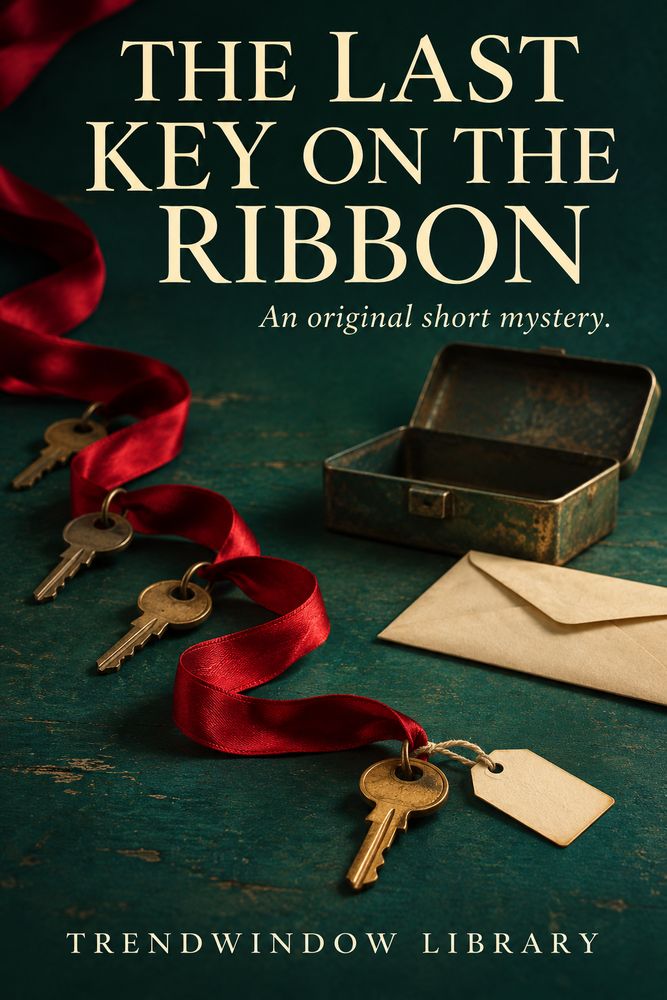
Front cover of The Last Key on the Ribbon

Mystery, Crime & Thriller

The Last Key on the Ribbon

By TrendWindow Library

A complete original short mystery. A workshop’s cash tin is empty after its keys are returned. The cleaner had the last key, the treasurer says. Lena Moss separates a label from a lock—and a witnessed count from money nobody saw being stored.

Read this complete edition, including its ending and notes. No purchase is required.

1. An Empty Tin

On Saturday morning Lena Moss opened the workshop office and found the cash tin empty. The counting slip was still inside. Eighteen notes at twenty pounds each: three hundred and sixty pounds. Beneath the total were her initials and Rafi Nash's.

She read the figures twice. Then she set the tin on the desk without moving the slip.

The workshop would close for a week while its worn floor was replaced. Members had returned their keys on Friday, and Lena had tied them to a red ribbon so they would not vanish among the packing boxes. The last one, handed over at nine fifteen, belonged to Ida Bell, the cleaner.

At forty-two, Lena had been the keeper for twelve years. She knew where the spare light bulbs lived, which windows stuck and how often people said they had returned something when they had merely decided to return it. Nevertheless, she had accepted the keys without checking each one.

The money was the workshop's small repair fund, collected during the previous month's sale. Rafi, its treasurer, had counted it with her at half past eight on Friday evening. He was forty and ordinarily the person who noticed a missing pound before anyone else noticed the total.

Lena remembered the money in his hands. She remembered him folding the counting slip. Then a member had called her out to the hall to ask about collecting a drying clay bowl.

When she returned, the office door was shut. Rafi gave her a key with a paper tag marked Office. It was eight fifty.

“All done,” he said.

She had taken that to mean more than she had actually seen.

2. The Last Person

Rafi arrived at nine on Saturday after Lena called him. He looked into the tin, then at the ribbon of keys lying beside it.

“Ida was still here after I left,” he said.

“So was I.”

“You know what I mean. She had the last key.”

Lena did know what he meant. She also knew that she had been on the phone in the entrance hall while Ida finished cleaning at the back. She had not watched every doorway.

“Did you see anybody take the money?” she asked.

“No. I locked it in the office.”

“You put all three hundred and sixty in the tin?”

“We counted it together.”

That was true. It was not the answer she had asked for.

Two members came to collect finished work before the closure. Lena asked them to wait in the main room. Rafi went out to explain that there was a problem with the fund. By the time Lena joined them, one of the members was asking whether Ida had a key to the office.

“Please don't turn a question into her name,” Lena said.

Rafi put a hand on the back of a chair.

“We have to establish who could get in.”

“We have to establish when the money was last there.”

She surprised herself with the distinction. An empty tin in a locked room encouraged a very particular story: somebody must have opened the room after it was locked. But the tin had not told her that.

Lena took the ribbon off the desk. The last key on it carried a blue tag. Front door, in her own handwriting.

3. What Ida Had Returned

Ida came at ten because Lena asked her to, not because Rafi summoned her. At twenty-nine she had cleaned the workshop for four years. She brought her small notebook, expecting a question about the extra work before the floor replacement.

When she heard about the money, she looked towards the main room.

“Who else has heard my name?”

Lena told her about the conversation. She did not pretend that no harm had been done because nobody had yet used the word thief.

Ida pointed to the blue tag.

“That's the front-door key you lent me. I gave it back at nine fifteen. I don't have an office key.”

She had cleaned the sinks, swept the main room and carried rubbish out through the side passage. The office door had been closed. She had not gone inside it that evening.

Lena had her own office key throughout. Rafi had the other one. A member's returned key did not account for every possible key or every possible movement, and nobody could establish a whole evening merely by counting pieces of metal. Still, Rafi's phrase had made Ida's front-door key sound like something it was not.

“I'll record what you actually returned,” Lena said.

“And tell the people you spoke to.”

“Yes.”

Rafi said that he had only suggested checking. Ida turned towards him.

“You suggested checking me. You didn't suggest the bowl collector. Or Lena. You said I was here last.”

“You were here later than me.”

“That doesn't tell you what I did.”

Lena untied the key marked Office. Its tag had stuck to the ribbon where a little paste from somebody's project had dried.

4. The Key with the Right Label

The key Rafi had returned did not open the office door. Lena tried it once without forcing it, then used her own key. The lock worked as it always had.

“It's the wrong key,” she said.

Ida recognised it. It opened the small staff cupboard in the main room, where tea towels and spare mugs were kept. With Lena's permission, they checked. It opened that cupboard.

Rafi looked at the tag.

“I must have mixed them up.”

He reached into his jacket and brought out another key. This one opened the office.

Lena put both on the desk, separately.

“Then you hadn't returned your office key.”

“It was a mistake.”

“It may have been. But you used the fact that you'd returned it as if that settled something about the money.”

The wrong key did not prove that Rafi had taken anything. Nor did the real key in his pocket prove when he had used it. Lena could feel how easily each small discovery wanted to become a larger accusation.

She asked the two members to come back into the office. Ida could choose whether to stay. Ida said she would.

“We know this key was returned,” Lena said, touching the staff-cupboard key. “We know the tag says Office. Those are different facts. I accepted the tag last night without checking the object. That was my mistake.”

“And the money?” one of the members asked.

Lena looked at the empty tin.

“We're going to stop telling the story backwards.”

5. Before the Door Closed

They began at half past eight on Friday, while the office door was still open.

Lena and Rafi had counted eighteen twenty-pound notes. Lena had signed the slip. Rafi had put the notes into a plain paper envelope, ready to place in the tin. The envelope had lain beside his canvas work bag.

“Then I went to speak to Helen about the clay bowl,” Lena said. “I didn't see the envelope go into the tin.”

Nobody had asked her to make that distinction before. She had signed a count and remembered it as a deposit.

Rafi stared at the slip.

“You put this in,” Lena said. “I found it in the tin this morning. What did you do with the envelope?”

“I was going to bring it back.”

The words came out before he had arranged them into an explanation.

“From where?”

He looked towards the window. His van was parked outside the gate.

Lena did not go to search it. She asked whether he was saying he had taken the money out of the office on Friday. He said yes. It had never been in the tin after their count.

He had put the envelope in his work bag before locking the door. He had then returned the wrong key by mistake. The real office key had remained in his jacket. On Saturday, when Lena called, he had known why the tin was empty.

“Then why did you say Ida?” she asked.

Rafi covered the counting slip with his hand. For a moment Lena could see only the edge of her initials.

“I didn't want it to be me.”

Ida said nothing. Lena did not ask her to make the silence easier for him.

6. Three Hundred and Sixty

Rafi said the envelope was still in the van. He had intended to use the money for rent on Monday and replace it from his wages on the following Friday. He had not asked the workshop for permission. He had not spent it yet.

“I called it borrowing in my head,” he said.

“You let us call it missing,” Lena replied. “And you let us look at Ida.”

He went outside and returned with the paper envelope. Lena and one of the members counted its contents while Ida stood by the doorway. Eighteen twenty-pound notes. Three hundred and sixty pounds.

They recorded the return and kept the original counting slip with a separate account of what Rafi had admitted. They did not change Friday's slip to make it appear that the money had been safely stored all along.

Lena contacted the workshop committee. She described the empty tin, the two different keys, the returned money and Rafi's account. The committee would decide the next steps. Rafi would not handle the fund while that happened. Returning the notes did not settle every consequence, and the story did not supply a court's verdict.

Before he left, Ida asked him to speak to the two members again.

“Not just to me. You put my name in that room.”

Rafi told them he had taken the money before locking the office and that Ida had not taken it. He said he had raised her name to draw attention away from himself. He apologised without calling the affair a misunderstanding.

Ida listened. Then she gave Lena her notebook.

“This is the extra hour I worked last night. Please keep it separate from his account.”

Lena wrote the work down under Ida's name.

7. After the Floor Was Dry

The following Saturday the workshop reopened. The new floor had changed the sound of footsteps. Lena kept expecting the old loose board to answer her near the sinks.

The keys were no longer bunched on the red ribbon. She had recorded the front-door key, the office keys and the staff-cupboard key separately, checking the returned objects rather than merely copying their tags. The change did not promise that nobody could ever do wrong. It meant she would be clearer about what she knew.

The repair fund was counted and stored with two committee members present. Ida's extra hour was recorded with her cleaning work, not as a footnote to the missing money. The committee's review continued. Nobody announced that a fresh floor made a fresh start for everybody.

Ida arrived carrying clean cloths. Lena offered her the front-door key for her next agreed shift.

“That's the one,” Ida said.

They both looked at its blue tag. Lena had not replaced the words with a more impressive name.

Ida took it and went to put her bag away. Soon the first members were bringing in their work. Helen carried the clay bowl she had collected the previous Friday and asked where it could stand without being knocked over.

Lena found a clear shelf for it.

On her desk the red ribbon lay around a rolled plan of the room. She untied it and smoothed it flat. It had held a row of keys. It had never held the order in which the evening happened.

She put it in the drawer with the other ribbons, then opened the workshop's front door for the people waiting outside.

Edition note

This is an original complete short mystery. All people, the workshop, money, keys, room arrangements and events are fictional. Eighteen twenty-pound notes total three hundred and sixty pounds. A returned key, a label or the possession of a different key would not alone establish who took money or when; the resolution includes the distinction between a witnessed count and an unwitnessed deposit, Rafi's direct admission and the returned cash. No lock-bypass method, legal verdict or financial advice is offered. AI-assisted writing, original conceptual English front/back illustrations and full translations receive editorial review; no independent human-authorship or native-human certification, assigned ISBN or print proof is claimed.

Explore more books →