BOOK LIBRARY · Complete books · Purchases disabled
TrendWindow

← Book Library · Complete book

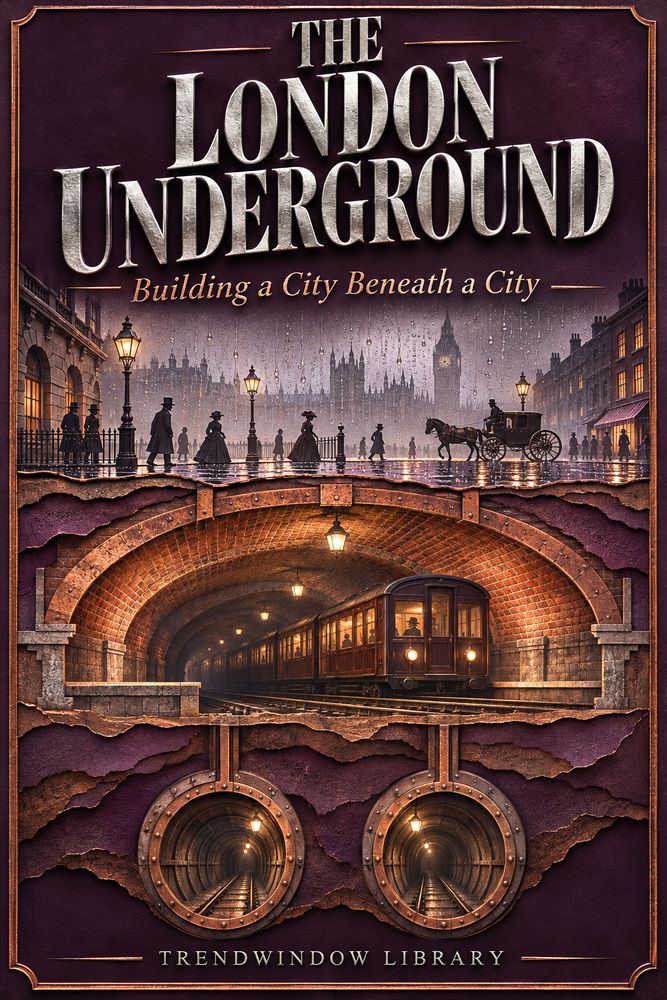
Front cover of The London Underground: Building a City Beneath a City

History & Culture

The London Underground: Building a City Beneath a City

By TrendWindow Library

A short history of the London Underground through its shallow steam railways, deep electric tubes and Harry Beck’s passenger diagram.

Read this complete edition, including its ending and notes. No purchase is required.

Chapter 1 — The Street Was Part of the Job

Imagine a street in section, as if the front wall of a model city had been lifted away. A railway occupies a long space under the road. A roof carries the road above it. The first thing to notice is not the train but the roof. Without it, this would be an open railway cutting and the street would still be interrupted. The roof lets two different journeys use much the same strip of London.

In 1863 the Metropolitan Railway began carrying passengers between Paddington and the City, connecting several main-line railway stations along the way. Its wooden carriages were hauled by steam locomotives. Parts of the route were made by opening the ground, building the railway enclosure and covering it again. The Science Museum Group's company record also distinguishes this work from other tunnelling. Even within one railway, there was no single way to get underground.

The word underground can make the surface sound incidental. It was anything but. Where a trench had to be opened, the builders needed room for the excavation and a way to remove what came out of it. They needed somewhere to lower building materials. Where the railway crossed a street, the new roof would eventually have to support whatever returned above. The construction site was in the city that the finished line was meant to serve.

A rider looking out at brickwork saw a small part of a much larger transaction. A street that had once been useful for getting across London now also offered a way to travel beneath it. For the people trying to reach a shop or keep a home along the works, the order was reversed. First came the interruption. The faster journey, if it helped them at all, came later.

Chapter 2 — What the Camera Could See

Henry Flather photographed work on the Metropolitan District Railway in the late 1860s. London Museum preserves a collection of his photographs. They show a later company and later works, so they cannot illustrate the Metropolitan opening of 1863 as eyewitness images. They can show what building a shallow railway meant once work was under way in a dense city.

In one photograph the museum identifies construction at Kensington Station, where a large roof is being built. Other views record works around Earl's Court and at Bayswater. Read these locations as separate points rather than consecutive frames from one moving camera. The roof at a station, the cut near a junction and a station entrance are answers to different problems. Standing above a railway and entering it are different things, too.

A photograph often makes a difficult operation look settled. Workers have stopped moving long enough to appear in the picture. The edges of the trench sit neatly inside the frame. The view doesn't show how long a family waited to cross the street or where people went when the demolition reached their homes. The museum's accompanying account records the loss of working-class housing. It supplies a consequence that the arrangement of bricks and timber alone cannot tell us.

Try reading one of these pictures from its edges inward. Where can a person stand? Which walls are temporary, and which are supposed to stay? What would have to be moved before the street could reopen? If the photograph doesn't answer, leave the question there. The value of the image is what it can show in detail. The value of the archive is that it gives us other evidence when the frame runs out.

Chapter 3 — Smoke Had Somewhere to Go

A roof made the railway compatible with a street. It also changed what happened to the air. A steam locomotive burns fuel. On an open railway, its exhaust can disperse into the surrounding atmosphere. In an enclosure the same release is closer to the people on the train, in the station and at any opening that connects the railway to the surface. An opening that looks like a minor detail on a drawing can matter to everyone near it.

London Museum records concern over the air on the shallow lines alongside their use by large numbers of riders. Both can be true. A passenger can prefer a train to a slow road journey and still find the railway unpleasant. The presence of riders gives us evidence that the service met a need. It doesn't supply a measurement of air quality or tell us how any one person felt.

Think of the service as a repeated event. One engine passing through is one release. A working timetable means engines arriving again and again, while people wait in spaces that don't empty every time a train leaves. Moving the railway out of sight does not move away the work of keeping it usable. The operator inherits the enclosure from the builder and has to live with it every day.

That distinction makes the next railway easier to understand. A deep tunnel doesn't solve the smoke problem by putting it farther from a road. It gives smoke a longer, less direct route back to the open air. The question for a railway in such a tube is what sort of power can move a train without burning fuel on the locomotive itself.

Chapter 4 — A Different Way Through the Ground

In 1890 the City and South London Railway opened a deep electric railway between Stockwell and King William Street. The endpoints matter. This was a crossing between particular parts of London, built as a line of its own, not an overnight change to the railway that had opened in 1863. A deep tube and a shallow railway could belong to the same city without having the same construction, equipment or history.

A shallow cutting needs a strip of ground opened from above wherever that method is used. A tunnel driven at depth creates its passage underground. Access is still required for the people, materials and machinery making it. Stations still have to connect to the surface, and digging still produces material to be removed. The difference is where the work opens the city. It can concentrate surface work at particular sites instead of exposing the length of every running tunnel from the street.

Look again at the imaginary model. This time draw a narrow circle under the road instead of a broad rectangle immediately below it. Beside it, draw another circle for the other direction. The shape puts a limit on what can fit. A railway vehicle has to leave room around it, including where it moves through a curve. The track and its equipment also need space. Once the tube has been built, a wider carriage is no longer a simple purchase. It is a question about the structure.

Electricity changes another part of the drawing. A locomotive drawing power from a conductor doesn't need a fire aboard to produce its pull. The system still needs power to be supplied and maintained. A station still needs ventilation, and people still need a safe route between the train and the street. The deep line succeeded as an arrangement of connected things. A new locomotive by itself couldn't have made it.

Chapter 5 — The Short Rails in the Museum

The Science Museum Group lists an electric locomotive from the City and South London Railway under object number 1923-301. The catalogue describes short lengths of rail, a conductor rail and sleepers with it. A tunnel-section model has its own part entry. Those details are a good place to pause. It's possible to admire a locomotive as a compact machine and miss the pieces that turn it into part of a railway.

The ordinary running rails carry the wheels and guide them. A conductor rail has a different job. It makes power available along the line to equipment designed to collect it. Sleepers support the rails and hold their arrangement. A few short rails in a museum can't deliver a working service, but they can show where the vehicle meets the system that gives it a path and power.

The short length is useful precisely because it is short. On a platform, the rails disappear into the distance before a rider can think much about their different jobs. In a collection description, they're near enough to name. You can ask which pieces would have to continue to the next station and which ones travel with the train. The machine's job becomes clearer when you can say what it depends on.

The catalogue identifies the railway associated with the locomotive. It doesn't establish that this particular vehicle pulled the first public train. The opening date comes from records of the line. The components come from the object record. Together the two sources let us describe both an event and a mechanism without turning a museum exhibit into an eyewitness.

Chapter 6 — A Map for Decisions

There is another moment when a passenger has to deal with a city they cannot see. They stand before a map and decide which way to go. Their first question may be which stop comes next. Their second may be where they can change. The physical shape of the route can matter less to these decisions than the order of stops and the places where lines meet.

The London Transport Museum dates Harry Beck's diagrammatic design to 1931 and its first issue to 1933. Its straight and diagonal runs and more regular station spacing made it easier to see the sequence of stops. A place can be moved on the paper to make the next connection legible. Its position on the ground hasn't moved. The diagram has made a choice about which part of the journey deserves space.

Take three fictional stops called Park, Market and River. On a street plan, Park might be immediately beside Market while River is much farther away. A diagram can put them at regular intervals and still show the correct order. If another route meets this one at Market, the diagram can give that meeting enough room to see at a glance. A person using the same picture to estimate the walk from Market to River would need different information.

One omission helps explain another. A running tunnel is essential to making the trip, but the passenger diagram need not show its depth or whether the train curves between stops. A construction drawing must care about the curve and might omit a connection several miles away. Beck's design belongs beside the drawings of the railway as a document of use. It answers the practical question a passenger has before the train moves.

Chapter 7 — Put the Three Views Together

Return to the imaginary model and set three documents beside it. The first is a photograph of a cut in a street. The second is a drawing or model of track inside a deep tube. The third is a passenger diagram. Pick one question each document can answer and one it cannot. If you're looking for a place to change, the diagram may answer you first. If you're wondering what holds up a street, you can put the diagram down and look at the roof.

Now follow a fictional passenger from a pavement to a platform, onto a train and out at the far end. The first steps belong to the city above ground. The stairway, passage or lift brings them into the railway. The track and its supply carry the train. A glance at the diagram lets them decide whether to stay aboard. The journey works because these tasks meet, although no one document needs to show all of them.

There is still the question raised by Flather's photographs. Who had to move to make room for the journey? A train diagram can't show the answer. A photograph might show the boundary of the works but leave out the people who had already gone. To ask the question properly, put the railway back on a map of its streets and look for records of the people who lived there. It is possible to be impressed by the engineering and still want to know what it cost those people.

The next time a line on a diagram makes a clean turn, picture what the line stands for. There may be a broad roof carrying a road somewhere on the route or a narrow tube far beneath one. There will be a place where someone can enter and another where they can get out. Those places are the points where the drawing becomes a city again.

Research and Reading Notes

This short history uses the Science Museum Group's company record for the Metropolitan Railway, its catalogue entry for locomotive 1923-301, London Museum's published account of Henry Flather's District Railway photographs, Transport for London's Bank design and access statement for the 1890 line, and the London Transport Museum's catalogue Q&A for Beck's design and first issue. The company history and Flather collection concern different railways. The locomotive and the tunnel model are separate catalogue components. The full source links are listed with the book's research record.

The imagined section through the street, the fictional Park, Market and River stops, and the final passenger exercise are explanatory illustrations. They don't describe a named passenger, reproduce an official diagram or provide directions for today's network. The photographs are discussed through the museum's description. The book does not reproduce those images.

Explore more books →