BOOK LIBRARY · Complete books · Purchases disabled
TrendWindow

← Book Library · Complete book

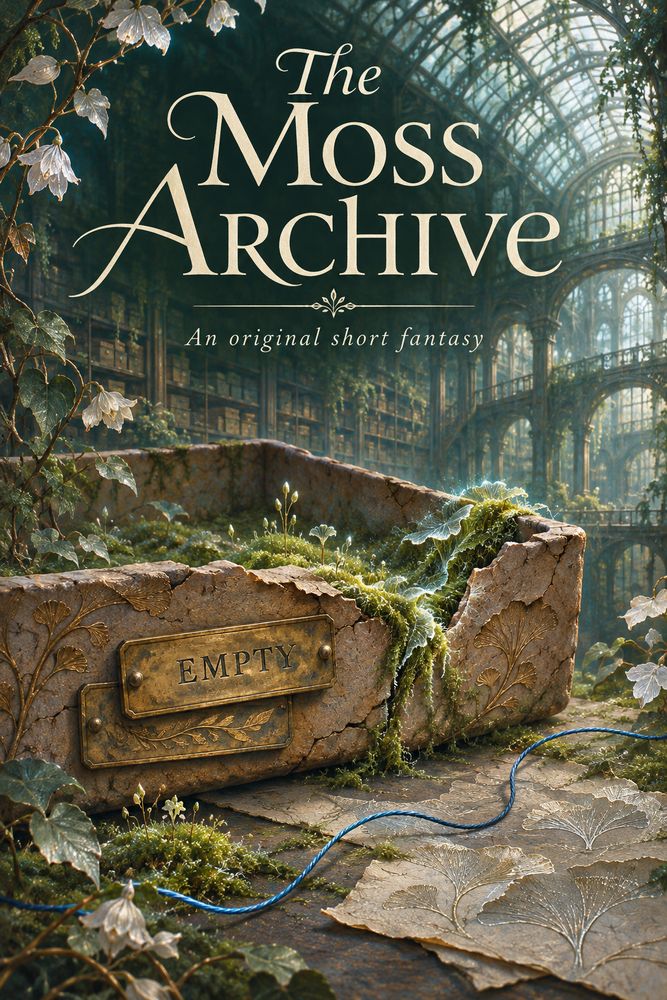
Front cover of The Moss Archive

Fantasy & Science Fiction

The Moss Archive

By TrendWindow Library

An archive tray marked EMPTY contains a living witness to a flood. Rin refuses to make a worker pay to read it, then faces her own voluntary choice. An eight-chapter short fantasy about evidence, memory and the right to refuse.

Read this complete edition, including its ending and notes. No purchase is required.

About this book

An original short fantasy

The city, people, institutions and living archive in this story are invented. Its moss and memory exchange are imaginary, not botanical or neurological claims. Civic procedures belong to the fictional city and are not descriptions of real law.

Original short fantasy prepared with AI assistance. People, city, archive moss and memory exchange are invented. No botanical, neurological, memory-treatment or real legal guidance is offered. Translation meaning reviewed with AI, not independently certified by native-language professionals.

1. The tray marked empty

When the city ordered the lower archive emptied, Rin found a tray that had been empty for forty years.

At least, that was what its brass label said.

She carried it into the morning light. A thin green seam ran beneath the broken rim. The moss had grown upside down, away from the glass ceiling, where a clerk looking quickly would not have seen it.

Behind her, the removal crew waited with their slatted boxes. The youngest worker, Oren, held a list with every empty tray marked for the furnace. Rin put her palm between the green seam and the sun.

“This one stays.”

“The order says empty.”

“The order hasn't looked underneath.”

Rin was thirty-eight and had worked in the archive for seventeen years. She knew the ordinary moss that softened the city walls and the archive moss that remembered. They were not the same living thing, whatever the souvenir sellers claimed.

An ordinary plant kept no witness. The archive beds carried scenes willingly deposited by people who could not be sure a paper record would survive them. A person laid a hand on the moss and gave one experience into its keeping. The deposit did not remove the experience from the donor. Reading was different.

To read, another person had to surrender a memory of their own.

Not a fact. Not a sentence they could relearn. A lived scene they cherished: the warmth, the sound, the inward sense of having been there. They chose the scene before touching the reading surface. If the moss accepted, a silver edge appeared. They could withdraw before making the second contact.

After that contact, the chosen scene was gone from them. Written descriptions remained descriptions. Another person's recollection could not put the lost presence back.

Rin had read three deposits in her life. She could name what she had paid. She could no longer inhabit those moments.

She turned the tray again. Beneath the moss, on the fired clay, someone had scratched a number: NINE.

Oren glanced towards the shuttered eastern windows. Beyond them, the old canal district was being cleared for a new civic hall.

“Gate Nine?” he asked.

Rin did not answer from a scratched word.

“Bring me the transfer book,” she said. “And don't burn the label.”

2. A city remembers neatly

The official account of Gate Nine occupied six lines in the school histories.

During the Great Water, the residents had abandoned the canal district voluntarily. The eastern gate had remained closed until the streets were clear. No households had been displaced by a city decision. Years later, the council had declared the district's unclaimed ground available for public building.

Sava, who repaired boots beside the bridge, had spent twelve years trying to add a seventh line.

“My grandmother was carried out in a bread cart,” she told Rin. “She did not volunteer for the water.”

A family story was not the same as an official record. It was also not the same as nothing.

The council had rejected Sava's petition because the names on her grandmother's papers did not appear on the final departure roll. Now the new hall would cover the lane where those households had stood.

Rin invited her to see the tray without promising what it held.

The transfer book listed a deposit by Mara Dain, a gate messenger, twelve days after the flood. Its tray number had later been copied into an empty-stock register. A different hand had written EMPTY beside it. There was no reading record, no disposal note, no explanation for the change.

“This could be a filing mistake,” Rin said.

“Could be.”

“It could also have been made deliberately. The books don't settle that.”

Sava leaned over the tray but kept her hands behind her back. “Will it know whether she lied?”

“No. It can hold what she experienced. Not what everyone experienced. Not the reason someone else did something.”

“Then why do people call this the city's truth?”

“Because truth fits on a sign.”

Rin took the label to the public desk and wrote a new temporary description: deposit attributed to Mara Dain; content unread; provenance under review. She attached the old EMPTY label behind it, where it could still be examined.

At noon Councillor Teren came down from the hall. His coat was dry despite the rain. Someone had carried an umbrella for him.

“The clearance has a timetable,” he said.

“So does decay,” Rin replied. “Neither is a reason to pretend a tray is empty.”

He looked at the moss, which did not look back.

“Have someone read it by tomorrow.”
3. The price cannot be assigned

Teren's first suggestion was a rota. Every archive employee would owe the city one reading during the clearance. The cost would be distributed evenly, he said.

Rin asked him which memory he would contribute.

“I am responsible for the decision, not the technical work.”

“Then you haven't distributed the cost evenly.”

Oren stood by the door with the transfer book. Teren looked at him, and the young man straightened in the way people do when they think their wages are listening.

Rin closed the book.

“No employee is being assigned a reading. This is not a jar we can ask someone to lift.”

“The city owns the deposit.”

“It doesn't own the person who reads it.”

Teren left saying he would seek a formal instruction. Rin wrote down exactly what he had proposed, including her refusal, and sent a copy through the archive's ordinary internal record channel. She did not call the refusal a victory. He could come back.

Oren asked whether he had done something wrong.

“No.”

“I thought of my father's song. I still have him. Perhaps it wouldn't matter.”

Rin remembered the list of her own three payments.

“You can decide what matters to you. You cannot decide freely while someone is making you afraid for your job.”

She took him off the room's duty for the afternoon without reducing his hours. There were boxes upstairs that needed ordinary work. He looked relieved and ashamed of the relief.

“Relief doesn't owe us an apology,” she said.

When he had gone, Sava placed two paper packets on the table. One contained her grandmother's account. The other held copied receipts from the old bread warehouse, including a cart repair charged to the emergency committee on the flood night.

They spent the afternoon following names through paper.

The receipts did not prove who opened a gate. Together with the household papers, they showed that the official account did not address all the surviving evidence. There was already reason to suspend the clearance while the departure list was examined.

“Then we don't have to read,” Sava said.

“No.”

The word changed the room.

Rin went home before deciding anything.

4. The blue thread

Her mother was mending a curtain when Rin arrived. A bowl of blue thread sat between them, bright as a little piece of afternoon sky.

“Your hands smell of the lower rooms,” her mother said.

“The lower rooms have followed me.”

Rin told her about the tray, the clerk's EMPTY entry and the receipts. She did not ask her mother to choose a memory for her.

“Do you want to read it?”

“Yes.”

“Because the councillor ordered it?”

“No. Because Mara left something in our care and somebody filed her out of existence. I want her experience to have a place in the hearing.”

“Wanting that doesn't make the price small.”

“I know.”

The memory Rin considered was an afternoon when she was nine. Her mother had taught her to mend a blue kite. Rain had kept them indoors. They had run the kite across the kitchen until its tail tangled in the chair legs, laughing at a flight that had never left the floor.

Her mother remembered it too.

“I can tell you about it afterward,” she said.

“You can. It won't bring my part back.”

“I know that as well.”

They sat with the distinction. Her mother did not say a good daughter would preserve the scene. She did not say a good citizen would give it up.

Instead she put the curtain aside.

“Will you come for supper after the hearing?”

“Yes.”

“Then I'll cook enough for two.”

Rin slept badly. In the morning she wrote down the kite afternoon before choosing whether to surrender it. The page did not make her safe from loss. It gave her a record she could later know was her own.

At the archive she told Sava she would volunteer for one reading, on conditions. The clearance must first be suspended for the paper review. Oren's duty must remain untouched. The hearing must acknowledge the moss as one person's experience, not an oracle. No further reading could be ordered as part of her offer.

Sava carried those conditions to the hearing clerk. Teren objected to the delay. The clerk placed the warehouse papers beside the transfer-book discrepancy and recorded the review panel's decision to suspend clearance.

The reasons for suspension existed before Rin's sacrifice. She wanted that sequence visible.

5. What Mara saw

They moved the tray to the small hearing room, not the grand hall. The public benches held former canal families, two teachers, archive workers and people who had never needed to care where Gate Nine stood.

Rin described the reading rules before touching the moss. She named the kind of memory she intended to give, but kept its intimate details private. Her mother's afternoon did not belong to the audience.

Sava sat where Rin could see her. Oren was upstairs doing the work for which he had been paid. Nobody brought him down to witness a lesson in courage.

Rin thought of the kite's blue paper, the patch beneath her thumb and her mother's laugh. She touched the offering edge.

Silver appeared.

She lifted her hand. The scene was still hers. The room waited while she made the second choice.

Then she placed her palm on the reading bed.

Water entered the world sideways.

She was running in a body with a painful left knee. A messenger's pouch beat against her hip. Rain struck her eyelids. Gate Nine rose ahead, its dark wheel turning.

Someone in a green work sash stood on the upper platform. Rin could not see a face. A bell sounded twice. Down the lane, a woman lifted a child onto a bread cart while another person tried to lead a goat through water already at the doorstep.

Mara shouted, “There are people below!”

The wheel did not stop.

Rin felt Mara's hand close around the platform rail. Heard a voice say, “The upper basin cannot wait.” She did not know whose voice. Mara did not turn far enough to see.

Then the deposit ended with a small, terrible detail: a wooden shoe floating past a door whose number had been washed clean.

Rin found herself on the hearing-room floor. Sava was beside her, asking whether she wanted a hand. She said yes.

The moss had become duller, but the deposit remained. Reading did not erase it. The price had been taken elsewhere.

Rin knew that a kite had existed. She knew she had loved an afternoon.

When she reached for the blue paper and laughter, there was only the sentence she had written about them.

6. A witness is not a verdict

The hearing clerk offered to read Rin's description back to her. She asked for water first.

Then she dictated what she had experienced, distinguishing what she saw, what she heard and what she could not identify. Green sash, no face. An unidentified voice. People below the gate when its wheel was turning. Two bell strokes. No view of the whole district.

A man on the back bench said Teren's grandfather had worn green.

“So did every gate worker,” Sava replied.

Teren stood. “You see? It proves nothing.”

“It supports some things,” Rin said. “It doesn't support everything.”

The paper records already showed emergency carts and missing household names. Mara's scene contradicted the neat claim that every street was empty before the gate was opened. It did not establish who gave the command, why the other basin was threatened, or whether every action could have been avoided.

The teachers asked whether the school account would change.

“The six lines cannot remain unqualified,” the hearing clerk said. “A replacement account needs the evidence and its limits.”

The panel required the departure roll to be checked against the household papers and warehouse records. It ordered the living tray preserved with its complete label history. The names omitted from the roll would be examined for restoration to the district register. The hearing would continue on a stated date.

There was no instant punishment for a person nobody had identified. There was also no permission to continue building over the disputed lane.

Teren asked whether another reading might reveal a different angle.

“It would reveal Mara's same deposited experience to another reader,” Rin said. “Not a new camera above the city.”

Someone suggested that a second reader would make the account more respectable.

“Then ask a willing adult,” she said. “Explain the price. Don't confuse a repeated cost with a wider view.”

No one volunteered that afternoon. The clerk recorded that fact without calling it a failure.

7. The register of refusals

Over the next month, the archive became less tidy and more useful.

The public catalogue gained a field for uncertainty. EMPTY no longer meant unread, misplaced or inconvenient. It meant no living deposit had been found after a documented examination. Disputed labels stayed visible alongside their replacements.

The review restored several households to the district register, including Sava's grandmother's. Others remained unresolved. Sava helped families bring what they had and refused to tell them that a thin packet meant a thin claim.

The new hall's plan was moved to another site. The old lane would remain open while the flood records were studied. This did not rebuild a grandmother's room or return anyone's lost years. Sava still came to the bridge to mend boots each morning.

The archive staff met without Teren. They drafted a reading agreement that separated employment from willingness to pay. The city's review panel adopted it for the archive. No worker's hours or position could depend on consenting to a reading. A person could refuse privately, without naming the memory they wished to keep.

Rin insisted on another register: requests withdrawn, readings declined, and decisions made without reading. No intimate reasons, only enough information to show that refusal was part of the institution's work.

Oren entered the first line himself. Reading not undertaken; documentary review sufficient to begin.

“Will anyone think I was afraid?”

“Perhaps,” Rin said. “The register isn't here to make everyone think well of you.”

“What is it for?”

“To make sure the next person knows there was a choice.”

Later, she found him humming while he tied a box. His father's song, she guessed. She did not ask him to perform it or identify which memory had survived.

The archive did not own the proof of his happiness.

8. Enough for two

At supper, Rin's mother asked whether she wanted to hear about the kite.

“Not tonight.”

“All right.”

They ate lentils and onions at the kitchen table. A chair leg scraped the floor. Rin knew the old memory had included that sound. Knowing did not open it.

For several days she had been angry at people who called her brave. The word tried to finish a transaction that was still costing her. She did not regret her choice; she also did not enjoy every part of living after it. Both could be true without cancelling each other.

Her mother brought out the mended curtain. Along its hem ran a line of blue stitches, ordinary and uneven.

“I missed one,” she said.

Rin found the gap. Her mother passed her the needle.

The new stitch did not restore the old afternoon. No hidden mercy in the moss returned what it had taken. Rin's written account remained in a drawer, and she could read it whenever she wished to remember what she no longer remembered.

But the curtain was here. Her mother was here. The next few minutes had not yet belonged to either of them.

Rin threaded the needle. At first she made the knot too large. Her mother laughed—not the laugh from the kite afternoon, which Rin could not summon, but a laugh in this room, at this table, now.

Rin laughed too.

The following morning she returned to the archive. Light lay across the public desk. Beneath glass, Mara's tray carried its old label and its new description. People could see the living green seam without paying to enter its memory.

A child asked why the word EMPTY had not been thrown away.

“Because it tells us something about the people who kept the record,” Rin said.

“Something good?”

“Something we need to know.”

She opened the catalogue to the next uncertain entry. Beside her was an empty chair, available to anyone who wanted help reading the ordinary paper.

For once, the city did not ask a memory as the price of being heard.

### Fiction and scope

A complete original short fantasy with a resolved civic dispute and a lasting personal cost. Archive moss, voluntary deposits, silver acceptance and irreversible chosen-memory payment are invented rules. A deposited perspective is not omniscience; repeated reading does not create new evidence outside that scene. The story is not a real account of memory treatment, botany or legal procedure.

Explore more books →