BOOK LIBRARY · Complete books · Purchases disabled
TrendWindow

← Book Library · Complete book

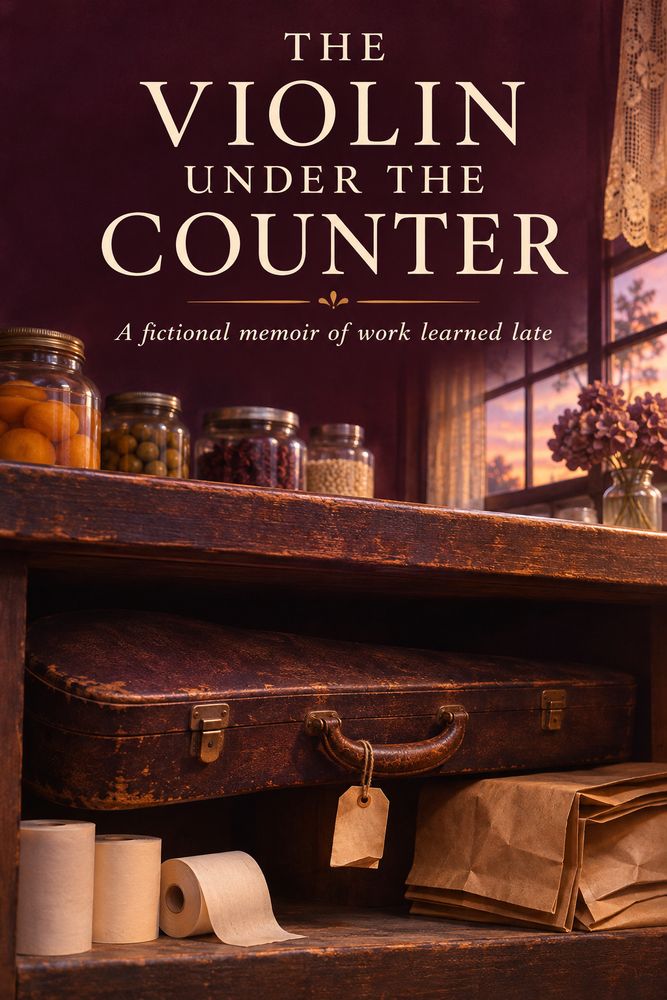
Front cover of The Violin Under the Counter

Biography & Memoir

The Violin Under the Counter

By TrendWindow Library

At fifty-eight, a grocer takes his father’s violin out from beneath the counter and begins learning what he cannot yet do. Eight chapters follow Elias through supervised apprenticeship, a damaged family label and the work of making room for his daughter’s own life.

Read this complete edition, including its ending and notes. No purchase is required.

About this book

*A fictional memoir of work learned late*

This is an original work of fiction written in the form of a memoir. Elias, his family, the shop, the workshop and every remembered incident are invented. The narrator's apprenticeship is a story, not an instrument-repair manual. No real person's testimony or historical biography is represented.

Original fictional memoir; all people, places and remembered events are invented. Not a real person’s testimony or an instrument-repair manual. AI-assisted writing and translations; no independent human-editor or native-speaker certification is claimed.

1. The weight below my knees

For four years after Rosa died, I kept my father's violin under the grocery counter, between a box of receipt rolls and the spare shopping bags. I said it was there because our flat was small. The case took up exactly as much room beneath the counter as it would have beneath my bed. Space was an explanation I could offer without inviting another question.

I was fifty-eight that winter. I could judge a sack of potatoes by lifting one corner. I knew which customer wanted conversation and which wanted the change placed on the counter without a word. These were modest skills, acquired through forty years of opening a shop, and I was proud of them. When people said I must be good with my hands, however, I let the compliment include things I had never tried.

The violin entered daylight because a boy called Sam came in carrying another one. He was buying an apple before a lesson. His case handle came away at one end, and he caught the case against his stomach. Nothing fell. I offered him a shopping bag large enough to carry it level. He thanked me and asked whether I played.

“A little, once,” I said.

It was not quite true. My father had once put the instrument into my hands. I had drawn a noise from it and asked to be excused. After that I preferred telling people that he had never really played either. He had played on Sunday afternoons, badly and happily, while my mother repaired clothes at the window. I had edited those afternoons until my own embarrassment looked like family history.

After Sam left, I pulled out the case. One catch resisted. I did not force it. A paper label on the handle carried Rosa's writing: “Elias's father's violin. Keep upright.” She had labelled it when we moved above the shop. The words were neither affectionate nor impatient. They were instructions to a mover. I read them as though she had left me a private message, then felt foolish for asking a label to become a letter.

My daughter Mara arrived to help with the evening delivery. She found me sitting on a crate with the case across my knees.

“Are you selling it?” she asked.

“I thought I might mend it.”

“Does it need mending?”

I had not opened it. That was the first useful question anyone asked me about my new ambition. I put the case on the dry shelf behind us and went to help her count the delivery.

2. What Irena would not promise

Irena's workshop occupied two rooms above a tailor. A customer gave me her address and warned me that she did not like being interrupted while listening to an instrument. I imagined silence and solemn gestures. When I arrived by appointment, she was arguing pleasantly with a delivery driver about which entrance his parcel had reached.

She opened the violin case at a cleared bench and looked before she spoke. I stood beside her with the impatience of a customer who has already decided that interest should be rewarded by good news. She explained that an assessment came before a repair proposal, and that she would write down the condition, possible work and cost. I had brought my own instrument, but ownership did not give me the knowledge to decide what should happen to it.

“Can you teach me?” I asked.

“To do what?”

“Mend violins.”

She waited. I became aware that I had asked for an entire occupation as though it were an item from the top shelf.

I told her about the grocery and my father. I also told her I used to play a little. The second time a small lie leaves your mouth, it begins to look like a fact you are obliged to protect.

Irena offered no promise of a new career. If I wanted to see whether I could learn, I could attend six Saturday mornings. I would pay an agreed lesson fee, begin with observation and exercises on her designated practice material, and touch no customer's instrument without her permission and supervision. Work on my violin would be separately discussed and authorised. She would tell me when a task exceeded what she could responsibly let me attempt.

I asked whether six mornings would be enough.

“Enough to decide about six more.”

At the shop, Mara listened while she checked a delivery invoice. I explained that she could cover the Saturdays. She put down her pencil.

“You have explained your lessons,” she said. “You haven't asked about my Saturdays.”

She had recently applied for a paid bicycle-workshop apprenticeship. I knew this, but had placed it in the part of my mind reserved for things that might happen later. We agreed that she would cover the first two mornings, for pay, and no others unless she offered. I would arrange the remaining time before accepting it from Irena.

That evening I wrote two appointments in the shop diary. Beside each, I wrote Mara's name and the hours she had actually agreed to work. It was an unromantic beginning. It was also the first part of the plan that could be kept.
3. Learning to leave a thing alone

At my first lesson, Irena gave me a lamp, a notebook and an old practice piece she had marked for study. I expected a tool. She asked me to describe what I saw without deciding what had caused it.

I wrote “bad repair” beside a dark line.

“How do you know?”

I did not. Under different light, the line looked different. She showed me how a description could remain useful without becoming a diagnosis. My page gradually lost its confident adjectives and acquired locations, questions and small drawings. I felt less accomplished at the end of the morning than at the beginning, which seemed an unfair result for a paid lesson.

At the grocery I was impatient with a new assistant called Dev, who had agreed to cover my later Saturdays. He asked where I kept the paper bags although I had shown him once. I heard myself answer in the tone I had feared from Irena. I stopped, took him to the shelf and labelled it. Knowing something for thirty years did not make it visible to someone on his second day.

On the third Saturday I reached towards a customer's violin that Irena had set down while answering a question. A cloth lay beside it. I thought I could at least make myself useful by wiping away a mark.

“Leave that,” she said.

I withdrew my hand. No damage had been done, but I was embarrassed enough to become offended. I had meant to help. Irena said that the intention was not the issue. The owner had entrusted an instrument to her workshop; my curiosity was not permission to alter it. I wrote that sentence in my notebook when I got home, after first considering whether to stop attending.

The practice exercises that followed were slower than anything I could turn into an interesting account for customers. I learned to prepare my place, describe my uncertainty and stop before an action I could not explain. Specific work remained under Irena's eye. I did not bring tools home to repeat it on my father's violin.

Mara asked what I had made that week.

“A page of questions.”

She nodded. At her bicycle interview, she said, she had been asked what she would do with a fault she could not identify. I did not tell her that our answers had made us the same kind of apprentice. She was seeking a livelihood. I was spending money and time she had helped me make available. Our beginnings deserved their differences.

4. The label I threw away

I could not yet work on the violin, so I decided to improve its surroundings. One Tuesday after closing, I emptied the case compartment onto clean paper: an old programme, a broken pencil and a button that belonged to no coat I remembered. Rosa's label had curled around its string. I copied the words onto a new card and threw the old one into the shop bin.

The new label was square, legible and without a stain. I looked at it for perhaps half a minute before I understood what I had done.

I retrieved the old label. Tea leaves from my mug had marked one corner. The ink there had blurred. “Keep upright” was still readable, but the small turn at the end of Rosa's last letter had spread into a grey patch. This was not a disaster to anyone outside our family. That fact did not make it less final.

When Mara came upstairs, I told her that I had found the label damaged. The words were technically defensible. I had found it damaged after I had put it in the bin.

She examined the new card and asked why there were two. I answered the question she had asked, then finally answered the one I had been avoiding. I told her about the rubbish and the tea.

“Then write that down,” she said.

I wanted forgiveness, perhaps an assurance that her mother would not have minded. Mara offered neither on Rosa's behalf. She fetched a small envelope. We left the label to dry undisturbed before putting it away, and I wrote a dated account of what I had done on a separate sheet. I kept the new copy too, identifying it as a copy. I did not try to draw Rosa's lost pen stroke back into existence.

At the next lesson I told Irena. She did not turn the mistake into a beautiful lesson that made the damage worthwhile. She said only that a record should distinguish what had arrived from what we had changed.

Thereafter, on Tuesday evenings, my work beneath the shop lamp was mostly writing. I recorded the objects in the case and the things I knew about them. Where memory failed, I left a question. I could not restore the label to its previous condition. I could stop improving the story of how it had changed.

5. The space behind the tins

By spring, I wanted a bench in the grocery's back room. I pictured a cleared surface beneath the high window, with the ordinary shop sounds on the other side of the door. I also pictured Mara admiring it. I was less precise about where the stock would go.

She had been offered the bicycle apprenticeship. Her start date was three weeks away. When I suggested that we move several cartons into the passage for a while, she stood in the doorway and made me walk the route we used with deliveries. The cartons would obstruct it. When I suggested that she handle the stock orders while I attended lessons, she asked which of her new working hours I intended to remove.

“I kept this place running for you,” I said.

It was a sentence I had polished privately for years. Spoken aloud, it sounded like a bill she had never agreed to incur.

“You kept it running for us,” she said. “And for yourself. I didn't ask you to stop. I'm asking you not to choose my work for me.”

We did not solve the argument before closing. She went home to her own flat, and I counted tins badly. The next morning I apologised without adding a speech about what I had sacrificed. That omission took more effort than the apology.

We measured the back room. There was space for a small desk if I reduced stock that had been sitting unsold and kept all access routes clear. It would be a place for notes and approved practice material, not a public repair counter. Irena had not said I was ready to operate one, and I would not imply that she had.

I asked Dev which hours he actually wanted. We agreed on a limited paid arrangement I could afford. I reduced the shop's Saturday opening hours and posted them in advance. Some customers disliked the change. One began shopping elsewhere. A smaller timetable was not a magical improvement to the business; it was a cost I chose instead of assigning it invisibly to my daughter.

Mara helped me move the desk on her last paid shift. Then she handed me the shop keys she no longer needed. We stood awkwardly beside the tins, as though a ceremony had been promised but nobody had prepared words. I put the keys in the drawer. She took her bicycle outside and rode to meet the people who would teach her something I could not.

6. Two names on the record

Six months after my first visit, Irena allowed me to assist with one limited repair on my father's violin. She had completed the assessment, explained the proposed work and obtained my agreement. We had practised the relevant tasks separately, and she remained beside me. Nothing about owning the violin made supervision unnecessary.

I will not describe the procedure here. A memory of someone's hands is not an adequate set of instructions for another person's instrument. What I remember most clearly is asking to stop because I could not tell whether the result matched what we were trying to achieve. Irena examined it, explained what she saw, and took over the part beyond my skill. Later I resumed the portion she judged appropriate.

At the grocery I told a customer, “I've repaired my father's violin.”

He congratulated me. There it was again: an easy sentence that made a modest thing sound complete. Before he left, I corrected it. I had assisted with part of the work under a qualified maker's supervision. She had carried the responsibility for decisions I could not yet make. He seemed no less interested, although I felt less impressive.

Irena's record described the work and our respective roles. I asked for a copy. On my desk, it occupied the place where I had imagined a certificate announcing a new profession. Two names made it a truer account.

That month Sam returned for an apple. His case now had a sound handle. I asked about his lessons. He said he was tired of playing something slowly when he already knew how it should sound.

“I said I used to play,” I told him. “I didn't, really. I tried once and gave up.”

Sam considered this while choosing an apple without a bruise.

“You could try twice,” he said.

I did not ask him for a free lesson. Through Irena I found a teacher, arranged a single paid introductory appointment and made clear that I was beginning. For once I arrived without a previous version of myself to defend. The teacher adjusted the lesson to what I could actually do. At the end, I had produced little music. I also had no lie to remember before the next appointment.

7. An evening without an audience

The following autumn, the community room held a modest music evening. Irena had been invited to speak briefly about caring for instruments and knowing when to seek qualified help. She asked whether I could help carry her display cases. I agreed, then spent two days hoping someone would mistake me for a colleague.

Mara came after work with a bicycle grease mark still on one sleeve. She had begun to enjoy the parts of her apprenticeship that did not make good stories: checking a record, asking another mechanic to examine a doubt, telling a customer when work would really be ready. I recognised the pattern and kept the recognition to myself long enough to listen.

Irena introduced me as Elias, who ran the grocery and was learning in her workshop. Both halves of the sentence were allowed to remain. She did not conceal the grocery to flatter my ambition. I did not feel obliged to make a joke about being too old to learn.

Sam played with two other students. There were hesitations, a missed entrance and a recovery that made his teacher smile. I watched him listen to the others. My father had mostly played alone. I wondered what his Sunday afternoons might have been like if I had sat down beside him instead of closing my bedroom door.

It was a question with no appointment available for an answer. I did not ask Sam's performance to repair it.

After the chairs were stacked, someone asked whether I would play my father's violin. I said I was not ready to perform. The refusal surprised me by containing no shameful explanation and no promise of a future triumph. I had helped with the cases, listened to the music and spoken honestly. The evening did not need to become a test of everything I had begun.

Later, above the shop, I took out the violin for the short practice my teacher had given me. Mara was drinking tea in the kitchen. I played three uncertain notes and stopped to start again. She did not applaud. Through the doorway she asked whether I wanted the last piece of bread.

I said yes. The notes had been allowed to exist in an ordinary room, beside an ordinary question. That was more room than I had ever given my father's playing.

8. What stayed beneath the counter

A year after Sam's case handle broke, the grocery still opened on weekdays. Dev worked the hours we had agreed, and Mara's visits were visits unless we arranged otherwise. Some weeks I attended Irena's workshop; others I stayed at the shop because the business needed me. Continuity looked less like an uninterrupted line than I had expected.

My desk held a notebook, the copied repair record and the envelope containing Rosa's label. It also held an unfinished practice exercise. I had not become a master, and no customer was invited to entrust a violin to my grocery. When asked, I gave Irena's contact details with her permission. I could offer an honest introduction without pretending that her competence had become mine.

The violin no longer lived under the counter. I kept it in its case in the place agreed with my teacher and Irena, away from the bustle of deliveries. On practice evenings I brought it out deliberately. Moving it had not rescued my father or returned my wife. It had changed what I did on a Tuesday.

I wrote an account of my father playing on Sundays and gave it to Mara. In it I admitted that I had found the sound embarrassing and had later claimed he barely played. She read the page at the kitchen table.

“Is this how it happened?” she asked.

“As nearly as I remember. The words he said are less certain than the rest.”

“Then put that in.”

I did. She kept the revised page. I retained a copy with its date, not because our family had become important enough for an archive, but because I had discovered how easily certainty could be manufactured by leaving out a sentence.

Before closing that Friday, I reached beneath the counter for a receipt roll. The space where the violin had rested now held shopping bags. I took one out for an older customer whose paper bag had split. He thanked me, and I helped him collect the scattered oranges. It was familiar work. I did not need it to stand for something else.

After he left, I locked the shop, checked the delivery note for Monday and went upstairs. The violin case waited where I had put it. I opened it without an audience, took out my notebook and began with the part I still could not do.

Explore more books →