BOOK LIBRARY · Complete books · Purchases disabled
TrendWindow

← Book Library · Complete book

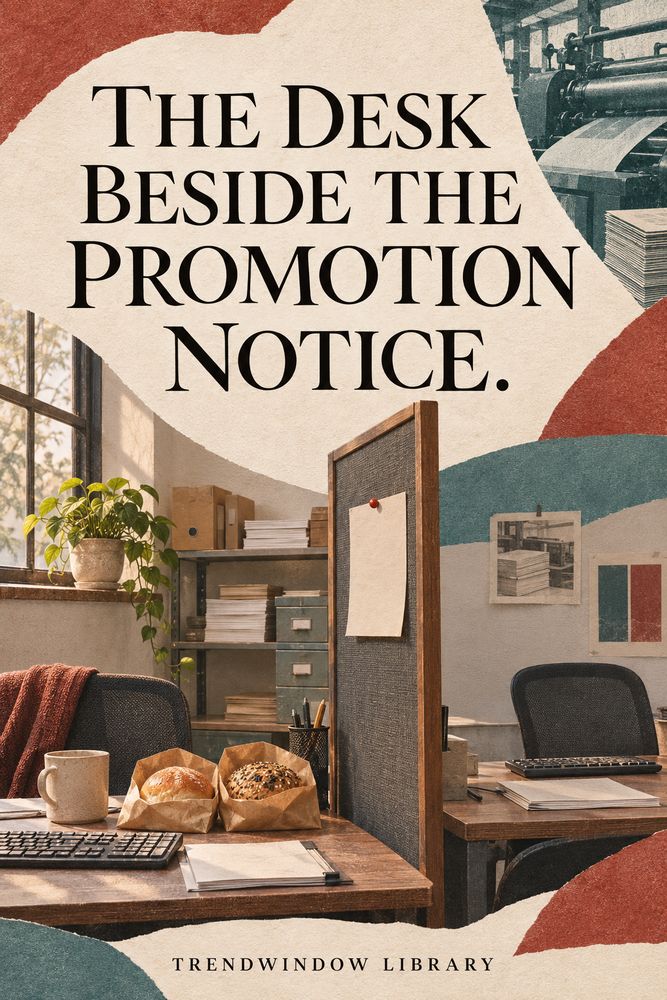
Front cover of The Desk Beside the Promotion Notice

Contemporary & Literary Fiction

The Desk Beside the Promotion Notice

By TrendWindow Library

A complete original work of contemporary literary fiction. Rosa and Leanne have worked together for twelve years. When Leanne gets a promotion, Rosa must face a decision they never made together—and an unfinished application of her own.

Read this complete edition, including its ending and notes. No purchase is required.

1. Neither of Us

On Monday, the notice went up beside Rosa's desk because that was where the drawing pin still held. The board by the stairs had become too soft, and Gwen had been promising a replacement since March.

TEAM COORDINATOR. Applications by Friday.

Rosa read it while the kettle boiled. She had worked in the printing company's office for twelve years, long enough to recognise the machine downstairs by the sound it made before it stopped.

Leanne arrived carrying two rolls from the bakery. She put one on Rosa's desk without asking. They had settled the order of the rolls years ago: the one with more seeds belonged to Rosa.

“Are you going for it?” Rosa asked.

Leanne looked at the notice.

“I doubt I'm their person.”

“Exactly.”

Rosa meant that she doubted it about herself too. She was forty-one, Leanne thirty-nine. They had started in the same month, complained about the same cold corner and become friends partly through the long practice of noticing when the other needed tea.

At eleven, Finn came upstairs with a question about an order. He was new enough to read every notice.

“Are either of you applying?”

“Neither of us,” Rosa said. “We know better.”

Leanne was at the copier. Rosa did not look over to check.

Later, she would remember that small omission more clearly than the words.

2. A Name on the Paper

Three weeks later, Gwen brought a second notice to the same board.

Leanne would take up the coordinator role the following month. Until then, questions about the change should come to Gwen. Rosa read both sentences, then the first one again.

Leanne stood beside the window with her coat still on.

“I wanted to tell you before the notice,” she said. “Gwen asked me to wait until this morning.”

“You applied.”

“Yes.”

Downstairs, the printer made its little warning click. Someone went to see to it.

Rosa looked at the board.

“Well. Lucky you.”

She heard how it sounded. The words had come out in the bright voice she used when a customer thanked her for something she had not done.

Leanne's hand stayed on her coat button.

“I worked on the application.”

“I didn't say you hadn't.”

“No.”

Finn came up with a folder. He saw the notice and congratulated her with an openness Rosa suddenly found unbearable.

“We thought nobody here was interested,” he said.

“I was,” Leanne answered.

Rosa picked up a ringing phone. For once she was glad of a customer who took several minutes to explain something simple.

At lunch, Leanne went out alone. The seeded roll Rosa had bought for herself remained in its bag.

3. What Had Been Agreed

They did not speak privately until Thursday. Wednesday had filled itself with ordinary work, which Rosa performed with an accuracy that felt almost rude.

On Thursday, Leanne asked if they could use the small room behind the sample cupboard. They left the door ajar. There was no meeting booked, no audience waiting to judge them.

“You said you weren't going for it,” Rosa began.

“I said I doubted I was their person.”

“You knew what I meant.”

“I knew you didn't want to apply. I hadn't decided.”

Rosa sat on the edge of a chair. A stack of unused paper samples leaned against the wall, colours she had once been able to name without looking at the labels.

“You could have told me.”

“I could. I didn't want to argue myself out of it before I'd written a page.”

“Would I have done that?”

Leanne did not answer quickly.

“You said we knew better.”

Rosa looked at the samples.

The phrase had pleased her when she said it. It had made not trying feel like the result of experience rather than a choice she might have to examine.

“I was answering for myself,” she said.

“You said neither of us.”

“I know.”

She did know. It was there in the room with them, more exact than the accusation she had brought in.

“I thought we agreed about this place.”

“We agree about the cold corner. And the kettle. And several other things. I still wanted the job.”

“To be in charge of me.”

Leanne's face changed.

“To try different work. You're part of that work. You weren't the reason I wanted it.”

Rosa had no useful answer. She had made herself central to an ambition that belonged to someone else and had called that friendship.

4. The Part That Was Hers

That evening, Rosa took the longer walk home. She did not want to arrive while she could still imagine herself explaining that she had been betrayed.

There had been things she and Leanne had done for each other. Hospital waiting rooms. A difficult house move. The week Rosa could not face the phone after her father died. None of those things were imaginary. None had included a promise to remain in the same job forever.

The coordinator notice had been beside her desk for five days. She had read it every time she stood up.

She had imagined being asked to apply. In that version, someone else would first say she was ready. She could then pretend the decision had arrived from outside her.

Nobody had asked. She had not applied.

That was different from not wanting it.

At home she opened the document she had started on the Wednesday before the deadline. It contained her name, the date and one sentence about her experience. Below that, a blank page waited.

She had not told Leanne about the document either.

Rosa sat with that until it ceased to be a clever point she might use against her friend and became an uncomfortable fact about herself.

The next morning she put the usual roll on Leanne's desk.

Then she took it back.

“This isn't meant to do the talking,” she said.

Leanne looked up.

“Calling you lucky was unfair. You applied and did the work. I was disappointed in myself, and I made it sound as though you had done something to me.”

“It hurt.”

“I know. I'm sorry.”

Leanne looked at the roll in Rosa's hand.

“You can put that down.”

Rosa did. The relief was not forgiveness completed and filed. It was simply somewhere to begin again.

5. A Different Conversation

When Finn came upstairs, Rosa stopped him before he could leave the folder.

“About the applications. I shouldn't have told you neither of us was interested. I hadn't asked Leanne. I was speaking for her.”

Finn glanced towards Leanne, then back.

“Right. All right.”

He did not demand the rest of the story. Rosa let him go without explaining how long she and Leanne had been friends.

Later she asked Gwen for a conversation about her own work. She did not ask why Leanne had got the job. She asked what she would need to learn if she wanted responsibility beyond her present desk.

Gwen suggested that Rosa spend time with the person who prepared quotations. There was a part of that work Rosa knew only from the finished numbers on an order.

“It isn't a promise of another vacancy,” Gwen said.

“I know.”

“And you would need to make room for it in your week, not do two jobs at once.”

They agreed to discuss a small, scheduled trial with her existing work covered. Nothing had yet changed her title or pay. Rosa left with a meeting time rather than a promotion she could imagine herself already deserving.

At lunch, she told Leanne.

“I started an application too,” she added. “A name and one sentence. I never finished it.”

Leanne broke her roll in half.

“I didn't know.”

“No. I didn't tell you.”

They were quiet for a moment.

“I don't want you to have to stop talking about the new job,” Rosa said. “I may still find it difficult.”

“I can understand difficult. I don't want to pretend I didn't want it.”

“You shouldn't.”

Leanne told her about a question she had asked in the interview. Rosa listened without preparing the joke that would have made the job seem foolish.

6. The Same Window

Leanne moved to the coordinator's desk on the first Monday of the next month. It was nearer the window but farther from the kettle. Rosa helped carry a plant, not the application papers.

“More light,” she said.

“More people asking where things are.”

They smiled. The joke did not need to prove that wanting the job had been a mistake.

The work changed. Leanne asked Rosa to alter an order of tasks, and Rosa disliked the alteration. She said why. Leanne explained the reason. They settled what needed doing without turning the exchange into a test of twelve years together.

That afternoon, Rosa went to the quotations desk for the first planned hour. She asked two questions she would once have tried to make sound like comments. She wrote the answers down.

She was not suddenly fearless. Leanne was not suddenly an excellent coordinator at every task. By Thursday, both of them were tired in new places.

They still had lunch outside on Friday. Leanne brought the rolls. She handed Rosa the one with more seeds.

“I may need to leave early,” she said. “Gwen wants ten minutes before the afternoon starts.”

“Then we'd better eat.”

For a little while they spoke about a film neither had liked. Rosa enjoyed the ease of agreeing. Then Leanne mentioned something about the new work and they did not agree at once.

Neither woman packed up her lunch.

Back upstairs, the promotion notice had been taken down. The pin remained beside Rosa's desk, holding nothing.

She opened the unfinished document at home that evening. She did not send an application for a job that had already been filled. She changed the date, wrote what she had learned in the hour at the other desk, and saved it.

It was not a promise that next time she would win. It was no longer a blank page she could call a shared decision.

Edition Note

This is a complete original work of contemporary literary fiction. Rosa, Leanne, Gwen, Finn, the unnamed company, role, application, interviews, work arrangements and events are invented. It does not describe a real employer or establish employment rules, management findings, salary expectations, legal rights, psychological results or financial advice. The English original, full translations and original cover artwork are AI-assisted and editorially reviewed, without independent human-authorship or native-human certification.

Explore more books →