BOOK LIBRARY · Complete books · Purchases disabled
TrendWindow

← Book Library · Complete book

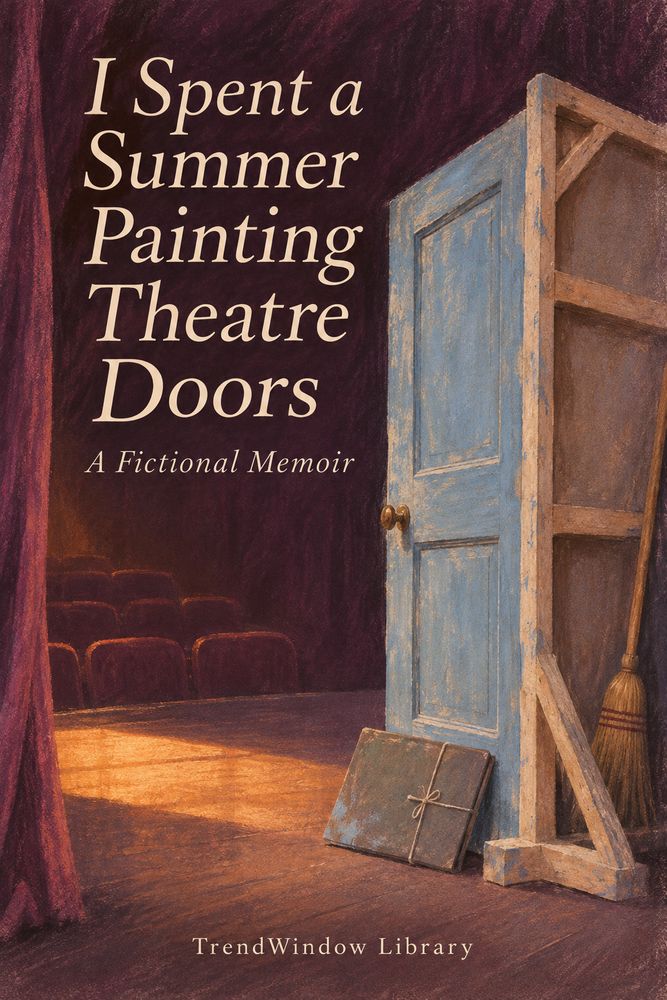
Front cover of I Spent a Summer Painting Theatre Doors

Biography & Memoir

I Spent a Summer Painting Theatre Doors

By TrendWindow Library

A fictional stagehand spends a summer painting an ordinary theatre door. A misplaced improvement, a rehearsal mark and his mother’s visit change what he wants an audience to notice, while his temporary job reaches its agreed ending.

Read this complete edition, including its ending and notes. No purchase is required.

About this story

A complete short fictional memoir in eight chapters. Tomas, Dena, Mira, Oren, the theatre and its productions are invented. The first-person memories belong to an imaginary narrator; they are not the author's lived experience or a historical account. Descriptions of workshop work serve the story and are not instructions for construction, painting or stage safety.

© 2026 TrendWindow Library. Original AI-assisted fiction and translations, reviewed by an AI assistant. No independent human-editor or native-speaker certification is claimed.

1. The door without a house

At twenty-seven I arrived at the Bellweather Theatre carrying a folder of drawings and a sandwich that had leaked into it. I remember the smell of the onion more clearly than what I said to Oren, the production manager. In later versions of the story I made a witty remark. I doubt I did. He looked at my wet folder, then at the dates I had written on the availability form.

There was summer work on the scenery crew, he said. There was no vacancy for a designer. I told him I understood, although I was already imagining how quickly that distinction might disappear.

Dena, who painted the scenery, took me through the rehearsal room to a workshop where a blue door stood inside a freestanding piece of wall. There was nothing behind it except a broom. I walked around to the other side, disappointed by how little remained of the room I had begun to invent.

“You'll get used to that,” she said.

She meant the exposed backs of things. I thought she meant disappointment.

The door was for a play about two sisters sharing a house after their father's departure. It was neither a real entrance to the building nor one of its fire doors. Oren made that distinction before assigning any work: the day-to-day running of the theatre belonged to trained people with responsibilities I did not have. My first tasks concerned scenery, under Dena's supervision, and mostly involved carrying, cleaning and waiting.

At lunch I put my drawings beside her mug. She moved the mug away from the damp corner but did not open the folder. Instead she asked whether I had brought old clothes for tomorrow. I heard a refusal where there was only a practical question.

That evening I told my mother I was working in theatre design. She asked if the work would last through August. I said yes. For her, that was the interesting part. I found this unambitious, which now seems a generous word for how little I understood her.

2. A blue that looked like grey

Dena gave me a sample board, not the door. The approved colour was a greyish blue. I had expected scenery to offer escape from the flat colours of rented rooms. Here was precisely the colour I remembered from the corridor outside my first bedsit.

I tried to improve it. Within the work Dena had assigned, I painted an alternative sample with darker streaks that suggested expensive old wood. When she returned, I held it upright as if unveiling a portrait.

“Which scene is that for?” she asked.

I said it would look richer. She set my sample beside the approved one and asked me to come into rehearsal. Mira, playing the younger sister, crossed the room carrying a suitcase whose contents rattled. She stopped at the door, listened, and put the suitcase down without opening the door.

I watched the painted wood I had imagined, even though it was not there. Dena watched Mira.

Afterwards she explained that the designer had chosen an ordinary door for an ordinary house. It should not announce a wealth the family did not possess. My grain was attractive on its own and wrong for this room. She did not tell me that beauty was useless. She told me that I had changed the subject.

We kept both samples until the next review, when the designer confirmed the plainer blue. My version went onto a shelf with other unused trials. Nothing was ceremonially destroyed. That made the rejection harder to dramatise.

The following afternoon I worked on the actual scenery door with Dena. By the time we stopped, my back hurt and the surface looked almost as unremarkable as it had in the first sample. I wanted a photograph that would show the labour. There was no angle that did.

Mira passed on her way out and said, “Yes. That's our hallway.” She meant the invented family's hallway. For a moment I felt included in it.
3. The mark I had not been asked to erase

During rehearsals a temporary pale chalk mark appeared near the scenery door's handle. I assumed it was an accident left by somebody moving the piece. In the workshop, while doing the surface corrections Dena had assigned, I cleaned it away without asking.

At the next rehearsal Mira reached towards the handle, stopped, and looked at the blank patch. The mark had been a temporary reference agreed within the rehearsal team, helping her place a hand during a particular pause. It was not part of the finished design. It was also not mine to interpret.

No disaster followed. The rehearsal paused; the team restored its reference and discussed how the action would work without the temporary mark later. The cost was several people waiting while I explained something that became less convincing each time I repeated it.

“I thought it shouldn't be there,” I said.

“You could have asked,” Mira replied. She was not shouting. I would have found shouting easier to resent.

Dena asked me to list what I had been told to change. The missing mark was not on the list. I had turned an instruction to correct a surface into permission to decide everything that belonged on it.

I apologised to Mira after rehearsal. I began by saying how keen I was to do a good job, then heard myself asking her to admire the motive behind the inconvenience. I stopped and said I should have checked before removing it. She accepted that and went to catch her bus.

For the next few days I asked questions so often that Dena finally said, “Read the note first. Then ask what it doesn't answer.” She had not hired my helplessness as a replacement for my confidence.

In my pocket I began carrying a folded sheet of the agreed changes. By Friday it had become soft at the edges. I liked that it looked used. Even then I was capable of making a small costume out of learning.

4. The back of the door

My employment included evening scene changes after the production opened. I had imagined these as glimpses of performance from a privileged angle. Mostly I saw the unpainted backs of scenery and the concentration of people waiting for their assigned moments.

Oren trained and checked me for the particular backstage tasks I was given. I did not improvise machinery, lighting or moving scenery. The rehearsed sequence mattered more than my wish to seem indispensable. When I had nothing assigned, my contribution was to remain where I had been told to stand.

Through a narrow gap I could see one sleeve of Mira's costume. Each night, just before her entrance, her fingers opened and closed once. I decided she was nervous. Later she told me she was checking whether the cuff caught her wrist. I had supplied an inner life to a sleeve.

That summer I was always doing this: making an explanation quickly, then mistaking it for attention.

One evening the audience laughed at a line that had seemed sad in rehearsal. Afterwards I asked Mira whether they had misunderstood. She said she did not know; perhaps the line had reminded someone of a person they loved. She was tired and did not turn this into a lesson. She asked me to pass her the water bottle from the shelf.

From behind, the blue door looked like a collection of decisions that did not need to resemble a house. I could see old labels from earlier productions, mostly covered but not entirely erased. I wanted to read them all. Dena said we could look when the piece was no longer in use.

At home I began a drawing of that reverse side. It had no grand entrance, no person in the centre, and a broom leaning beyond the frame. For the first time that month I did not know whether I wanted to show anyone the drawing. I continued it anyway.

5. My mother in row F

My mother came on a Wednesday, using a ticket I had bought from my wages. I had told her that the scenery was simple on purpose. I said it twice, as though preparing an excuse for a meal that had not yet been served.

Before the show I walked past her seat in row F. She was reading the programme slowly. My name appeared among the scenery crew, one of several names in the same size. She touched the line with a finger and asked if she could keep the programme. I said of course, embarrassed by her pleasure and ashamed of being embarrassed.

I was working backstage that night. During the sisters' quarrel, I tried to identify her cough in the audience. There was no way to know. For once the people out there were not a single dark presence to be impressed; one of them had made the journey after a full day at work.

Outside afterwards I asked what she thought of the door.

“Which door?”

“The blue one.”

She remembered it then. She said the younger sister had stood beside it exactly as my aunt used to wait outside my grandmother's room. I began to explain that I had painted it. She said she knew. What she wanted to discuss was why the older sister had not answered.

We missed one bus talking about the sisters and took the next. She did not praise the brushwork. She told me a story about my aunt that I had never heard, then asked whether I was eating properly. The two subjects did not seem inconsistent to her.

I had wanted my work to interrupt her attention and announce me. Instead it had helped make a place in which she could remember somebody else. I did not immediately become generous about this. On the bus I still pointed out a tiny feature she had missed. She listened, and then she fell asleep with the programme flat on her bag.

6. The red door for another room

After the first production closed, the scenery door returned to the workshop. The next play needed the same piece in a different wall, painted a dull red. Dena showed me the new approved design before we did any work.

I had expected to feel relief at a fresh colour. Instead I resented it. The blue had become evidence of my summer, and now it was being covered for a story I had not yet learned to care about.

We photographed the completed blue version as a record before its approved repainting. I asked whether I could keep the unused sample board. Dena checked which samples needed to remain in the workshop archive and gave me my rejected wood-grain trial. The approved blue sample stayed with the production records. I was amused, then disappointed, then amused again by what I was permitted to take home.

On the back of the scenery piece we found a label naming an invented farce from an earlier season: The Wrong Uncle. Under it was another label too worn to read. I had been ready to imagine a hidden history of masterpieces. One legible joke and one illegible scrap were what the object offered.

Dena did not know who had painted its first colour. She had started after that. I disliked the gap until I realised that pretending she knew would not make the door older or more interesting.

The red belonged to a cramped office in the new play. Its director asked for a small revision to the approved finish after seeing it in rehearsal. Dena recorded the change; we made it. I asked a useful question about its extent and, for an entire afternoon, neither improved the brief nor treated it as an insult.

When I returned home, I hung the rejected sample on the wall above my desk. It did not represent my finest achievement. It reminded me how strongly I had once preferred the picture I brought with me to the work in front of me.

7. A drawing with an empty centre

In August Oren told me the summer contract would end on the date we had agreed. There might be occasional work later, but he could not promise it. I had begun to regard being useful as a method of becoming permanent. It was painful to discover that gratitude and a job offer were different things.

I asked Dena if she would look at my drawings before I left. This time I asked when she had time, and waited until the day she named. The onion-stained sheet was gone from the folder. In its place were the backs of scenery, a half-seen sleeve, and a drawing of the blue door from row F, made from memory after my mother's visit.

Dena paused over the reverse side with the broom.

“This one notices something,” she said.

I nearly asked whether I could be a designer. The question would have required her to turn a drawing into a prediction. Instead I asked what she meant. She pointed to the empty space where I had resisted adding a figure to explain the scene. The drawing allowed the viewer to look without being told whom to admire.

She also showed me where the proportions were uncertain. I had hoped that a kind remark would excuse the rest. It did not.

I revised the drawing over three evenings. On the third I removed a decorative shadow I had added on the second. The result was quieter and, to my eyes, less like an advertisement for my talent. I sent it with several other drawings to an open portfolio review that charged no fee. There was no reply before my contract ended.

This is where a tidier memoir would place a letter offering me a remarkable future. No letter arrived that summer. I packed my work clothes, checked the final wages with the office, and asked Oren whether I could use him as a reference for the work I had actually done. He said yes.

8. What I took through the exit

On my last evening, the red door stood ready for the following night's performance. It was not waiting for me to leave. The new crew member, Pavel, was learning his assigned tasks with Oren. I showed him where our agreed paint notes were kept, then left the training to the person responsible for it.

Dena handed me the drawing she had borrowed to look at again. On a separate sheet she had written two observations about proportion. She did not write a recommendation to become somebody extraordinary. I thanked her without asking for one.

Before going, I stood for a moment in the empty auditorium. I tried to locate my mother's seat, found row F and sat down. From there the red was less dramatic than it appeared in the workshop. The room on stage looked ready for somebody else's difficult afternoon.

Years later, in the life I am inventing on these pages, I still draw. I have taken temporary work, lost interest in some projects and finished others. That summer did not settle a career or cure my wish to be noticed. It gave the wish something to contend with: the possibility that another person's attention might be going somewhere more important than towards me.

I cannot now remember the final line of the sisters' play. I remember my mother asleep on the bus, the dark patch of my ruined drawing, and Dena asking which scene my beautiful blue belonged to. Those are the memories this imaginary narrator keeps. They are smaller than a history of the theatre and less reliable than a production record.

At home on the last night, I took the rejected sample off the wall and put it beside my new drawing. Neither cancelled the other. I washed my work clothes for whatever came next. Then my mother called, and when she asked how the summer had been, I told her about the two sisters before I told her about the door.

Explore more books →