BOOK LIBRARY · Complete books · Purchases disabled
TrendWindow

← Book Library · Complete book

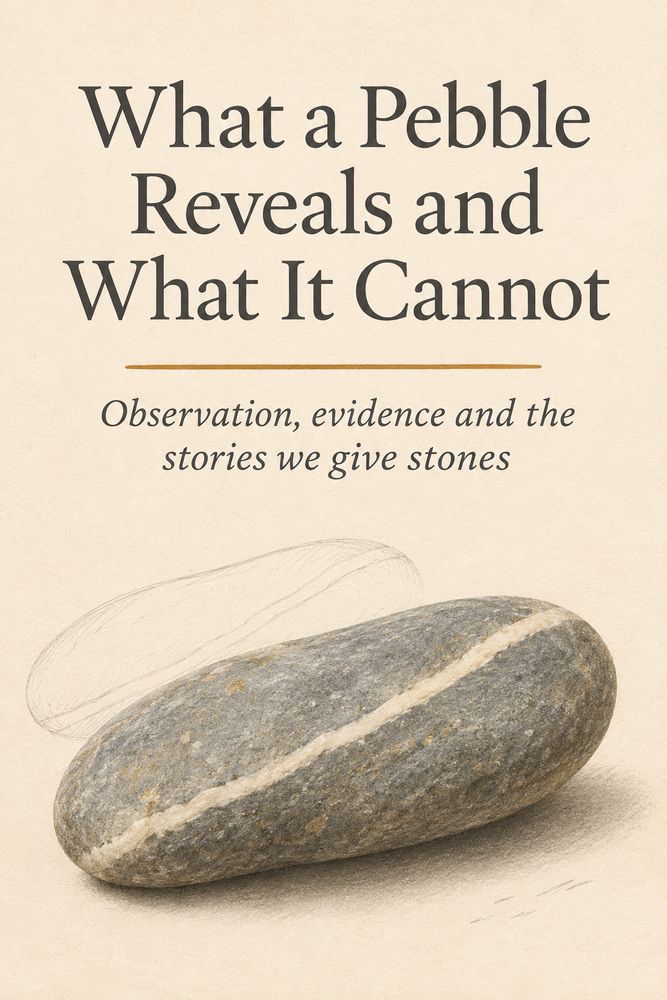
Front cover of What a Pebble Reveals and What It Cannot

Science, Technology & Nature

What a Pebble Reveals and What It Cannot

By TrendWindow Library

An eight-chapter introduction to observation and evidence through Mara’s invented notebook and an unlabelled pebble. Distinguishes colour from identification, rounded edges from a proven route, weathering from erosion and deposition, and geological age from recent ownership. No actual specimen is identified.

Read this complete edition, including its ending and notes. No purchase is required.

About this book

A short book about observation, evidence and the stories we give stones

This is a focused introduction, not a field identification manual. Mara, her notebook and the pebble described here are invented teaching examples. No specimen was collected, identified or experimentally tested for this book. Scientific background comes from the primary institutional sources listed at the end. The example uses an ordinary stone already owned; it does not invite collecting from protected places or damaging an unknown specimen.

Original complete short science introduction prepared with AI assistance. Mara, the pebble and notebook are invented teaching examples; no specimen collection, identification, dating or experiment is reported. Five primary institutional sources rechecked on 22 November 2026; original consultation date retained. Not a field-identification or destructive-testing manual. Original conceptual covers. Translation meaning reviewed with AI, without independent native-language certification.

1. The label arrives before the evidence

Mara puts a pebble beside a notebook. Her first caption is already a journey: “An ancient river stone, carried down from the mountains.” It sounds appropriate beneath a drawing. She has, however, received the stone from a neighbour who found it in a bag of decorative gravel. Neither person knows where that gravel originated.

In our invented example, the stone measures about three centimetres along its longest visible dimension. It looks grey in daylight, with a pale stripe across one face. Its outline is elongated rather than circular, and the edges appear rounded. These are descriptions we have assigned to the example, not measurements from a research project. They give Mara something to record without giving her an origin story.

She divides a new page into three spaces: observation, possible explanation and unanswered question. “Pale stripe” belongs in the first. “A different material may form the stripe” belongs in the second. “What is it?” belongs in the third. Moving a phrase between these spaces requires a reason, not a more confident voice.

Her original caption mixes all three. River, mountains and age are interpretations presented as things she has seen. Removing them feels like making the stone less interesting. Yet the revised record contains a new possibility: another person could inspect what she noticed and disagree about the explanation without first dismantling a whole invented expedition.

A useful first description need not be elegant. It needs to make clear which stone is being discussed, what was observed and under what circumstances. Mara adds the date of her fictional observation and a small drawing of the striped face. The drawing is a record of appearance, not a geological map.

2. A colour is not a name

“Grey rock” is a modest phrase, but modesty does not make it an identification. A colour label and a rock name answer different questions. Mara can describe the pale stripe without knowing its composition. Giving the stripe a familiar mineral name would add a claim that the description has not established.

The US Geological Survey cautions that accurate identification generally requires examining a specimen in person and from different perspectives; a photograph can be insufficient. That warning does not make photographs useless. It tells us to distinguish a useful record from an adequate basis for a conclusion.

Mara draws the other face. The stripe is not equally visible there. She notes the difference instead of forcing both sketches to match the image she likes best. She also writes that her colour description was made in daylight. If a later photograph looks warmer under a room lamp, the discrepancy should prompt a check of the viewing conditions before it becomes a claim that the stone changed.

The notebook is not improved by a string of impressive terms she cannot explain. “Speckled” can be an honest first observation. “I can see separate light and dark areas” is more useful than an uncertain technical word used as if it were settled. Where she cannot tell whether an area is a grain, a coating or a reflection, she says so.

She is building a record that could support a better question. She is not awarding the stone a final name. A blank identification line is therefore compatible with a page full of worthwhile work.

3. Rounded is not the same as a route

Mara's stone is elongated, although its edges look rounded. Those two descriptions can coexist. She need not draw a perfect ball to show that conspicuous sharp corners are absent. Her sketch should preserve the shape she is describing rather than turning “rounded” into an ideal circle.

The National Park Service describes waves knocking together granite fragments on Mount Desert Island and gradually rounding their edges. This is an explanation tied to a particular setting. It offers Mara a possible process to think about, not permission to assign that island's history to her bag of gravel.

She sketches two separate things: the stone's overall outline and one edge seen more closely. Then she writes, “Could wear during movement help explain the edges?” The question is useful precisely because it has not yet become “This stone travelled a hundred kilometres in a river.” No distance has been measured, and no river has been identified.

A description can be compatible with a process without uniquely proving it. That distinction is easy to lose when a finished caption must fit into one attractive sentence. Mara's original sentence did not contain a place for alternatives, missing context or uncertainty. Her notebook does.

She keeps the possible explanation but removes the unsupported route. This is not a declaration that transport can never be studied. It is a decision about what her present evidence can support. A specialist investigation with appropriate observations is different from a guess attached to a pleasing shape.

At the bottom of the page she writes a small restraint: “Do not turn an edge into an itinerary.” The phrase is hers, a reminder for this exercise, not a law of geology.

4. Three verbs that should not collapse into one

Weathering changes or breaks material in place; erosion involves removal and transport; deposition is the laying down of transported material. This basic distinction follows the National Park Service's explanations. The terms organise questions; they do not supply the missing history of Mara's particular stone.

She makes three boxes in the notebook and places a question in each. What might have happened before this piece was loose? What might have moved it? Where might it have been left? The boxes contain questions rather than a finished sequence of drawings. She has not found evidence for every stage simply by naming the stages.

The bag adds another event: people placed material in packaging and moved it to a garden supply chain. The example does not establish what happened before that. Human handling is part of this object's recent story, but it is not a substitute for the geological story she hoped to tell.

Mara first draws a mountain, a river, a gravel bag and the neighbour in a straight line. She then notices that the river is still an invention. She replaces the first two drawings with a bracket labelled “earlier history unknown” and keeps the bag and the neighbour, which belong to the example's known account.

This change makes the diagram less picturesque and more useful. It separates a model of processes from a record of events. A general explanation can help us understand what evidence to look for without proving that every event in the explanation occurred here.

Her three boxes remain on the page. They will guide later reading. She does not fill them merely to avoid the discomfort of empty space.

5. Found here does not mean formed here

The neighbour lives two streets away. That fact is relevant to how Mara obtained the pebble, but it does not locate the rock's formation. The same distinction would matter if a specimen arrived in a parcel. The place where an object changes hands is not automatically the place where it began.

Mara writes a short provenance note: “Given by neighbour; reportedly taken from a bag of decorative gravel; earlier source unknown.” The word “reportedly” preserves a small but important boundary. In this example she did not watch the neighbour open the bag. She is recording an account, not converting it into a personal observation.

There is no surviving bag label in our story. She does not invent one to make the chain complete. If a label later appeared, it would be a new piece of information requiring interpretation. A seller's address, for instance, would not by itself identify a quarry. The right question would be what the label actually claims and how it connects to this specimen.

For her drawing, Mara assigns the identifier P1. It keeps the image, description and provenance note together. If she later examines another grey stone, she should not accidentally attach P1's notes to it merely because the stones look similar.

This is a simple record-keeping choice, not an official collection system. Its value lies in avoiding a specific confusion. A beautiful page about the wrong specimen would still be wrong.

The note also gives the neighbour's contribution its proper scale. That person supplied the stone and an account of the bag. They did not certify its geological origin.

6. Which age are we asking about?

“How old is it?” sounds like one question. Mara discovers that she has several questions in mind: when the material formed, when a piece became separated, when its present outline developed and when it entered the bag. A single number would need an explanation of which event it refers to.

USGS geologist Mark Stelten's 2024 introduction to rock dating describes methods suited to different events and materials. It distinguishes, for example, crystal formation from surface exposure. Mara's lesson is limited: a date must be attached to an event and an appropriate method. A smooth edge is not itself a numerical date.

She deletes “millions of years old” from a draft caption. The deletion does not prove that the stone is young. It means she lacks evidence for that number. Refusing an unsupported claim should not be confused with establishing its opposite.

The bag's purchase date would answer a different question again. Knowing when someone bought gravel might help reconstruct its recent ownership, but it would not tell us when the mineral material formed. Likewise, the date on Mara's drawing records when the drawing was made. It does not age the stone.

She leaves room in the notebook for a future dated result, should a suitable investigation ever exist. Beside that space she writes three prompts: what was examined, which event was dated and what limits accompany the result? She is not proposing a home dating experiment or claiming that every pebble warrants laboratory work.

Her curiosity has become more precise. Instead of asking for the biggest impressive number, she can ask what a particular number would mean.

7. A better question leaves something open

Mara's next imaginary enquiry is no longer “Please confirm my ancient mountain river stone.” It becomes: “I have an unlabelled pebble with a pale stripe. Its earlier source is unknown. What observations would help decide whether it can be identified?” No actual enquiry has been sent; this is practice in framing a question.

The USGS suggests local geological surveys, museums or university geology departments among possible places to seek identification help. That does not promise that any particular institution will accept a specimen, answer immediately or provide a free service. Mara would need to check its arrangements before approaching it.

For now, the exercise remains observational. It does not require acids, breaking the stone, making dust or licking a surface. A request for information should not silently become a destructive test. If a qualified person proposed a test, its purpose and implications would be a separate decision, outside this introductory notebook exercise.

She reads the three columns aloud. In the observation column, she finds “river-polished.” The word has smuggled a cause into an apparent description. She changes it to “edges appear rounded” and puts possible wear during movement back into the explanation column.

That correction matters more than adding another paragraph. The page now shows both what she noticed and where she crossed into interpretation. It gives a future reader a fair chance to examine the same problem.

She also keeps the old phrase lightly crossed out, still readable. The correction records a change in reasoning. It does not pretend that she began with perfect judgement.

8. The caption she can stand behind

Mara returns to the first drawing. Her new caption reads: “P1: grey, elongated pebble, about three centimetres long in this teaching example, with rounded-looking edges and a pale stripe. Given by a neighbour who said it came from decorative gravel. Geological source, composition and age not established.”

It is a longer caption than she wanted. She could shorten it for display, but she keeps the full version beside the notebook drawing. The unknowns are not decorative disclaimers added after a confident story. They determine what the story is allowed to say.

She has not identified a rock type or discovered a mountain range. She has learned to preserve an observation, separate a reported account from something witnessed, distinguish a possible process from a proven route and ask which event an age would describe. Those are real gains within the limits of our invented exercise.

The stone still has its stripe. The light still catches one edge when she turns it. Careful language has not removed either feature. It has removed the obligation to make them prove more than they can.

Mara closes the notebook with the first caption crossed out and the second intact. There is an ending to this small investigation even though some questions remain unanswered: the record now says what she knows, how she knows it and where knowledge stops. The pebble has not surrendered a complete biography. She has stopped writing one on its behalf.

Source notes — consulted 10 November 2026: [USGS, Can you identify my rock or mineral?](https://www.usgs.gov/faqs/can-you-identify-my-rock-or-mineral); [NPS, Weathering](https://www.nps.gov/subjects/erosion/weathering.htm), updated 26 January 2023; [NPS, About erosion](https://www.nps.gov/subjects/erosion/about.htm), updated 12 September 2019; [NPS, How do Square Blocks become Round Rocks on Mount Desert Island?](https://www.nps.gov/articles/000/how-do-square-blocks-become-round-rocks-on-mount-desert-island.htm), updated 29 December 2020; [Mark Stelten, USGS, A beginner's guide to dating (rocks)](https://www.usgs.gov/observatories/yvo/news/a-beginners-guide-dating-rocks), 8 April 2024. These support the stated background, not identification of an actual pebble. The notebook procedure and Mara's completed example are original teaching constructions.
Explore more books →