BOOK LIBRARY · Complete books · Purchases disabled
TrendWindow

← Book Library · Complete book

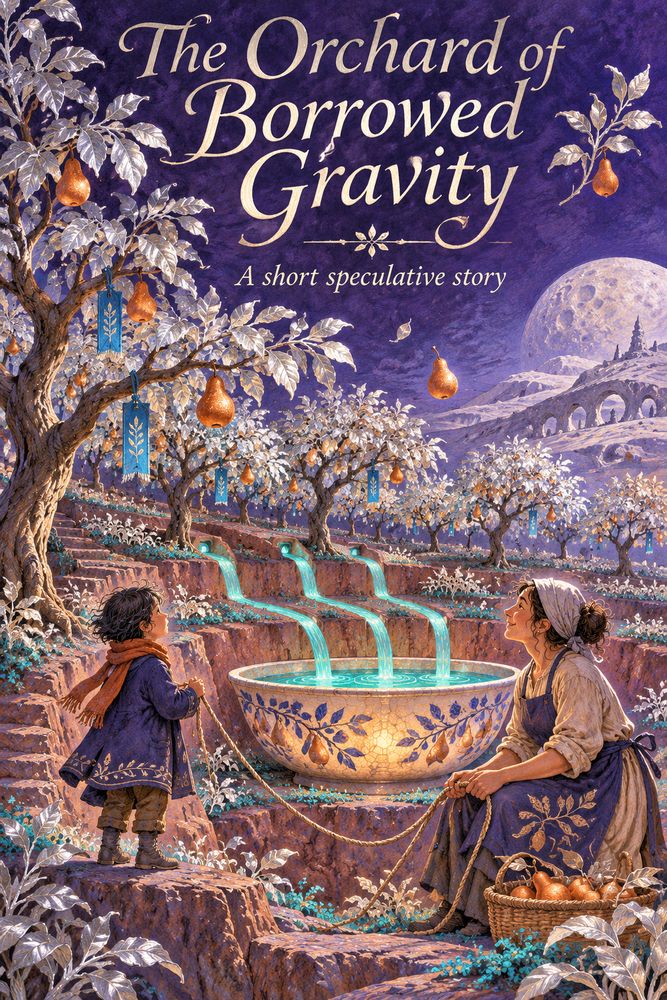
Front cover of The Orchard of Borrowed Gravity

Fantasy & Science Fiction

The Orchard of Borrowed Gravity

By TrendWindow Library

On the invented moon of Vey, Sera and Ivo question why council badges receive steadier paths while pear trees bear the cost of a ceremonial supper. Old records and an open meeting change access without creating more gravity. A complete short fantasy in eight chapters.

Read this complete edition, including its ending and notes. No purchase is required.

About this book

A complete short speculative story

This is fantasy set on an invented low-gravity world. The gravity bowls, badges and trees follow the imagined rules of the story, not real physics or engineering. The people and settlement are fictional.

Original complete short fantasy prepared with AI assistance. Vey, its inhabitants, gravity bowls, badges and rules are invented; not real physics, engineering or an accessibility specification. Original conceptual covers. Six complete editions read and compared with AI, without independent native-language certification.

1. The boy above the path

Ivo arrived at the orchard with his heels a finger's breadth above the path. He pulled himself along the handline, trying to look as if he had chosen that way of walking. His clay badge knocked softly against his coat.

Sera pretended not to notice his embarrassment. She was tying strips of blue cloth to the pear branches, marking fruit that would be ready by the following morning.

“Your mother sent the basket back?” she asked.

“She says you keep calling it a loan when you fill it with pears.”

“A serious complaint.”

He held out the empty basket. A breeze turned him sideways before she took it. Sera caught the handline beside his shoulder, steadying the line rather than grabbing him. He found his balance and glared at the wind.

On the moon of Vey, everything weighed little until the bowls lent it more downward pull. The settlers called that borrowed gravity. Twelve measures lived in the great bowl beneath the orchard: six held the soil and trees, four served the council's privileged passage, and two supplied the ordinary paths. Badges decided who received the pull of the privileged passage. Clay badges did not.

The numbers had been painted on the bowl before Sera was born. Most people had stopped looking at them.

Ivo looked because a pear had slipped from a branch. It drifted sideways across the weakly held path until Sera caught it against her apron.

“Why does the council get four?” he asked.

Sera turned the pear in her palm. There was a question she could have answered easily, if the answer had been a good one.

2. Silver on the collar

Councillor Meret came at noon to inspect the harvest preparations. Her silver badge lay flat on her collar. When she stepped onto the council passage beside the orchard, her shoes settled firmly. Ivo, standing a few paces away on the ordinary path, kept one hand on the line.

Meret had known Sera since they were children. Before her appointment she had crossed the orchard with the same awkward, careful movements as everyone else. Now she carried a tall vase without watching its rim.

“The Founding Supper is tomorrow,” she said. “We're expecting visitors. The passage will need two more measures for the evening.”

Sera looked towards the central bowl.

“From where?”

“The usual place.”

The usual place was the orchard. Last year, and the year before, Sera had lent two of its six measures. She had laid cloth over exposed roots afterwards and told herself that one evening was a small price for keeping the council interested in the trees.

This year a young tree leaned where its roots had lifted from the soil. It had not recovered its old position when the measures came back. Sera had supported it with a forked branch and hoped no one would call that a cure.

“Four won't hold the whole orchard properly,” she said.

Meret glanced at the little brace. “It has managed before.”

“I have managed what happened afterwards.”

Ivo looked from the tree to Meret's steady shoes. Meret followed his eyes and, for the first time that day, set down her vase.

3. The writing under the paint

The bowl's keeper was Bram, who mended its ceramic rim and kept the old records in a cupboard that smelled of dust and pear leaves. He did not control the allocation; the council sent him the order, and he moved the measures between the channels.

Sera asked him to show her the first record of the privileged passage. Ivo sat on the threshold, holding his knees to keep them from floating apart.

The earliest page did not call it privileged. It called it the rescue passage. Four measures had been reserved there when the settlement arrived, so people carrying an injured neighbour could reach the shelter without drifting from the route. The badges had belonged to the rescue carriers, not to councillors.

Later pages changed the wording. The passage became official, then distinguished. A rule attached its badges to council office. Another allowed retired councillors to keep them. The four measures stayed in the same channel while the people allowed to use them changed.

Bram laid the pages side by side. He did not say that every old rule was wise, or that an emergency route no longer mattered. He showed them how one useful provision had become a reward.

“Can you put it back?” Ivo asked.

“I can move a measure,” Bram said. “I can't make the council tell the truth about where it goes.”

Sera copied the dates and wording. She would not take the original pages out of his care. For once she wanted a problem brought into the open without asking the person who kept its record to carry the whole risk.

4. What a pear could not do

Ivo proposed throwing the silver badges into the bowl.

“Then everybody would weigh the same.”

“No,” Sera said. “Then we would have damaged badges and the same twelve measures.”

He considered that disappointment. The badges were permissions, not little stores of gravity. Breaking one did not send its portion to the lightest child.

“We could take the four from their passage.”

“And close the route people still use when someone needs carrying?”

He pulled at the clay badge on his coat. “Then everything stays.”

Sera sat beside him on a low root. The orchard's six measures held them both well enough there. It was one reason children liked to visit, even when no fruit was ripe.

“No. We stop pretending that these are the only choices.”

She gave him the pear she had caught that morning. He tried to balance it on the back of his hand. It rolled off, and he caught it against his stomach, laughing despite himself.

The pear could feed him. It could not decide who deserved to stand comfortably. Sera had spent too long asking the harvest to buy the trees a little peace.

She wrote to the council that she would not approve the additional loan. The orchard's six measures would remain in its channel. She also asked for the old passage records to be read before the supper allocation was settled.

It was not a secret diversion. Bram would receive the refusal and the council would receive its reason. The argument would have her name on it.

5. The supper without its extra weight

Meret returned before dusk. This time she came by the ordinary path, her silver badge in her pocket. Sera saw how carefully she used the handline.

“They say you're holding the supper hostage.”

“The trees aren't guests,” Sera said. “They can't choose to leave.”

Meret was quiet. From the council terrace came the sound of people moving benches. Without the extra two measures, the visitors would have to use the lighter setting already available. The supper could still happen. It would not feel as grand.

Sera showed Meret the leaning tree, then Bram's copied records. Meret read them twice. She had believed the silver badge was an old recognition of service. The pages did not make her service worthless. They made the origin of the privilege different from what she had repeated.

“You could have told me sooner,” she said.

“I could have looked sooner.”

It was the first answer that evening which left both of them something to do.

Meret asked Sera to come to the open allocation meeting. Ivo asked whether children could attend. Meret began to say that children never did, then corrected herself: there was no rule excluding them. There simply had never been chairs set out for them.

“Then put out one,” Ivo said.

“More than one,” Sera added. “He isn't the only child with a clay badge.”

6. Four measures and a question

Bram brought the original records to the meeting. Meret read the rescue passage's first purpose and the later changes. A retired councillor said that giving up his badge would deny the years he had worked for the settlement.

Ivo rose from his chair. The ordinary floor pull was weak, so he kept a hand on its back.

“Did you work to make the paths better,” he asked, “or to be the only one who could use them?”

Sera expected Meret to soften the question. Instead she let it stand.

The argument lasted beyond the time set for decorating the supper terrace. Some people wanted all four measures moved into the ordinary paths at once. Bram explained that the rescue route still had a purpose. Others wanted no change until a study could be made, without saying who would make it or when.

Sera spoke about the orchard's roots. She did not claim that trees mattered more than injured people. She asked why the discussion kept treating ceremonial comfort as if it were the same need.

In the end the meeting agreed on an immediate arrangement: the four-measure channel would serve rescue carrying and people who needed its steadier passage, regardless of office or badge. Its old restrictions would be removed under Bram's supervision. The ordinary paths would keep their two measures and the orchard its six. No extra weight would go to the supper.

The settlement had not found more gravity. It had changed who could use what it already held.

7. A path without a title

The following day, the change did not happen merely because Meret had spoken. Bram altered the passage controls, checked them, and asked people with clay badges to try the route while he remained there. These were the invented workings of Vey's bowls, not a trick anyone could perform on another world.

Ivo crossed slowly. At the edge of the steadier passage his heels met the ground. He looked down, then took another step. His clay badge still knocked against his coat. It had not become silver.

His mother came after him carrying an empty laundry basket. She stopped halfway, surprised by how little of her attention the basket required. A neighbour who needed support on the ordinary paths followed with a companion. The route was no longer a corridor that made people explain their titles before their needs.

There were still narrow places and awkward turns. The meeting had asked for a review of access after a week, with users invited to describe what remained difficult. Nobody was to count a changed rule as proof that every journey had become easy.

The retired councillor crossed last. He was not forbidden to use the path. He only had to share it.

At the supper, the flowers in Meret's tall vase trembled more than usual. She moved the vase to a low table. The speeches survived, and so did the meal. No pear tree had to loosen its roots to make a councillor look composed.

8. Where the roots remained

The next morning Sera found Ivo at the orchard gate. He had come by the steadier passage, then used the handline for the final stretch along the ordinary path. Changing one route had not changed the whole moon.

“My mother says we can return the basket tomorrow,” he said.

“Empty?”

“She says she refuses to negotiate with pears.”

Sera laughed and gave him a blue strip to tie to a ripe branch. Beneath the tree, the soil remained where she had left it. The leaning sapling still needed its brace. Keeping six measures overnight had prevented another loss; it had not undone the old one.

Meret arrived carrying the vase, now empty. She asked where she could put it while she helped sort the fallen leaves. Sera pointed to the low shelf. For a while they worked without discussing the meeting.

When a pear came loose, it dropped into the basket under the branch. Ivo watched it settle.

“We didn't find another measure,” he said.

“We stopped making some people ask for what others took for granted.”

He thought about that, then said the ordinary path by his home was still difficult. Sera told him to bring that to the review. It would be another question, not a reason to pretend the first answer had meant nothing.

Before leaving, he put the basket on the steadier passage and lifted it again. He could stand and carry it at the same time. No one had awarded him a new title.

Sera returned to the trees. The old numbers were still painted on the bowl: six, four, two. Under them Bram had fixed a new board describing their use in plain words. In the morning light, the orchard looked much as it had before. What had changed was who could reach it without being made to feel small.
Explore more books →