BOOK LIBRARY · Complete books · Purchases disabled
TrendWindow

← Book Library · Complete book

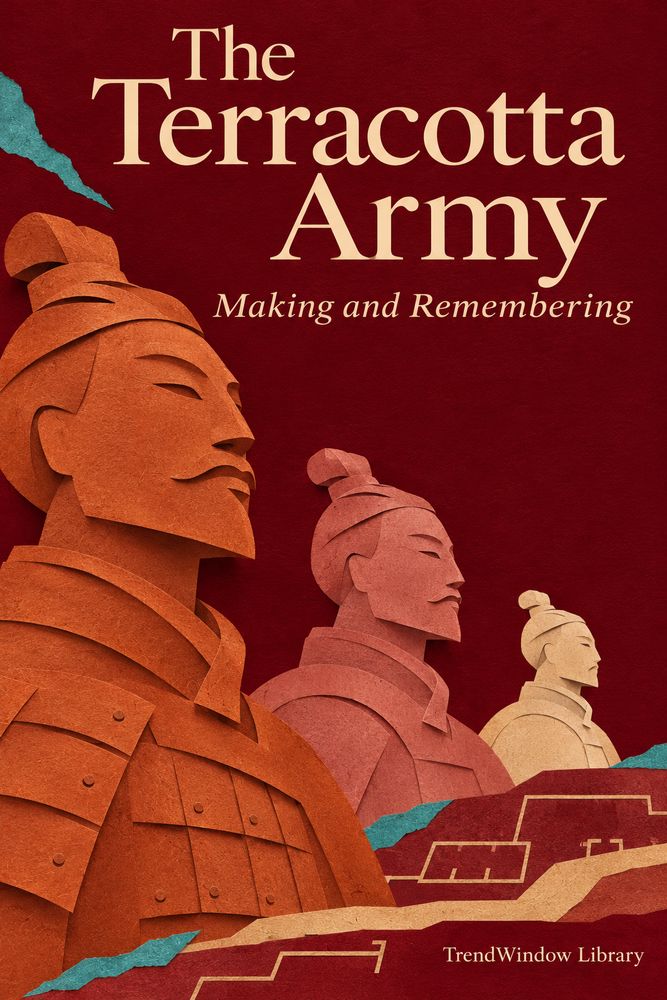
Front cover of The Terracotta Army: Making and Remembering

History & Culture

The Terracotta Army: Making and Remembering

By TrendWindow Library

An original complete short cultural history of the Terracotta Army. Follow the figures within a larger imperial burial landscape, research into production and preservation, the discovery of 1974 and the museum record. Primary sources and explicit limits distinguish surviving objects from changing explanations.

Read this complete edition, including its ending and notes. No purchase is required.

1. An Army within a Larger Place

The Terracotta Army is an arresting name, but it can make a burial landscape sound smaller than it is. UNESCO's record places the mausoleum of the First Qin Emperor near Xi'an in Shaanxi, China. It describes a complex that includes the tomb mound, enclosing walls, accompanying pits and architectural remains. The warriors belong to that larger setting. They are not the whole place.

The same record connects the mausoleum with Qin Shihuang and the establishment of a centralised empire in 221 BCE. The emperor died in 210 BCE. These dates locate the project historically without requiring us to invent his final thoughts or a conversation with a craft worker. This short history follows what was made, what has been investigated and how the site entered a later public record.

Scale matters here in two different ways. One is the scale of the figures: the museum describes life-size warriors and horses. The other is the relationship between those figures and the burial complex around them. A row of figures can be studied closely, but its meaning is not exhausted by an individual face. Placement and association also belong to the object of study.

An original reading exercise can keep those scales together. On a blank page, write “figure”, “group” and “landscape” in three separate spaces. Under each, put a question rather than an invented answer. What can a figure show about making? What can a group show about arrangement? What changes when the surrounding burial setting returns to view? This is not a site plan, only a way to stop one impressive object from standing in for everything around it.

Our account begins with that wider frame. The army is remarkable, but treating it as part of a place gives us more to investigate than an isolated spectacle. It also prepares us to notice the work behind the objects rather than letting the emperor's name fill the entire story.

2. Clay, Surfaces and Skilled Work

The museum's own description presents the warriors and horses in ordered groups and identifies real bronze weapons associated with the figures. Clay figures and metal objects therefore enter this history together, even though they are different materials. An account of making must resist letting one material silently explain all the others.

The figures' surfaces also have a history. The 2019 research paper by Marcos Martinón-Torres and colleagues discusses lacquer and painted surfaces in the mausoleum. Its description reminds us that a terracotta figure should not automatically be imagined as an object intended to remain uniformly bare clay. That does not licence this edition to reconstruct a particular figure's complete original colour scheme. No such reconstruction is supplied here.

Making becomes a more interesting subject when we separate a visible result from the work needed to explain it. A repeated form may prompt a question about organisation. A small difference may prompt a question about finishing. Neither question is answered simply by declaring that every figure was entirely unique or that every object came from a modern-style assembly line.

Those alternatives are too easy because they make the whole production system fit a slogan. A more useful account asks which objects were examined, which features were compared and how far the resulting interpretation reaches. The next chapter follows one study of metal components, while keeping its object of study distinct from the ceramic figures themselves.

There are limits to what this book reconstructs. It supplies no fictional workshop scene, names for unidentified makers or instructions for making weapons. The skilled work remains important even where the selected records do not let us attach a complete personal biography to each craft worker. Not knowing a worker's name is different from having no reason to notice that work was done.

3. Production Seen through Patterns

In a 2014 study, Xiuzhen Li and colleagues investigated bronze crossbow triggers associated with the Terracotta Army. The abstract deposited at UCL describes measurement and spatial analysis, with production in batches as a conclusion. It presents possible storage in an arsenal as a possibility, not as a directly witnessed event. The same abstract relates batches to groups in sectors of Pit 1.

The distinction between a finding and a possibility is part of the history, not an inconvenience to edit away. A measured component, its location and an interpretation of production are different things. They can support one another without becoming identical. The useful question is how the argument connects them.

Imagine a study table with headings “compared”, “mapped” and “proposed”. These are our headings for reading the abstract, not a reproduction of the researchers' dataset. Under “compared”, we would note the components being examined. Under “mapped”, we would ask where they were recovered. Under “proposed”, we would place the account of organisation inferred from the patterns. The last column needs the first two; it should not erase them once a compelling story has formed.

The study also gives a reason to look beyond an individual object. One trigger may reveal features of its manufacture. The relationship between several triggers may help address a different question: how making and delivery were organised. The value of a small component can therefore extend beyond its size.

This edition reviewed the repository's abstract and bibliographic record, not the full 2014 paper or its underlying dataset. It does not turn that limited reading into a claim to have checked every workshop reconstruction. The chapter ends with a narrower but useful conclusion: production can be investigated through patterns, while the reconstruction remains an argument whose evidence and qualifications should stay visible.

4. A Surface Does Not Explain Itself

Another research question concerns the preservation of bronze weapons. The 2019 Martinón-Torres study examined weapons, lacquer and soils, alongside experimental work. It rejected the explanation that chromium on some weapon surfaces represented an ancient anti-rust treatment responsible for their good condition. The paper associated surface chromium with nearby lacquer and argued for the importance of burial conditions and bronze composition in preservation.

That is a claim made by a dated research paper. It is more precise than saying that an ancient technological secret has finally been revealed. Finding an element on a surface and explaining why an object survived are separate tasks. An attractive explanation can connect them too quickly.

The question did not stop there. A 2024 Heritage Science paper by Yang Chenchen, Rong Bo and colleagues investigated the origin of chromium within the lacquer itself. Its indexed abstract and conclusions describe laboratory ageing work supporting migration from burial soil into lacquer, rather than deliberate addition of a refined chromium substance. That addresses a further question about the lacquer; it should not be collapsed into the earlier question about an alleged protective treatment on bronze.

Putting the papers side by side changes what remembering can mean. Remembering need not be repeating the most exciting explanation first encountered. It can include keeping the dates of explanations, noticing a different research question and allowing the account to become more specific.

This chapter does not offer chemical treatment or restoration instructions. It does not claim that every preservation problem at the mausoleum has been resolved, or that the 2019 paper settled all later questions. Its endpoint is a disciplined distinction: an object can survive, a substance can be detected and an explanation can be revised. Respect for ancient craft does not depend on retaining an unsupported anti-rust story.

5. Discovery and the Public Record

The museum's timeline dates the discovery of the Terracotta Army to March 1974. Its account describes local farmers finding broken figure fragments while digging a well. The museum records its public opening on 1 October 1979. UNESCO records the mausoleum's World Heritage inscription in 1987. Discovery, museum opening and inscription are three different events.

The sequence makes the familiar word “discovery” less final. Finding fragments did not mean that the whole meaning of the site arrived at once. Nor did a public opening turn every question about production into a settled answer. The later research discussed in this book is one reason to keep those distinctions clear.

The museum's history page also records later openings: the hall for Pit 2 in 1994 and the mausoleum site park in 2010. These selected entries show a public institution with its own chronology. They are not current opening hours, ticket advice or a promise that a particular space will be accessible when a reader visits.

Public presentation adds another kind of work to the history. A figure must not only have been made and recovered; it must also be described to someone who was not present at either event. A label can separate established facts from an interpretation, or blur them. A research date can help a reader recognise when an explanation was offered.

There is a small source limitation worth retaining. The museum's English page gives conflicting days for the 1987 inscription in different parts of the page. This edition uses the year, confirmed in UNESCO's record, rather than selecting one day and hiding the discrepancy. That is not a dramatic discovery about antiquity. It is an ordinary responsibility in writing a history that readers can check.

The chapter ends with a public record extending beyond the first find. Objects, excavations, exhibitions and institutional recognition have related histories. None needs to be mistaken for all the others.

6. Remembering without Freezing the Explanation

The path through this book has moved from a burial landscape to objects, from objects to questions about making, and from research to a museum chronology. It ends with a way of remembering that leaves those relationships intact. The figures do not become less impressive because we ask how an explanation was reached.

Three distinctions can hold the account together. First, the army belongs within a larger mausoleum. Second, a surviving object and an interpretation of its production are connected but different. Third, a dated research finding and a final answer to every later question are not the same thing. Each distinction keeps some part of the work visible.

For a final original exercise, choose one statement from this history and give it three short annotations: its source, the kind of claim it makes and its limit. A museum opening date is a claim about an institution. A batch-production interpretation is a claim arising from analysis. A revised account of surface chemistry concerns another kind of evidence. The exercise is ours, not an ancient practice or a museum's official method.

This is also a way to make room for people without inventing their voices. The emperor's burial project, the work of makers, the finding of fragments and later custodial and research work can all appear in the account. An unnamed maker need not receive fictional dialogue to be acknowledged. A modern researcher need not have settled every question to have contributed something important.

Our short history closes after considering the selected research through 2024 and the museum record consulted in 2026. That is a complete ending for this chosen route, not a claim that the site has no future discoveries. Making and remembering remain different kinds of work. Keeping them connected lets the Terracotta Army be more than an image of rows: it becomes a place where objects, labour and explanations can continue to be understood with care.

Sources and Edition Note

Research checked 7 November 2026, Asia/Dhaka. This complete original short cultural history has six chapters and a documented chosen endpoint, not an exhaustive excavation report, imperial biography, restoration manual or visitor guide. Reading exercises and connective interpretations are original. No private scenes, workshop dialogue or first-hand visit have been invented.

Emperor Qinshihuang's Mausoleum Site Museum, its own history and introduction: https://bmy.com.cn/jingtai/bmyweb/about.html . Read directly for discovery, the life-size figures and selected public-opening dates. The page conflicts internally on the day of the 1987 inscription; only the year is used. Unreconciled heights, area figures, labour totals and cumulative excavation counts are not repeated as verified current measurements.

UNESCO World Heritage Centre, Mausoleum of the First Qin Emperor: https://whc.unesco.org/en/list/441 . Read directly as the institutional heritage record, with limited historical context. This book does not reproduce its descriptive prose, images or maps and does not claim to have surveyed the full property. The record supports the wider setting, selected ancient dates and inscription year.

Xiuzhen Li and colleagues, 2014, “Crossbows and imperial craft organisation”: https://discovery.ucl.ac.uk/id/eprint/1412513/ . The repository's actual abstract and bibliographic record were read directly. The full paper and dataset were not reviewed for this edition. Batch production is a research interpretation; the abstract qualifies possible arsenal storage. No weapon-building detail is provided.

Marcos Martinón-Torres and colleagues, Scientific Reports, 2019: https://www.nature.com/articles/s41598-019-40613-7 . Selected primary text in the public search index was read for the chromium-preservation argument. Direct access reached an inaccessible identity redirect; an open repository PDF request timed out. Neither was bypassed, and full direct-paper or supplementary-data reading is not claimed. No paper figures are reproduced.

Yang Chenchen, Rong Bo and colleagues, Heritage Science, 2024: https://www.nature.com/articles/s40494-024-01381-4 . The public indexed abstract, selected discussion and conclusions were reviewed for the separate question of chromium's origin in lacquer. Direct access also reached an inaccessible identity redirect. This is a bounded account of that paper's interpretation, not an independent replication or a final survey of all later studies.

Facts are briefly paraphrased and attributed. No third-party prose, photographs, reconstructions or scientific figures are copied. The English front and back covers are original conceptual paper-relief illustrations, not archaeological records or authenticated colour reconstructions. Writing and all translations are AI-assisted with editorial comparison; no independent human-authorship or native-human certification, institutional endorsement, assigned ISBN or print proof is claimed.

Explore more books →