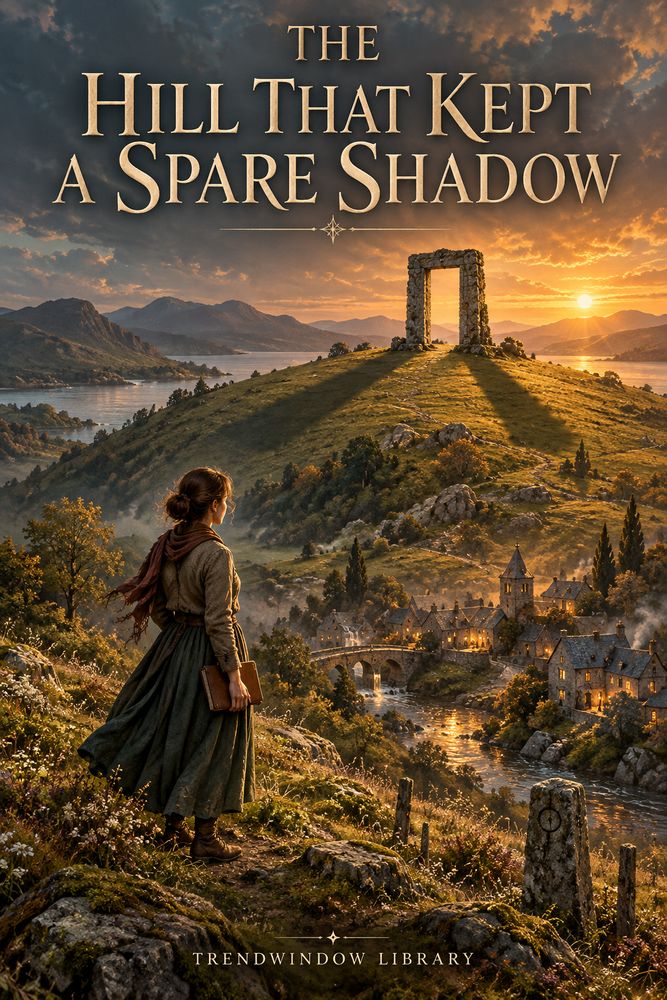
1. The Wrong Side of Noon
Anwen had been paid to find the edges of a hill. By noon she had found something less convenient.
The stone doorway at its crest threw two shadows. One lay where it should, reaching away from the sun. The other crossed the grass towards the light.
She moved her measuring rod. Both shadows remained. A cloud passed, and the ordinary one faded. The other stayed dark.
In the village below, the council's new storehouse waited in the shape of a promise. The existing grain shed flooded every wet autumn. The council had bought the hill, hired a surveyor, and promised the builders a level site by the next market day. Anwen's fee would pay three months of her mother's rent.
She wrote: Second shadow observed. Cause unknown.
Then she crossed out cause and wrote owner.
That was premature. She crossed out owner too.
The old doorway had no hinges, no lintel inscription, and no room behind it. Two upright stones and a third across their heads. Through it she could see the same grass as around it.
On the ground beside her boot, however, the spare shadow contained a step.
Anwen knelt. A shallow rectangle lay inside the darkness, though her hand found only grass. She put her closed notebook on the apparent step. It fell flat on the hill.
From somewhere beneath her palm came a small, irritated knock.
Not thunder. Not a hollow in the stone. Three knocks, separated by pauses long enough for someone to expect an answer.
Anwen lifted her hand.
The village clerk was climbing towards her with a folded agreement and a packet of seed biscuits.
"Please," he said, breathless, "tell me we can begin on Monday."
She looked from the agreement to the doorway.
"Do you know what used to stand here?"
The clerk stopped climbing.
"Nothing," he said, much too quickly.