BOOK LIBRARY · Complete books · Purchases disabled
TrendWindow

← Book Library · Complete book

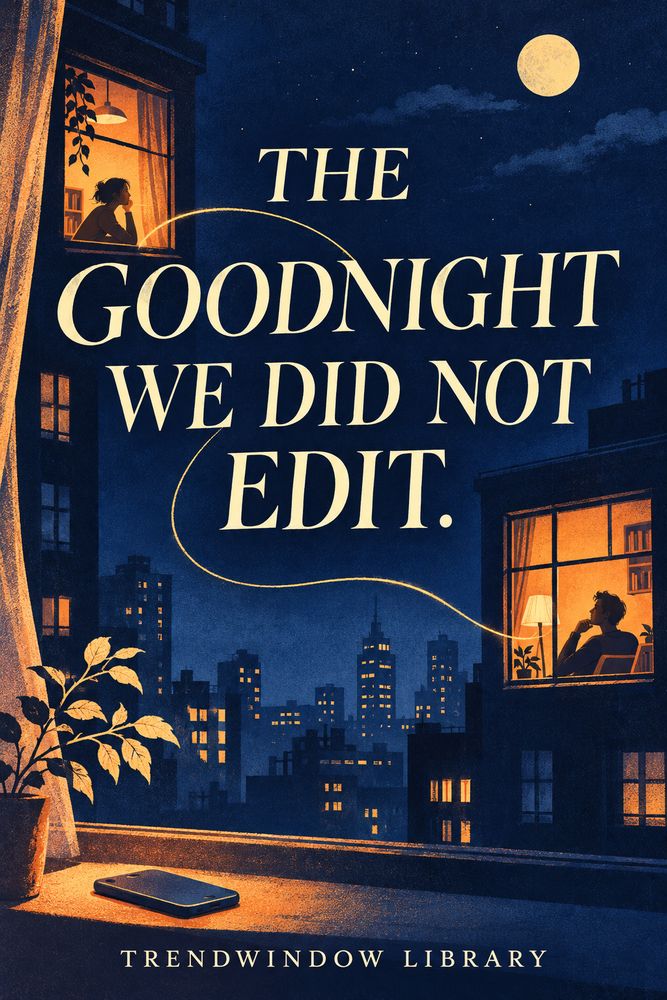
Front cover of The Goodnight We Did Not Edit

Romance & Relationships

The Goodnight We Did Not Edit

By TrendWindow Library

A complete original short romance. Ada has made time for a call. Felix is still recording the perfect hello. Between two towns, an ordinary conversation and a planned visit help two adults hear each other without rehearsing every moment.

Read this complete edition, including its ending and notes. No purchase is required.

1. The Seventeenth Beginning

At eight seventeen on Sunday evening, Felix North recorded himself saying hello for the seventeenth time.

He had started before eight. There had been a good reason for the first restart: a motorbike outside his window. Then he had stumbled over Ada's name, although he had been saying it happily for eleven months. After that, each version contained something he could improve.

In one he sounded tired. In another he laughed too early. In a third, the account of his day seemed so small that he wondered why anyone would want to hear it.

Ada had asked for a live call at eight.

He knew that. He had sent a message saying he needed two minutes. He meant to send a short recording first, something warm enough to make her smile when she answered. The two minutes had acquired another two, then several more.

At eight nineteen, her message appeared.

I'm not waiting any longer tonight. We need to talk, but not like this.

Felix put the phone down. His flat was quiet. He could hear a tap not quite turned off in the kitchen.

He was thirty-seven and worked at a museum reception desk. He could greet a roomful of strangers without rehearsing. With Ada Wren, who knew him better than most people did, he had somehow become afraid to send an ordinary voice.

She was thirty-five, worked in a bookshop and lived in another town. For the last six months, they had made a relationship between two homes. They visited on alternate weekends when their work allowed it. Neither town had become a punishment for the other person's absence.

The voice notes had begun as a pleasure. Ada describing a customer looking for a book with a possibly green cover. Felix reporting a sandwich that had fallen apart before he could claim it was lunch. Little sounds of lives they did not always see.

Then he had started trying to make his sound worth the distance.

On the table, the phone remained dark. Seventeen careful beginnings, and he had not actually spoken to her.

2. A Different Message

He wanted to record an apology. That was the first difficulty.

He picked up the phone and put it down again. The words he rehearsed were becoming another way to postpone the person who should hear them.

At half past eight, he wrote instead.

You're right. I kept rerecording a message instead of making the call we agreed. Nothing went wrong with my phone. I am sorry. Can we arrange a time to talk tomorrow or another day that suits you? I won't call tonight unless you ask.

He read it once and sent it.

Ada did not answer that evening. He did not turn the silence into a reason to send six explanations.

On Monday, she replied during her lunch break. Wednesday at half past seven would work. She wanted a conversation, not a recording to listen to later.

He said yes.

On Tuesday, a message from her arrived while he was making dinner. He recognised the familiar length of a voice note and felt briefly relieved. Then he listened.

She had seen a dog outside the shop carrying its own lead, looking as though it had given up waiting for somebody competent. She had thought he would like that. That was all.

It was not a signal that Sunday no longer mattered. It was also not a test he must answer immediately. He finished moving a hot pan off the stove, then told her he had laughed at the dog.

He almost added a joke of his own. He could not find one that felt good enough, so he sent the answer without it.

For once, the message arrived before dinner went cold.

3. At Half Past Seven

On Wednesday, Felix was ready at seven twenty-five. Ready meant sitting beside the phone, not practising how to sound as if he had just sat down.

At half past seven he called. Ada answered in her kitchen.

“Hello,” he said.

“Hello.”

It was absurd how much he had missed that small exchange.

She had a mug near her elbow and a dish towel over one shoulder. He could see the corner of a shopping list, but could not read it. It was an ordinary view of the person he wanted, not an image arranged for him.

“I was angry on Sunday,” she said.

“I know.”

“I don't think you do yet. Not all of it.”

He stopped preparing his next sentence.

“I had made time,” she said. “I ate early. I put aside something I wanted to read. You said two minutes, so I stayed. I wasn't missing an excellent voice note. I was missing the conversation we had agreed to have.”

“I thought I could give you something better first.”

“Better than being there?”

He looked down at his hands.

“When you say it like that—”

“I'm not trying to make it sound worse. That's what it was like at my end.”

He nodded.

“I made you wait for something you hadn't asked for.”

“Yes.”

For a little while, they said nothing. He could hear a cupboard close somewhere behind her. It was not the end of the call.

“I don't need you available all the time,” she said. “I can't do that either. Sometimes I can't listen at work. Sometimes I want to finish dinner. But when we choose a time, I need you to choose it too. Or tell me honestly that you can't.”

“I could on Sunday. I didn't. That's mine.”

Her shoulders moved with a breath he could almost feel.

“Thank you for saying that.”

4. The Voice He Kept Back

Felix told her about the recordings. The motorbike, the tired voice, the account of an uneventful day. Not as a defence, but because he wanted her to know what he had been doing with the time that belonged to their call.

“I listened to myself and thought there wasn't much there,” he said. “You could have been doing anything. I didn't want to be the dullest part of your evening.”

Ada looked away, then back at him.

“Sometimes you tell me very dull things.”

He stared at her.

“The long explanation of your coat pocket?” she said. “The one with the broken lining?”

He laughed despite himself.

“That was an important structural failure.”

“I know. You lost three coins and a receipt. I was concerned.”

The laugh let him sit back properly. She smiled, but did not pretend that a joke had repaired everything.

“I like knowing your life,” she said. “Some of it is going to be about pockets. Some of mine is going to be about moving a display of books twice because I don't like it the first time.”

“You don't have to like every message.”

“No. And you don't have to make every one into a present I must admire.”

He had not thought of that part: the little pressure on her to praise what had cost him so many attempts. He had been trying to offer affection. Sometimes he had sent her the work of reassuring him instead.

“I'd like to keep voice notes,” she said. “I like them. Just not instead of every other way of being together.”

“So would I.”

They made no rule that all messages must be spontaneous. Sometimes a person wanted to choose words carefully. Sometimes a second attempt was kinder or clearer. What they could change was turning an agreed conversation into a rehearsal without telling the other person.

“Are you still coming on Friday?” he asked.

Her visit had been planned before Sunday. He did not want to treat it as a prize she owed him for this call.

“Yes,” she said. “I want to. And I want you to meet the train, not send a beautiful description of meeting it.”

“I can be there.”

“Good.”

5. The Arrival

Felix reached the station early on Friday with no speech in his pocket. He had bought three orange flowers, then spent an unnecessary minute wondering whether three looked mean. He brought them anyway.

Ada came through the gate with her overnight bag sliding off one shoulder. She saw him, moved the bag and smiled.

“You look very real,” she said.

“I made a special effort.”

She took the flowers and kissed him before he could think of something better to say. The station was loud. A suitcase rolled against his heel. He barely noticed.

They walked to his flat. She told him the person opposite her on the train had eaten an apple with the concentration of someone completing a difficult examination. He told her he had forgotten to buy milk.

“A flaw in the welcome,” she said.

“A serious one.”

They stopped at a shop. She held the flowers while he found the milk. At his door, he took her bag only after she held it out to him.

They made dinner together, talking and sometimes not talking. Once, he began an anecdote, lost the middle and started laughing at his own failure to find it.

“Wait,” he said. “There was a ladder. That mattered.”

Ada sat on the kitchen chair with one foot hooked around its leg.

“I'm not going anywhere.”

She did not mean forever, or that she would always wait through anything. She meant she was in his kitchen, interested in this story. He let it be enough.

The ladder eventually arrived in the right part of the anecdote. The ending was less funny than he had hoped. Ada laughed anyway, partly because of the route they had taken to reach it.

After dinner, he put his phone face down on the table. She put hers beside it. This was not a new permanent rule. They simply had nobody they needed to answer just then.

He kissed her beside the sink. She leaned into him, smelling faintly of the flowers she had trimmed for a jam jar. For a while, neither of them tried to improve the moment by preserving it.

6. Goodnight

The weekend did not decide where they would live in a year. They talked about their next visits, and changed one date when Ada remembered a plan with a friend. Felix did not hear that as a smaller amount of love.

On Sunday, she went home. He met her eyes through the train window and raised a hand. She kept hers raised as the train started moving.

That night, he sat in his flat with the three flowers on the table. She had left them in his jam jar because he liked looking at them too.

He recorded a short message. Halfway through, he lost a word. He found it, said goodnight and stopped. Before he could begin judging the sound of his own breathing, he sent it.

She answered later. He had been reading and did not see the message arrive. When he did, he listened once.

She was home. She had unpacked the bag but left the book inside it, which meant getting up again. She liked the weekend. She liked him. Goodnight.

There was a small knock in the recording, then her laugh. Nothing had been removed to make room for a better laugh.

Felix smiled. He wrote that he liked her too and would call at the time they had chosen for Tuesday.

Then he returned to his book. Ada returned to whatever she had been doing in her own home. There were still two towns, two kitchens, days they could not share and things they would have to ask rather than assume.

The distance had not vanished. But tonight, a voice had crossed it, and a person had answered.

He turned out the light without recording the goodnight again.

Edition Note

This is a complete original short work of romantic fiction. Ada Wren, Felix North, their towns, messages, workplaces and travel arrangements are invented. No real messaging service, timetable or private recording is represented. The story offers no psychological advice or universal rule for communication. The English original, full translations and original cover artwork are AI-assisted and editorially reviewed, without independent human-authorship or native-human certification.

Explore more books →